Java Programming: From Problem Analysis to Program Design, 3e Chapter 1 An Overview of Computers and Programming Languages
Chapter Objectives Learn about different types of computers Explore the hardware and software components of a computer system Learn about the language of a computer Learn about the evolution of programming languages Examine high-level programming languages Java Programming: From Problem Analysis to Program Design, 3e
Chapter Objectives (continued) Discover what a compiler is and what it does Examine how a Java program is processed Learn what an algorithm is and explore problem-solving techniques Become aware of structured and object-oriented programming design methodologies Java Programming: From Problem Analysis to Program Design, 3e
Introduction Computers have greatly affected our daily lives – helping us complete many tasks Computer programs (software) are designed specifically for each task Software is created with programming languages Java is an example of a programming language Java Programming: From Problem Analysis to Program Design, 3e
An Overview of the History of Computers The first device known to carry out calculations was the abacus The abacus uses a system of sliding beads on a rack for addition and subtraction Blaise Pascal invented the calculating device called the Pascaline Java Programming: From Problem Analysis to Program Design, 3e
An Overview of the History of Computers (continued) In 1819, Joseph Jacquard, a French weaver, discovered that the weaving instructions for his looms could be stored on cards with holes punched in them In the early and mid-1800s, Charles Babbage, an English mathematician and physical scientist, designed two calculating machines—the difference engine and the analytical engine Java Programming: From Problem Analysis to Program Design, 3e
An Overview of the History of Computers (continued) The first computer-like machine was the Mark I Built in 1944  Used punched cards to feed data into the machine  52 feet long, weighed 50 tons, and had 750,000 parts In 1946, ENIAC (Electronic Numerical Integrator and Calculator) was built at the University of Pennsylvania.  Contained 18,000 vacuum tubes and weighed some 30 tons Java Programming: From Problem Analysis to Program Design, 3e
An Overview of the History of Computers (continued) In 1956, the invention of the transistors resulted in smaller, faster, more reliable, and more energy-efficient computers  This era also saw the emergence of the software development industry with the introduction of FORTRAN and COBOL, two early programming languages In 1970, the microprocessor, an entire CPU on a single chip, was invented  Java Programming: From Problem Analysis to Program Design, 3e
An Overview of the History of Computers (continued) In 1977, Stephen Wozniak and Steven Jobs designed and built the first Apple computer in their garage  In 1981, IBM introduced its personal computer (PC) Modern-day computers are very powerful, reliable, and easy to use Can accept spoken-word instructions and imitate human reasoning through artificial intelligence Java Programming: From Problem Analysis to Program Design, 3e
An Overview of the History of Computers (continued) Although there are several categories of computers, such as mainframe, midsize, and micro, all computers share some basic elements Java Programming: From Problem Analysis to Program Design, 3e
Elements of a Computer System A computer has 2 components Hardware Software Java Programming: From Problem Analysis to Program Design, 3e
Hardware Components of a Computer Central Processing Unit (CPU) Main Memory Java Programming: From Problem Analysis to Program Design, 3e
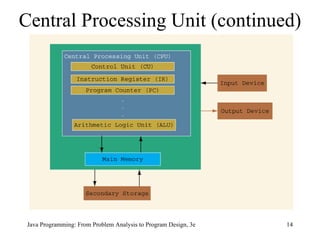
Central Processing Unit Control Unit (CU) Arithmetic Logic Unit (ALU) Program Counter (PC) Instruction Register (IR) Java Programming: From Problem Analysis to Program Design, 3e
Java Programming: From Problem Analysis to Program Design, 3e Central Processing Unit (continued)
Main Memory Ordered sequence of cells (memory cells) Directly connected to CPU All programs must be brought into main memory before execution When power is turned off, everything in main memory is lost Java Programming: From Problem Analysis to Program Design, 3e
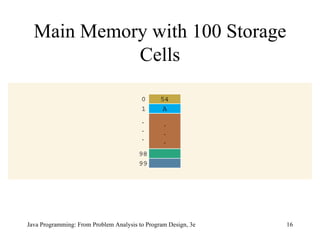
Main Memory with 100 Storage Cells Java Programming: From Problem Analysis to Program Design, 3e
Secondary Storage Provides permanent storage for information Examples of secondary storage: Hard Disks Floppy Disks Flash memory ZIP Disks CD-ROMs Tapes Java Programming: From Problem Analysis to Program Design, 3e
Input Devices Definition: devices that feed data and computer programs into computers Examples Keyboard Mouse Secondary Storage Java Programming: From Problem Analysis to Program Design, 3e
Output Devices Definition: devices that the computer uses to display results Examples Printer Monitor Secondary Storage Java Programming: From Problem Analysis to Program Design, 3e
Software Software consists of programs written to perform specific tasks Two types of programs System Programs Application Programs Java Programming: From Problem Analysis to Program Design, 3e
System Programs System programs   control the computer The operating system is first to load when you turn on a computer Java Programming: From Problem Analysis to Program Design, 3e
Operating System (OS) OS monitors overall activity of the computer and provides services Example services Memory management Input/output Activities Storage management Java Programming: From Problem Analysis to Program Design, 3e
Application Programs Written using programming languages Perform a specific task Run by the OS Example programs Word processors Spreadsheets Games Java Programming: From Problem Analysis to Program Design, 3e
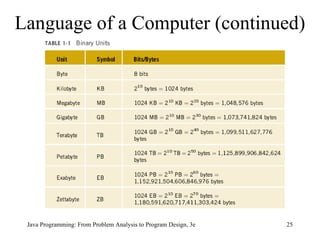
Language of a Computer Machine language: the most basic language of a computer A sequence of 0s and 1s  Every computer directly understands its own machine language A bit is a binary digit, 0 or 1 A byte is a sequence of eight bits Java Programming: From Problem Analysis to Program Design, 3e
Language of a Computer (continued) Java Programming: From Problem Analysis to Program Design, 3e
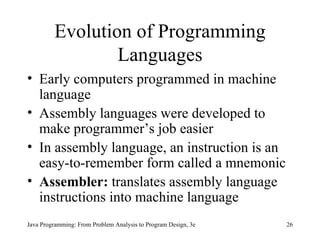
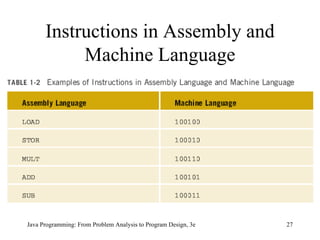
Evolution of Programming Languages Early computers programmed in machine language Assembly languages were developed to make programmer’s job easier In assembly language, an instruction is an easy-to-remember form called a mnemonic Assembler:  translates assembly language instructions into machine language Java Programming: From Problem Analysis to Program Design, 3e
Instructions in Assembly and Machine Language Java Programming: From Problem Analysis to Program Design, 3e
Evolution of Programming Languages High-level languages   make programming easier Closer to spoken languages Examples Basic  FORTRAN COBOL C/C++ Java Java Programming: From Problem Analysis to Program Design, 3e
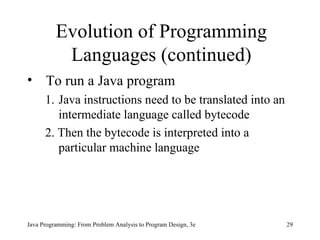
Evolution of Programming Languages (continued) To run a Java program Java instructions need to be translated into an intermediate language called bytecode 2. Then the bytecode is interpreted into a particular machine language  Java Programming: From Problem Analysis to Program Design, 3e
Evolution of Programming Languages (continued) Compiler:  a program that translates a program written in a high-level language into the equivalent machine language In the case of Java, this machine language is the bytecode Java Virtual Machine (JVM):  hypothetical computer developed to make Java programs machine independent Java Programming: From Problem Analysis to Program Design, 3e
A Java Program public class  ASimpleJavaProgram  {  public static void  main(String[] args)  {  System.out.println("My first Java program."); System.out.println("The sum of 2 and 3 = " + 5); System.out.println("7 + 8 = " + (7 + 8)); }  } Sample Run : My first Java program. The sum of 2 and 3 = 5 7 + 8 = 15 Java Programming: From Problem Analysis to Program Design, 3e
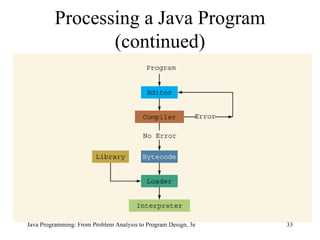
Processing a Java Program Two types of Java programs: applications and applets Source program:  written in a high-level language Loader:  transfers the compiled code (bytecode) into main memory Interpreter:  reads and translates each bytecode instruction into machine language and then executes it Java Programming: From Problem Analysis to Program Design, 3e
Processing a Java Program (continued) Java Programming: From Problem Analysis to Program Design, 3e
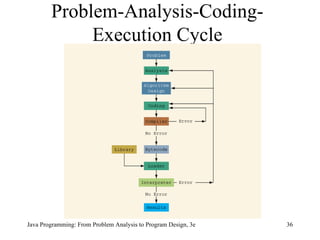
Problem-Analysis-Coding-Execution Cycle Algorithm:  a step-by-step problem-solving process in which a solution is arrived at in a finite amount of time Java Programming: From Problem Analysis to Program Design, 3e
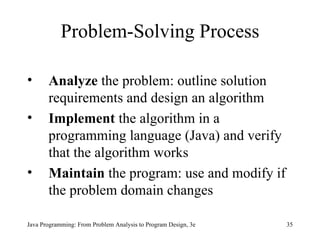
Problem-Solving Process Analyze  the problem: outline solution requirements and design an algorithm Implement  the algorithm in a programming language (Java) and verify that the algorithm works Maintain  the program: use and modify if the problem domain changes Java Programming: From Problem Analysis to Program Design, 3e
Problem-Analysis-Coding-Execution Cycle Java Programming: From Problem Analysis to Program Design, 3e
Programming Methodologies Two basic approaches to programming design Structured design  Object-oriented design Java Programming: From Problem Analysis to Program Design, 3e
Structured Design A problem is divided into smaller subproblems Each subproblem is solved The solutions of all subproblems are then combined to solve the problem Java Programming: From Problem Analysis to Program Design, 3e
Object-Oriented Design (OOD) In OOD, a program is a collection of interacting objects An object consists of data and operations Steps in OOD Identify objects Form the basis of the solution Determine how these objects interact Java Programming: From Problem Analysis to Program Design, 3e
Chapter Summary A computer system is made up of hardware and software components Computers understand machine language; it is easiest for programmers to write in high-level languages A compiler translates high-level language into machine language Java steps to execute a program: edit, compile, load, and execute Java Programming: From Problem Analysis to Program Design, 3e
Chapter Summary (continued) Algorithm: step-by-step problem-solving process in which a solution is arrived at in a finite amount of time Three steps to problem solving: analyze the problem and design an algorithm, implement the algorithm in a programming language, and maintain the program Two basic approaches to programming design: structured and object-oriented Java Programming: From Problem Analysis to Program Design, 3e

Chap01

  • 1.
    Java Programming: FromProblem Analysis to Program Design, 3e Chapter 1 An Overview of Computers and Programming Languages
  • 2.
    Chapter Objectives Learnabout different types of computers Explore the hardware and software components of a computer system Learn about the language of a computer Learn about the evolution of programming languages Examine high-level programming languages Java Programming: From Problem Analysis to Program Design, 3e
  • 3.
    Chapter Objectives (continued)Discover what a compiler is and what it does Examine how a Java program is processed Learn what an algorithm is and explore problem-solving techniques Become aware of structured and object-oriented programming design methodologies Java Programming: From Problem Analysis to Program Design, 3e
  • 4.
    Introduction Computers havegreatly affected our daily lives – helping us complete many tasks Computer programs (software) are designed specifically for each task Software is created with programming languages Java is an example of a programming language Java Programming: From Problem Analysis to Program Design, 3e
  • 5.
    An Overview ofthe History of Computers The first device known to carry out calculations was the abacus The abacus uses a system of sliding beads on a rack for addition and subtraction Blaise Pascal invented the calculating device called the Pascaline Java Programming: From Problem Analysis to Program Design, 3e
  • 6.
    An Overview ofthe History of Computers (continued) In 1819, Joseph Jacquard, a French weaver, discovered that the weaving instructions for his looms could be stored on cards with holes punched in them In the early and mid-1800s, Charles Babbage, an English mathematician and physical scientist, designed two calculating machines—the difference engine and the analytical engine Java Programming: From Problem Analysis to Program Design, 3e
  • 7.
    An Overview ofthe History of Computers (continued) The first computer-like machine was the Mark I Built in 1944 Used punched cards to feed data into the machine 52 feet long, weighed 50 tons, and had 750,000 parts In 1946, ENIAC (Electronic Numerical Integrator and Calculator) was built at the University of Pennsylvania. Contained 18,000 vacuum tubes and weighed some 30 tons Java Programming: From Problem Analysis to Program Design, 3e
  • 8.
    An Overview ofthe History of Computers (continued) In 1956, the invention of the transistors resulted in smaller, faster, more reliable, and more energy-efficient computers This era also saw the emergence of the software development industry with the introduction of FORTRAN and COBOL, two early programming languages In 1970, the microprocessor, an entire CPU on a single chip, was invented Java Programming: From Problem Analysis to Program Design, 3e
  • 9.
    An Overview ofthe History of Computers (continued) In 1977, Stephen Wozniak and Steven Jobs designed and built the first Apple computer in their garage In 1981, IBM introduced its personal computer (PC) Modern-day computers are very powerful, reliable, and easy to use Can accept spoken-word instructions and imitate human reasoning through artificial intelligence Java Programming: From Problem Analysis to Program Design, 3e
  • 10.
    An Overview ofthe History of Computers (continued) Although there are several categories of computers, such as mainframe, midsize, and micro, all computers share some basic elements Java Programming: From Problem Analysis to Program Design, 3e
  • 11.
    Elements of aComputer System A computer has 2 components Hardware Software Java Programming: From Problem Analysis to Program Design, 3e
  • 12.
    Hardware Components ofa Computer Central Processing Unit (CPU) Main Memory Java Programming: From Problem Analysis to Program Design, 3e
  • 13.
    Central Processing UnitControl Unit (CU) Arithmetic Logic Unit (ALU) Program Counter (PC) Instruction Register (IR) Java Programming: From Problem Analysis to Program Design, 3e
  • 14.
    Java Programming: FromProblem Analysis to Program Design, 3e Central Processing Unit (continued)
  • 15.
    Main Memory Orderedsequence of cells (memory cells) Directly connected to CPU All programs must be brought into main memory before execution When power is turned off, everything in main memory is lost Java Programming: From Problem Analysis to Program Design, 3e
  • 16.
    Main Memory with100 Storage Cells Java Programming: From Problem Analysis to Program Design, 3e
  • 17.
    Secondary Storage Providespermanent storage for information Examples of secondary storage: Hard Disks Floppy Disks Flash memory ZIP Disks CD-ROMs Tapes Java Programming: From Problem Analysis to Program Design, 3e
  • 18.
    Input Devices Definition:devices that feed data and computer programs into computers Examples Keyboard Mouse Secondary Storage Java Programming: From Problem Analysis to Program Design, 3e
  • 19.
    Output Devices Definition:devices that the computer uses to display results Examples Printer Monitor Secondary Storage Java Programming: From Problem Analysis to Program Design, 3e
  • 20.
    Software Software consistsof programs written to perform specific tasks Two types of programs System Programs Application Programs Java Programming: From Problem Analysis to Program Design, 3e
  • 21.
    System Programs Systemprograms control the computer The operating system is first to load when you turn on a computer Java Programming: From Problem Analysis to Program Design, 3e
  • 22.
    Operating System (OS)OS monitors overall activity of the computer and provides services Example services Memory management Input/output Activities Storage management Java Programming: From Problem Analysis to Program Design, 3e
  • 23.
    Application Programs Writtenusing programming languages Perform a specific task Run by the OS Example programs Word processors Spreadsheets Games Java Programming: From Problem Analysis to Program Design, 3e
  • 24.
    Language of aComputer Machine language: the most basic language of a computer A sequence of 0s and 1s Every computer directly understands its own machine language A bit is a binary digit, 0 or 1 A byte is a sequence of eight bits Java Programming: From Problem Analysis to Program Design, 3e
  • 25.
    Language of aComputer (continued) Java Programming: From Problem Analysis to Program Design, 3e
  • 26.
    Evolution of ProgrammingLanguages Early computers programmed in machine language Assembly languages were developed to make programmer’s job easier In assembly language, an instruction is an easy-to-remember form called a mnemonic Assembler: translates assembly language instructions into machine language Java Programming: From Problem Analysis to Program Design, 3e
  • 27.
    Instructions in Assemblyand Machine Language Java Programming: From Problem Analysis to Program Design, 3e
  • 28.
    Evolution of ProgrammingLanguages High-level languages make programming easier Closer to spoken languages Examples Basic FORTRAN COBOL C/C++ Java Java Programming: From Problem Analysis to Program Design, 3e
  • 29.
    Evolution of ProgrammingLanguages (continued) To run a Java program Java instructions need to be translated into an intermediate language called bytecode 2. Then the bytecode is interpreted into a particular machine language Java Programming: From Problem Analysis to Program Design, 3e
  • 30.
    Evolution of ProgrammingLanguages (continued) Compiler: a program that translates a program written in a high-level language into the equivalent machine language In the case of Java, this machine language is the bytecode Java Virtual Machine (JVM): hypothetical computer developed to make Java programs machine independent Java Programming: From Problem Analysis to Program Design, 3e
  • 31.
    A Java Programpublic class ASimpleJavaProgram { public static void main(String[] args) { System.out.println("My first Java program."); System.out.println("The sum of 2 and 3 = " + 5); System.out.println("7 + 8 = " + (7 + 8)); } } Sample Run : My first Java program. The sum of 2 and 3 = 5 7 + 8 = 15 Java Programming: From Problem Analysis to Program Design, 3e
  • 32.
    Processing a JavaProgram Two types of Java programs: applications and applets Source program: written in a high-level language Loader: transfers the compiled code (bytecode) into main memory Interpreter: reads and translates each bytecode instruction into machine language and then executes it Java Programming: From Problem Analysis to Program Design, 3e
  • 33.
    Processing a JavaProgram (continued) Java Programming: From Problem Analysis to Program Design, 3e
  • 34.
    Problem-Analysis-Coding-Execution Cycle Algorithm: a step-by-step problem-solving process in which a solution is arrived at in a finite amount of time Java Programming: From Problem Analysis to Program Design, 3e
  • 35.
    Problem-Solving Process Analyze the problem: outline solution requirements and design an algorithm Implement the algorithm in a programming language (Java) and verify that the algorithm works Maintain the program: use and modify if the problem domain changes Java Programming: From Problem Analysis to Program Design, 3e
  • 36.
    Problem-Analysis-Coding-Execution Cycle JavaProgramming: From Problem Analysis to Program Design, 3e
  • 37.
    Programming Methodologies Twobasic approaches to programming design Structured design Object-oriented design Java Programming: From Problem Analysis to Program Design, 3e
  • 38.
    Structured Design Aproblem is divided into smaller subproblems Each subproblem is solved The solutions of all subproblems are then combined to solve the problem Java Programming: From Problem Analysis to Program Design, 3e
  • 39.
    Object-Oriented Design (OOD)In OOD, a program is a collection of interacting objects An object consists of data and operations Steps in OOD Identify objects Form the basis of the solution Determine how these objects interact Java Programming: From Problem Analysis to Program Design, 3e
  • 40.
    Chapter Summary Acomputer system is made up of hardware and software components Computers understand machine language; it is easiest for programmers to write in high-level languages A compiler translates high-level language into machine language Java steps to execute a program: edit, compile, load, and execute Java Programming: From Problem Analysis to Program Design, 3e
  • 41.
    Chapter Summary (continued)Algorithm: step-by-step problem-solving process in which a solution is arrived at in a finite amount of time Three steps to problem solving: analyze the problem and design an algorithm, implement the algorithm in a programming language, and maintain the program Two basic approaches to programming design: structured and object-oriented Java Programming: From Problem Analysis to Program Design, 3e