Content
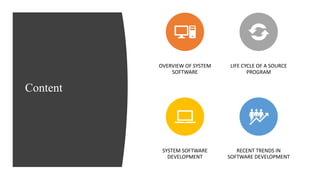
OVERVIEW OF SYSTEM
SOFTWARE
LIFE CYCLE OF A SOURCE
PROGRAM
SYSTEM SOFTWARE
DEVELOPMENT
RECENT TRENDS IN
SOFTWARE DEVELOPMENT
Overview of System Software
Software
• A set of instruction to perform specific tasks is called a
Program.
• The collection of one or many programs for a specific
purpose is called Software.
Software Hierarchy
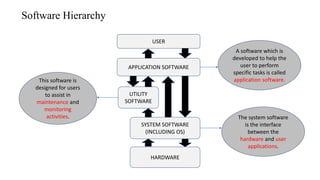
USER
APPLICATION SOFTWARE
UTILITY
SOFTWARE
SYSTEM SOFTWARE
(INCLUDING OS)
HARDWARE
A software which is
developed to help the
user to perform
specific tasks is called
application software.
The system software
is the interface
between the
hardware and user
applications.
This software is
designed for users
to assist in
maintenance and
monitoring
activities.
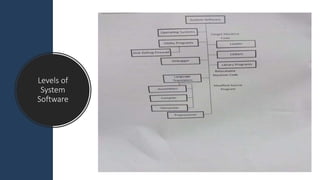
System
software
diagram
Levels of
System
Software
System Programming
• System programming involves designing and writing computer programs that allow the
computer hardware to interface with the programmer and the user , leading to the
effective execution of application software on the computer system.
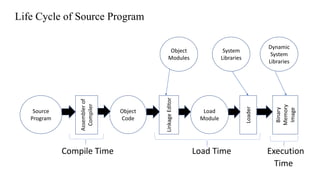
Life Cycle of Source Program
Compile Time Load Time Execution
Time
Source
Program
Assemblerof
Compiler
Object
Code
LinkageEditor
Load
Module
Loader
Binary
Memory
Image
Object
Modules
System
Libraries
Dynamic
System
Libraries
• Edit time : It is the phase where editing of program code takes place
and is also known as design time.
• Compile time : At this stage , the source code after editing is passed
to a translator that translates it into machine code.This
stage checks the program for inconsistencies and error
produces an executable file.
• Distribution time : In this stage that sends or distributes the program
from the entity creating it to an entity invoking it.
• Installation time : A program goes through the installation process ,
which makes ready for execution within the system.
• Link time : At this stage , the specific implementation of the
interface is linked and associated to the program
invoking it.
• Load time : This stage actively takes the execution image from
its stored repositories and places them into active
memory to initiate the execution.
• Run time : This stage of the life cycle in which the programmed behavior of
the source program is demonstrated.
System
Software
Development
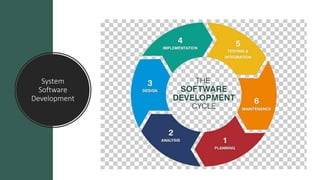
• Preliminary analysis : Begin with a preliminary analysis, propose alternative
solutions, describe costs and benefits, and submit a
preliminary plan with recommendations.
• Systems analysis : Define project goals into defined functions and operations of
intended application. This involves the process of gathering
interpreting facts, diagnosing problems, and recommending
improvements to the system.
• Systems design : At this step desired features and operations are described in
details, including screen layouts, business rules, process diagram
pseudocode, and other documentation.
• System tool acquisition : It decides and works around the software tools to develop the
functionalities of the system software.
• Implementation : It builds the software using the software tools with all the
functionality , interfaces and support for the execution. This
may be specify as the system software adheres to the architecture.
• Maintenance : During the maintenance stage of the SDLC, the system is
assessed/evaluated to ensure it does not become obsolete. This is
where changes are made to initial software
Recent trends in Software Development
• Use the preprocessors against full software stack.
• JavaScript MV* frameworks rather than JavaScript files.
• CSS framework against generic cascading style sheets.
• SVG with JavaScript on canvas in competition with flash.
• Gaming framework against native game development.
• Mobile app
• Android against iOS
• Cloud services.
• Single-page Web apps against websites.
System Programming

System Programming

  • 1.
    Content OVERVIEW OF SYSTEM SOFTWARE LIFECYCLE OF A SOURCE PROGRAM SYSTEM SOFTWARE DEVELOPMENT RECENT TRENDS IN SOFTWARE DEVELOPMENT
  • 2.
    Overview of SystemSoftware Software • A set of instruction to perform specific tasks is called a Program. • The collection of one or many programs for a specific purpose is called Software.
  • 3.
    Software Hierarchy USER APPLICATION SOFTWARE UTILITY SOFTWARE SYSTEMSOFTWARE (INCLUDING OS) HARDWARE A software which is developed to help the user to perform specific tasks is called application software. The system software is the interface between the hardware and user applications. This software is designed for users to assist in maintenance and monitoring activities.
  • 4.
  • 5.
  • 6.
    System Programming • Systemprogramming involves designing and writing computer programs that allow the computer hardware to interface with the programmer and the user , leading to the effective execution of application software on the computer system.
  • 7.
    Life Cycle ofSource Program Compile Time Load Time Execution Time Source Program Assemblerof Compiler Object Code LinkageEditor Load Module Loader Binary Memory Image Object Modules System Libraries Dynamic System Libraries
  • 8.
    • Edit time: It is the phase where editing of program code takes place and is also known as design time. • Compile time : At this stage , the source code after editing is passed to a translator that translates it into machine code.This stage checks the program for inconsistencies and error produces an executable file. • Distribution time : In this stage that sends or distributes the program from the entity creating it to an entity invoking it.
  • 9.
    • Installation time: A program goes through the installation process , which makes ready for execution within the system. • Link time : At this stage , the specific implementation of the interface is linked and associated to the program invoking it. • Load time : This stage actively takes the execution image from its stored repositories and places them into active memory to initiate the execution. • Run time : This stage of the life cycle in which the programmed behavior of the source program is demonstrated.
  • 10.
  • 11.
    • Preliminary analysis: Begin with a preliminary analysis, propose alternative solutions, describe costs and benefits, and submit a preliminary plan with recommendations. • Systems analysis : Define project goals into defined functions and operations of intended application. This involves the process of gathering interpreting facts, diagnosing problems, and recommending improvements to the system. • Systems design : At this step desired features and operations are described in details, including screen layouts, business rules, process diagram pseudocode, and other documentation. • System tool acquisition : It decides and works around the software tools to develop the functionalities of the system software.
  • 12.
    • Implementation :It builds the software using the software tools with all the functionality , interfaces and support for the execution. This may be specify as the system software adheres to the architecture. • Maintenance : During the maintenance stage of the SDLC, the system is assessed/evaluated to ensure it does not become obsolete. This is where changes are made to initial software
  • 13.
    Recent trends inSoftware Development • Use the preprocessors against full software stack. • JavaScript MV* frameworks rather than JavaScript files. • CSS framework against generic cascading style sheets. • SVG with JavaScript on canvas in competition with flash. • Gaming framework against native game development. • Mobile app • Android against iOS • Cloud services. • Single-page Web apps against websites.