Data Structures I (CPCS-204) 
Week # 2: Algorithm Analysis tools
Algorithm Analysis: Motivation 
 A problem can be solved in many different ways 
 Single problem, many algorithms 
 Which of the several algorithms should I 
choose? 
 We use algorithm analysis to answer this question 
o Writing a working program is not good enough 
o The program may be inefficient! 
o If the program runs on a large data set, then the running time 
becomes an issue
What is algorithm analysis? 
 A methodology to predict the resources that the 
algorithm requires 
 Computer memory 
 Computational time 
 We’ll focus on computational time 
 It does not mean memory is not important 
 Generally, there is a trade-off between the two factors 
o Space-time trade-off is a common term
How to analyse algorithms? 
 Experimental Approach 
 Implement algorithms as programs and run them on 
computers 
 Not a good approach, though! 
o Results only for a limited set of test inputs 
o Difficult comparisons due to the experiment environments 
(need the same computers, same operating systems, etc.) 
o Full implementation and execution of an algorithm 
 We need an approach which allows us to avoid 
experimental study
How to analyse algorithms? 
 Theoretical Approach 
 General methodology for analysing the running time 
o Considers all possible inputs 
o Evaluates algorithms in a way that is independent from the 
hardware and software environments 
o Analyses an algorithm without implementing it 
 Count only primitive operations used in an algorithm 
 Associate each algorithm with a function f(n) that 
characterises the running time of the algorithm as a 
function of the input size n 
o A good approximation of the total number of primitive 
operations
Primitive Operations 
 Basic computations performed by an algorithm 
 Each operation corresponding to a low-level 
instruction with a constant execution time 
 Largely independent from the programming 
language 
 Examples 
 Evaluating an expression (x + y) 
 Assigning a value to a variable (x ←5) 
 Comparing two numbers (x < y) 
 Indexing into an array (A[i]) 
 Calling a method (mycalculator.sum()) 
 Returning from a method (return result)
Counting Primitive Operations 
 Total number of primitive operations executed 
 is the running time of an algorithms 
 is a function of the input size 
 Example 
Algorithm ArrayMax(A, n) # operations 
currentMax ←A[0] 2: (1 +1) 
for i←1;i<n; i←i+1 do 3n-1: (1 + n+2(n- 1)) 
if A[i]>currentMax then 2(n − 1) 
currentMax ←A[i] 2(n − 1) 
endif 
endfor 
return currentMax 1 
Total: 7n − 2
Algorithm efficiency: growth rate 
 An algorithm’s time requirements can be 
expressed as a function of (problem) input size 
 Problem size depends on the particular problem: 
 For a search problem, the problem size is the 
number of elements in the search space 
 For a sorting problem, the problem size is the 
number of elements in the given list 
 How quickly the time of an algorithm grows as a 
function of problem size -- this is often called an 
algorithm’s growth rate
Algorithm growth rate 
Which algorithm is the most efficient? [The one with 
the growth rate Log N.]
Algorithmic time complexity 
 Rather than counting the exact number of 
primitive operations, we approximate the 
runtime of an algorithm as a function of data 
size – time complexity 
 Algorithms A, B, C and D (previous slide) 
belong to different complexity classes 
 We’ll not cover complexity classes in detail – 
they will be covered in Algorithm Analysis 
course, in a later semester 
 We’ll briefly discuss seven basic functions 
which are often used in complexity analysis
Seven basic function 
1. Constant function f(n) = c 
2. Linear function f(n) = n 
3. Quadratic function f(n) = n2 
4. Cubic function f(n) = n3 
5. Log function f(n) = log n 
6. Log linear function f(n) = n log n 
7. Exponential function f(n) = bn
Constant function 
 For a given argument/variable n, the function 
always returns a constant value 
 It is independent of variable n 
 It is commonly used to approximate the total 
number of primitive operations in an algorithm 
 Most common constant function is g(n) = 1 
 Any constant value c can be expressed as 
constant function f(n) = c.g(1)
Linear function 
 For a given argument/variable n, the function 
always returns n 
 This function arises in algorithm analysis any 
time we have to do a single basic operation over 
each of n elements 
 For example, finding min/max value in a list 
of values 
 Time complexity of linear/sequential search 
algorithm is linear
Quadratic function 
 For a given argument/variable n, the function 
always returns square of n 
 This function arises in algorithm analysis any 
time we use nested loops 
 The outer loop performs primitive operations in 
linear time; for each iteration, the inner loop also 
perform primitive operations in linear time 
 For example, sorting an array in 
ascending/descending order using Bubble Sort 
(more later on) 
 Time complexity of most algorithms is quadratic
Cubic function 
 For a given argument/variable n, the function 
always returns n x n x n 
 This function is very rarely used in algorithm 
analysis 
 Rather, a more general class “polynomial” is 
often used 
o f(n) = a0 + a1n + a2n2 + a3n3 + … + adnd
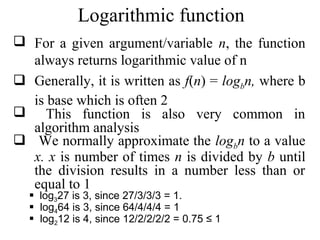
Logarithmic function 
 For a given argument/variable n, the function 
always returns logarithmic value of n 
 Generally, it is written as f(n) = logbn, where b 
is base which is often 2 
 This function is also very common in 
algorithm analysis 
 We normally approximate the logbn to a value 
x. x is number of times n is divided by b until 
the division results in a number less than or 
equal to 1 
 log327 is 3, since 27/3/3/3 = 1. 
 log464 is 3, since 64/4/4/4 = 1 
 log212 is 4, since 12/2/2/2/2 = 0.75 ≤ 1
Log linear function 
 For a given argument/variable n, the function 
always returns n log n 
 Generally, it is written as f(n) = n logbn, where 
b is base which is often 2 
 This function is also common in algorithm 
analysis 
 Growth rate of log linear function is faster as 
compared to linear and log functions
Exponential function 
 For a given argument/variable n, the function 
always returns bn, where b is base and n is 
power (exponent) 
 This function is also common in algorithm 
analysis 
 Growth rate of exponential function is faster 
than all other functions
Algorithmic runtime 
 Worst-case running time 
 measures the maximum number of primitive operations 
executed 
 The worst case can occur fairly often 
o e.g. in searching a database for a particular piece of information 
 Best-case running time 
 measures the minimum number of primitive operations 
executed 
o Finding a value in a list, where the value is at the first position 
o Sorting a list of values, where values are already in desired order 
 Average-case running time 
 the efficiency averaged on all possible inputs 
 maybe difficult to define what “average” means
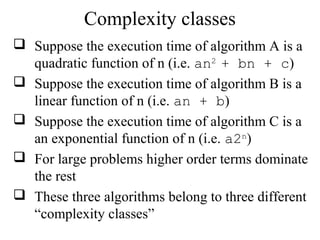
Complexity classes 
 Suppose the execution time of algorithm A is a 
quadratic function of n (i.e. an2 + bn + c) 
 Suppose the execution time of algorithm B is a 
linear function of n (i.e. an + b) 
 Suppose the execution time of algorithm C is a 
an exponential function of n (i.e. a2n) 
 For large problems higher order terms dominate 
the rest 
 These three algorithms belong to three different 
“complexity classes”
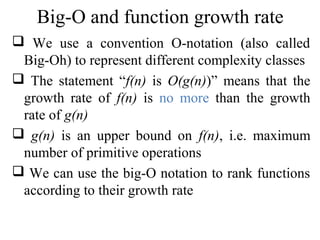
Big-O and function growth rate 
 We use a convention O-notation (also called 
Big-Oh) to represent different complexity classes 
 The statement “f(n) is O(g(n))” means that the 
growth rate of f(n) is no more than the growth 
rate of g(n) 
 g(n) is an upper bound on f(n), i.e. maximum 
number of primitive operations 
 We can use the big-O notation to rank functions 
according to their growth rate
22 
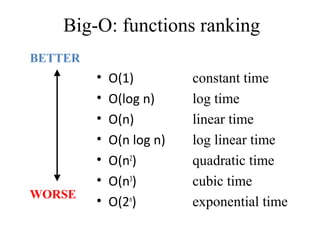
Big-O: functions ranking 
• O(1) constant time 
• O(log n) log time 
• O(n) linear time 
• O(n log n) log linear time 
• O(n2) quadratic time 
• O(n3) cubic time 
• O(2n) exponential time 
BETTER 
WORSE
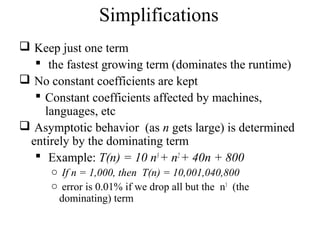
Simplifications 
 Keep just one term 
 the fastest growing term (dominates the runtime) 
 No constant coefficients are kept 
 Constant coefficients affected by machines, 
languages, etc 
 Asymptotic behavior (as n gets large) is determined 
entirely by the dominating term 
 Example: T(n) = 10 n3 + n2 + 40n + 800 
o If n = 1,000, then T(n) = 10,001,040,800 
o error is 0.01% if we drop all but the n3 (the 
dominating) term
Big Oh: some examples 
 n3 – 3n = O(n3) 
 1 + 4n = O(n) 
 7n2 + 10n + 3 = O(n2) 
 2n + 10n + 3 = O(2n)
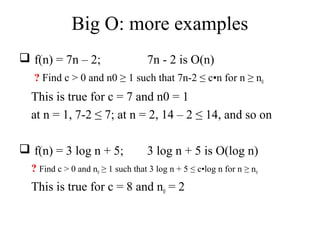
Big O: more examples 
 f(n) = 7n – 2; 7n - 2 is O(n) 
? Find c > 0 and n0 ≥ 1 such that 7n-2 ≤ c•n for n ≥ n0 
This is true for c = 7 and n0 = 1 
at n = 1, 7-2 ≤ 7; at n = 2, 14 – 2 ≤ 14, and so on 
 f(n) = 3 log n + 5; 3 log n + 5 is O(log n) 
? Find c > 0 and n0 ≥ 1 such that 3 log n + 5 ≤ c•log n for n ≥ n0 
This is true for c = 8 and n0 = 2
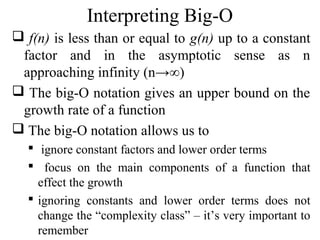
Interpreting Big-O 
 f(n) is less than or equal to g(n) up to a constant 
factor and in the asymptotic sense as n 
approaching infinity (n→∞) 
 The big-O notation gives an upper bound on the 
growth rate of a function 
 The big-O notation allows us to 
 ignore constant factors and lower order terms 
 focus on the main components of a function that 
effect the growth 
 ignoring constants and lower order terms does not 
change the “complexity class” – it’s very important to 
remember
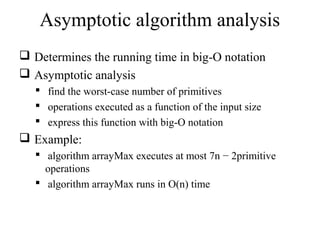
Asymptotic algorithm analysis 
 Determines the running time in big-O notation 
 Asymptotic analysis 
 find the worst-case number of primitives 
 operations executed as a function of the input size 
 express this function with big-O notation 
 Example: 
 algorithm arrayMax executes at most 7n − 2primitive 
operations 
 algorithm arrayMax runs in O(n) time
Practice 
 Express the following functions in terms of Big-O 
notation (a, b and c are constants) 
1. f(n) = an2 + bn + c 
2. f(n) = 2n + n log n + c 
3. f(n) = n log n + b log n + c
Outlook 
Next week, we’ll discuss arrays and searching algorithms

Data Structures- Part2 analysis tools

  • 1.
    Data Structures I(CPCS-204) Week # 2: Algorithm Analysis tools
  • 2.
    Algorithm Analysis: Motivation  A problem can be solved in many different ways  Single problem, many algorithms  Which of the several algorithms should I choose?  We use algorithm analysis to answer this question o Writing a working program is not good enough o The program may be inefficient! o If the program runs on a large data set, then the running time becomes an issue
  • 3.
    What is algorithmanalysis?  A methodology to predict the resources that the algorithm requires  Computer memory  Computational time  We’ll focus on computational time  It does not mean memory is not important  Generally, there is a trade-off between the two factors o Space-time trade-off is a common term
  • 4.
    How to analysealgorithms?  Experimental Approach  Implement algorithms as programs and run them on computers  Not a good approach, though! o Results only for a limited set of test inputs o Difficult comparisons due to the experiment environments (need the same computers, same operating systems, etc.) o Full implementation and execution of an algorithm  We need an approach which allows us to avoid experimental study
  • 5.
    How to analysealgorithms?  Theoretical Approach  General methodology for analysing the running time o Considers all possible inputs o Evaluates algorithms in a way that is independent from the hardware and software environments o Analyses an algorithm without implementing it  Count only primitive operations used in an algorithm  Associate each algorithm with a function f(n) that characterises the running time of the algorithm as a function of the input size n o A good approximation of the total number of primitive operations
  • 6.
    Primitive Operations Basic computations performed by an algorithm  Each operation corresponding to a low-level instruction with a constant execution time  Largely independent from the programming language  Examples  Evaluating an expression (x + y)  Assigning a value to a variable (x ←5)  Comparing two numbers (x < y)  Indexing into an array (A[i])  Calling a method (mycalculator.sum())  Returning from a method (return result)
  • 7.
    Counting Primitive Operations  Total number of primitive operations executed  is the running time of an algorithms  is a function of the input size  Example Algorithm ArrayMax(A, n) # operations currentMax ←A[0] 2: (1 +1) for i←1;i<n; i←i+1 do 3n-1: (1 + n+2(n- 1)) if A[i]>currentMax then 2(n − 1) currentMax ←A[i] 2(n − 1) endif endfor return currentMax 1 Total: 7n − 2
  • 8.
    Algorithm efficiency: growthrate  An algorithm’s time requirements can be expressed as a function of (problem) input size  Problem size depends on the particular problem:  For a search problem, the problem size is the number of elements in the search space  For a sorting problem, the problem size is the number of elements in the given list  How quickly the time of an algorithm grows as a function of problem size -- this is often called an algorithm’s growth rate
  • 9.
    Algorithm growth rate Which algorithm is the most efficient? [The one with the growth rate Log N.]
  • 10.
    Algorithmic time complexity  Rather than counting the exact number of primitive operations, we approximate the runtime of an algorithm as a function of data size – time complexity  Algorithms A, B, C and D (previous slide) belong to different complexity classes  We’ll not cover complexity classes in detail – they will be covered in Algorithm Analysis course, in a later semester  We’ll briefly discuss seven basic functions which are often used in complexity analysis
  • 11.
    Seven basic function 1. Constant function f(n) = c 2. Linear function f(n) = n 3. Quadratic function f(n) = n2 4. Cubic function f(n) = n3 5. Log function f(n) = log n 6. Log linear function f(n) = n log n 7. Exponential function f(n) = bn
  • 12.
    Constant function For a given argument/variable n, the function always returns a constant value  It is independent of variable n  It is commonly used to approximate the total number of primitive operations in an algorithm  Most common constant function is g(n) = 1  Any constant value c can be expressed as constant function f(n) = c.g(1)
  • 13.
    Linear function For a given argument/variable n, the function always returns n  This function arises in algorithm analysis any time we have to do a single basic operation over each of n elements  For example, finding min/max value in a list of values  Time complexity of linear/sequential search algorithm is linear
  • 14.
    Quadratic function For a given argument/variable n, the function always returns square of n  This function arises in algorithm analysis any time we use nested loops  The outer loop performs primitive operations in linear time; for each iteration, the inner loop also perform primitive operations in linear time  For example, sorting an array in ascending/descending order using Bubble Sort (more later on)  Time complexity of most algorithms is quadratic
  • 15.
    Cubic function For a given argument/variable n, the function always returns n x n x n  This function is very rarely used in algorithm analysis  Rather, a more general class “polynomial” is often used o f(n) = a0 + a1n + a2n2 + a3n3 + … + adnd
  • 16.
    Logarithmic function For a given argument/variable n, the function always returns logarithmic value of n  Generally, it is written as f(n) = logbn, where b is base which is often 2  This function is also very common in algorithm analysis  We normally approximate the logbn to a value x. x is number of times n is divided by b until the division results in a number less than or equal to 1  log327 is 3, since 27/3/3/3 = 1.  log464 is 3, since 64/4/4/4 = 1  log212 is 4, since 12/2/2/2/2 = 0.75 ≤ 1
  • 17.
    Log linear function  For a given argument/variable n, the function always returns n log n  Generally, it is written as f(n) = n logbn, where b is base which is often 2  This function is also common in algorithm analysis  Growth rate of log linear function is faster as compared to linear and log functions
  • 18.
    Exponential function For a given argument/variable n, the function always returns bn, where b is base and n is power (exponent)  This function is also common in algorithm analysis  Growth rate of exponential function is faster than all other functions
  • 19.
    Algorithmic runtime Worst-case running time  measures the maximum number of primitive operations executed  The worst case can occur fairly often o e.g. in searching a database for a particular piece of information  Best-case running time  measures the minimum number of primitive operations executed o Finding a value in a list, where the value is at the first position o Sorting a list of values, where values are already in desired order  Average-case running time  the efficiency averaged on all possible inputs  maybe difficult to define what “average” means
  • 20.
    Complexity classes Suppose the execution time of algorithm A is a quadratic function of n (i.e. an2 + bn + c)  Suppose the execution time of algorithm B is a linear function of n (i.e. an + b)  Suppose the execution time of algorithm C is a an exponential function of n (i.e. a2n)  For large problems higher order terms dominate the rest  These three algorithms belong to three different “complexity classes”
  • 21.
    Big-O and functiongrowth rate  We use a convention O-notation (also called Big-Oh) to represent different complexity classes  The statement “f(n) is O(g(n))” means that the growth rate of f(n) is no more than the growth rate of g(n)  g(n) is an upper bound on f(n), i.e. maximum number of primitive operations  We can use the big-O notation to rank functions according to their growth rate
  • 22.
    22 Big-O: functionsranking • O(1) constant time • O(log n) log time • O(n) linear time • O(n log n) log linear time • O(n2) quadratic time • O(n3) cubic time • O(2n) exponential time BETTER WORSE
  • 23.
    Simplifications  Keepjust one term  the fastest growing term (dominates the runtime)  No constant coefficients are kept  Constant coefficients affected by machines, languages, etc  Asymptotic behavior (as n gets large) is determined entirely by the dominating term  Example: T(n) = 10 n3 + n2 + 40n + 800 o If n = 1,000, then T(n) = 10,001,040,800 o error is 0.01% if we drop all but the n3 (the dominating) term
  • 24.
    Big Oh: someexamples  n3 – 3n = O(n3)  1 + 4n = O(n)  7n2 + 10n + 3 = O(n2)  2n + 10n + 3 = O(2n)
  • 25.
    Big O: moreexamples  f(n) = 7n – 2; 7n - 2 is O(n) ? Find c > 0 and n0 ≥ 1 such that 7n-2 ≤ c•n for n ≥ n0 This is true for c = 7 and n0 = 1 at n = 1, 7-2 ≤ 7; at n = 2, 14 – 2 ≤ 14, and so on  f(n) = 3 log n + 5; 3 log n + 5 is O(log n) ? Find c > 0 and n0 ≥ 1 such that 3 log n + 5 ≤ c•log n for n ≥ n0 This is true for c = 8 and n0 = 2
  • 26.
    Interpreting Big-O f(n) is less than or equal to g(n) up to a constant factor and in the asymptotic sense as n approaching infinity (n→∞)  The big-O notation gives an upper bound on the growth rate of a function  The big-O notation allows us to  ignore constant factors and lower order terms  focus on the main components of a function that effect the growth  ignoring constants and lower order terms does not change the “complexity class” – it’s very important to remember
  • 27.
    Asymptotic algorithm analysis  Determines the running time in big-O notation  Asymptotic analysis  find the worst-case number of primitives  operations executed as a function of the input size  express this function with big-O notation  Example:  algorithm arrayMax executes at most 7n − 2primitive operations  algorithm arrayMax runs in O(n) time
  • 28.
    Practice  Expressthe following functions in terms of Big-O notation (a, b and c are constants) 1. f(n) = an2 + bn + c 2. f(n) = 2n + n log n + c 3. f(n) = n log n + b log n + c
  • 29.
    Outlook Next week,we’ll discuss arrays and searching algorithms