

PMP
Trainer: Anand BobadePMBOK 6th Edition, 2019, All rights reserved.
Chapter 8 –
Project Quality Management
Plan Quality
management
Manage Quality Control Quality
SIXTH EDITION
PMBOK 6 - All rights reserved 2019, By: Anand Bobade (nmbobade@gmail.com)
Chap 8: Project Quality Management
What is Quality
What is Quality management definition
Quality Vs Grade
Precision vs. Accuracy
Quality theories
Trends & emerging practices
Tailoring considerations
Quality management processes
Review
PMBOK 6 - All rights reserved 2019, By: Anand Bobade (nmbobade@gmail.com)
Introduction -> What is Quality?
Quality
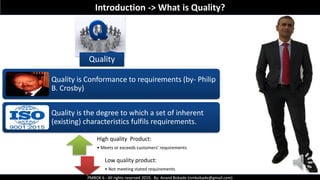
Quality is Conformance to requirements (by- Philip
B. Crosby)
Quality is the degree to which a set of inherent
(existing) characteristics fulfils requirements.
High quality Product:
• Meets or exceeds customers’ requirements
Low quality product:
• Not meeting stated requirements
PMBOK 6 - All rights reserved 2019, By: Anand Bobade (nmbobade@gmail.com)
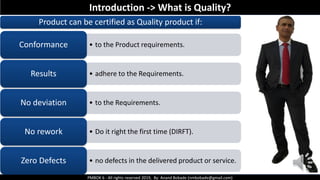
Product can be certified as Quality product if:
• to the Product requirements.Conformance
• adhere to the Requirements.Results
• to the Requirements.No deviation
• Do it right the first time (DIRFT).No rework
• no defects in the delivered product or service.Zero Defects
Introduction -> What is Quality?
PMBOK 6 - All rights reserved 2019, By: Anand Bobade (nmbobade@gmail.com)
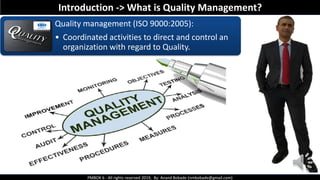
Quality management (ISO 9000:2005):
• Coordinated activities to direct and control an
organization with regard to Quality.
Introduction -> What is Quality Management?
PMBOK 6 - All rights reserved 2019, By: Anand Bobade (nmbobade@gmail.com)
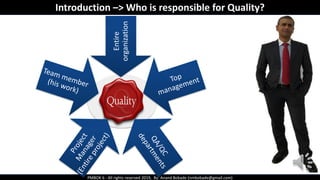
Entire
organization
Introduction –> Who is responsible for Quality?
PMBOK 6 - All rights reserved 2019, By: Anand Bobade (nmbobade@gmail.com)
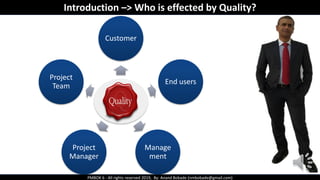
Customer
End users
Manage
ment
Project
Manager
Project
Team
Introduction –> Who is effected by Quality?
PMBOK 6 - All rights reserved 2019, By: Anand Bobade (nmbobade@gmail.com)
If you opted for Saloon CAR, you probably choose it over the regular
looking CAR because it looks superior.
However, this Saloon CAR will looks low grade compared to Sports CAR.
Introduction –> Quality vs. Grade
PMBOK 6 - All rights reserved 2019, By: Anand Bobade (nmbobade@gmail.com)
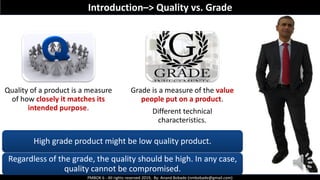
Introduction–> Quality vs. Grade
Quality of a product is a measure
of how closely it matches its
intended purpose.
Grade is a measure of the value
people put on a product.
Different technical
characteristics.
High grade product might be low quality product.
Regardless of the grade, the quality should be high. In any case,
quality cannot be compromised.
PMBOK 6 - All rights reserved 2019, By: Anand Bobade (nmbobade@gmail.com)
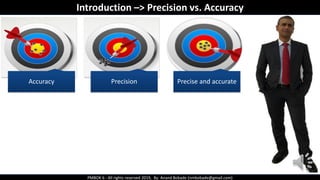
Accuracy Precision Precise and accurate
Introduction –> Precision vs. Accuracy
PMBOK 6 - All rights reserved 2019, By: Anand Bobade (nmbobade@gmail.com)
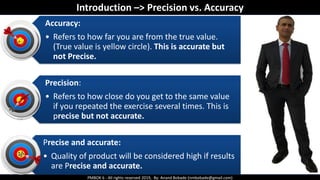
Accuracy:
• Refers to how far you are from the true value.
(True value is yellow circle). This is accurate but
not Precise.
Precision:
• Refers to how close do you get to the same value
if you repeated the exercise several times. This is
precise but not accurate.
Precise and accurate:
• Quality of product will be considered high if results
are Precise and accurate.
Introduction –> Precision vs. Accuracy
PMBOK 6 - All rights reserved 2019, By: Anand Bobade (nmbobade@gmail.com)
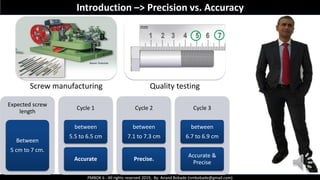
Screw manufacturing Quality testing
Expected screw
length
Between
5 cm to 7 cm.
Cycle 1
between
5.5 to 6.5 cm
Accurate
Cycle 2
between
7.1 to 7.3 cm
Precise.
Cycle 3
between
6.7 to 6.9 cm
Accurate &
Precise
Introduction –> Precision vs. Accuracy
PMBOK 6 - All rights reserved 2019, By: Anand Bobade (nmbobade@gmail.com)
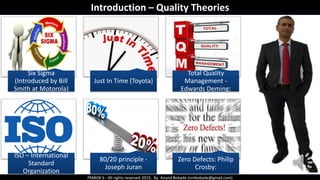
Six Sigma
(Introduced by Bill
Smith at Motorola)
Just In Time (Toyota)
Total Quality
Management -
Edwards Deming:
ISO – International
Standard
Organization
80/20 principle -
Joseph Juran
Zero Defects: Philip
Crosby:
Introduction – Quality Theories
PMBOK 6 - All rights reserved 2019, By: Anand Bobade (nmbobade@gmail.com)
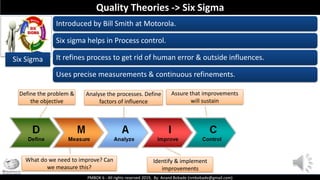
Six Sigma
Introduced by Bill Smith at Motorola.
Six sigma helps in Process control.
It refines process to get rid of human error & outside influences.
Uses precise measurements & continuous refinements.
Quality Theories -> Six Sigma
Define the problem &
the objective
Analyse the processes. Define
factors of influence
Assure that improvements
will sustain
What do we need to improve? Can
we measure this?
Identify & implement
improvements
PMBOK 6 - All rights reserved 2019, By: Anand Bobade (nmbobade@gmail.com)
Six Sigma
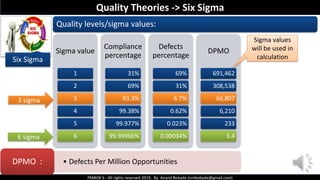
Quality levels/sigma values:
Sigma value
1
2
3
4
5
6
Compliance
percentage
31%
69%
93.3%
99.38%
99.977%
99.99966%
Defects
percentage
69%
31%
6.7%
0.62%
0.023%
0.00034%
DPMO
691,462
308,538
66,807
6,210
233
3.4
• Defects Per Million OpportunitiesDPMO :
Quality Theories -> Six Sigma
Sigma values
will be used in
calculation
6 sigma
3 sigma
PMBOK 6 - All rights reserved 2019, By: Anand Bobade (nmbobade@gmail.com)
TQM
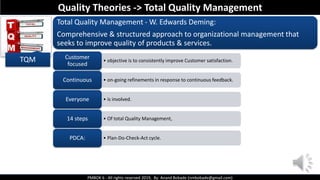
Total Quality Management - W. Edwards Deming:
Comprehensive & structured approach to organizational management that
seeks to improve quality of products & services.
• objective is to consistently improve Customer satisfaction.
Customer
focused
• on-going refinements in response to continuous feedback.Continuous
• is involved.Everyone
• Of total Quality Management,14 steps
• Plan-Do-Check-Act cycle.PDCA:
Quality Theories -> Total Quality Management
PMBOK 6 - All rights reserved 2019, By: Anand Bobade (nmbobade@gmail.com)
ISO
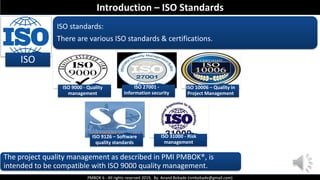
ISO standards:
There are various ISO standards & certifications.
ISO 9000 - Quality
management
ISO 27001 -
Information security
ISO 10006 – Quality in
Project Management
ISO 9126 – Software
quality standards
ISO 31000 - Risk
management
The project quality management as described in PMI PMBOK®, is
intended to be compatible with ISO 9000 quality management.
Introduction – ISO Standards
PMBOK 6 - All rights reserved 2019, By: Anand Bobade (nmbobade@gmail.com)
ISO
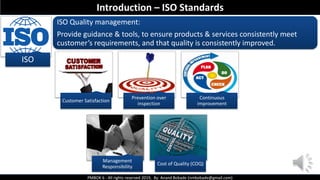
ISO Quality management:
Provide guidance & tools, to ensure products & services consistently meet
customer’s requirements, and that quality is consistently improved.
Customer Satisfaction
Prevention over
inspection
Continuous
improvement
Management
Responsibility
Cost of Quality (COQ)
Introduction – ISO Standards
PMBOK 6 - All rights reserved 2019, By: Anand Bobade (nmbobade@gmail.com)
Prevention over inspection:
• Quality should be planned, designed, and built into
into the project’s deliverables.
• It should not be inspection driven (reactive).
Customer satisfaction :
• Understanding, evaluating, defining & managing
requirements, so that customer expectations are
met.
Introduction -> Generic concepts
PMBOK 6 - All rights reserved 2019, By: Anand Bobade (nmbobade@gmail.com)
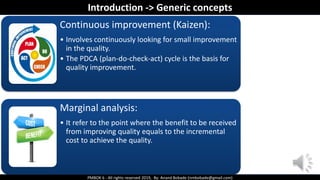
Continuous improvement (Kaizen):
• Involves continuously looking for small improvement
in the quality.
• The PDCA (plan-do-check-act) cycle is the basis for
quality improvement.
Marginal analysis:
• It refer to the point where the benefit to be received
from improving quality equals to the incremental
cost to achieve the quality.
Introduction -> Generic concepts
PMBOK 6 - All rights reserved 2019, By: Anand Bobade (nmbobade@gmail.com)
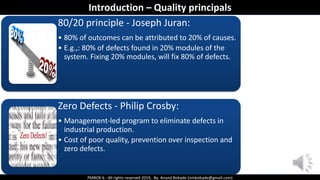
80/20 principle - Joseph Juran:
• 80% of outcomes can be attributed to 20% of causes.
• E.g.,: 80% of defects found in 20% modules of the
system. Fixing 20% modules, will fix 80% of defects.
Zero Defects - Philip Crosby:
• Management-led program to eliminate defects in
industrial production.
• Cost of poor quality, prevention over inspection and
zero defects.
Introduction – Quality principals
PMBOK 6 - All rights reserved 2019, By: Anand Bobade (nmbobade@gmail.com)
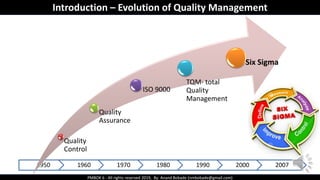
1950 1960 1970 1980 1990 2000 2007
Quality
Control
Quality
Assurance
ISO 9000
TQM- total
Quality
Management
Six Sigma
Introduction – Evolution of Quality Management
PMBOK 6 - All rights reserved 2019, By: Anand Bobade (nmbobade@gmail.com)
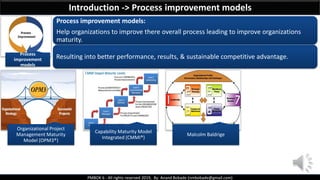
Process
improvement
models
Process improvement models:
Help organizations to improve there overall process leading to improve organizations
maturity.
Resulting into better performance, results, & sustainable competitive advantage.
Organizational Project
Management Maturity
Model (OPM3®)
Capability Maturity Model
Integrated (CMMI®)
Malcolm Baldrige
Introduction -> Process improvement models
PMBOK 6 - All rights reserved 2019, By: Anand Bobade (nmbobade@gmail.com)
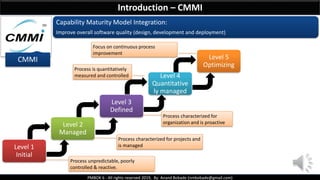
CMMI
Capability Maturity Model Integration:
Improve overall software quality (design, development and deployment)
Introduction – CMMI
Level 1
Initial
Level 2
Managed
Level 3
Defined
Level 4
Quantitative
ly managed
Level 5
Optimizing
Process unpredictable, poorly
controlled & reactive.
Process characterized for projects and
is managed
Process characterized for
organization and is proactive
Process is quantitatively
measured and controlled
Focus on continuous process
improvement
PMBOK 6 - All rights reserved 2019, By: Anand Bobade (nmbobade@gmail.com)
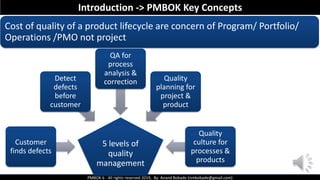
Cost of quality of a product lifecycle are concern of Program/ Portfolio/
Operations /PMO not project
5 levels of
quality
management
Customer
finds defects
Detect
defects
before
customer
QA for
process
analysis &
correction Quality
planning for
project &
product
Quality
culture for
processes &
products
Introduction -> PMBOK Key Concepts
PMBOK 6 - All rights reserved 2019, By: Anand Bobade (nmbobade@gmail.com)
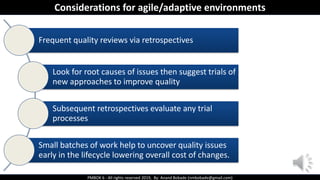
Frequent quality reviews via retrospectives
Look for root causes of issues then suggest trials of
new approaches to improve quality
Subsequent retrospectives evaluate any trial
processes
Small batches of work help to uncover quality issues
early in the lifecycle lowering overall cost of changes.
Considerations for agile/adaptive environments
PMBOK 6 - All rights reserved 2019, By: Anand Bobade (nmbobade@gmail.com)
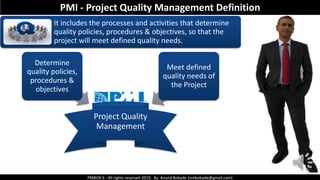
It includes the processes and activities that determine
quality policies, procedures & objectives, so that the
project will meet defined quality needs.
Project Quality
Management
Determine
quality policies,
procedures &
objectives
Meet defined
quality needs of
the Project
PMI - Project Quality Management Definition
PMBOK 6 - All rights reserved 2019, By: Anand Bobade (nmbobade@gmail.com)
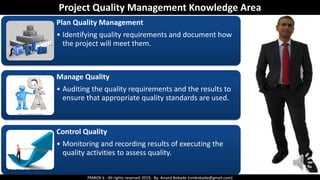
Plan Quality Management
• Identifying quality requirements and document how
the project will meet them.
Manage Quality
• Auditing the quality requirements and the results to
ensure that appropriate quality standards are used.
Control Quality
• Monitoring and recording results of executing the
quality activities to assess quality.
Project Quality Management Knowledge Area
PMBOK 6 - All rights reserved 2019, By: Anand Bobade (nmbobade@gmail.com)
Project Quality Management -> Review
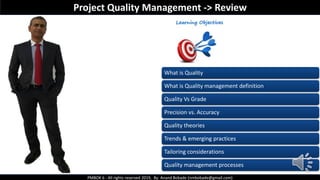
What is Quality
What is Quality management definition
Quality Vs Grade
Precision vs. Accuracy
Quality theories
Trends & emerging practices
Tailoring considerations
Quality management processes
Quality begins with the intent, which is fixed by
Management.
Dr. W. Edwards Deming

Chap 8.0 Quality Management Overview

  • 1.
    PMP Trainer: Anand BobadePMBOK6th Edition, 2019, All rights reserved. Chapter 8 – Project Quality Management Plan Quality management Manage Quality Control Quality SIXTH EDITION
  • 2.
    PMBOK 6 -All rights reserved 2019, By: Anand Bobade (nmbobade@gmail.com) Chap 8: Project Quality Management What is Quality What is Quality management definition Quality Vs Grade Precision vs. Accuracy Quality theories Trends & emerging practices Tailoring considerations Quality management processes Review
  • 3.
    PMBOK 6 -All rights reserved 2019, By: Anand Bobade (nmbobade@gmail.com) Introduction -> What is Quality? Quality Quality is Conformance to requirements (by- Philip B. Crosby) Quality is the degree to which a set of inherent (existing) characteristics fulfils requirements. High quality Product: • Meets or exceeds customers’ requirements Low quality product: • Not meeting stated requirements
  • 4.
    PMBOK 6 -All rights reserved 2019, By: Anand Bobade (nmbobade@gmail.com) Product can be certified as Quality product if: • to the Product requirements.Conformance • adhere to the Requirements.Results • to the Requirements.No deviation • Do it right the first time (DIRFT).No rework • no defects in the delivered product or service.Zero Defects Introduction -> What is Quality?
  • 5.
    PMBOK 6 -All rights reserved 2019, By: Anand Bobade (nmbobade@gmail.com) Quality management (ISO 9000:2005): • Coordinated activities to direct and control an organization with regard to Quality. Introduction -> What is Quality Management?
  • 6.
    PMBOK 6 -All rights reserved 2019, By: Anand Bobade (nmbobade@gmail.com) Entire organization Introduction –> Who is responsible for Quality?
  • 7.
    PMBOK 6 -All rights reserved 2019, By: Anand Bobade (nmbobade@gmail.com) Customer End users Manage ment Project Manager Project Team Introduction –> Who is effected by Quality?
  • 8.
    PMBOK 6 -All rights reserved 2019, By: Anand Bobade (nmbobade@gmail.com) If you opted for Saloon CAR, you probably choose it over the regular looking CAR because it looks superior. However, this Saloon CAR will looks low grade compared to Sports CAR. Introduction –> Quality vs. Grade
  • 9.
    PMBOK 6 -All rights reserved 2019, By: Anand Bobade (nmbobade@gmail.com) Introduction–> Quality vs. Grade Quality of a product is a measure of how closely it matches its intended purpose. Grade is a measure of the value people put on a product. Different technical characteristics. High grade product might be low quality product. Regardless of the grade, the quality should be high. In any case, quality cannot be compromised.
  • 10.
    PMBOK 6 -All rights reserved 2019, By: Anand Bobade (nmbobade@gmail.com) Accuracy Precision Precise and accurate Introduction –> Precision vs. Accuracy
  • 11.
    PMBOK 6 -All rights reserved 2019, By: Anand Bobade (nmbobade@gmail.com) Accuracy: • Refers to how far you are from the true value. (True value is yellow circle). This is accurate but not Precise. Precision: • Refers to how close do you get to the same value if you repeated the exercise several times. This is precise but not accurate. Precise and accurate: • Quality of product will be considered high if results are Precise and accurate. Introduction –> Precision vs. Accuracy
  • 12.
    PMBOK 6 -All rights reserved 2019, By: Anand Bobade (nmbobade@gmail.com) Screw manufacturing Quality testing Expected screw length Between 5 cm to 7 cm. Cycle 1 between 5.5 to 6.5 cm Accurate Cycle 2 between 7.1 to 7.3 cm Precise. Cycle 3 between 6.7 to 6.9 cm Accurate & Precise Introduction –> Precision vs. Accuracy
  • 13.
    PMBOK 6 -All rights reserved 2019, By: Anand Bobade (nmbobade@gmail.com) Six Sigma (Introduced by Bill Smith at Motorola) Just In Time (Toyota) Total Quality Management - Edwards Deming: ISO – International Standard Organization 80/20 principle - Joseph Juran Zero Defects: Philip Crosby: Introduction – Quality Theories
  • 14.
    PMBOK 6 -All rights reserved 2019, By: Anand Bobade (nmbobade@gmail.com) Six Sigma Introduced by Bill Smith at Motorola. Six sigma helps in Process control. It refines process to get rid of human error & outside influences. Uses precise measurements & continuous refinements. Quality Theories -> Six Sigma Define the problem & the objective Analyse the processes. Define factors of influence Assure that improvements will sustain What do we need to improve? Can we measure this? Identify & implement improvements
  • 15.
    PMBOK 6 -All rights reserved 2019, By: Anand Bobade (nmbobade@gmail.com) Six Sigma Quality levels/sigma values: Sigma value 1 2 3 4 5 6 Compliance percentage 31% 69% 93.3% 99.38% 99.977% 99.99966% Defects percentage 69% 31% 6.7% 0.62% 0.023% 0.00034% DPMO 691,462 308,538 66,807 6,210 233 3.4 • Defects Per Million OpportunitiesDPMO : Quality Theories -> Six Sigma Sigma values will be used in calculation 6 sigma 3 sigma
  • 16.
    PMBOK 6 -All rights reserved 2019, By: Anand Bobade (nmbobade@gmail.com) TQM Total Quality Management - W. Edwards Deming: Comprehensive & structured approach to organizational management that seeks to improve quality of products & services. • objective is to consistently improve Customer satisfaction. Customer focused • on-going refinements in response to continuous feedback.Continuous • is involved.Everyone • Of total Quality Management,14 steps • Plan-Do-Check-Act cycle.PDCA: Quality Theories -> Total Quality Management
  • 17.
    PMBOK 6 -All rights reserved 2019, By: Anand Bobade (nmbobade@gmail.com) ISO ISO standards: There are various ISO standards & certifications. ISO 9000 - Quality management ISO 27001 - Information security ISO 10006 – Quality in Project Management ISO 9126 – Software quality standards ISO 31000 - Risk management The project quality management as described in PMI PMBOK®, is intended to be compatible with ISO 9000 quality management. Introduction – ISO Standards
  • 18.
    PMBOK 6 -All rights reserved 2019, By: Anand Bobade (nmbobade@gmail.com) ISO ISO Quality management: Provide guidance & tools, to ensure products & services consistently meet customer’s requirements, and that quality is consistently improved. Customer Satisfaction Prevention over inspection Continuous improvement Management Responsibility Cost of Quality (COQ) Introduction – ISO Standards
  • 19.
    PMBOK 6 -All rights reserved 2019, By: Anand Bobade (nmbobade@gmail.com) Prevention over inspection: • Quality should be planned, designed, and built into into the project’s deliverables. • It should not be inspection driven (reactive). Customer satisfaction : • Understanding, evaluating, defining & managing requirements, so that customer expectations are met. Introduction -> Generic concepts
  • 20.
    PMBOK 6 -All rights reserved 2019, By: Anand Bobade (nmbobade@gmail.com) Continuous improvement (Kaizen): • Involves continuously looking for small improvement in the quality. • The PDCA (plan-do-check-act) cycle is the basis for quality improvement. Marginal analysis: • It refer to the point where the benefit to be received from improving quality equals to the incremental cost to achieve the quality. Introduction -> Generic concepts
  • 21.
    PMBOK 6 -All rights reserved 2019, By: Anand Bobade (nmbobade@gmail.com) 80/20 principle - Joseph Juran: • 80% of outcomes can be attributed to 20% of causes. • E.g.,: 80% of defects found in 20% modules of the system. Fixing 20% modules, will fix 80% of defects. Zero Defects - Philip Crosby: • Management-led program to eliminate defects in industrial production. • Cost of poor quality, prevention over inspection and zero defects. Introduction – Quality principals
  • 22.
    PMBOK 6 -All rights reserved 2019, By: Anand Bobade (nmbobade@gmail.com) 1950 1960 1970 1980 1990 2000 2007 Quality Control Quality Assurance ISO 9000 TQM- total Quality Management Six Sigma Introduction – Evolution of Quality Management
  • 23.
    PMBOK 6 -All rights reserved 2019, By: Anand Bobade (nmbobade@gmail.com) Process improvement models Process improvement models: Help organizations to improve there overall process leading to improve organizations maturity. Resulting into better performance, results, & sustainable competitive advantage. Organizational Project Management Maturity Model (OPM3®) Capability Maturity Model Integrated (CMMI®) Malcolm Baldrige Introduction -> Process improvement models
  • 24.
    PMBOK 6 -All rights reserved 2019, By: Anand Bobade (nmbobade@gmail.com) CMMI Capability Maturity Model Integration: Improve overall software quality (design, development and deployment) Introduction – CMMI Level 1 Initial Level 2 Managed Level 3 Defined Level 4 Quantitative ly managed Level 5 Optimizing Process unpredictable, poorly controlled & reactive. Process characterized for projects and is managed Process characterized for organization and is proactive Process is quantitatively measured and controlled Focus on continuous process improvement
  • 25.
    PMBOK 6 -All rights reserved 2019, By: Anand Bobade (nmbobade@gmail.com) Cost of quality of a product lifecycle are concern of Program/ Portfolio/ Operations /PMO not project 5 levels of quality management Customer finds defects Detect defects before customer QA for process analysis & correction Quality planning for project & product Quality culture for processes & products Introduction -> PMBOK Key Concepts
  • 26.
    PMBOK 6 -All rights reserved 2019, By: Anand Bobade (nmbobade@gmail.com) Frequent quality reviews via retrospectives Look for root causes of issues then suggest trials of new approaches to improve quality Subsequent retrospectives evaluate any trial processes Small batches of work help to uncover quality issues early in the lifecycle lowering overall cost of changes. Considerations for agile/adaptive environments
  • 27.
    PMBOK 6 -All rights reserved 2019, By: Anand Bobade (nmbobade@gmail.com) It includes the processes and activities that determine quality policies, procedures & objectives, so that the project will meet defined quality needs. Project Quality Management Determine quality policies, procedures & objectives Meet defined quality needs of the Project PMI - Project Quality Management Definition
  • 28.
    PMBOK 6 -All rights reserved 2019, By: Anand Bobade (nmbobade@gmail.com) Plan Quality Management • Identifying quality requirements and document how the project will meet them. Manage Quality • Auditing the quality requirements and the results to ensure that appropriate quality standards are used. Control Quality • Monitoring and recording results of executing the quality activities to assess quality. Project Quality Management Knowledge Area
  • 29.
    PMBOK 6 -All rights reserved 2019, By: Anand Bobade (nmbobade@gmail.com) Project Quality Management -> Review What is Quality What is Quality management definition Quality Vs Grade Precision vs. Accuracy Quality theories Trends & emerging practices Tailoring considerations Quality management processes
  • 30.
    Quality begins withthe intent, which is fixed by Management. Dr. W. Edwards Deming