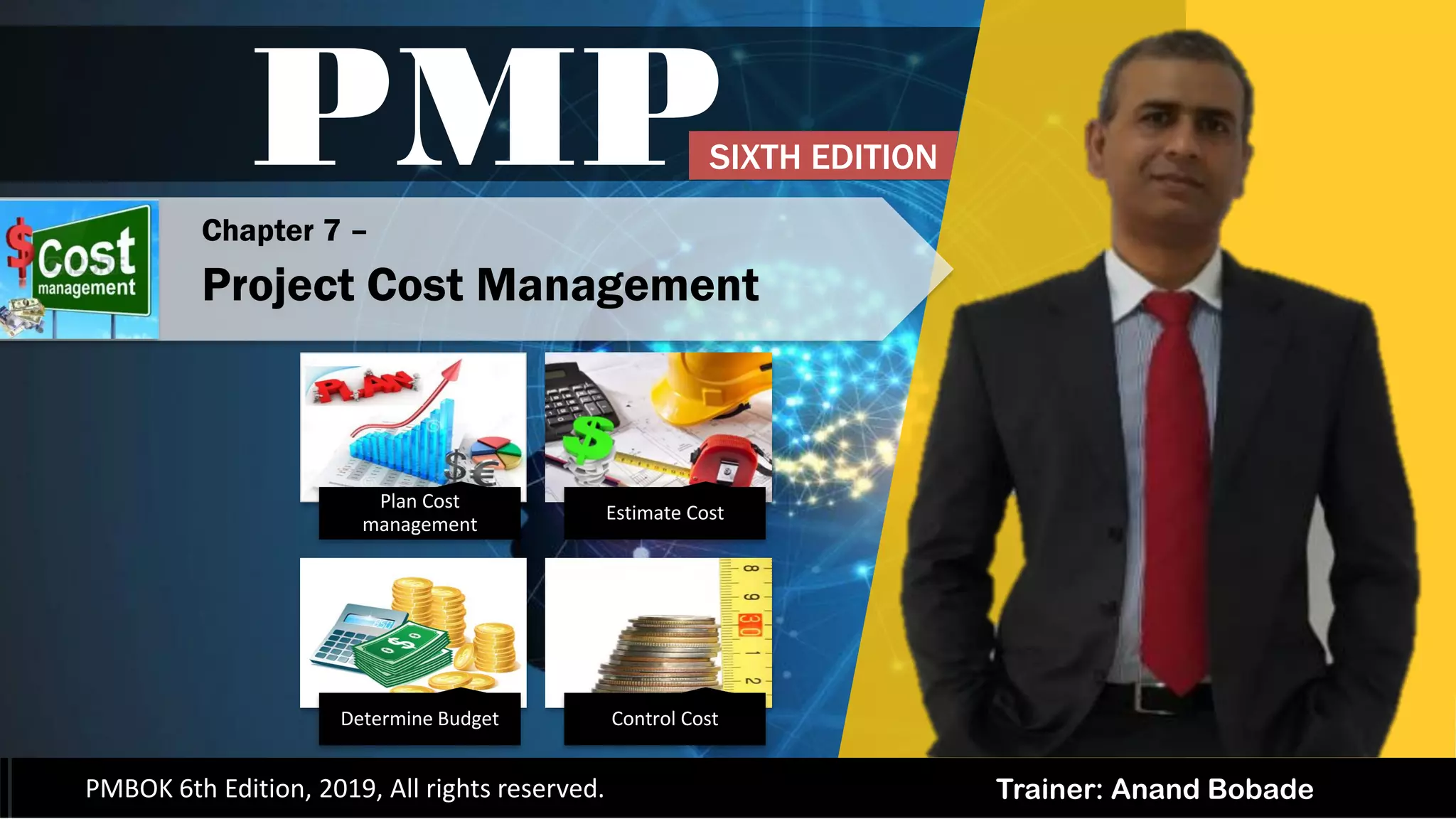

Trainer: Anand Bobade
PMP
PMBOK 6th Edition, 2019, All rights reserved.
Chapter 7 –
Project Cost Management
Plan Cost
management
Estimate Cost
Determine Budget Control Cost
SIXTH EDITION
By: Anand Bobade (nmbobade@gmail.com)PMBOK 6edition @ All rights reserved .
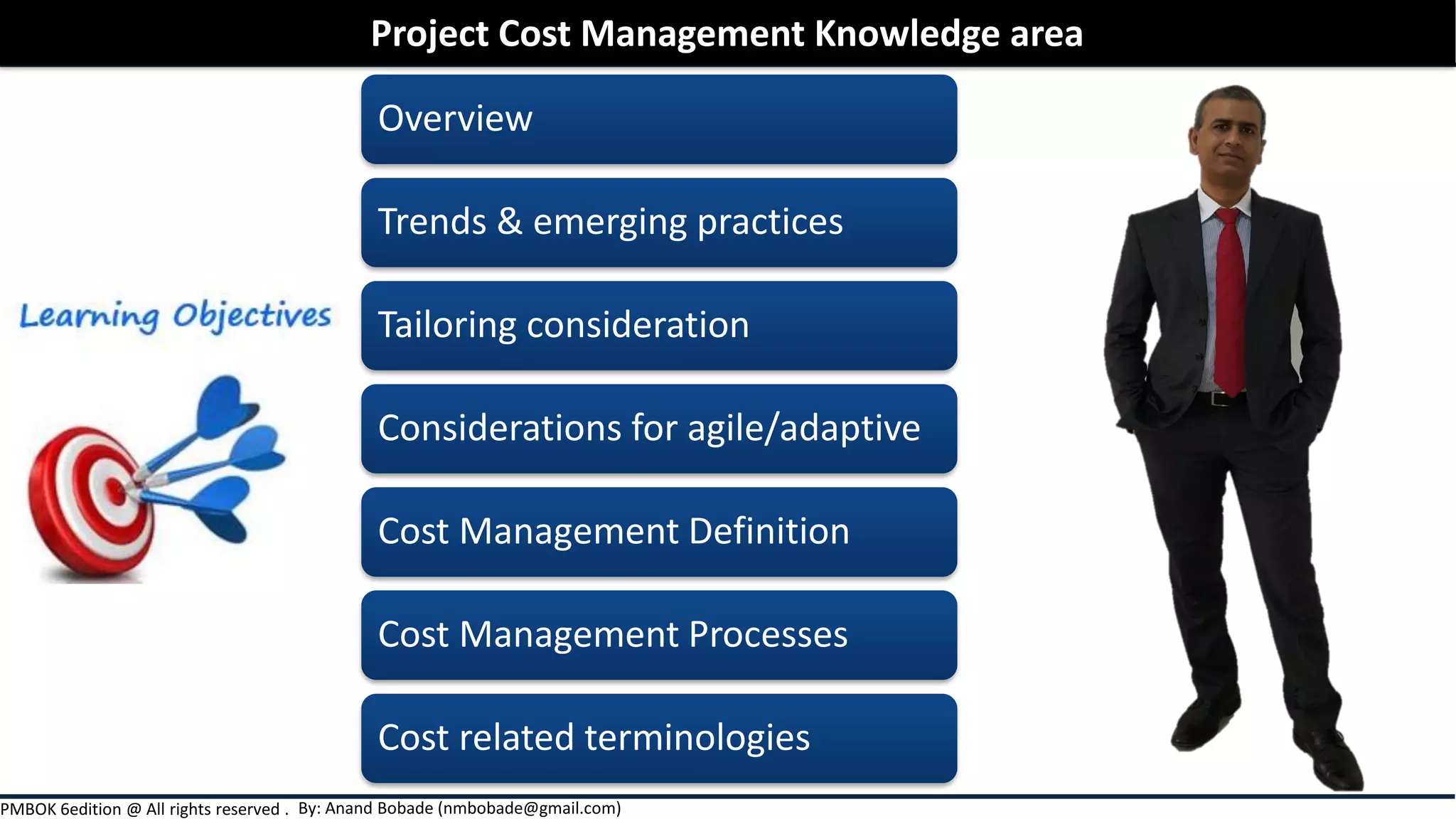
Overview
Trends & emerging practices
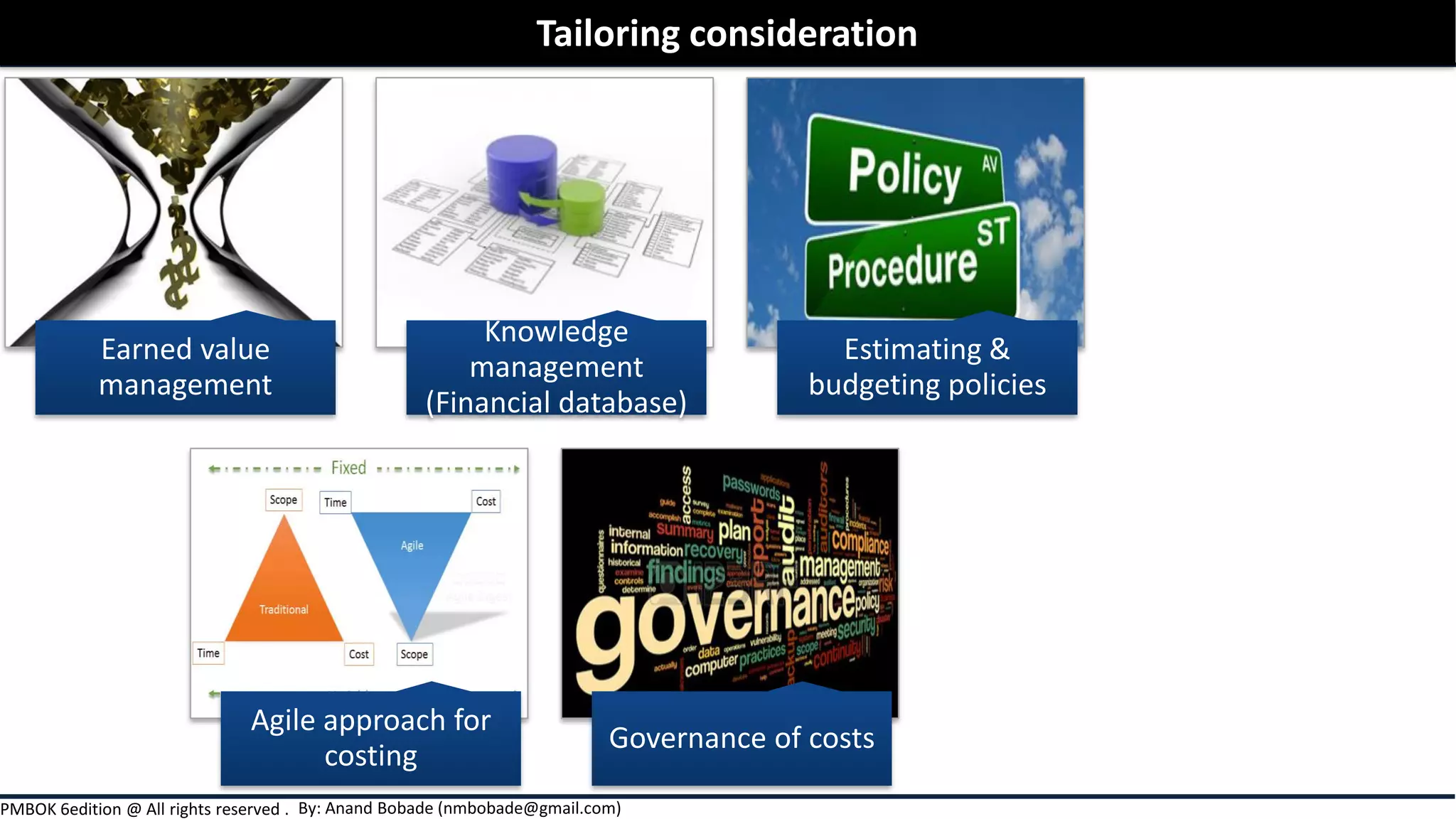
Tailoring consideration
Considerations for agile/adaptive
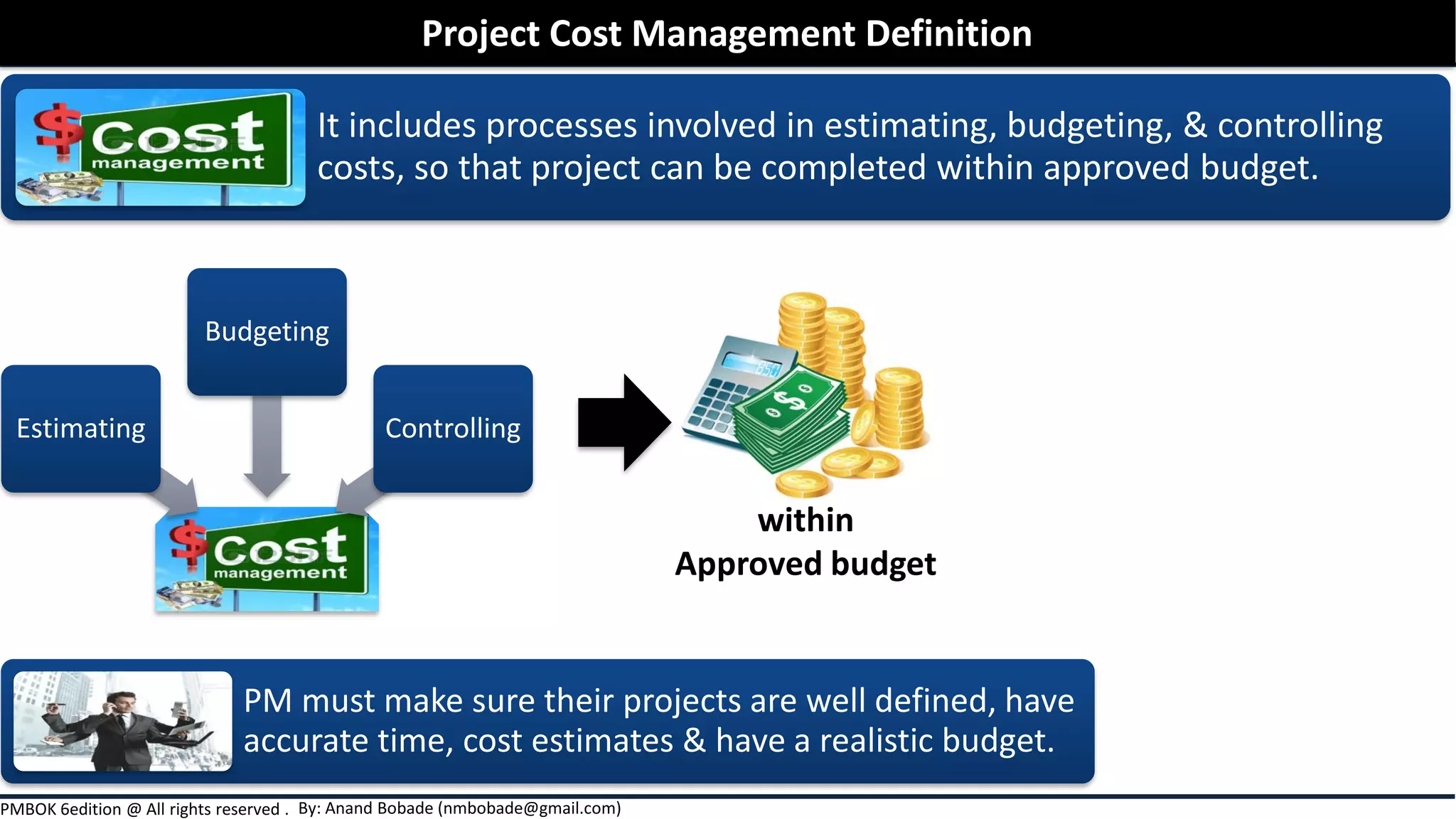
Cost Management Definition
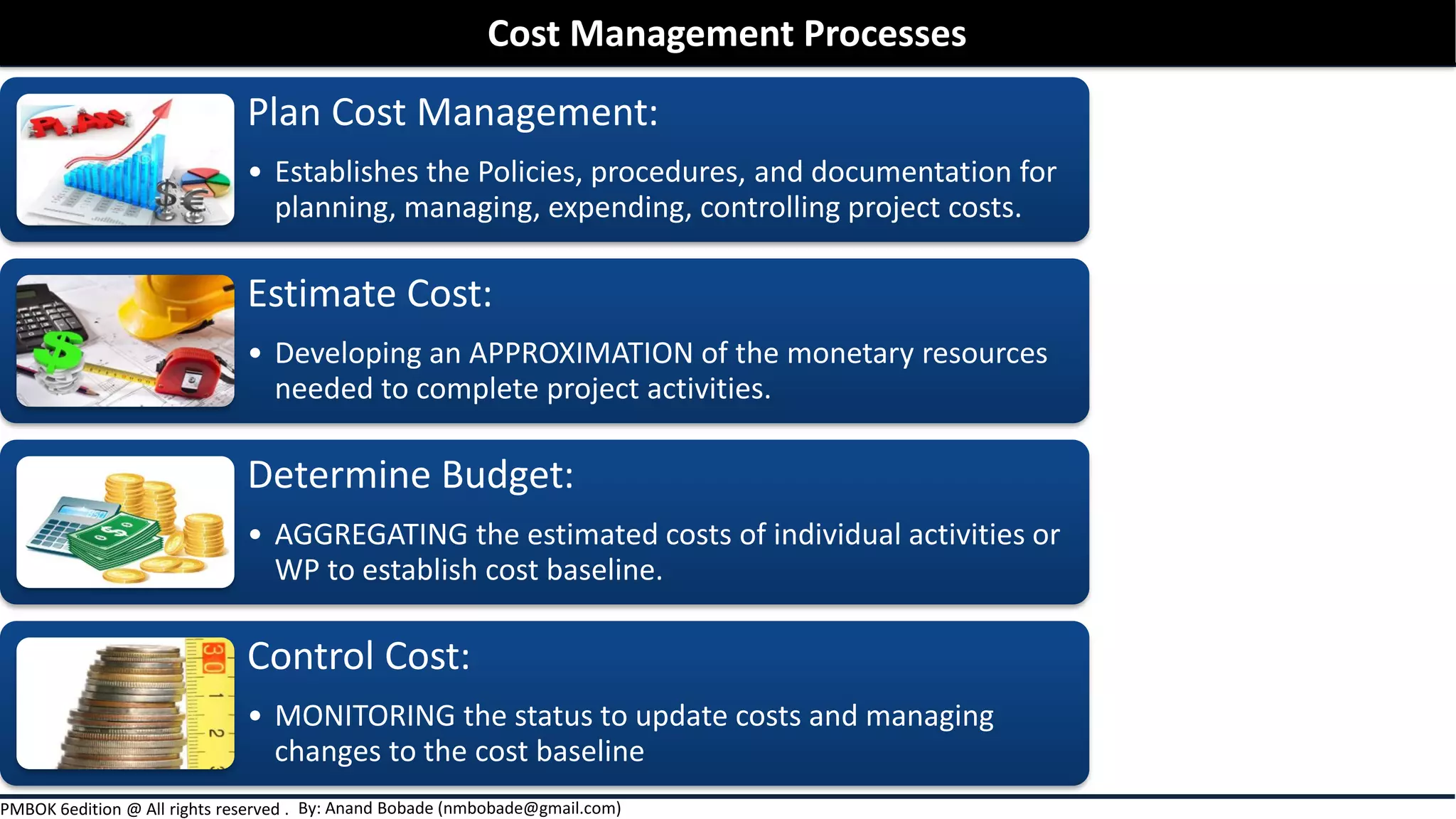
Cost Management Processes
Cost related terminologies
Project Cost Management Knowledge area
By: Anand Bobade (nmbobade@gmail.com)PMBOK 6edition @ All rights reserved .
Provide cost management framework.
Develop a cost estimates.
Finalize budget including contingency reserves.
Prepare cost baseline
Control project cost.
Introduction
By: Anand Bobade (nmbobade@gmail.com)PMBOK 6edition @ All rights reserved .
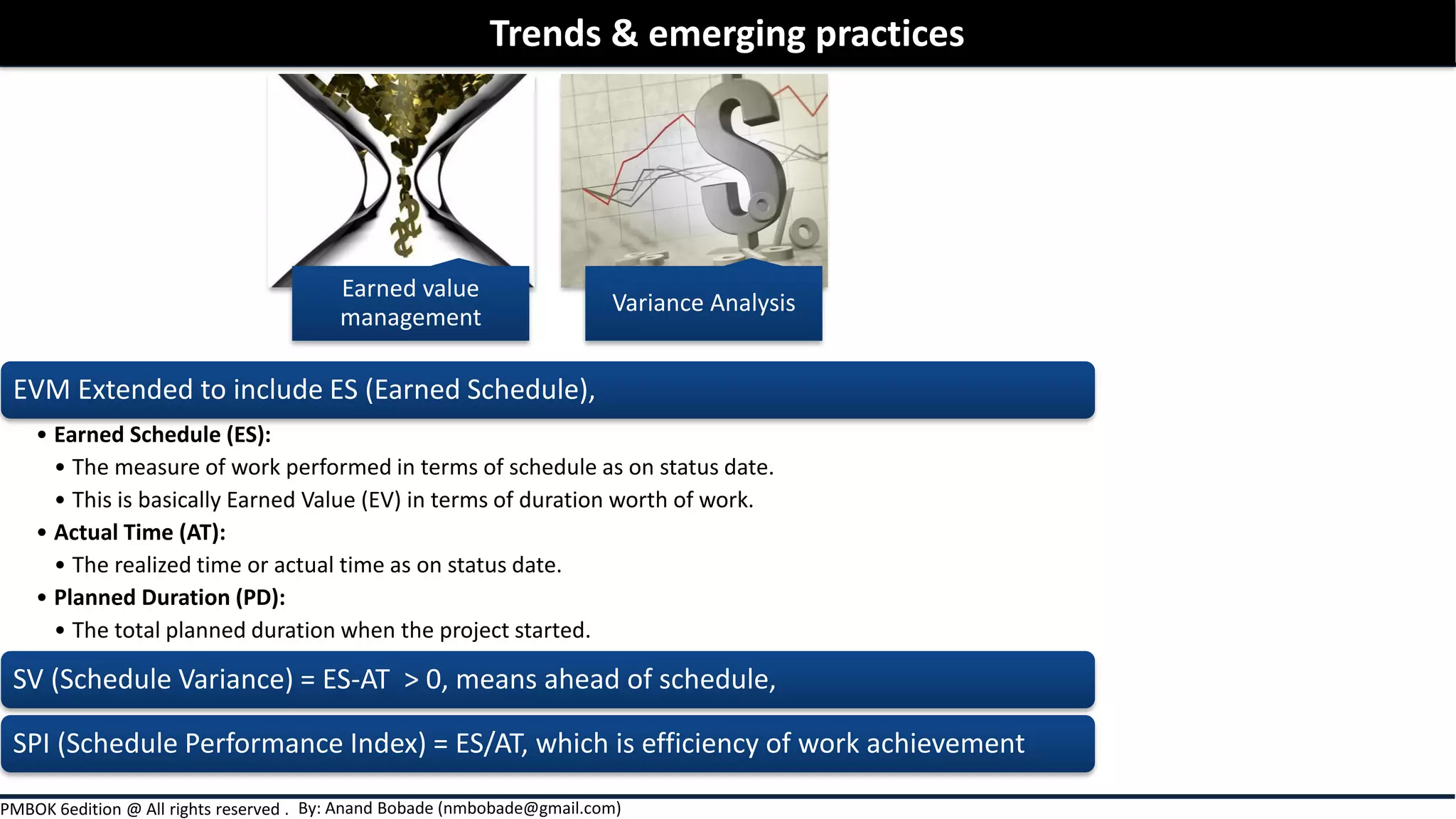
EVM Extended to include ES (Earned Schedule),
• Earned Schedule (ES):
• The measure of work performed in terms of schedule as on status date.
• This is basically Earned Value (EV) in terms of duration worth of work.
• Actual Time (AT):
• The realized time or actual time as on status date.
• Planned Duration (PD):
• The total planned duration when the project started.
SV (Schedule Variance) = ES-AT > 0, means ahead of schedule,
SPI (Schedule Performance Index) = ES/AT, which is efficiency of work achievement
Trends & emerging practices
Earned value
management
Variance Analysis
By: Anand Bobade (nmbobade@gmail.com)PMBOK 6edition @ All rights reserved .
Earned value
management
Knowledge
management
(Financial database)
Estimating &
budgeting policies
Agile approach for
costing
Governance of costs
Tailoring consideration
By: Anand Bobade (nmbobade@gmail.com)PMBOK 6edition @ All rights reserved .
Use lightweight estimation when scope is not finalized, for fast and
high level forecast of labor cost
Use detailed estimation for short term horizons
Strict budgeting for high variability projects will require frequent cost
adjustments
Considerations for agile/adaptive environments
By: Anand Bobade (nmbobade@gmail.com)PMBOK 6edition @ All rights reserved .
It includes processes involved in estimating, budgeting, & controlling
costs, so that project can be completed within approved budget.
Estimating
Budgeting
Controlling
Project Cost Management Definition
within
Approved budget
PM must make sure their projects are well defined, have
accurate time, cost estimates & have a realistic budget.
By: Anand Bobade (nmbobade@gmail.com)PMBOK 6edition @ All rights reserved .
Plan Cost Management:
• Establishes the Policies, procedures, and documentation for
planning, managing, expending, controlling project costs.
Estimate Cost:
• Developing an APPROXIMATION of the monetary resources
needed to complete project activities.
Determine Budget:
• AGGREGATING the estimated costs of individual activities or
WP to establish cost baseline.
Control Cost:
• MONITORING the status to update costs and managing
changes to the cost baseline
Cost Management Processes
By: Anand Bobade (nmbobade@gmail.com)PMBOK 6edition @ All rights reserved .
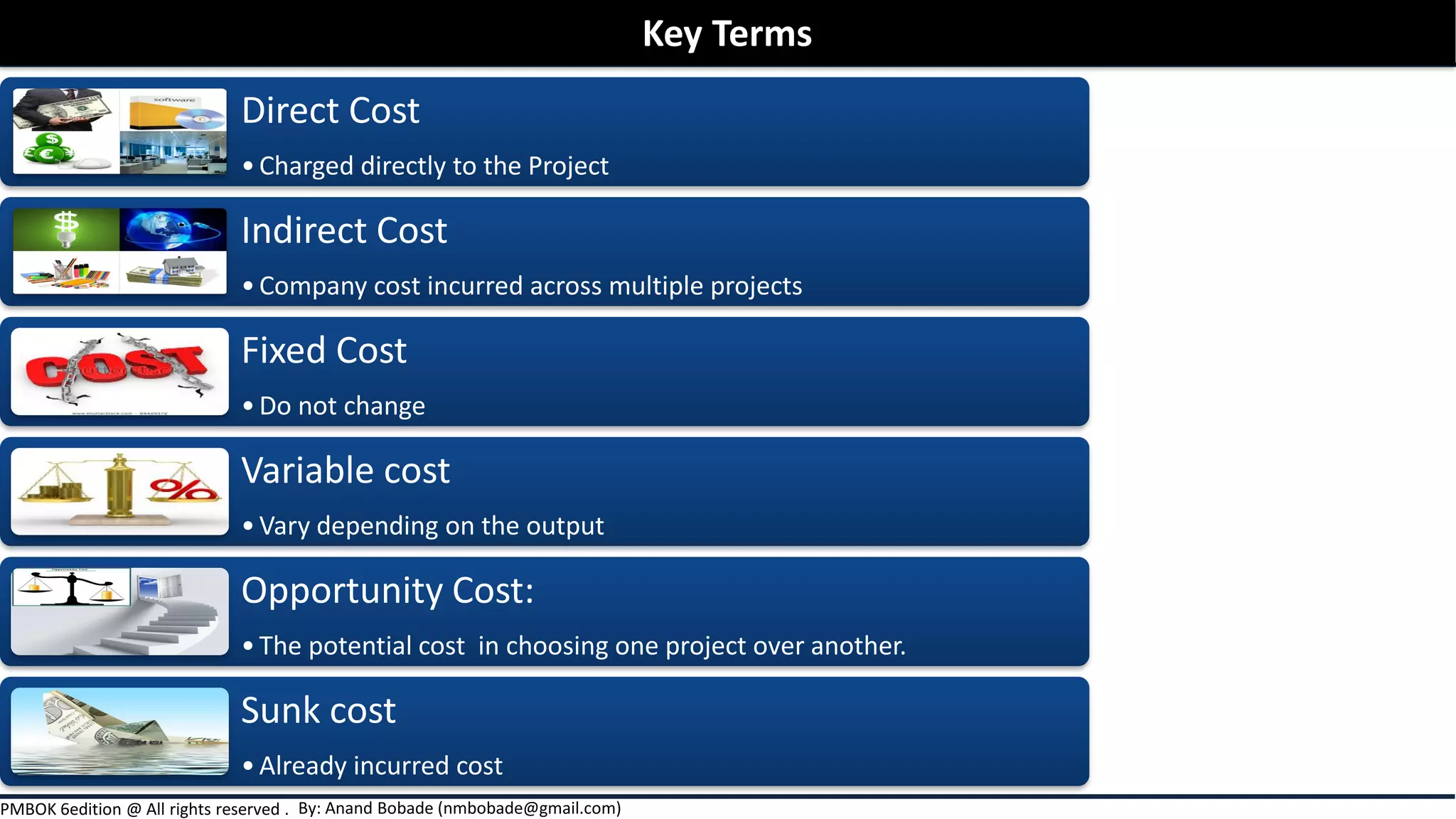
Direct Cost
•Charged directly to the Project
Indirect Cost
•Company cost incurred across multiple projects
Fixed Cost
•Do not change
Variable cost
•Vary depending on the output
Opportunity Cost:
•The potential cost in choosing one project over another.
Sunk cost
•Already incurred cost
Key Terms
By: Anand Bobade (nmbobade@gmail.com)PMBOK 6edition @ All rights reserved .
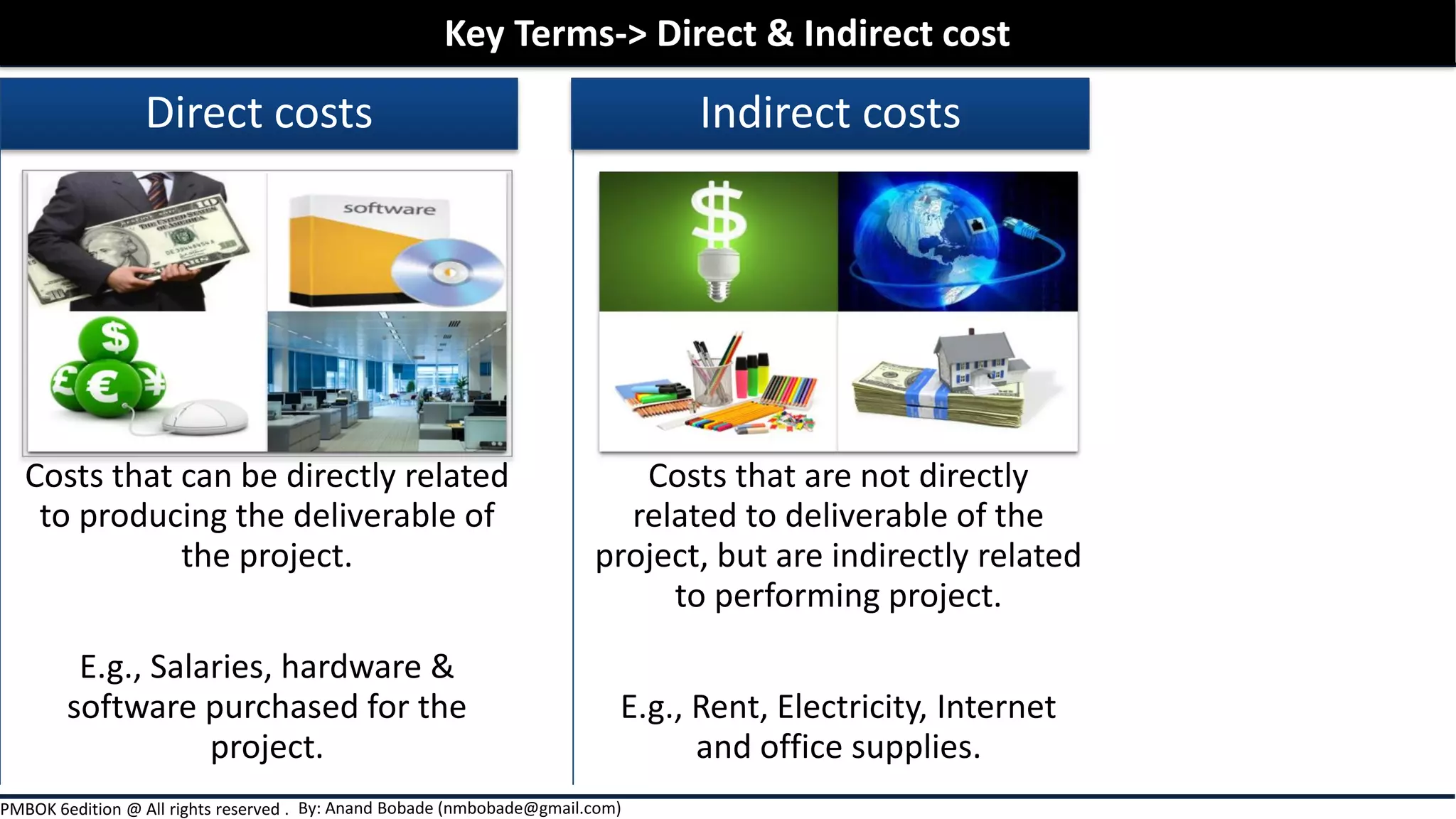
Costs that can be directly related
to producing the deliverable of
the project.
E.g., Salaries, hardware &
software purchased for the
project.
Direct costs
Costs that are not directly
related to deliverable of the
project, but are indirectly related
to performing project.
E.g., Rent, Electricity, Internet
and office supplies.
Indirect costs
Key Terms-> Direct & Indirect cost
By: Anand Bobade (nmbobade@gmail.com)PMBOK 6edition @ All rights reserved .
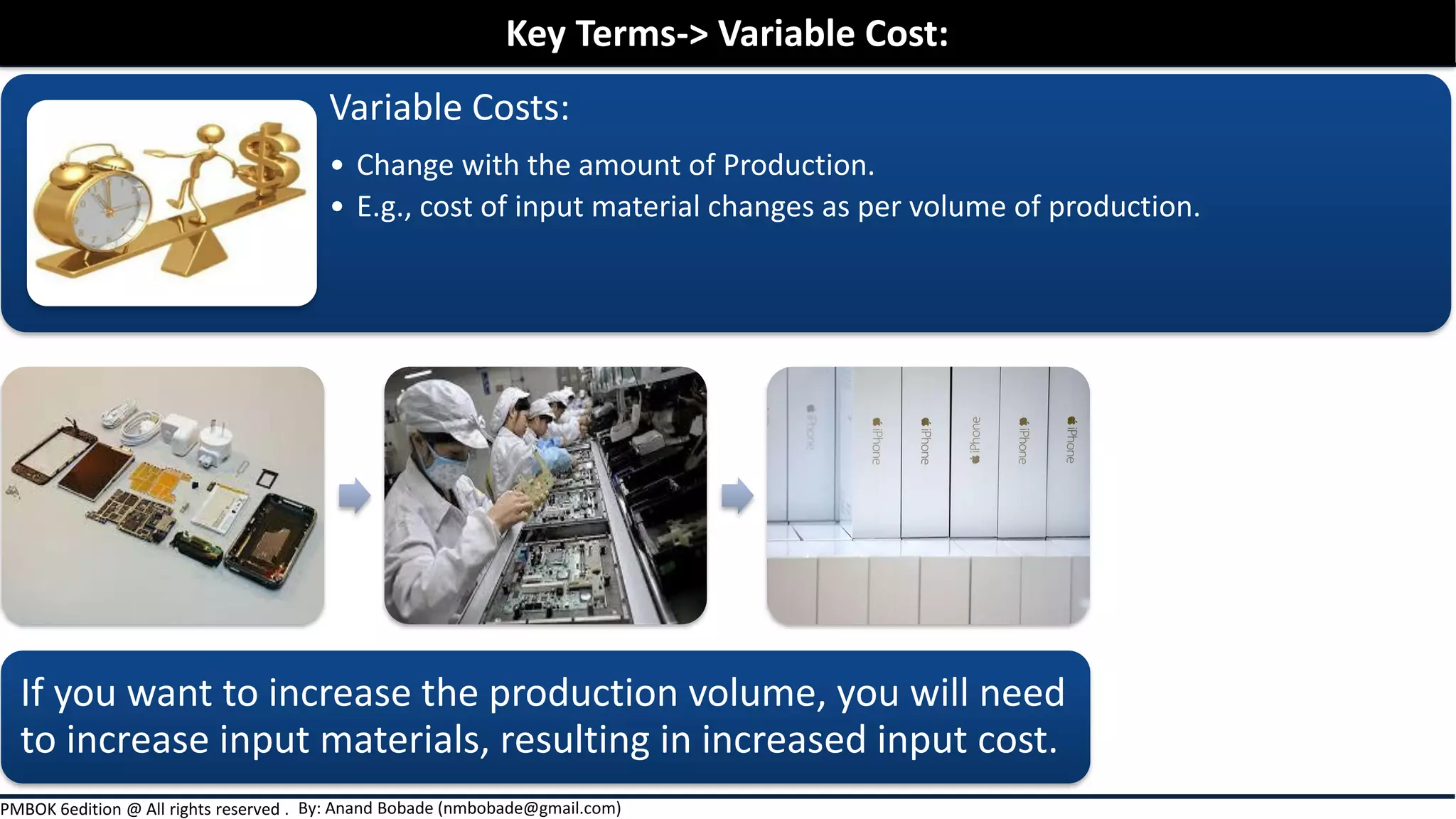
Variable Costs:
• Change with the amount of Production.
• E.g., cost of input material changes as per volume of production.
If you want to increase the production volume, you will need
to increase input materials, resulting in increased input cost.
Key Terms-> Variable Cost:
By: Anand Bobade (nmbobade@gmail.com)PMBOK 6edition @ All rights reserved .
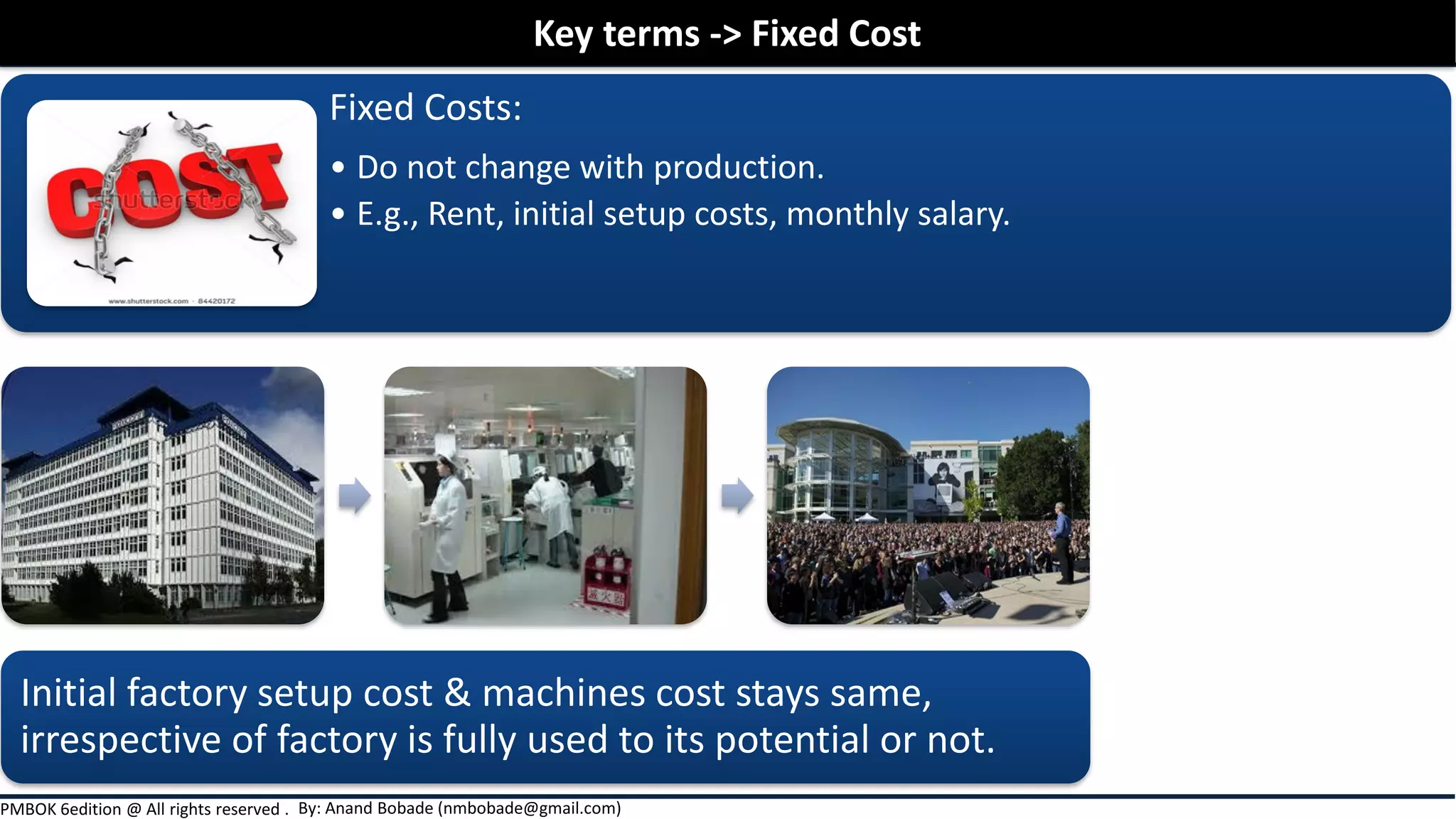
Fixed Costs:
• Do not change with production.
• E.g., Rent, initial setup costs, monthly salary.
Initial factory setup cost & machines cost stays same,
irrespective of factory is fully used to its potential or not.
Key terms -> Fixed Cost
By: Anand Bobade (nmbobade@gmail.com)PMBOK 6edition @ All rights reserved .
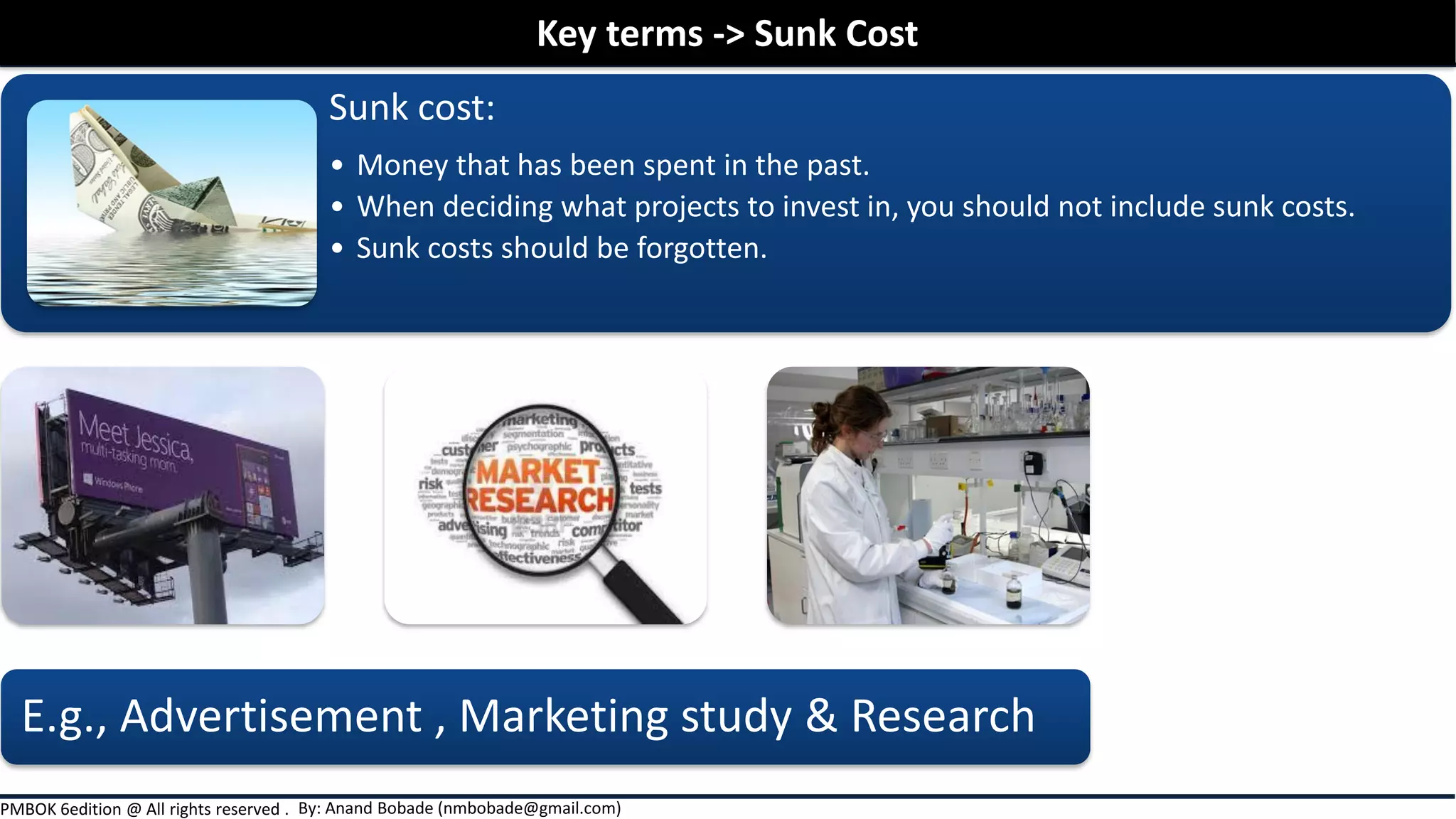
Sunk cost:
• Money that has been spent in the past.
• When deciding what projects to invest in, you should not include sunk costs.
• Sunk costs should be forgotten.
E.g., Advertisement , Marketing study & Research
Key terms -> Sunk Cost
By: Anand Bobade (nmbobade@gmail.com)PMBOK 6edition @ All rights reserved .
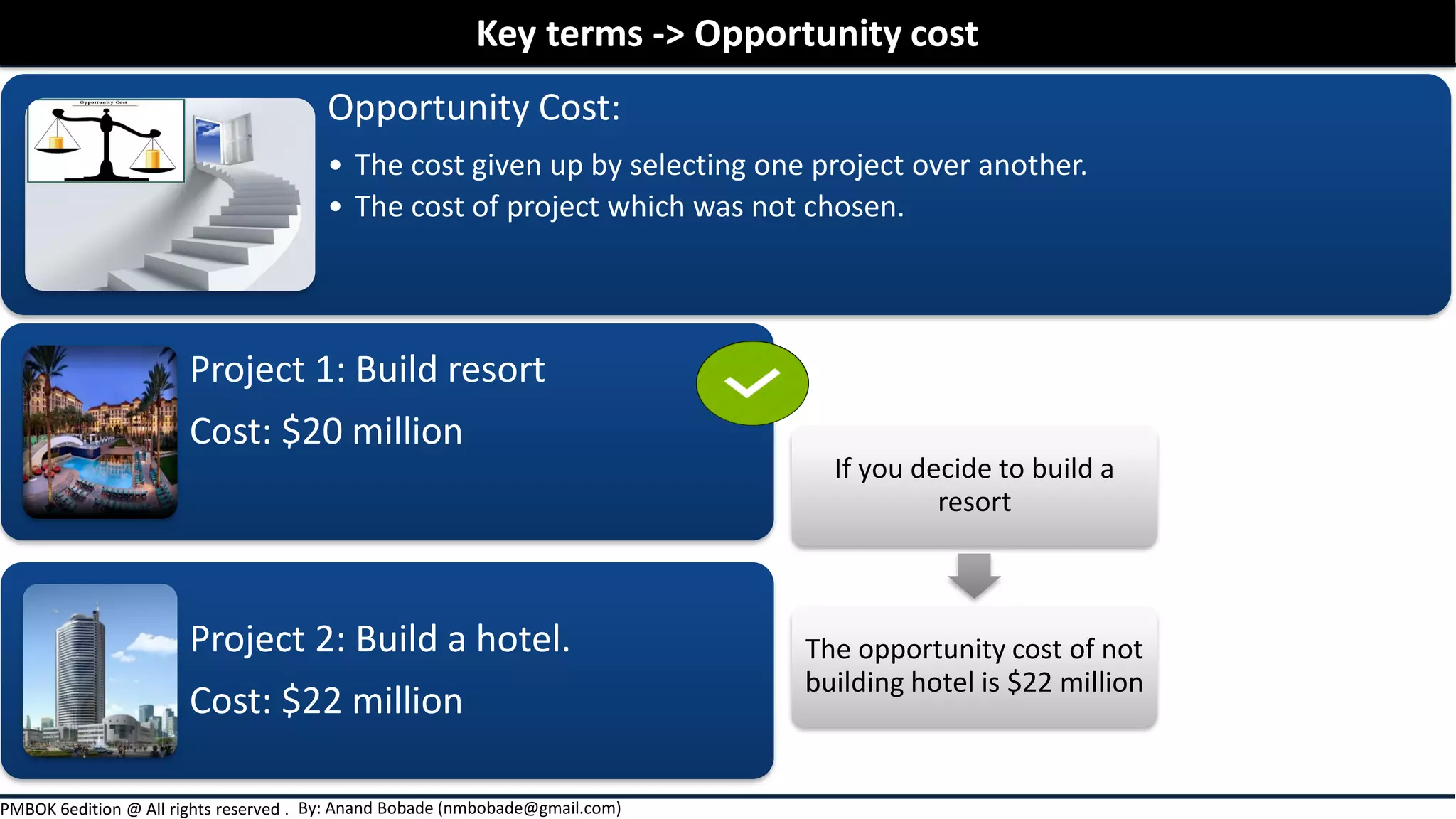
Opportunity Cost:
• The cost given up by selecting one project over another.
• The cost of project which was not chosen.
Key terms -> Opportunity cost
Project 1: Build resort
Cost: $20 million
Project 2: Build a hotel.
Cost: $22 million
If you decide to build a
resort
The opportunity cost of not
building hotel is $22 million
By: Anand Bobade (nmbobade@gmail.com)PMBOK 6edition @ All rights reserved .
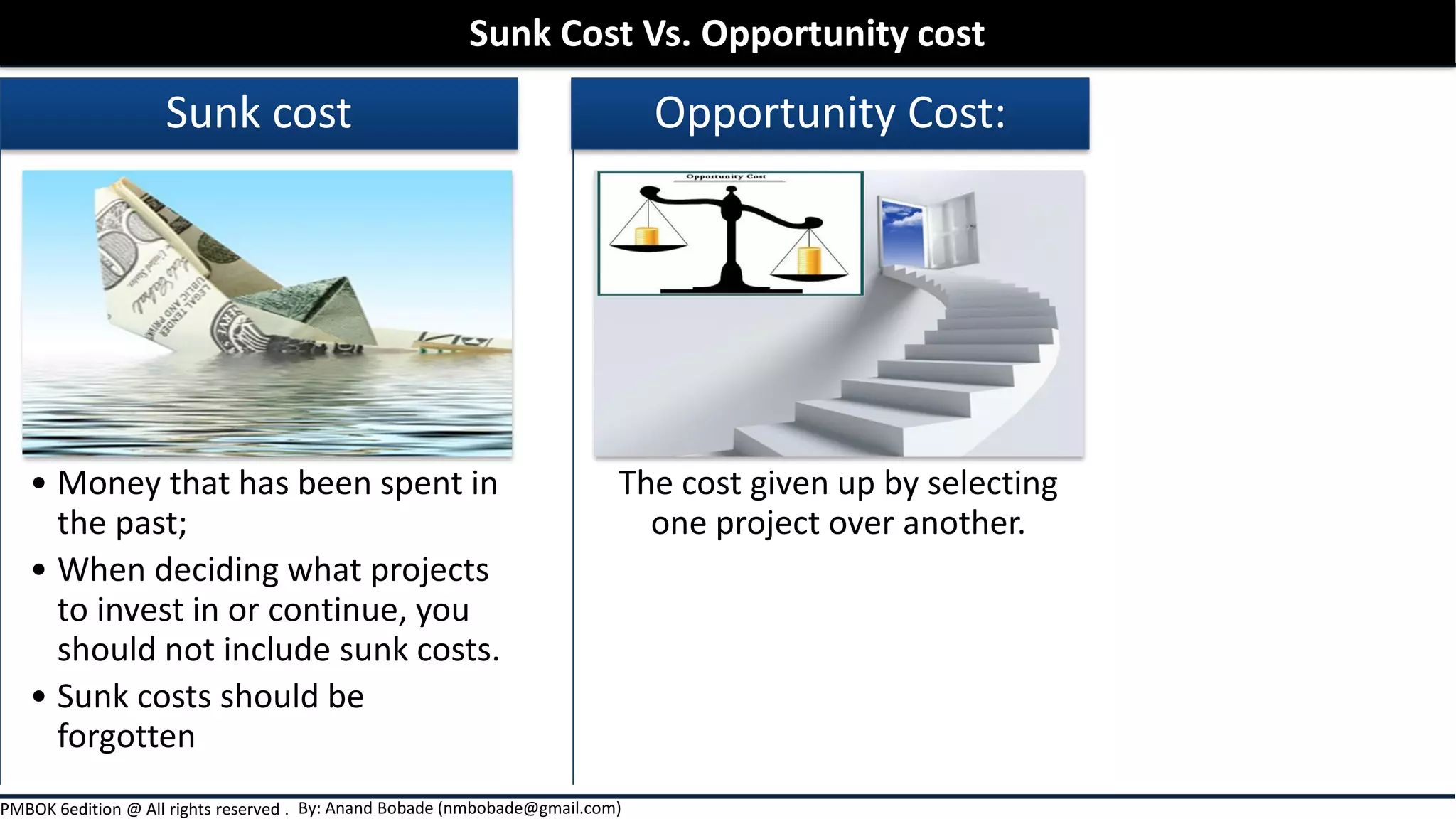
• Money that has been spent in
the past;
• When deciding what projects
to invest in or continue, you
should not include sunk costs.
• Sunk costs should be
forgotten
Sunk cost
The cost given up by selecting
one project over another.
Opportunity Cost:
Sunk Cost Vs. Opportunity cost
By: Anand Bobade (nmbobade@gmail.com)PMBOK 6edition @ All rights reserved .
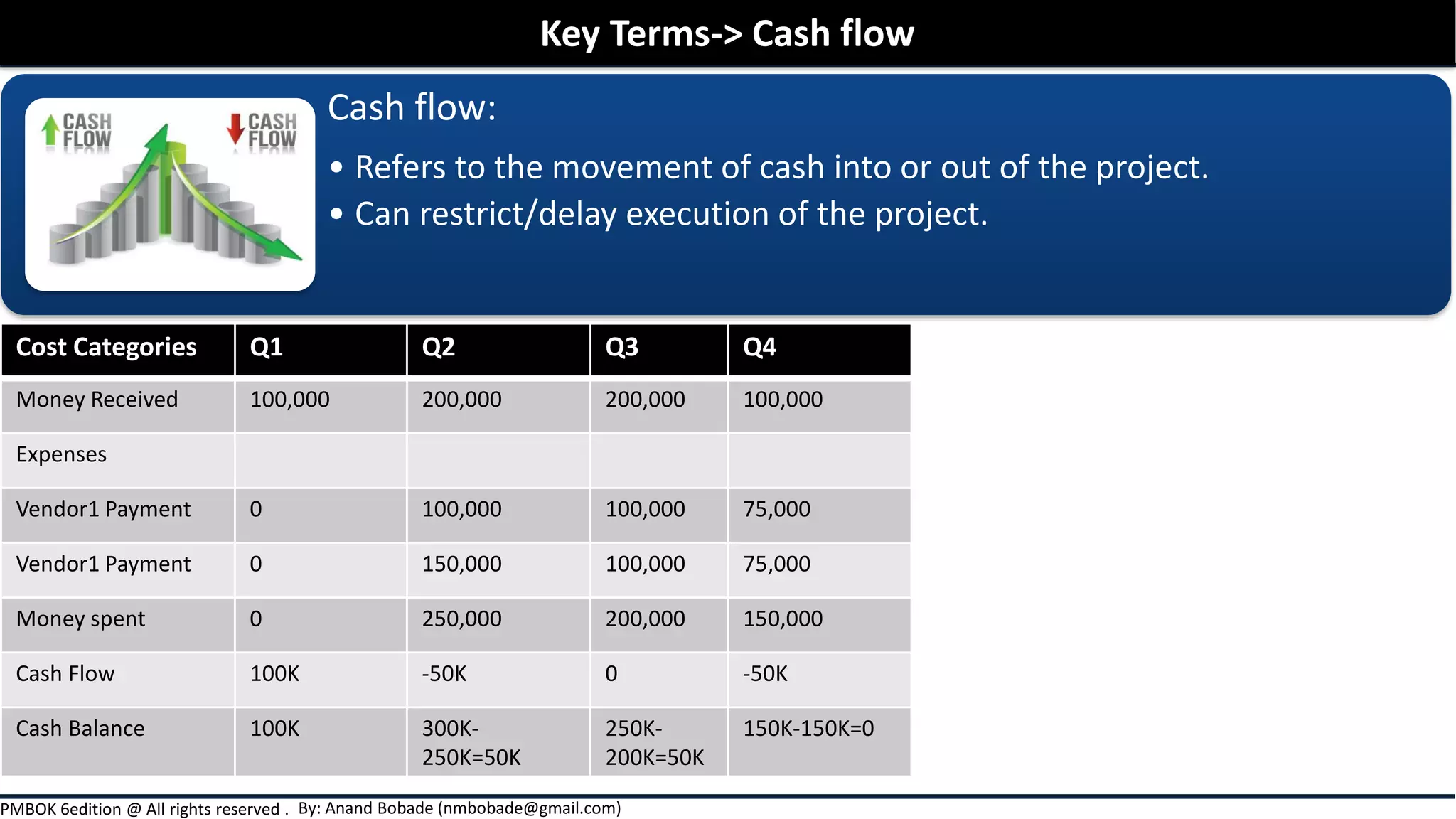
Cash flow:
• Refers to the movement of cash into or out of the project.
• Can restrict/delay execution of the project.
Cost Categories Q1 Q2 Q3 Q4
Money Received 100,000 200,000 200,000 100,000
Expenses
Vendor1 Payment 0 100,000 100,000 75,000
Vendor1 Payment 0 150,000 100,000 75,000
Money spent 0 250,000 200,000 150,000
Cash Flow 100K -50K 0 -50K
Cash Balance 100K 300K-
250K=50K
250K-
200K=50K
150K-150K=0
Key Terms-> Cash flow
By: Anand Bobade (nmbobade@gmail.com)PMBOK 6edition @ All rights reserved .

Chap 7.0 Project Cost Management Overview

  • 1.
    Trainer: Anand Bobade PMP PMBOK6th Edition, 2019, All rights reserved. Chapter 7 – Project Cost Management Plan Cost management Estimate Cost Determine Budget Control Cost SIXTH EDITION
  • 2.
    By: Anand Bobade(nmbobade@gmail.com)PMBOK 6edition @ All rights reserved . Overview Trends & emerging practices Tailoring consideration Considerations for agile/adaptive Cost Management Definition Cost Management Processes Cost related terminologies Project Cost Management Knowledge area
  • 3.
    By: Anand Bobade(nmbobade@gmail.com)PMBOK 6edition @ All rights reserved . Provide cost management framework. Develop a cost estimates. Finalize budget including contingency reserves. Prepare cost baseline Control project cost. Introduction
  • 4.
    By: Anand Bobade(nmbobade@gmail.com)PMBOK 6edition @ All rights reserved . EVM Extended to include ES (Earned Schedule), • Earned Schedule (ES): • The measure of work performed in terms of schedule as on status date. • This is basically Earned Value (EV) in terms of duration worth of work. • Actual Time (AT): • The realized time or actual time as on status date. • Planned Duration (PD): • The total planned duration when the project started. SV (Schedule Variance) = ES-AT > 0, means ahead of schedule, SPI (Schedule Performance Index) = ES/AT, which is efficiency of work achievement Trends & emerging practices Earned value management Variance Analysis
  • 5.
    By: Anand Bobade(nmbobade@gmail.com)PMBOK 6edition @ All rights reserved . Earned value management Knowledge management (Financial database) Estimating & budgeting policies Agile approach for costing Governance of costs Tailoring consideration
  • 6.
    By: Anand Bobade(nmbobade@gmail.com)PMBOK 6edition @ All rights reserved . Use lightweight estimation when scope is not finalized, for fast and high level forecast of labor cost Use detailed estimation for short term horizons Strict budgeting for high variability projects will require frequent cost adjustments Considerations for agile/adaptive environments
  • 7.
    By: Anand Bobade(nmbobade@gmail.com)PMBOK 6edition @ All rights reserved . It includes processes involved in estimating, budgeting, & controlling costs, so that project can be completed within approved budget. Estimating Budgeting Controlling Project Cost Management Definition within Approved budget PM must make sure their projects are well defined, have accurate time, cost estimates & have a realistic budget.
  • 8.
    By: Anand Bobade(nmbobade@gmail.com)PMBOK 6edition @ All rights reserved . Plan Cost Management: • Establishes the Policies, procedures, and documentation for planning, managing, expending, controlling project costs. Estimate Cost: • Developing an APPROXIMATION of the monetary resources needed to complete project activities. Determine Budget: • AGGREGATING the estimated costs of individual activities or WP to establish cost baseline. Control Cost: • MONITORING the status to update costs and managing changes to the cost baseline Cost Management Processes
  • 9.
    By: Anand Bobade(nmbobade@gmail.com)PMBOK 6edition @ All rights reserved . Direct Cost •Charged directly to the Project Indirect Cost •Company cost incurred across multiple projects Fixed Cost •Do not change Variable cost •Vary depending on the output Opportunity Cost: •The potential cost in choosing one project over another. Sunk cost •Already incurred cost Key Terms
  • 10.
    By: Anand Bobade(nmbobade@gmail.com)PMBOK 6edition @ All rights reserved . Costs that can be directly related to producing the deliverable of the project. E.g., Salaries, hardware & software purchased for the project. Direct costs Costs that are not directly related to deliverable of the project, but are indirectly related to performing project. E.g., Rent, Electricity, Internet and office supplies. Indirect costs Key Terms-> Direct & Indirect cost
  • 11.
    By: Anand Bobade(nmbobade@gmail.com)PMBOK 6edition @ All rights reserved . Variable Costs: • Change with the amount of Production. • E.g., cost of input material changes as per volume of production. If you want to increase the production volume, you will need to increase input materials, resulting in increased input cost. Key Terms-> Variable Cost:
  • 12.
    By: Anand Bobade(nmbobade@gmail.com)PMBOK 6edition @ All rights reserved . Fixed Costs: • Do not change with production. • E.g., Rent, initial setup costs, monthly salary. Initial factory setup cost & machines cost stays same, irrespective of factory is fully used to its potential or not. Key terms -> Fixed Cost
  • 13.
    By: Anand Bobade(nmbobade@gmail.com)PMBOK 6edition @ All rights reserved . Sunk cost: • Money that has been spent in the past. • When deciding what projects to invest in, you should not include sunk costs. • Sunk costs should be forgotten. E.g., Advertisement , Marketing study & Research Key terms -> Sunk Cost
  • 14.
    By: Anand Bobade(nmbobade@gmail.com)PMBOK 6edition @ All rights reserved . Opportunity Cost: • The cost given up by selecting one project over another. • The cost of project which was not chosen. Key terms -> Opportunity cost Project 1: Build resort Cost: $20 million Project 2: Build a hotel. Cost: $22 million If you decide to build a resort The opportunity cost of not building hotel is $22 million
  • 15.
    By: Anand Bobade(nmbobade@gmail.com)PMBOK 6edition @ All rights reserved . • Money that has been spent in the past; • When deciding what projects to invest in or continue, you should not include sunk costs. • Sunk costs should be forgotten Sunk cost The cost given up by selecting one project over another. Opportunity Cost: Sunk Cost Vs. Opportunity cost
  • 16.
    By: Anand Bobade(nmbobade@gmail.com)PMBOK 6edition @ All rights reserved . Cash flow: • Refers to the movement of cash into or out of the project. • Can restrict/delay execution of the project. Cost Categories Q1 Q2 Q3 Q4 Money Received 100,000 200,000 200,000 100,000 Expenses Vendor1 Payment 0 100,000 100,000 75,000 Vendor1 Payment 0 150,000 100,000 75,000 Money spent 0 250,000 200,000 150,000 Cash Flow 100K -50K 0 -50K Cash Balance 100K 300K- 250K=50K 250K- 200K=50K 150K-150K=0 Key Terms-> Cash flow
  • 17.
    By: Anand Bobade(nmbobade@gmail.com)PMBOK 6edition @ All rights reserved .