By: Anand Bobade (nmbobade@gmail.com)
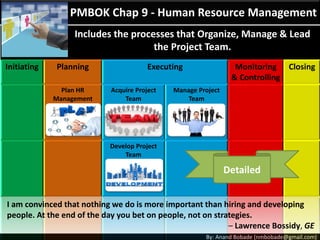
Plan HR management Acquire Project Team Develop Project Team Manage Project Team
PMBOK Chap 9 - Human Resource
Management
Learn Project Management & prepare for PMP exam:
• Learn visually
• Detailed coverage of all PMP concepts
• Sample Questions
ExecutingPlanning
By: Anand Bobade (nmbobade@gmail.com)
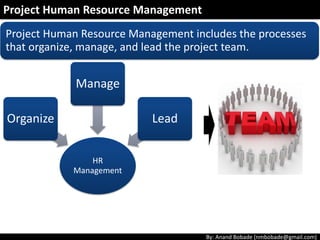
It includes processes that organize, manage & lead the project
team.
Chap 9: Project Human Resource Management -> Definition
HR
Management
Organize
Manage
Lead
By: Anand Bobade (nmbobade@gmail.com)
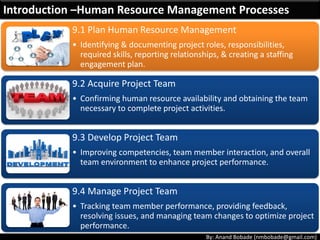
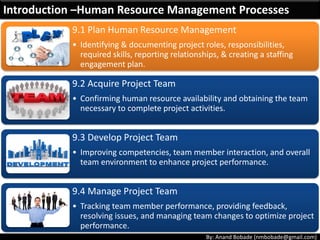
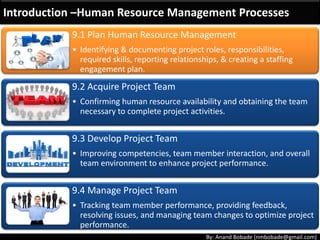
9.1 Plan Human Resource Management
• Identifying & documenting project roles, responsibilities,
required skills, reporting relationships, & creating a staffing
engagement plan.
9.2 Acquire Project Team
• Confirming human resource availability and obtaining the team
necessary to complete project activities.
9.3 Develop Project Team
• Improving competencies, team member interaction, and overall
team environment to enhance project performance.
9.4 Manage Project Team
• Tracking team member performance, providing feedback,
resolving issues, and managing team changes to optimize project
performance.
Chap 9: Project Human Resource Management-> Processes
By: Anand Bobade (nmbobade@gmail.com)By: Anand Bobade (nmbobade@gmail.com)
9.1 Plan Human Resource Management
Introduction
Plan Human Resource Management Definition
Plan Human Resource Management -> ITTO
Organizational Theory
Data flow diagram
Review
Self Assessment
By: Anand Bobade (nmbobade@gmail.com)
9.1 Plan Human Resource Management
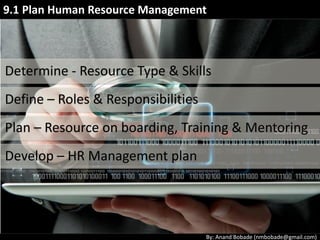
Determine - Resource Type & Skills.
Define – Roles & Responsibilities.
Plan – Resource on boarding, Training & Mentoring.
Develop – HR Management plan.
By: Anand Bobade (nmbobade@gmail.com)
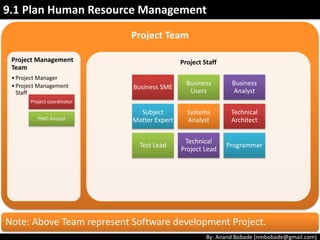
Project Team
Project Management
Team
•Project Manager
•Project Management
Staff
Project Staff
9.1 Plan Human Resource Management
Business SME
Business
Users
Business
Analyst
Subject
Matter Expert
Systems
Analyst
Technical
Architect
Test Lead
Technical
Project Lead
Programmer
Project coordinator
PMO Analyst
Note: Above Team represent Software development Project.
By: Anand Bobade (nmbobade@gmail.com)
9.1 Plan Human Resource Management
Who do you need?
What skills are required?
What are their responsibilities?
what's their engagement (start & end) dates?
Whom thy will report to?
How they will be trained?
How they will be rewarded?
By: Anand Bobade (nmbobade@gmail.com)
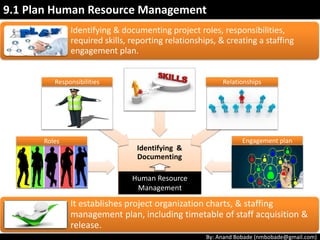
Identifying &
Documenting
Identifying & documenting project roles, responsibilities,
required skills, reporting relationships & creating a staffing
engagement plan.
It establishes staffing management plan, including timetable
of staff acquisition & release.
9.1 Plan Human Resource Management
Roles Engagement plan
Responsibilities Relationships
Human Resource
Management
By: Anand Bobade (nmbobade@gmail.com)
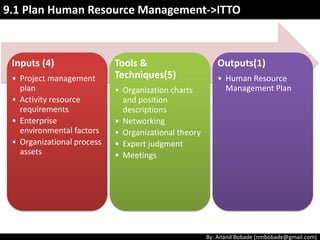
Inputs (4)
• Project management
plan
• Activity resource
requirements
• Enterprise
environmental factors
• Organizational process
assets
Tools &
Techniques(5)
• Organization charts
and position
descriptions
• Networking
• Organizational theory
• Expert judgment
• Meetings
Outputs(1)
• Human Resource
Management Plan
9.1 Plan Human Resource Management->ITTO
By: Anand Bobade (nmbobade@gmail.com)
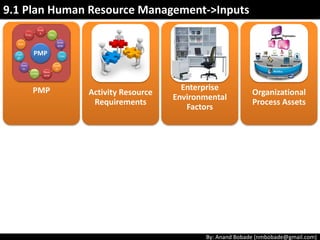
PMP Activity Resource
Requirements
Enterprise
Environmental
Factors
Organizational
Process Assets
9.1 Plan Human Resource Management->Inputs
By: Anand Bobade (nmbobade@gmail.com)
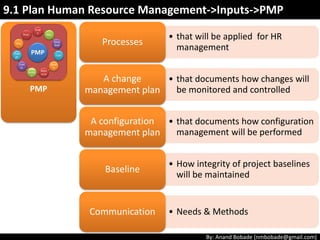
PMP
• that will be applied for HR
management.
Processes
• documents how changes will be
monitored and controlled.
A change
management plan
• documents how configuration
management will be performed.
A configuration
management plan
• How integrity of project
baselines will be maintained
Baseline
• Needs & MethodsCommunication
9.1 Plan Human Resource Management->Inputs->PMP
By: Anand Bobade (nmbobade@gmail.com)
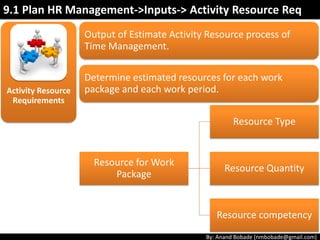
Activity Resource
Requirements
Output of Estimate Activity Resource process of
Time Management.
Provide resource estimate for each work.
Resource for Work
Package
Resource Type
Resource Quantity
Resource competency
9.1 Plan HR Management->Inputs-> Activity Resource Req
By: Anand Bobade (nmbobade@gmail.com)
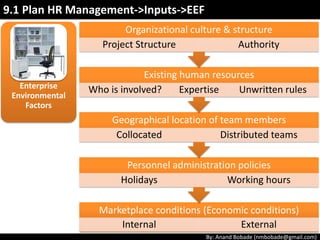
Enterprise
Environmental
Factors
Marketplace conditions (Economic conditions)
Internal External
Personnel administration policies
Holidays Working hours
Geographical location of team members
Collocated Distributed teams
Existing human resources
Who is involved? Expertise Unwritten rules
Organizational culture & structure
Project Structure Authority
9.1 Plan HR Management->Inputs->EEF
By: Anand Bobade (nmbobade@gmail.com)
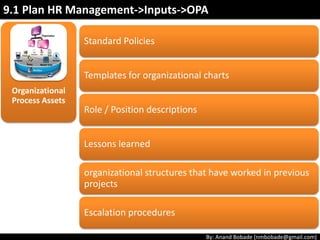
Organizational
Process Assets
Standard Policies.
Templates for organizational charts.
Role / Position descriptions.
Lessons learned.
Organizational structures that have worked in previous
projects.
Escalation procedures.
9.1 Plan HR Management->Inputs->OPA
By: Anand Bobade (nmbobade@gmail.com)
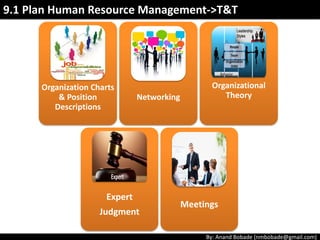
Organization Charts
& Position
Descriptions
Networking
Organizational
Theory
Expert
Judgment
Meetings
9.1 Plan Human Resource Management->T&T
By: Anand Bobade (nmbobade@gmail.com)
Organization Charts
& Position
Descriptions
9.1 Plan HR Manag’t->T&T->Org. Charts & Position Descriptions
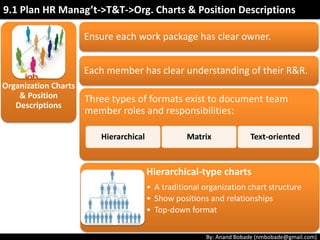
Formats used to document roles & responsibilities:
Hierarchical Matrix Text-oriented
Graphically depicts project team members & their
interrelationships for a project.
Ensure each work package has clear owner & each
member has clear Roles & Responsibilities.
By: Anand Bobade (nmbobade@gmail.com)
Organization Charts
& Position
Descriptions
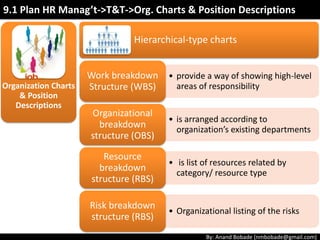
• OBS is arranged according to
organization’s existing
departments.
Organizational
breakdown
structure (OBS)
• RBS is list of resources
related by category/
resource type.
Resource
breakdown
structure (RBS)
9.1 Plan HR Manag’t->T&T->Org. Charts & Position Descriptions
Hierarchical-type charts
• A traditional organization chart structure.
• Show positions and relationships.
By: Anand Bobade (nmbobade@gmail.com)
Organization Charts
& Position
Descriptions
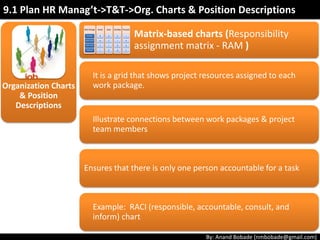
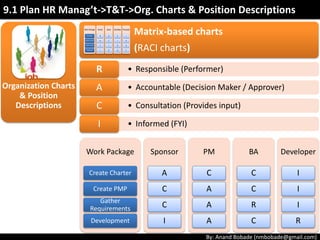
Matrix-based charts (Responsibility
assignment matrix - RAM )
Shows project resources assigned to each work package.
Illustrate connections between work packages & project
team members.
Ensures that, there is only one person accountable for a task.
E.g., RACI (responsible, accountable, consult, inform) chart.
9.1 Plan HR Manag’t->T&T->Org. Charts & Position Descriptions
By: Anand Bobade (nmbobade@gmail.com)
Organization Charts
& Position
Descriptions
Matrix-based charts
(RACI charts)
9.1 Plan HR Manag’t->T&T->Org. Charts & Position Descriptions
Work Package
Create Charter
Create PMP
Gather
Requirements
Development
Sponsor
R
A
C
I
PM
C
R
A
A
BA
C
C
R
C
Developer
I
I
I
R
• Responsible (Performer)R
• Accountable (Decision Maker / Approver)A
• Consultation (Provides input)C
• Informed (FYI)I
By: Anand Bobade (nmbobade@gmail.com)
Organization Charts
& Position
Descriptions
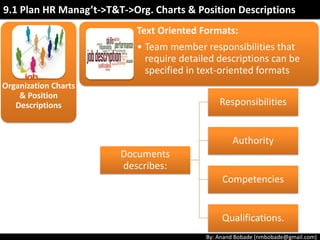
Text Oriented Formats:
• Responsibilities descriptions are
documented in text-oriented formats.
Documents describes:
Responsibilities
Authority
Competencies
Qualifications.
9.1 Plan HR Manag’t->T&T->Org. Charts & Position Descriptions
By: Anand Bobade (nmbobade@gmail.com)
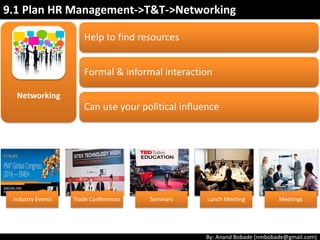
Networking
Establishing connections & relationships with other
people from the same or other organizations.
Industry Events Trade Conferences Seminars Lunch Meeting Meetings
9.1 Plan HR Management->T&T->Networking
Help to find
resources.
Formal &
informal
interaction.
Can use your
political
influence.
By: Anand Bobade (nmbobade@gmail.com)
Organizational
Theory
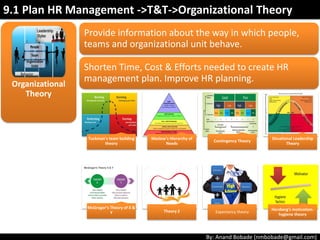
Provide information about the way in which people,
teams & organizational behave.
Shorten Time, Cost & Efforts needed to create HR
management plan. Improve HR planning.
9.1 Plan HR Management ->T&T->Organizational Theory
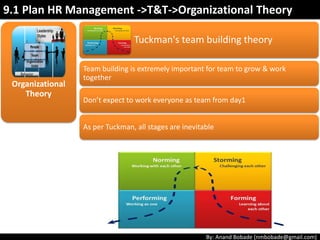
Tuckman's team building
theory
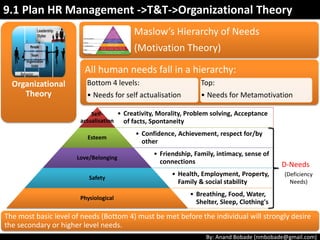
Maslow’s Hierarchy of
Needs
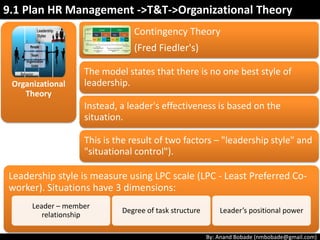
Contingency Theory
Situational Leadership
Theory
McGregor’s Theory of X &
Y Theory Z Expectancy theory
Herzberg's motivation-
hygiene theory
By: Anand Bobade (nmbobade@gmail.com)
Organizational
Theory
9.1 Plan HR Management ->T&T->Organizational Theory
Extremely important for team to grow & work together.
Don’t expect everyone to work as team from day1.
As per Tuckman, all stages are inevitable.
Tuckman's team building theory
By: Anand Bobade (nmbobade@gmail.com)
Organizational
Theory
Tuckman's team building theory
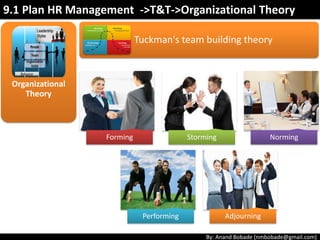
Forming Storming Norming
Performing Adjourning
9.1 Plan HR Management ->T&T->Organizational Theory
By: Anand Bobade (nmbobade@gmail.com)
Organizational
Theory
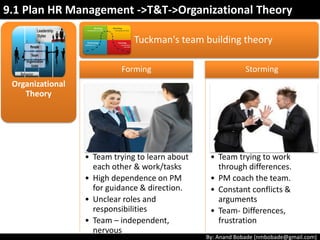
• Team trying to learn about
each other & their tasks.
• High dependence on PM
for guidance & direction.
• Unclear roles and
responsibilities
• Team – independent,
nervous
Forming
• Team trying to work
through differences.
• PM coach the team.
• Constant conflicts &
arguments
• Team- Differences,
frustration
Storming
9.1 Plan HR Management ->T&T->Organizational Theory
Tuckman's team building theory
By: Anand Bobade (nmbobade@gmail.com)
Organizational
Theory
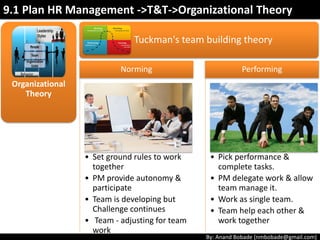
• Set ground rules to work
together.
• PM provide autonomy &
participate .
• Team is developing but
Challenge continues.
• Team - adjusting for team
work.
Norming
• Pick performance &
complete tasks.
• PM delegate work & allow
team manage it.
• Work as single team.
• Team help each other &
work together.
Performing
9.1 Plan HR Management ->T&T->Organizational Theory
Tuckman's team building theory
By: Anand Bobade (nmbobade@gmail.com)
Organizational
Theory
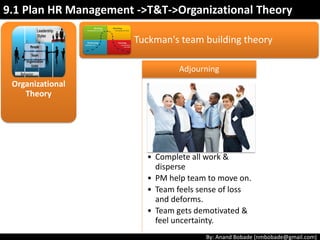
• Complete all work &
disperse.
• PM help team to move on.
• Team feels sense of loss and
deforms.
• Team gets demotivated &
feel uncertainty.
Adjourning
9.1 Plan HR Management ->T&T->Organizational Theory
Tuckman's team building theory
By: Anand Bobade (nmbobade@gmail.com)
Organizational
Theory
Maslow’s Hierarchy of Needs
(Motivation Theory)
9.1 Plan HR Management ->T&T->Organizational Theory
All human needs fall in a hierarchy:
Bottom 4 levels:
• Needs for self actualisation
Top:
• Needs for Metamotivation
• Creativity, Morality, Problem solving, Acceptance
of facts, Spontaneity
Self-
actualisation
• Confidence, Achievement, respect for/by
other
Esteem
• Friendship, Family, intimacy, sense of
connections
Love/Belonging
• Health, Employment, Property,
Family & social stability
Safety
• Breathing, Food, Water,
Shelter, Sleep, Clothing's
Physiological
D-Needs
(Deficiency
Needs)
The most basic level of needs (Bottom 4) must be met before the individual will strongly desire
the secondary or higher level needs.
By: Anand Bobade (nmbobade@gmail.com)
Organizational
Theory
Contingency Theory (Fred Fiedler's)
9.1 Plan HR Management ->T&T->Organizational Theory
Believes that there is no one best style of leadership.
Instead, a leader's effectiveness is based on situation.
Two factors – "leadership style" & "situational control".
Situations have 3 dimensions:
Leader & member
relationship
Degree of task structure
Leader’s positional
power
• LPC - Least Preferred Co-
worker
Leadership style is measure
using LPC scale
By: Anand Bobade (nmbobade@gmail.com)
Organizational
Theory
9.1 Plan HR Management ->T&T->Organizational Theory
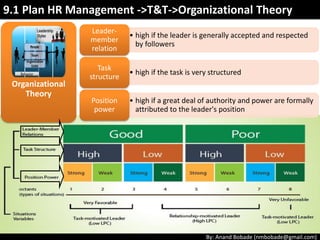
• High, if the leader is generally accepted & respected.
Leader-
member
relation
• High, if the task is very structured.
Task
structure
• High, if authority & power are attributed to leader's
position.
Position
power
By: Anand Bobade (nmbobade@gmail.com)
Organizational
Theory
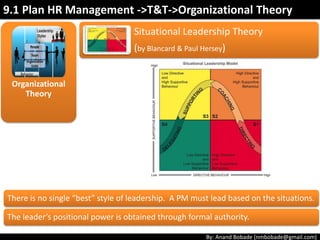
Situational Leadership Theory
(by Blancard & Paul Hersey)
9.1 Plan HR Management ->T&T->Organizational Theory
There is no single “best” style of leadership. A PM must lead based on the situations.
The leader’s positional power is obtained through formal authority.
By: Anand Bobade (nmbobade@gmail.com)
Organizational
Theory
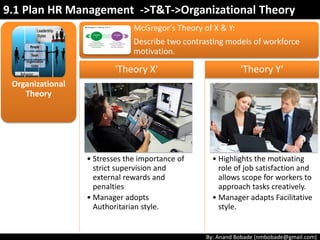
McGregor’s Theory of X & Y:
Describe two contrasting models of workforce
motivation.
• Stresses importance of
strict supervision.
• External rewards &
penalties.
• Manager adopts
Authoritarian style.
'Theory X'
• Highlights motivating role of
job satisfaction.
• Allows workers to approach
tasks creatively.
• Manager adapts Facilitative
style.
'Theory Y‘
9.1 Plan HR Management ->T&T->Organizational Theory
By: Anand Bobade (nmbobade@gmail.com)
Organizational
Theory
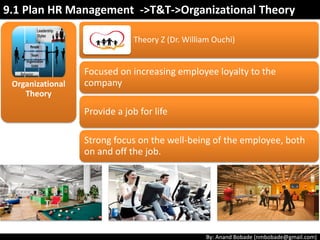
Theory Z (Dr. William Ouchi)
Focused on increasing employee loyalty to company.
Strong focus on well-being of employee, both on and
off the job.
Provide a job for life.
9.1 Plan HR Management ->T&T->Organizational Theory
By: Anand Bobade (nmbobade@gmail.com)
Organizational
Theory
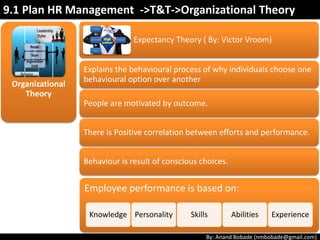
Expectancy Theory ( By: Victor Vroom)
Explains the behavioural process of “Why individuals choose
one behavioural option over another”.
People are motivated by outcome.
There is Positive correlation between efforts & performance.
Behaviour is result of conscious choices.
9.1 Plan HR Management ->T&T->Organizational Theory
Employee performance is based on:
Knowledge Personality Skills Abilities Experience
By: Anand Bobade (nmbobade@gmail.com)
Organizational
Theory
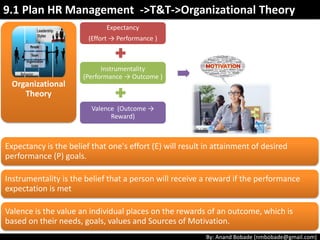
9.1 Plan HR Management ->T&T->Organizational Theory
Expectancy
(Effort → Performance )
Instrumentality
(Performance → Outcome )
Valence (Outcome →
Reward)
• Belief that one's effort (E) will result in attainment of desired
performance (P) goals.
Expectancy:
• Belief that a person will receive a reward if the performance
expectation is met.
Instrumentality:
• Value an individual places on rewards of an outcome, which
is based on their needs, goals, values & motivation sources.
Valence:
By: Anand Bobade (nmbobade@gmail.com)
Organizational
Theory
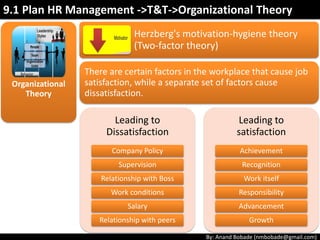
Herzberg's motivation-hygiene theory
(Two-factor theory)
There are certain factors in the workplace that cause job
satisfaction, while a separate set of factors cause
dissatisfaction.
9.1 Plan HR Management ->T&T->Organizational Theory
Absence lead to
dissatisfaction
Company Policy
Supervision
Relationship with Boss
Work conditions
Salary
Relationship with peers
Factors that lead to
satisfaction
Achievement
Recognition
Work itself
Responsibility
Advancement
Growth
Presence
doesn't lead
to satisfaction
By: Anand Bobade (nmbobade@gmail.com)
HR Management
Plan
9.1 Plan Human Resource Management->Output
By: Anand Bobade (nmbobade@gmail.com)
HR Management
Plan
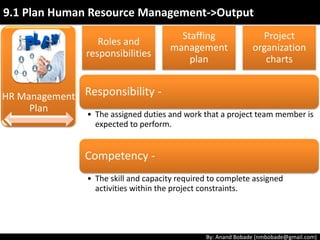
How roles & responsibilities, reporting relationships,
& staff management will be addressed & structured.
HR
Management
Plan
Roles and
responsibilities
Project
organization
charts
Staffing
management
plan
9.1 Plan Human Resource Management->Output
Roles & Responsibilities:
Role Responsibility Competency Authority
By: Anand Bobade (nmbobade@gmail.com)
HR Management
Plan
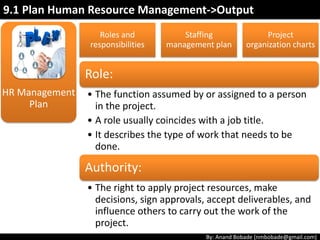
• Function to be performed by a project team member.
E.g., Testing.
Role:
• Specific work a member is expected to perform as part
of the project. E.g., Test Module A.
Responsibility (Duties):
• The skill and capacity required to complete assigned
activities within the project constraints.
Competency:
• Right to apply resources, make decisions, and sign
approvals. Authority should match individual
responsibilities.
Authority
9.1 Plan Human Resource Management->Output
By: Anand Bobade (nmbobade@gmail.com)
HR Management
Plan
9.1 Plan Human Resource Management->Output
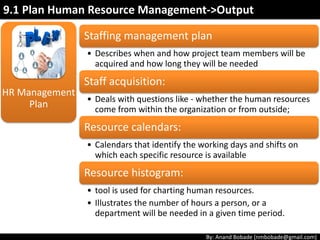
Staffing management plan:
• Describes when and how project team
members will be acquired and how long
they will be needed.
• Acquire within the organization or from outside
Staff acquisition:
• Identify working days & shifts on which each specific
resource is available.
Resource calendars:
• Illustrates number of hours a person, or a
department will be needed in a given time period.
Resource histogram:
By: Anand Bobade (nmbobade@gmail.com)
HR Management
Plan
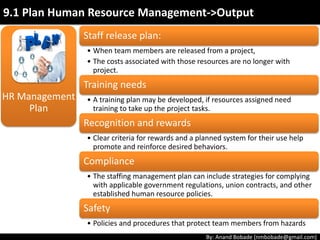
• When & how team members are released from a project.
• Costs associated with those resources are no longer with
project.
Release plan:
• Develop training plan, if resources assigned need training to
take up the project tasks.
Training needs
• Clear criteria for rewards and a planned system for their
use.
Recognition and rewards
• Strategies for complying with applicable government
regulations, union contracts & HR policies.
Compliance
• Policies and procedures that protect team members from
hazards
Safety
9.1 Plan Human Resource Management->Output
By: Anand Bobade (nmbobade@gmail.com)
HR Management
Plan
9.1 Plan Human Resource Management->Output
Project organization charts:
• Identifies positions and reporting relationships.
Project Governance
Board
Project Manager
Business Process
SME
Business Analyst
Technical
System analyst
Architect
Technical Lead
Developers
Testers
Project
Management staff
Project co-
ordinator
Risk Management
expert
PMO analyst
Contract
Management
Finance
By: Anand Bobade (nmbobade@gmail.com)
HR Management
Plan
9.1 Plan Human Resource Management->Output
Resource histogram example:
By: Anand Bobade (nmbobade@gmail.com)
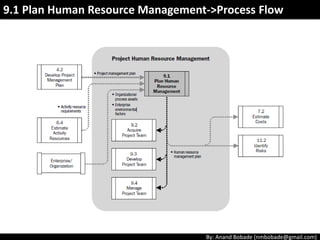
9.1 Plan Human Resource Management->Process Flow
By: Anand Bobade (nmbobade@gmail.com)By: Anand Bobade (nmbobade@gmail.com)
9.1 Plan Human Resource Management -> Review
Plan Human Resource Management Definition
HR Management plan
Tuckman's team building theory
Organizational Theory
Resource Histogram
Resource breakdown structure
By: Anand Bobade (nmbobade@gmail.com)
Learn Project Management & prepare for PMP exam:
• Learn visually
• Detailed coverage of all PMP concepts
• Sample Questions
By: Anand Bobade (nmbobade@gmail.com)
9.1 Plan Human Resource Management
• Identifying & documenting project roles, responsibilities,
required skills, reporting relationships, & creating a staffing
engagement plan.
9.2 Acquire Project Team
• Confirming human resource availability and obtaining the team
necessary to complete project activities.
9.3 Develop Project Team
• Improving competencies, team member interaction, and overall
team environment to enhance project performance.
9.4 Manage Project Team
• Tracking team member performance, providing feedback,
resolving issues, and managing team changes to optimize project
performance.
Introduction –Human Resource Management Processes
By: Anand Bobade (nmbobade@gmail.com)
9.2 Acquire Project Team
Finding Right resources for the right position on the Project
Follow normal hiring process specific to Project.
Negotiate with Line Managers to get required internal resources.
By: Anand Bobade (nmbobade@gmail.com)
9.2 Acquire Project Team
Project Manager may or may not have direct control over team
member selection due to:
Matrix project
environment
Internal or
external reporting
relationships
Subcontractor
personals
Collective
bargaining
agreements
By: Anand Bobade (nmbobade@gmail.com)
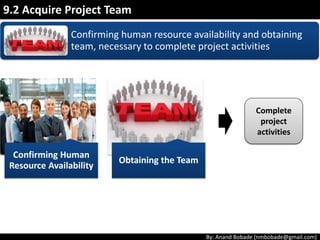
Confirming human resource availability and obtaining
team, necessary to complete project activities.
Confirming Human
Resource Availability
Obtaining the Team
9.2 Acquire Project Team -> Definition
Complete project
activities
By: Anand Bobade (nmbobade@gmail.com)
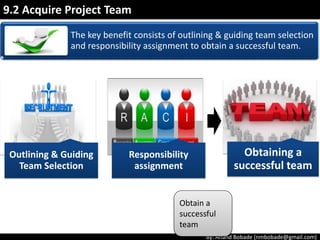
The key benefit consists of, outlining & guiding team selection
and responsibility assignment, to obtain a successful team.
Outlining & Guiding
Team Selection
Responsibility
assignment
9.2 Acquire Project Team
Obtaining a
successful team
By: Anand Bobade (nmbobade@gmail.com)
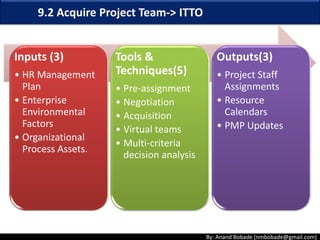
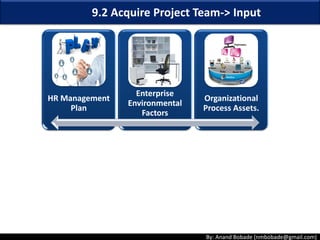
Inputs (3)
• HR Management
Plan
• Enterprise
Environmental
Factors
• Organizational
Process Assets.
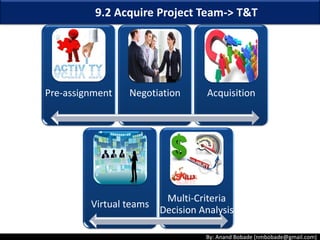
Tools &
Techniques(5)
• Pre-assignment
• Negotiation
• Acquisition
• Virtual teams
• Multi-criteria
decision analysis
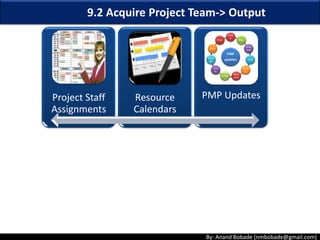
Outputs(3)
• Project Staff
Assignments
• Resource
Calendars
• PMP Updates
9.2 Acquire Project Team-> ITTO
By: Anand Bobade (nmbobade@gmail.com)
HR Management
Plan
Enterprise
Environmental
Factors
Organizational
Process Assets.
9.2 Acquire Project Team-> Input
By: Anand Bobade (nmbobade@gmail.com)
HR Management
Plan
Describes how the roles & responsibilities, reporting
relationships, and staff management will be
addressed & structured.
HR
Management
Plan
Roles and
responsibilities
Project
organization
charts
Staffing
management
plan
9.2 Acquire Project Team-> Input -> HR Management Plan
Before creating final schedule “resource
availability” has to be confirmed.
By: Anand Bobade (nmbobade@gmail.com)
Enterprise
Environmental
Factors
9.2 Acquire Project Team-> Input -> EEF
• Who are available and when?Availability
• What competencies are possessed
by resource pool?Ability
• Have candidates done similar
work? How was the performance?Experience
• Are candidates interested to work
on this project?Interest
• Resource rates?Cost
By: Anand Bobade (nmbobade@gmail.com)
Organizational
Process Assets
Standard Policies
Templates for organizational charts
Role / Position descriptions
Lessons learned
organizational structures that have worked in previous
projects
Escalation procedures
9.2 Acquire Project Team- >Inputs->OPA
By: Anand Bobade (nmbobade@gmail.com)
Pre-assignment Negotiation Acquisition
9.2 Acquire Project Team-> T&T
Virtual teams
Multi-Criteria
Decision Analysis
By: Anand Bobade (nmbobade@gmail.com)
Pre-assignment
Selection in advance. Reflect expertise defined in
project charter:
Key SME on the
Project
Architect Involved
during Proposal
Best PM to manage
Critical Project
9.2 Acquire Project Team-> T&T -> Pre-assignment
By: Anand Bobade (nmbobade@gmail.com)
Negotiation
Process to resolving disputes through consultations
between involved parties.
Ability to negotiate will increase chances of project
success.
PM has to constantly negotiate for appropriate, scarce,
specialized, qualified, certified human resources from:
Internal Line managers External organizations
• Vendors, Suppliers &
Contractors
9.2 Acquire Project Team-> T&T -> Negotiation
By: Anand Bobade (nmbobade@gmail.com)
Negotiation
Functional Managers
• Communicate & get resource
commitments
Management
• Explain benefits w.r.t resource
cost
Vendors, Contractors
• Involve HR. Clearly define
Roles and responsibilities
Other PM’s
• To get scared shared resources
Negotiate
with
9.2 Acquire Project Team-> T&T -> Negotiation
By: Anand Bobade (nmbobade@gmail.com)
Acquisition
Obtaining human & material resources necessary to
perform project activities. (Here refers to Human’s)
Reasons for acquisition:
Resource unavailability.
Augment existing skills.
New/External technology.
Lack of required project skills.
9.2 Acquire Project Team-> T&T -> Acquisition
Resources can be acquire from outside:
Contract
employees
Consultants
Outsourcing to
other organizations
By: Anand Bobade (nmbobade@gmail.com)
Virtual teams
It is a collection of task-driven members
separated by geographic space.
Reasons for building Virtual Teams:
Add special expertise.
Incorporate employees who work from home offices.
Form teams who work in different shifts, hours or days.
Include people with mobility limitations or disabilities.
Enable projects to move forward, which would have been ignored
due to travel expenses.
9.2 Acquire Project Team-> T&T -> Virtual teams
By: Anand Bobade (nmbobade@gmail.com)
Virtual teams
Technology in Virtual team
Teleconferencing / Voice over IP
Video Conferencing / Web Conferencing
Desktop sharing
Chat / Email
Collaboration tools ( Document management)
Challenges of Virtual team
Poor communication medium
Difficult to establish trust
Challenging conflict management
Technology cost can be high
Individuals often feel isolated
9.2 Acquire Project Team-> T&T -> Virtual teams
Good
communication
is critical for
virtual team.
By: Anand Bobade (nmbobade@gmail.com)
Multi-Criteria
Decision Analysis
Utilizes a decision matrix to provide analytical approach
to evaluate & rank team members.
Following weighted criteria may be used. (Weightage is
used to reflect importance)
Availability Cost Experience
Ability Knowledge Skills
Attitude
International
factors
9.2 Acquire Prj. team->T&T->Multi-Criteria Decision Analysis
By: Anand Bobade (nmbobade@gmail.com)
Project Staff
Assignments
Resource
Calendars
PMP Updates
9.2 Acquire Project Team-> Outputs
By: Anand Bobade (nmbobade@gmail.com)
Project Staff
Assignments
Staffs project by assigning specific individuals to
project roles and responsibilities
9.2 Acquire Project Team->Output->Project Staff Assignments
By: Anand Bobade (nmbobade@gmail.com)
Resource
Calendars
Documents time periods of availability of each member
Reflects scheduling conflicts, vacation & other projects
commitments.
Enables building final human resource budget.
9.2 Acquire Project Team-> Output -> Resource Calendars
By: Anand Bobade (nmbobade@gmail.com)
PMP Updates
Revised Staffing Management Plan.
Reflect realities of individual availabilities, competencies &
workloads.
Continuing updates should reflect promotions, retirements,
illnesses, performance issues, and changing workloads.
9.2 Acquire Project Team-> Output
By: Anand Bobade (nmbobade@gmail.com)
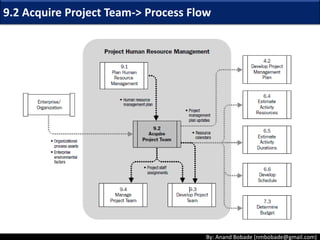
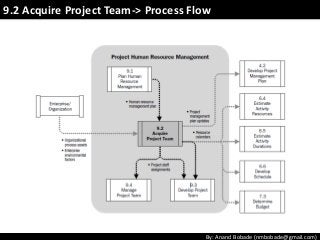
9.2 Acquire Project Team-> Process Flow
By: Anand Bobade (nmbobade@gmail.com)
Learn Project Management & prepare for PMP exam:
• Learn visually
• Detailed coverage of all PMP concepts
• Sample Questions
By: Anand Bobade (nmbobade@gmail.com)
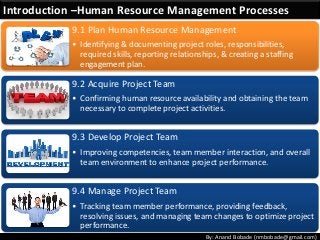
9.1 Plan Human Resource Management
• Identifying & documenting project roles, responsibilities,
required skills, reporting relationships, & creating a staffing
engagement plan.
9.2 Acquire Project Team
• Confirming human resource availability and obtaining the team
necessary to complete project activities.
9.3 Develop Project Team
• Improving competencies, team member interaction, and overall
team environment to enhance project performance.
9.4 Manage Project Team
• Tracking team member performance, providing feedback,
resolving issues, and managing team changes to optimize project
performance.
Introduction –Human Resource Management Processes
By: Anand Bobade (nmbobade@gmail.com)
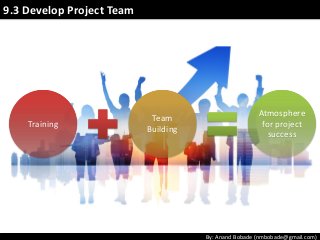
9.3 Develop Project Team
Training
Team
Building
Atmosphere
for project
success
By: Anand Bobade (nmbobade@gmail.com)
9.3 Develop Project Team
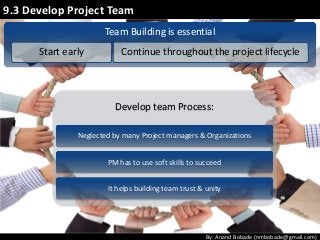
Team Building is essential
Start early Continue throughout the project lifecycle
Develop team Process:
Neglected by many Project managers & Organizations
PM has to use soft skills to succeed
It helps building team trust & unity
By: Anand Bobade (nmbobade@gmail.com)
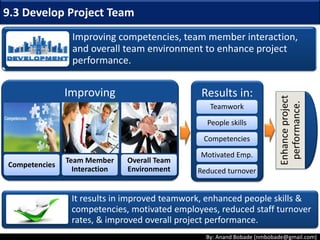
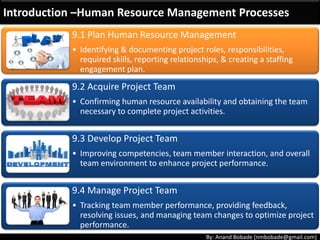
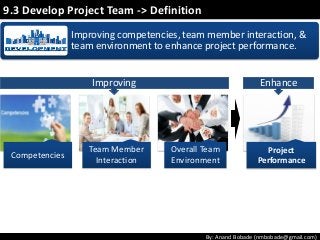
Improving competencies, team member interaction, &
team environment to enhance project performance.
9.3 Develop Project Team -> Definition
Project
Performance
Competencies
Team Member
Interaction
Overall Team
Environment
Improving Enhance
By: Anand Bobade (nmbobade@gmail.com)
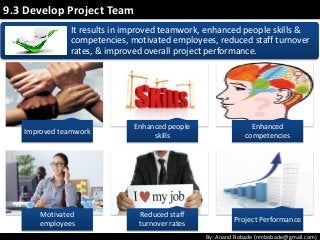
It results in improved teamwork, enhanced people skills &
competencies, motivated employees, reduced staff turnover
rates, & improved overall project performance.
Improved teamwork
Enhanced people
skills
Enhanced
competencies
Motivated
employees
Reduced staff
turnover rates
Project Performance
9.3 Develop Project Team
By: Anand Bobade (nmbobade@gmail.com)
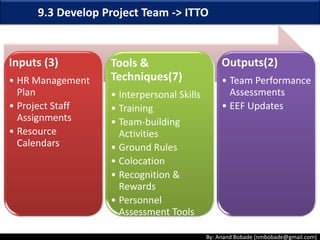
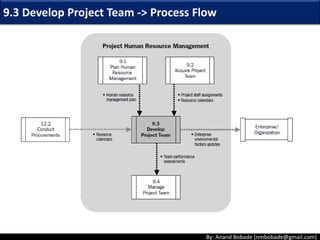
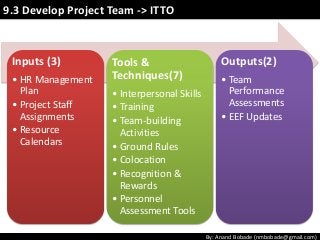
Inputs (3)
• HR Management
Plan
• Project Staff
Assignments
• Resource
Calendars
Tools &
Techniques(7)
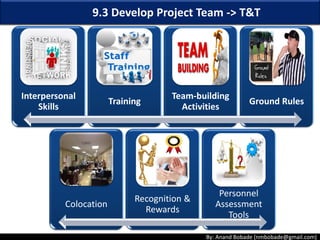
• Interpersonal Skills
• Training
• Team-building
Activities
• Ground Rules
• Colocation
• Recognition &
Rewards
• Personnel
Assessment Tools
Outputs(2)
• Team
Performance
Assessments
• EEF Updates
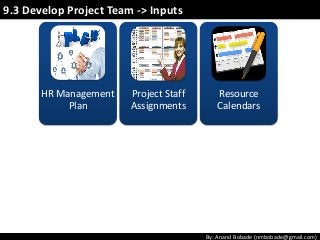
9.3 Develop Project Team -> ITTO
By: Anand Bobade (nmbobade@gmail.com)
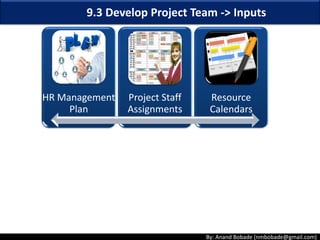
HR Management
Plan
Project Staff
Assignments
Resource
Calendars
9.3 Develop Project Team -> Inputs
By: Anand Bobade (nmbobade@gmail.com)
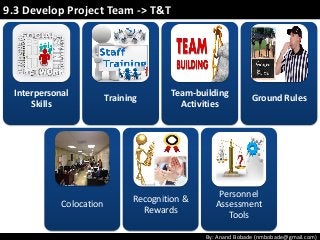
Interpersonal
Skills
Training
Team-building
Activities
Ground Rules
Colocation
Recognition &
Rewards
Personnel
Assessment
Tools
9.3 Develop Project Team -> T&T
By: Anand Bobade (nmbobade@gmail.com)
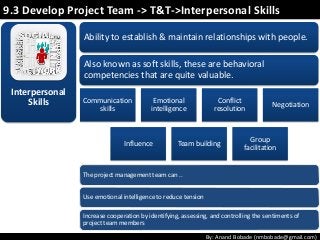
Interpersonal
Skills
Ability to establish & maintain relationships with people.
Also known as soft skills, these are behavioral
competencies that are quite valuable.
Communication
skills
Emotional
intelligence
Conflict
resolution
Negotiation
Influence Team building
Group
facilitation
9.3 Develop Project Team -> T&T->Interpersonal Skills
The project management team can ..
Use emotional intelligence to reduce tension
Increase cooperation by identifying, assessing, and controlling the sentiments of
project team members
By: Anand Bobade (nmbobade@gmail.com)
9.3 Develop Project Team -> T&T->Training
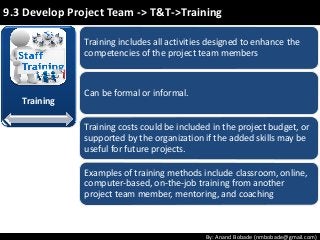
Training includes all activities designed to enhance the
competencies of the project team members
Can be formal or informal.
Training costs could be included in the project budget, or
supported by the organization if the added skills may be
useful for future projects.
Examples of training methods include classroom, online,
computer-based, on-the-job training from another
project team member, mentoring, and coaching
Training
By: Anand Bobade (nmbobade@gmail.com)
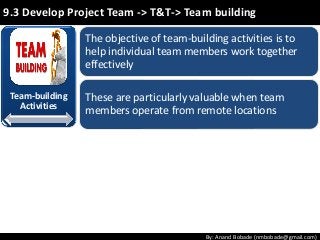
9.3 Develop Project Team -> T&T-> Team building
The objective of team-building activities is to
help individual team members work together
effectively
These are particularly valuable when team
members operate from remote locations
Team-building
Activities
By: Anand Bobade (nmbobade@gmail.com)
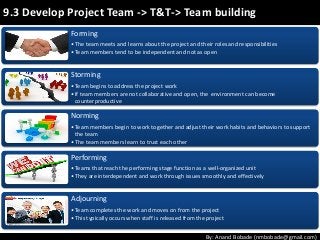
9.3 Develop Project Team -> T&T-> Team building
Forming
•The team meets and learns about the project and their roles and responsibilities
•Team members tend to be independent and not as open
Storming
•Team begins to address the project work
•If team members are not collaborative and open, the environment can become
counterproductive
Norming
•Team members begin to work together and adjust their work habits and behaviors to support
the team
•The team members learn to trust each other
Performing
•Teams that reach the performing stage function as a well-organized unit
•They are interdependent and work through issues smoothly and effectively
Adjourning
•Team completes the work and moves on from the project
•This typically occurs when staff is released from the project
By: Anand Bobade (nmbobade@gmail.com)
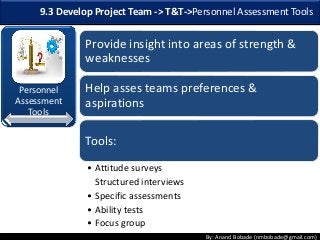
Personnel
Assessment
Tools
Provide insight into areas of strength &
weaknesses
Help asses teams preferences &
aspirations
Tools:
• Attitude surveys
Structured interviews
• Specific assessments
• Ability tests
• Focus group
9.3 Develop Project Team -> T&T->Personnel Assessment Tools
By: Anand Bobade (nmbobade@gmail.com)
Team
Performance
Assessments
EEF Updates
9.3 Develop Project Team -> Outputs
By: Anand Bobade (nmbobade@gmail.com)
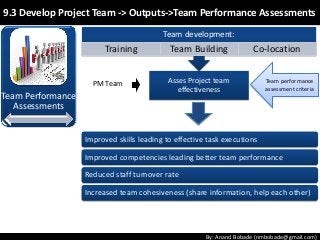
9.3 Develop Project Team -> Outputs9.3 Develop Project Team -> Outputs->Team Performance Assessments
Improved skills leading to effective task executions
Improved competencies leading better team performance
Reduced staff turnover rate
Increased team cohesiveness (share information, help each other)
Team Performance
Assessments
Asses Project team
effectiveness
Team development:
Training Team Building Co-location
PM Team Team performance
assessment criteria
By: Anand Bobade (nmbobade@gmail.com)
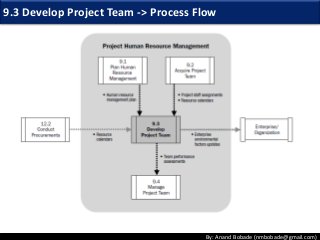
9.3 Develop Project Team -> Process Flow
By: Anand Bobade (nmbobade@gmail.com)
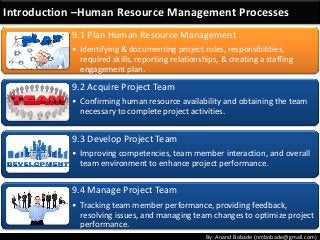
Introduction –Human Resource Management Processes
9.1 Plan Human Resource Management
• Identifying & documenting project roles, responsibilities,
required skills, reporting relationships, & creating a staffing
engagement plan.
9.2 Acquire Project Team
• Confirming human resource availability and obtaining the team
necessary to complete project activities.
9.3 Develop Project Team
• Improving competencies, team member interaction, and overall
team environment to enhance project performance.
9.4 Manage Project Team
• Tracking team member performance, providing feedback,
resolving issues, and managing team changes to optimize project
performance.
By: Anand Bobade (nmbobade@gmail.com)
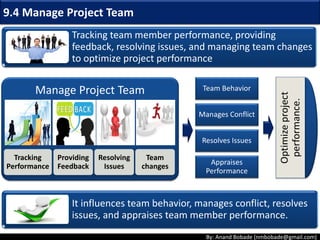
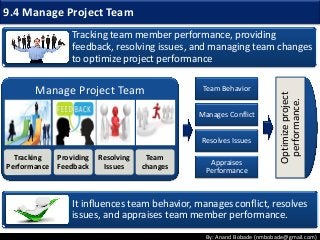
9.4 Manage Project Team
Tracking team member performance, providing
feedback, resolving issues, and managing team changes
to optimize project performance
It influences team behavior, manages conflict, resolves
issues, and appraises team member performance.
Manage Project Team
Tracking
Performance
Providing
Feedback
Resolving
Issues
Team
changes
Optimizeproject
performance.
Team Behavior
Manages Conflict
Resolves Issues
Appraises
Performance
By: Anand Bobade (nmbobade@gmail.com)
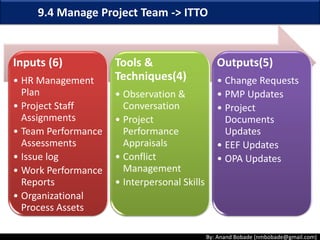
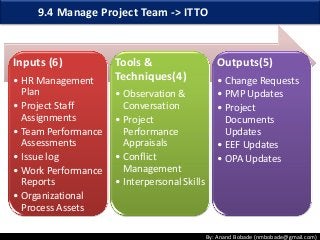
9.4 Manage Project Team -> ITTO
Inputs (6)
• HR Management
Plan
• Project Staff
Assignments
• Team Performance
Assessments
• Issue log
• Work Performance
Reports
• Organizational
Process Assets
Tools &
Techniques(4)
• Observation &
Conversation
• Project
Performance
Appraisals
• Conflict
Management
• Interpersonal Skills
Outputs(5)
• Change Requests
• PMP Updates
• Project
Documents
Updates
• EEF Updates
• OPA Updates
By: Anand Bobade (nmbobade@gmail.com)
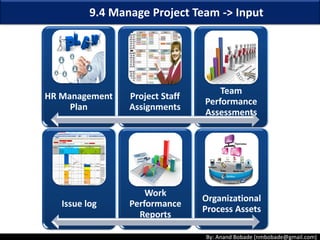
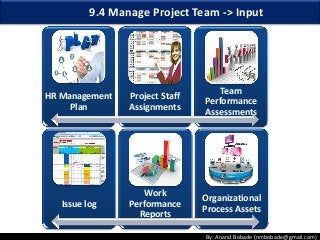
HR Management
Plan
Project Staff
Assignments
Team
Performance
Assessments
9.4 Manage Project Team -> Input
Issue log
Work
Performance
Reports
Organizational
Process Assets
By: Anand Bobade (nmbobade@gmail.com)
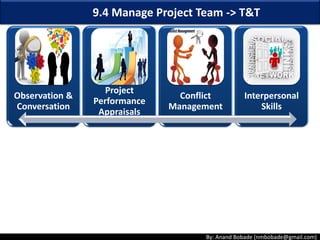
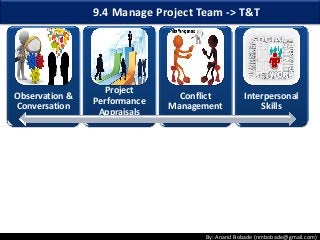
Observation &
Conversation
Project
Performance
Appraisals
Conflict
Management
Interpersonal
Skills
9.4 Manage Project Team -> T&T
By: Anand Bobade (nmbobade@gmail.com)
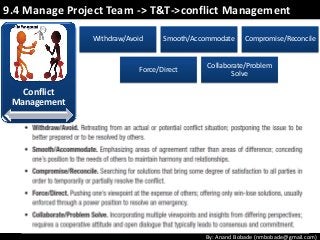
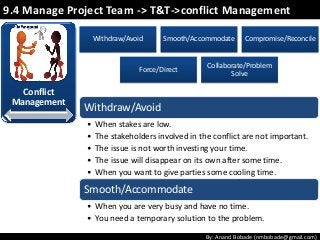
Conflict
Management
Withdraw/Avoid Smooth/Accommodate Compromise/Reconcile
Force/Direct
Collaborate/Problem
Solve
9.4 Manage Project Team -> T&T->conflict Management
By: Anand Bobade (nmbobade@gmail.com)
Conflict
Management
Withdraw/Avoid Smooth/Accommodate Compromise/Reconcile
Force/Direct
Collaborate/Problem
Solve
Withdraw/Avoid
• When stakes are low.
• The stakeholders involved in the conflict are not important.
• The issue is not worth investing your time.
• The issue will disappear on its own after some time.
• When you want to give parties some cooling time.
Smooth/Accommodate
• When you are very busy and have no time.
• You need a temporary solution to the problem.
9.4 Manage Project Team -> T&T->conflict Management
By: Anand Bobade (nmbobade@gmail.com)
Conflict
Management
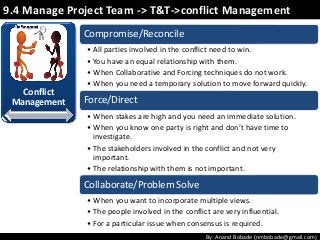
Compromise/Reconcile
• All parties involved in the conflict need to win.
• You have an equal relationship with them.
• When Collaborative and Forcing techniques do not work.
• When you need a temporary solution to move forward quickly.
Force/Direct
• When stakes are high and you need an immediate solution.
• When you know one party is right and don’t have time to
investigate.
• The stakeholders involved in the conflict and not very
important.
• The relationship with them is not important.
Collaborate/Problem Solve
• When you want to incorporate multiple views.
• The people involved in the conflict are very influential.
• For a particular issue when consensus is required.
9.4 Manage Project Team -> T&T->conflict Management
By: Anand Bobade (nmbobade@gmail.com)
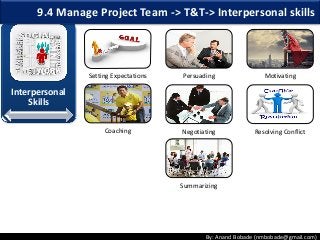
Interpersonal
Skills
Setting Expectations Persuading Motivating
Coaching Negotiating Resolving Conflict
Summarizing
9.4 Manage Project Team -> T&T-> Interpersonal skills
By: Anand Bobade (nmbobade@gmail.com)
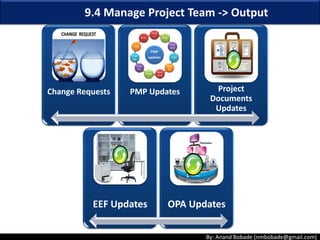
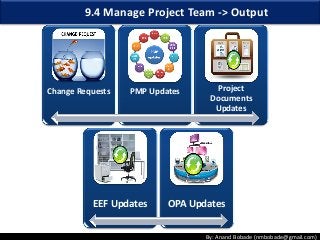
Change Requests PMP Updates Project
Documents
Updates
9.4 Manage Project Team -> Output
EEF Updates OPA Updates
By: Anand Bobade (nmbobade@gmail.com)
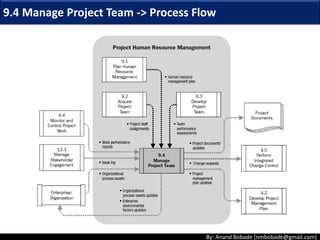
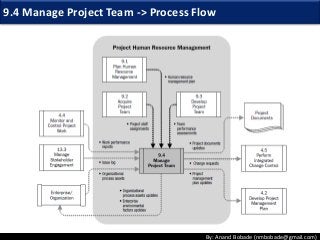
9.4 Manage Project Team -> Process Flow
By: Anand Bobade (nmbobade@gmail.com)
Additional Resources

PMP Chap9 - Project Human Resource management

  • 1.
    By: Anand Bobade(nmbobade@gmail.com) Plan HR management Acquire Project Team Develop Project Team Manage Project Team PMBOK Chap 9 - Human Resource Management Learn Project Management & prepare for PMP exam: • Learn visually • Detailed coverage of all PMP concepts • Sample Questions ExecutingPlanning
  • 2.
    By: Anand Bobade(nmbobade@gmail.com) It includes processes that organize, manage & lead the project team. Chap 9: Project Human Resource Management -> Definition HR Management Organize Manage Lead
  • 3.
    By: Anand Bobade(nmbobade@gmail.com) 9.1 Plan Human Resource Management • Identifying & documenting project roles, responsibilities, required skills, reporting relationships, & creating a staffing engagement plan. 9.2 Acquire Project Team • Confirming human resource availability and obtaining the team necessary to complete project activities. 9.3 Develop Project Team • Improving competencies, team member interaction, and overall team environment to enhance project performance. 9.4 Manage Project Team • Tracking team member performance, providing feedback, resolving issues, and managing team changes to optimize project performance. Chap 9: Project Human Resource Management-> Processes
  • 4.
    By: Anand Bobade(nmbobade@gmail.com)By: Anand Bobade (nmbobade@gmail.com) 9.1 Plan Human Resource Management Introduction Plan Human Resource Management Definition Plan Human Resource Management -> ITTO Organizational Theory Data flow diagram Review Self Assessment
  • 5.
    By: Anand Bobade(nmbobade@gmail.com) 9.1 Plan Human Resource Management Determine - Resource Type & Skills. Define – Roles & Responsibilities. Plan – Resource on boarding, Training & Mentoring. Develop – HR Management plan.
  • 6.
    By: Anand Bobade(nmbobade@gmail.com) Project Team Project Management Team •Project Manager •Project Management Staff Project Staff 9.1 Plan Human Resource Management Business SME Business Users Business Analyst Subject Matter Expert Systems Analyst Technical Architect Test Lead Technical Project Lead Programmer Project coordinator PMO Analyst Note: Above Team represent Software development Project.
  • 7.
    By: Anand Bobade(nmbobade@gmail.com) 9.1 Plan Human Resource Management Who do you need? What skills are required? What are their responsibilities? what's their engagement (start & end) dates? Whom thy will report to? How they will be trained? How they will be rewarded?
  • 8.
    By: Anand Bobade(nmbobade@gmail.com) Identifying & Documenting Identifying & documenting project roles, responsibilities, required skills, reporting relationships & creating a staffing engagement plan. It establishes staffing management plan, including timetable of staff acquisition & release. 9.1 Plan Human Resource Management Roles Engagement plan Responsibilities Relationships Human Resource Management
  • 9.
    By: Anand Bobade(nmbobade@gmail.com) Inputs (4) • Project management plan • Activity resource requirements • Enterprise environmental factors • Organizational process assets Tools & Techniques(5) • Organization charts and position descriptions • Networking • Organizational theory • Expert judgment • Meetings Outputs(1) • Human Resource Management Plan 9.1 Plan Human Resource Management->ITTO
  • 10.
    By: Anand Bobade(nmbobade@gmail.com) PMP Activity Resource Requirements Enterprise Environmental Factors Organizational Process Assets 9.1 Plan Human Resource Management->Inputs
  • 11.
    By: Anand Bobade(nmbobade@gmail.com) PMP • that will be applied for HR management. Processes • documents how changes will be monitored and controlled. A change management plan • documents how configuration management will be performed. A configuration management plan • How integrity of project baselines will be maintained Baseline • Needs & MethodsCommunication 9.1 Plan Human Resource Management->Inputs->PMP
  • 12.
    By: Anand Bobade(nmbobade@gmail.com) Activity Resource Requirements Output of Estimate Activity Resource process of Time Management. Provide resource estimate for each work. Resource for Work Package Resource Type Resource Quantity Resource competency 9.1 Plan HR Management->Inputs-> Activity Resource Req
  • 13.
    By: Anand Bobade(nmbobade@gmail.com) Enterprise Environmental Factors Marketplace conditions (Economic conditions) Internal External Personnel administration policies Holidays Working hours Geographical location of team members Collocated Distributed teams Existing human resources Who is involved? Expertise Unwritten rules Organizational culture & structure Project Structure Authority 9.1 Plan HR Management->Inputs->EEF
  • 14.
    By: Anand Bobade(nmbobade@gmail.com) Organizational Process Assets Standard Policies. Templates for organizational charts. Role / Position descriptions. Lessons learned. Organizational structures that have worked in previous projects. Escalation procedures. 9.1 Plan HR Management->Inputs->OPA
  • 15.
    By: Anand Bobade(nmbobade@gmail.com) Organization Charts & Position Descriptions Networking Organizational Theory Expert Judgment Meetings 9.1 Plan Human Resource Management->T&T
  • 16.
    By: Anand Bobade(nmbobade@gmail.com) Organization Charts & Position Descriptions 9.1 Plan HR Manag’t->T&T->Org. Charts & Position Descriptions Formats used to document roles & responsibilities: Hierarchical Matrix Text-oriented Graphically depicts project team members & their interrelationships for a project. Ensure each work package has clear owner & each member has clear Roles & Responsibilities.
  • 17.
    By: Anand Bobade(nmbobade@gmail.com) Organization Charts & Position Descriptions • OBS is arranged according to organization’s existing departments. Organizational breakdown structure (OBS) • RBS is list of resources related by category/ resource type. Resource breakdown structure (RBS) 9.1 Plan HR Manag’t->T&T->Org. Charts & Position Descriptions Hierarchical-type charts • A traditional organization chart structure. • Show positions and relationships.
  • 18.
    By: Anand Bobade(nmbobade@gmail.com) Organization Charts & Position Descriptions Matrix-based charts (Responsibility assignment matrix - RAM ) Shows project resources assigned to each work package. Illustrate connections between work packages & project team members. Ensures that, there is only one person accountable for a task. E.g., RACI (responsible, accountable, consult, inform) chart. 9.1 Plan HR Manag’t->T&T->Org. Charts & Position Descriptions
  • 19.
    By: Anand Bobade(nmbobade@gmail.com) Organization Charts & Position Descriptions Matrix-based charts (RACI charts) 9.1 Plan HR Manag’t->T&T->Org. Charts & Position Descriptions Work Package Create Charter Create PMP Gather Requirements Development Sponsor R A C I PM C R A A BA C C R C Developer I I I R • Responsible (Performer)R • Accountable (Decision Maker / Approver)A • Consultation (Provides input)C • Informed (FYI)I
  • 20.
    By: Anand Bobade(nmbobade@gmail.com) Organization Charts & Position Descriptions Text Oriented Formats: • Responsibilities descriptions are documented in text-oriented formats. Documents describes: Responsibilities Authority Competencies Qualifications. 9.1 Plan HR Manag’t->T&T->Org. Charts & Position Descriptions
  • 21.
    By: Anand Bobade(nmbobade@gmail.com) Networking Establishing connections & relationships with other people from the same or other organizations. Industry Events Trade Conferences Seminars Lunch Meeting Meetings 9.1 Plan HR Management->T&T->Networking Help to find resources. Formal & informal interaction. Can use your political influence.
  • 22.
    By: Anand Bobade(nmbobade@gmail.com) Organizational Theory Provide information about the way in which people, teams & organizational behave. Shorten Time, Cost & Efforts needed to create HR management plan. Improve HR planning. 9.1 Plan HR Management ->T&T->Organizational Theory Tuckman's team building theory Maslow’s Hierarchy of Needs Contingency Theory Situational Leadership Theory McGregor’s Theory of X & Y Theory Z Expectancy theory Herzberg's motivation- hygiene theory
  • 23.
    By: Anand Bobade(nmbobade@gmail.com) Organizational Theory 9.1 Plan HR Management ->T&T->Organizational Theory Extremely important for team to grow & work together. Don’t expect everyone to work as team from day1. As per Tuckman, all stages are inevitable. Tuckman's team building theory
  • 24.
    By: Anand Bobade(nmbobade@gmail.com) Organizational Theory Tuckman's team building theory Forming Storming Norming Performing Adjourning 9.1 Plan HR Management ->T&T->Organizational Theory
  • 25.
    By: Anand Bobade(nmbobade@gmail.com) Organizational Theory • Team trying to learn about each other & their tasks. • High dependence on PM for guidance & direction. • Unclear roles and responsibilities • Team – independent, nervous Forming • Team trying to work through differences. • PM coach the team. • Constant conflicts & arguments • Team- Differences, frustration Storming 9.1 Plan HR Management ->T&T->Organizational Theory Tuckman's team building theory
  • 26.
    By: Anand Bobade(nmbobade@gmail.com) Organizational Theory • Set ground rules to work together. • PM provide autonomy & participate . • Team is developing but Challenge continues. • Team - adjusting for team work. Norming • Pick performance & complete tasks. • PM delegate work & allow team manage it. • Work as single team. • Team help each other & work together. Performing 9.1 Plan HR Management ->T&T->Organizational Theory Tuckman's team building theory
  • 27.
    By: Anand Bobade(nmbobade@gmail.com) Organizational Theory • Complete all work & disperse. • PM help team to move on. • Team feels sense of loss and deforms. • Team gets demotivated & feel uncertainty. Adjourning 9.1 Plan HR Management ->T&T->Organizational Theory Tuckman's team building theory
  • 28.
    By: Anand Bobade(nmbobade@gmail.com) Organizational Theory Maslow’s Hierarchy of Needs (Motivation Theory) 9.1 Plan HR Management ->T&T->Organizational Theory All human needs fall in a hierarchy: Bottom 4 levels: • Needs for self actualisation Top: • Needs for Metamotivation • Creativity, Morality, Problem solving, Acceptance of facts, Spontaneity Self- actualisation • Confidence, Achievement, respect for/by other Esteem • Friendship, Family, intimacy, sense of connections Love/Belonging • Health, Employment, Property, Family & social stability Safety • Breathing, Food, Water, Shelter, Sleep, Clothing's Physiological D-Needs (Deficiency Needs) The most basic level of needs (Bottom 4) must be met before the individual will strongly desire the secondary or higher level needs.
  • 29.
    By: Anand Bobade(nmbobade@gmail.com) Organizational Theory Contingency Theory (Fred Fiedler's) 9.1 Plan HR Management ->T&T->Organizational Theory Believes that there is no one best style of leadership. Instead, a leader's effectiveness is based on situation. Two factors – "leadership style" & "situational control". Situations have 3 dimensions: Leader & member relationship Degree of task structure Leader’s positional power • LPC - Least Preferred Co- worker Leadership style is measure using LPC scale
  • 30.
    By: Anand Bobade(nmbobade@gmail.com) Organizational Theory 9.1 Plan HR Management ->T&T->Organizational Theory • High, if the leader is generally accepted & respected. Leader- member relation • High, if the task is very structured. Task structure • High, if authority & power are attributed to leader's position. Position power
  • 31.
    By: Anand Bobade(nmbobade@gmail.com) Organizational Theory Situational Leadership Theory (by Blancard & Paul Hersey) 9.1 Plan HR Management ->T&T->Organizational Theory There is no single “best” style of leadership. A PM must lead based on the situations. The leader’s positional power is obtained through formal authority.
  • 32.
    By: Anand Bobade(nmbobade@gmail.com) Organizational Theory McGregor’s Theory of X & Y: Describe two contrasting models of workforce motivation. • Stresses importance of strict supervision. • External rewards & penalties. • Manager adopts Authoritarian style. 'Theory X' • Highlights motivating role of job satisfaction. • Allows workers to approach tasks creatively. • Manager adapts Facilitative style. 'Theory Y‘ 9.1 Plan HR Management ->T&T->Organizational Theory
  • 33.
    By: Anand Bobade(nmbobade@gmail.com) Organizational Theory Theory Z (Dr. William Ouchi) Focused on increasing employee loyalty to company. Strong focus on well-being of employee, both on and off the job. Provide a job for life. 9.1 Plan HR Management ->T&T->Organizational Theory
  • 34.
    By: Anand Bobade(nmbobade@gmail.com) Organizational Theory Expectancy Theory ( By: Victor Vroom) Explains the behavioural process of “Why individuals choose one behavioural option over another”. People are motivated by outcome. There is Positive correlation between efforts & performance. Behaviour is result of conscious choices. 9.1 Plan HR Management ->T&T->Organizational Theory Employee performance is based on: Knowledge Personality Skills Abilities Experience
  • 35.
    By: Anand Bobade(nmbobade@gmail.com) Organizational Theory 9.1 Plan HR Management ->T&T->Organizational Theory Expectancy (Effort → Performance ) Instrumentality (Performance → Outcome ) Valence (Outcome → Reward) • Belief that one's effort (E) will result in attainment of desired performance (P) goals. Expectancy: • Belief that a person will receive a reward if the performance expectation is met. Instrumentality: • Value an individual places on rewards of an outcome, which is based on their needs, goals, values & motivation sources. Valence:
  • 36.
    By: Anand Bobade(nmbobade@gmail.com) Organizational Theory Herzberg's motivation-hygiene theory (Two-factor theory) There are certain factors in the workplace that cause job satisfaction, while a separate set of factors cause dissatisfaction. 9.1 Plan HR Management ->T&T->Organizational Theory Absence lead to dissatisfaction Company Policy Supervision Relationship with Boss Work conditions Salary Relationship with peers Factors that lead to satisfaction Achievement Recognition Work itself Responsibility Advancement Growth Presence doesn't lead to satisfaction
  • 37.
    By: Anand Bobade(nmbobade@gmail.com) HR Management Plan 9.1 Plan Human Resource Management->Output
  • 38.
    By: Anand Bobade(nmbobade@gmail.com) HR Management Plan How roles & responsibilities, reporting relationships, & staff management will be addressed & structured. HR Management Plan Roles and responsibilities Project organization charts Staffing management plan 9.1 Plan Human Resource Management->Output Roles & Responsibilities: Role Responsibility Competency Authority
  • 39.
    By: Anand Bobade(nmbobade@gmail.com) HR Management Plan • Function to be performed by a project team member. E.g., Testing. Role: • Specific work a member is expected to perform as part of the project. E.g., Test Module A. Responsibility (Duties): • The skill and capacity required to complete assigned activities within the project constraints. Competency: • Right to apply resources, make decisions, and sign approvals. Authority should match individual responsibilities. Authority 9.1 Plan Human Resource Management->Output
  • 40.
    By: Anand Bobade(nmbobade@gmail.com) HR Management Plan 9.1 Plan Human Resource Management->Output Staffing management plan: • Describes when and how project team members will be acquired and how long they will be needed. • Acquire within the organization or from outside Staff acquisition: • Identify working days & shifts on which each specific resource is available. Resource calendars: • Illustrates number of hours a person, or a department will be needed in a given time period. Resource histogram:
  • 41.
    By: Anand Bobade(nmbobade@gmail.com) HR Management Plan • When & how team members are released from a project. • Costs associated with those resources are no longer with project. Release plan: • Develop training plan, if resources assigned need training to take up the project tasks. Training needs • Clear criteria for rewards and a planned system for their use. Recognition and rewards • Strategies for complying with applicable government regulations, union contracts & HR policies. Compliance • Policies and procedures that protect team members from hazards Safety 9.1 Plan Human Resource Management->Output
  • 42.
    By: Anand Bobade(nmbobade@gmail.com) HR Management Plan 9.1 Plan Human Resource Management->Output Project organization charts: • Identifies positions and reporting relationships. Project Governance Board Project Manager Business Process SME Business Analyst Technical System analyst Architect Technical Lead Developers Testers Project Management staff Project co- ordinator Risk Management expert PMO analyst Contract Management Finance
  • 43.
    By: Anand Bobade(nmbobade@gmail.com) HR Management Plan 9.1 Plan Human Resource Management->Output Resource histogram example:
  • 44.
    By: Anand Bobade(nmbobade@gmail.com) 9.1 Plan Human Resource Management->Process Flow
  • 45.
    By: Anand Bobade(nmbobade@gmail.com)By: Anand Bobade (nmbobade@gmail.com) 9.1 Plan Human Resource Management -> Review Plan Human Resource Management Definition HR Management plan Tuckman's team building theory Organizational Theory Resource Histogram Resource breakdown structure
  • 46.
    By: Anand Bobade(nmbobade@gmail.com) Learn Project Management & prepare for PMP exam: • Learn visually • Detailed coverage of all PMP concepts • Sample Questions
  • 47.
    By: Anand Bobade(nmbobade@gmail.com) 9.1 Plan Human Resource Management • Identifying & documenting project roles, responsibilities, required skills, reporting relationships, & creating a staffing engagement plan. 9.2 Acquire Project Team • Confirming human resource availability and obtaining the team necessary to complete project activities. 9.3 Develop Project Team • Improving competencies, team member interaction, and overall team environment to enhance project performance. 9.4 Manage Project Team • Tracking team member performance, providing feedback, resolving issues, and managing team changes to optimize project performance. Introduction –Human Resource Management Processes
  • 48.
    By: Anand Bobade(nmbobade@gmail.com) 9.2 Acquire Project Team Finding Right resources for the right position on the Project Follow normal hiring process specific to Project. Negotiate with Line Managers to get required internal resources.
  • 49.
    By: Anand Bobade(nmbobade@gmail.com) 9.2 Acquire Project Team Project Manager may or may not have direct control over team member selection due to: Matrix project environment Internal or external reporting relationships Subcontractor personals Collective bargaining agreements
  • 50.
    By: Anand Bobade(nmbobade@gmail.com) Confirming human resource availability and obtaining team, necessary to complete project activities. Confirming Human Resource Availability Obtaining the Team 9.2 Acquire Project Team -> Definition Complete project activities
  • 51.
    By: Anand Bobade(nmbobade@gmail.com) The key benefit consists of, outlining & guiding team selection and responsibility assignment, to obtain a successful team. Outlining & Guiding Team Selection Responsibility assignment 9.2 Acquire Project Team Obtaining a successful team
  • 52.
    By: Anand Bobade(nmbobade@gmail.com) Inputs (3) • HR Management Plan • Enterprise Environmental Factors • Organizational Process Assets. Tools & Techniques(5) • Pre-assignment • Negotiation • Acquisition • Virtual teams • Multi-criteria decision analysis Outputs(3) • Project Staff Assignments • Resource Calendars • PMP Updates 9.2 Acquire Project Team-> ITTO
  • 53.
    By: Anand Bobade(nmbobade@gmail.com) HR Management Plan Enterprise Environmental Factors Organizational Process Assets. 9.2 Acquire Project Team-> Input
  • 54.
    By: Anand Bobade(nmbobade@gmail.com) HR Management Plan Describes how the roles & responsibilities, reporting relationships, and staff management will be addressed & structured. HR Management Plan Roles and responsibilities Project organization charts Staffing management plan 9.2 Acquire Project Team-> Input -> HR Management Plan Before creating final schedule “resource availability” has to be confirmed.
  • 55.
    By: Anand Bobade(nmbobade@gmail.com) Enterprise Environmental Factors 9.2 Acquire Project Team-> Input -> EEF • Who are available and when?Availability • What competencies are possessed by resource pool?Ability • Have candidates done similar work? How was the performance?Experience • Are candidates interested to work on this project?Interest • Resource rates?Cost
  • 56.
    By: Anand Bobade(nmbobade@gmail.com) Organizational Process Assets Standard Policies Templates for organizational charts Role / Position descriptions Lessons learned organizational structures that have worked in previous projects Escalation procedures 9.2 Acquire Project Team- >Inputs->OPA
  • 57.
    By: Anand Bobade(nmbobade@gmail.com) Pre-assignment Negotiation Acquisition 9.2 Acquire Project Team-> T&T Virtual teams Multi-Criteria Decision Analysis
  • 58.
    By: Anand Bobade(nmbobade@gmail.com) Pre-assignment Selection in advance. Reflect expertise defined in project charter: Key SME on the Project Architect Involved during Proposal Best PM to manage Critical Project 9.2 Acquire Project Team-> T&T -> Pre-assignment
  • 59.
    By: Anand Bobade(nmbobade@gmail.com) Negotiation Process to resolving disputes through consultations between involved parties. Ability to negotiate will increase chances of project success. PM has to constantly negotiate for appropriate, scarce, specialized, qualified, certified human resources from: Internal Line managers External organizations • Vendors, Suppliers & Contractors 9.2 Acquire Project Team-> T&T -> Negotiation
  • 60.
    By: Anand Bobade(nmbobade@gmail.com) Negotiation Functional Managers • Communicate & get resource commitments Management • Explain benefits w.r.t resource cost Vendors, Contractors • Involve HR. Clearly define Roles and responsibilities Other PM’s • To get scared shared resources Negotiate with 9.2 Acquire Project Team-> T&T -> Negotiation
  • 61.
    By: Anand Bobade(nmbobade@gmail.com) Acquisition Obtaining human & material resources necessary to perform project activities. (Here refers to Human’s) Reasons for acquisition: Resource unavailability. Augment existing skills. New/External technology. Lack of required project skills. 9.2 Acquire Project Team-> T&T -> Acquisition Resources can be acquire from outside: Contract employees Consultants Outsourcing to other organizations
  • 62.
    By: Anand Bobade(nmbobade@gmail.com) Virtual teams It is a collection of task-driven members separated by geographic space. Reasons for building Virtual Teams: Add special expertise. Incorporate employees who work from home offices. Form teams who work in different shifts, hours or days. Include people with mobility limitations or disabilities. Enable projects to move forward, which would have been ignored due to travel expenses. 9.2 Acquire Project Team-> T&T -> Virtual teams
  • 63.
    By: Anand Bobade(nmbobade@gmail.com) Virtual teams Technology in Virtual team Teleconferencing / Voice over IP Video Conferencing / Web Conferencing Desktop sharing Chat / Email Collaboration tools ( Document management) Challenges of Virtual team Poor communication medium Difficult to establish trust Challenging conflict management Technology cost can be high Individuals often feel isolated 9.2 Acquire Project Team-> T&T -> Virtual teams Good communication is critical for virtual team.
  • 64.
    By: Anand Bobade(nmbobade@gmail.com) Multi-Criteria Decision Analysis Utilizes a decision matrix to provide analytical approach to evaluate & rank team members. Following weighted criteria may be used. (Weightage is used to reflect importance) Availability Cost Experience Ability Knowledge Skills Attitude International factors 9.2 Acquire Prj. team->T&T->Multi-Criteria Decision Analysis
  • 65.
    By: Anand Bobade(nmbobade@gmail.com) Project Staff Assignments Resource Calendars PMP Updates 9.2 Acquire Project Team-> Outputs
  • 66.
    By: Anand Bobade(nmbobade@gmail.com) Project Staff Assignments Staffs project by assigning specific individuals to project roles and responsibilities 9.2 Acquire Project Team->Output->Project Staff Assignments
  • 67.
    By: Anand Bobade(nmbobade@gmail.com) Resource Calendars Documents time periods of availability of each member Reflects scheduling conflicts, vacation & other projects commitments. Enables building final human resource budget. 9.2 Acquire Project Team-> Output -> Resource Calendars
  • 68.
    By: Anand Bobade(nmbobade@gmail.com) PMP Updates Revised Staffing Management Plan. Reflect realities of individual availabilities, competencies & workloads. Continuing updates should reflect promotions, retirements, illnesses, performance issues, and changing workloads. 9.2 Acquire Project Team-> Output
  • 69.
    By: Anand Bobade(nmbobade@gmail.com) 9.2 Acquire Project Team-> Process Flow
  • 70.
    By: Anand Bobade(nmbobade@gmail.com) Learn Project Management & prepare for PMP exam: • Learn visually • Detailed coverage of all PMP concepts • Sample Questions
  • 71.
    By: Anand Bobade(nmbobade@gmail.com) 9.1 Plan Human Resource Management • Identifying & documenting project roles, responsibilities, required skills, reporting relationships, & creating a staffing engagement plan. 9.2 Acquire Project Team • Confirming human resource availability and obtaining the team necessary to complete project activities. 9.3 Develop Project Team • Improving competencies, team member interaction, and overall team environment to enhance project performance. 9.4 Manage Project Team • Tracking team member performance, providing feedback, resolving issues, and managing team changes to optimize project performance. Introduction –Human Resource Management Processes
  • 72.
    By: Anand Bobade(nmbobade@gmail.com) 9.3 Develop Project Team Training Team Building Atmosphere for project success
  • 73.
    By: Anand Bobade(nmbobade@gmail.com) 9.3 Develop Project Team Team Building is essential Start early Continue throughout the project lifecycle Develop team Process: Neglected by many Project managers & Organizations PM has to use soft skills to succeed It helps building team trust & unity
  • 74.
    By: Anand Bobade(nmbobade@gmail.com) Improving competencies, team member interaction, & team environment to enhance project performance. 9.3 Develop Project Team -> Definition Project Performance Competencies Team Member Interaction Overall Team Environment Improving Enhance
  • 75.
    By: Anand Bobade(nmbobade@gmail.com) It results in improved teamwork, enhanced people skills & competencies, motivated employees, reduced staff turnover rates, & improved overall project performance. Improved teamwork Enhanced people skills Enhanced competencies Motivated employees Reduced staff turnover rates Project Performance 9.3 Develop Project Team
  • 76.
    By: Anand Bobade(nmbobade@gmail.com) Inputs (3) • HR Management Plan • Project Staff Assignments • Resource Calendars Tools & Techniques(7) • Interpersonal Skills • Training • Team-building Activities • Ground Rules • Colocation • Recognition & Rewards • Personnel Assessment Tools Outputs(2) • Team Performance Assessments • EEF Updates 9.3 Develop Project Team -> ITTO
  • 77.
    By: Anand Bobade(nmbobade@gmail.com) HR Management Plan Project Staff Assignments Resource Calendars 9.3 Develop Project Team -> Inputs
  • 78.
    By: Anand Bobade(nmbobade@gmail.com) Interpersonal Skills Training Team-building Activities Ground Rules Colocation Recognition & Rewards Personnel Assessment Tools 9.3 Develop Project Team -> T&T
  • 79.
    By: Anand Bobade(nmbobade@gmail.com) Interpersonal Skills Ability to establish & maintain relationships with people. Also known as soft skills, these are behavioral competencies that are quite valuable. Communication skills Emotional intelligence Conflict resolution Negotiation Influence Team building Group facilitation 9.3 Develop Project Team -> T&T->Interpersonal Skills The project management team can .. Use emotional intelligence to reduce tension Increase cooperation by identifying, assessing, and controlling the sentiments of project team members
  • 80.
    By: Anand Bobade(nmbobade@gmail.com) 9.3 Develop Project Team -> T&T->Training Training includes all activities designed to enhance the competencies of the project team members Can be formal or informal. Training costs could be included in the project budget, or supported by the organization if the added skills may be useful for future projects. Examples of training methods include classroom, online, computer-based, on-the-job training from another project team member, mentoring, and coaching Training
  • 81.
    By: Anand Bobade(nmbobade@gmail.com) 9.3 Develop Project Team -> T&T-> Team building The objective of team-building activities is to help individual team members work together effectively These are particularly valuable when team members operate from remote locations Team-building Activities
  • 82.
    By: Anand Bobade(nmbobade@gmail.com) 9.3 Develop Project Team -> T&T-> Team building Forming •The team meets and learns about the project and their roles and responsibilities •Team members tend to be independent and not as open Storming •Team begins to address the project work •If team members are not collaborative and open, the environment can become counterproductive Norming •Team members begin to work together and adjust their work habits and behaviors to support the team •The team members learn to trust each other Performing •Teams that reach the performing stage function as a well-organized unit •They are interdependent and work through issues smoothly and effectively Adjourning •Team completes the work and moves on from the project •This typically occurs when staff is released from the project
  • 83.
    By: Anand Bobade(nmbobade@gmail.com) Personnel Assessment Tools Provide insight into areas of strength & weaknesses Help asses teams preferences & aspirations Tools: • Attitude surveys Structured interviews • Specific assessments • Ability tests • Focus group 9.3 Develop Project Team -> T&T->Personnel Assessment Tools
  • 84.
    By: Anand Bobade(nmbobade@gmail.com) Team Performance Assessments EEF Updates 9.3 Develop Project Team -> Outputs
  • 85.
    By: Anand Bobade(nmbobade@gmail.com) 9.3 Develop Project Team -> Outputs9.3 Develop Project Team -> Outputs->Team Performance Assessments Improved skills leading to effective task executions Improved competencies leading better team performance Reduced staff turnover rate Increased team cohesiveness (share information, help each other) Team Performance Assessments Asses Project team effectiveness Team development: Training Team Building Co-location PM Team Team performance assessment criteria
  • 86.
    By: Anand Bobade(nmbobade@gmail.com) 9.3 Develop Project Team -> Process Flow
  • 87.
    By: Anand Bobade(nmbobade@gmail.com) Introduction –Human Resource Management Processes 9.1 Plan Human Resource Management • Identifying & documenting project roles, responsibilities, required skills, reporting relationships, & creating a staffing engagement plan. 9.2 Acquire Project Team • Confirming human resource availability and obtaining the team necessary to complete project activities. 9.3 Develop Project Team • Improving competencies, team member interaction, and overall team environment to enhance project performance. 9.4 Manage Project Team • Tracking team member performance, providing feedback, resolving issues, and managing team changes to optimize project performance.
  • 88.
    By: Anand Bobade(nmbobade@gmail.com) 9.4 Manage Project Team Tracking team member performance, providing feedback, resolving issues, and managing team changes to optimize project performance It influences team behavior, manages conflict, resolves issues, and appraises team member performance. Manage Project Team Tracking Performance Providing Feedback Resolving Issues Team changes Optimizeproject performance. Team Behavior Manages Conflict Resolves Issues Appraises Performance
  • 89.
    By: Anand Bobade(nmbobade@gmail.com) 9.4 Manage Project Team -> ITTO Inputs (6) • HR Management Plan • Project Staff Assignments • Team Performance Assessments • Issue log • Work Performance Reports • Organizational Process Assets Tools & Techniques(4) • Observation & Conversation • Project Performance Appraisals • Conflict Management • Interpersonal Skills Outputs(5) • Change Requests • PMP Updates • Project Documents Updates • EEF Updates • OPA Updates
  • 90.
    By: Anand Bobade(nmbobade@gmail.com) HR Management Plan Project Staff Assignments Team Performance Assessments 9.4 Manage Project Team -> Input Issue log Work Performance Reports Organizational Process Assets
  • 91.
    By: Anand Bobade(nmbobade@gmail.com) Observation & Conversation Project Performance Appraisals Conflict Management Interpersonal Skills 9.4 Manage Project Team -> T&T
  • 92.
    By: Anand Bobade(nmbobade@gmail.com) Conflict Management Withdraw/Avoid Smooth/Accommodate Compromise/Reconcile Force/Direct Collaborate/Problem Solve 9.4 Manage Project Team -> T&T->conflict Management
  • 93.
    By: Anand Bobade(nmbobade@gmail.com) Conflict Management Withdraw/Avoid Smooth/Accommodate Compromise/Reconcile Force/Direct Collaborate/Problem Solve Withdraw/Avoid • When stakes are low. • The stakeholders involved in the conflict are not important. • The issue is not worth investing your time. • The issue will disappear on its own after some time. • When you want to give parties some cooling time. Smooth/Accommodate • When you are very busy and have no time. • You need a temporary solution to the problem. 9.4 Manage Project Team -> T&T->conflict Management
  • 94.
    By: Anand Bobade(nmbobade@gmail.com) Conflict Management Compromise/Reconcile • All parties involved in the conflict need to win. • You have an equal relationship with them. • When Collaborative and Forcing techniques do not work. • When you need a temporary solution to move forward quickly. Force/Direct • When stakes are high and you need an immediate solution. • When you know one party is right and don’t have time to investigate. • The stakeholders involved in the conflict and not very important. • The relationship with them is not important. Collaborate/Problem Solve • When you want to incorporate multiple views. • The people involved in the conflict are very influential. • For a particular issue when consensus is required. 9.4 Manage Project Team -> T&T->conflict Management
  • 95.
    By: Anand Bobade(nmbobade@gmail.com) Interpersonal Skills Setting Expectations Persuading Motivating Coaching Negotiating Resolving Conflict Summarizing 9.4 Manage Project Team -> T&T-> Interpersonal skills
  • 96.
    By: Anand Bobade(nmbobade@gmail.com) Change Requests PMP Updates Project Documents Updates 9.4 Manage Project Team -> Output EEF Updates OPA Updates
  • 97.
    By: Anand Bobade(nmbobade@gmail.com) 9.4 Manage Project Team -> Process Flow
  • 98.
    By: Anand Bobade(nmbobade@gmail.com)
  • 99.
    By: Anand Bobade(nmbobade@gmail.com) Additional Resources