Chapter	
  6:	
  	
  
Project	
  Quality	
  Management	
  
Stevbros	
  Training	
  &	
  Consultancy	
  
www.stevbros.edu.vn	
  
Copyright@STEVBROS	
   Project	
  Management	
  Fundamentals	
   1	
  
PMI,	
  PMP	
  and	
  PMBOK	
  are	
  registered	
  marks	
  of	
  the	
  Project	
  Management	
  Ins9tute,	
  Inc.	
  
Overview	


   Ini%a%ng	
  
process	
  
group	
  
Planning	
  process	
  
group	
  
Execu%ng	
  
process	
  group	
  
Monitoring	
  
&	
  
controlling	
  
process	
  
group	
  
Closing	
  
process	
  
group	
  
Project	
  
quality	
  
management	


   •  Plan	
  Quality	
  
Management	
  
•  Perform	
  
Quality	
  
Assurance	
  
•  Control	
  
Quality	


Copyright@STEVBROS	
   Project	
  Management	
  Fundamentals	
   2	
  
CraLspeople	
  à	
  Mass-­‐producNon	
  &	
  InspecNon	
  à	
  StaNsNcal	
  QC	
  à	
  QA	
  
à	
  Strategic	
  Quality	
  Management	
  (	
  Q.	
  Plan,	
  Q.	
  Assurance,	
  Q.	
  Control	
  )	
  
Copyright@STEVBROS	
   3	
  
Overview	
  
Project	
  Management	
  Fundamentals	
  
Concepts	
  
•  Quality	
  and	
  grade	
  are	
  not	
  the	
  same	
  concepts.	
  	
  
–  Quality	
   as	
   a	
   delivered	
   performance	
   or	
   result	
   is	
   “the	
  
degree	
  to	
  which	
  a	
  set	
  of	
  inherent	
  characterisNcs	
  fulfill	
  
requirements”	
  (ISO	
  9000).	
  	
  
–  Grade	
   as	
   a	
   design	
   intent	
   is	
   a	
   category	
   assigned	
   to	
  
deliverables	
   having	
   the	
   same	
   funcNonal	
   use	
   but	
  
different	
  technical	
  characterisNcs.	
  	
  
Grade	
  relates	
  to	
  Features	
  of	
  the	
  product,	
  while	
  Quality	
  
relates	
   to	
   Requirements	
   of	
   the	
   product.	
   A	
   high	
   grade	
  
product	
   may	
   be	
   of	
   low	
   quality,	
   and	
   a	
   high	
   quality	
  
product	
  may	
  be	
  of	
  low	
  grade.	
  
Copyright@STEVBROS	
   STEVBROS	
  -­‐	
  Global	
  PMI	
  R.E.P	
   4	
  
Concepts	
  
•  Precision	
  vs.	
  Accuracy	
  
–  Accuracy	
  is	
  an	
  assessment	
  of	
  correctness.	
  	
  
–  Precision	
  is	
  a	
  measure	
  of	
  exactness.	
  	
  
Accuracy	
  refers	
  to	
  how	
  far	
  you	
  are	
  from	
  the	
  true	
  value;	
  
Precision	
  refers	
  to	
  how	
  close	
  you	
  get	
  to	
  the	
  same	
  value	
  
if	
  you	
  repeated	
  the	
  exercise	
  several	
  Nmes.	
  
Copyright@STEVBROS	
   STEVBROS	
  -­‐	
  Global	
  PMI	
  R.E.P	
   5	
  
Concepts	
  
The	
  basic	
  approach	
  to	
  project	
  quality	
  management	
  is	
  intended	
  to	
  be	
  compaNble	
  
with	
   InternaNonal	
   OrganizaNon	
   for	
   StandardizaNon	
   (ISO)	
   quality	
   standards.	
  
Modern	
   quality	
   management	
   approaches	
   seek	
   to	
   minimize	
   variaNon	
   and	
   to	
  
deliver	
  results	
  that	
  meet	
  defined	
  requirements.	
  These	
  approaches	
  recognize	
  the	
  
importance	
  of:	
  	
  
1.  Customer	
  saNsfacNon:	
  	
  
o  is	
   defined	
   as	
   “conformance	
   to	
   requirements”	
   (P.	
   Crosby)	
   and	
   “fitness	
   for	
  
use”	
  (J.M.	
  Juran).	
  
2.  PrevenNon	
  over	
  inspecNon.	
  
o  Quality	
  should	
  be	
  planned,	
  designed,	
  and	
  built	
  into—not	
  inspected	
  into	
  the	
  
project’s	
  management	
  or	
  the	
  project’s	
  deliverables.	
  	
  
o  The	
   cost	
   of	
   preven9ng	
   mistakes	
   is	
   generally	
   much	
   less	
   than	
   the	
   cost	
   of	
  
correc9ng	
  mistakes	
  when	
  they	
  are	
  found	
  by	
  inspec9on	
  or	
  during	
  usage.	
  	
  
3.  Management	
  Responsibility.	
  	
  
o  Success	
  requires	
  the	
  parNcipaNon	
  of	
  all	
  members	
  of	
  the	
  project	
  team.	
  
o  Management	
  takes	
  responsibility	
  to	
  provide	
  suitable	
  resources	
  at	
  adequate	
  
capaciNes.	
  	
  
Copyright@STEVBROS	
   STEVBROS	
  -­‐	
  Global	
  PMI	
  R.E.P	
   6	
  
Concepts	
  
4.  ConNnuous	
  improvement	
  (Kaizen):	
  
o  The	
   PDCA	
   (plan-­‐do-­‐check-­‐act)	
   cycle	
   is	
   the	
   basis	
   for	
  
quality	
   improvement	
   as	
   defined	
   by	
   Shewhart	
   and	
  
modified	
  by	
  Deming.	
  	
  
o  Quality	
   improvement	
   iniNaNves	
   such	
   as	
   Total	
   Quality	
  
Management	
  (TQM),	
  Six	
  Sigma,	
  and	
  Lean	
  Six	
  Sigma	
  could	
  
improve	
  the	
  quality	
  of	
  the	
  project’s	
  management	
  as	
  well	
  
as	
  the	
  quality	
  of	
  the	
  project’s	
  product.	
  	
  
o  Commonly	
   used	
   process	
   improvement	
   models	
   include	
  
Malcolm	
   Baldrige,	
   OrganizaNonal	
   Project	
   Management	
  
Maturity	
  Model	
  (OPM3®),	
  and	
  Capability	
  Maturity	
  Model	
  
Integrated	
  (CMMI®).	
  	
  (detailed	
  at	
  next	
  slides)	
  
Copyright@STEVBROS	
   STEVBROS	
  -­‐	
  Global	
  PMI	
  R.E.P	
   7	
  
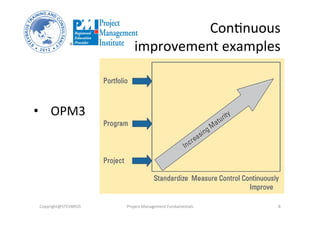
ConNnuous	
  	
  
improvement	
  examples	
  
Project	
  Management	
  Fundamentals	
   8	
  
•  OPM3	
  
Copyright@STEVBROS	
  
ConNnuous	
  	
  
improvement	
  examples	
  
Project	
  Management	
  Fundamentals	
   9	
  
•  Malcolm	
  
Baldrige	
  
Copyright@STEVBROS	
  
ConNnuous	
  	
  
improvement	
  examples	
  
Project	
  Management	
  Fundamentals	
   10	
  
•  CMMI	
  
Copyright@STEVBROS	
  
11	
  
•  Sigma:	
  Sigma	
  is	
  another	
  name	
  of	
  standard	
  deviaNon.	
  3	
  
or	
   6	
   sigma	
   represents	
   the	
   level	
   of	
   quality	
   that	
   a	
  
company	
  has	
  decided	
  to	
  try	
  to	
  achieve.	
  
§  1	
  sigma:	
  68,26%	
  
§  2	
  sigma:	
  95,46%	
  
§  3	
  sigma:	
  99,73%:	
  less	
  than	
  2,7	
  out	
  of	
  10	
  thousands	
  have	
  problem.	
  
§  6	
  sigma:	
  99,99985%:	
  less	
  than	
  1.5	
  out	
  of	
  1	
  million	
  products	
  have	
  problem.	
  
Continuous
improvement examples
Copyright@STEVBROS	
   Project	
  Management	
  Fundamentals	
  
Concepts	
  
Copyright@STEVBROS	
   STEVBROS	
  -­‐	
  Global	
  PMI	
  R.E.P	
   12	
  
A	
  Guide	
  to	
  the	
  Project	
  Management	
  Body	
  of	
  Knowledge,	
  FiTh	
  Edi9on	
  (PMBOK®	
  Guide)	
  ©2013	
  Project	
  Management	
  
Ins9tute,	
  Inc.	
  	
  All	
  Rights	
  Reserved.	
  	
  Figure	
  8-­‐5	
  Page	
  235.	
  
.. should be less then..
<	
  
5.  Cost	
  of	
  Quality	
  
Plan	
  quality	
  
management	
  
•  The	
  process	
  of	
  idenNfying	
  quality	
  requirements	
  and/or	
  standards	
  for	
  the	
  
project	
   and	
   its	
   deliverables,	
   and	
   documenNng	
   how	
   the	
   project	
   will	
  
demonstrate	
   compliance	
   with	
   relevant	
   quality	
   requirements.	
   The	
   key	
  
benefit	
  of	
  this	
  process	
  is	
  that	
  it	
  provides	
  guidance	
  and	
  direcNon	
  on	
  how	
  
quality	
  will	
  be	
  managed	
  and	
  validated	
  throughout	
  the	
  project.	
  
Copyright@STEVBROS	
   Project	
  Management	
  Fundamentals	
   13	
  
A	
  Guide	
  to	
  the	
  Project	
  Management	
  Body	
  of	
  Knowledge,	
  FiTh	
  Edi9on	
  (PMBOK®	
  Guide)	
  ©2013	
  Project	
  Management	
  
Ins9tute,	
  Inc.	
  	
  All	
  Rights	
  Reserved.	
  	
  Figure	
  8-­‐3	
  Page	
  232.	
  
Inputs(1/2)	
  
1.  Project	
  Management	
  Plan	
  
•  includes	
  scope	
  baseline,	
  schedule	
  baseline,	
  cost	
  baseline,	
  
and	
  other	
  management	
  plans	
  
2.  Stakeholder	
  Register	
  
•  aids	
   in	
   idenNfying	
   those	
   stakeholders	
   possessing	
   a	
  
parNcular	
  interest	
  in,	
  or	
  having	
  an	
  impact	
  on,	
  quality.	
  	
  
3.  Risk	
  Register	
  	
  
•  contains	
   informaNon	
   on	
   threats	
   and	
   opportuniNes	
   that	
  
may	
  impact	
  quality	
  requirements.	
  	
  
4.  Requirements	
  Documenta%on	


•  captures	
   the	
   requirements	
   that	
   the	
   project	
   shall	
   meet	
  
pertaining	
  to	
  stakeholder	
  expectaNons.	


Copyright@STEVBROS	
   Project	
  Management	
  Fundamentals	
   14	
  
Inputs(2/2)	
  
5.  Enterprise	
  Environmental	
  Factors	
  
•  include:	
   governmental	
   agency	
   regulaNons;	
   rules,	
  
standards,	
  and	
  guidelines	
  specific	
  to	
  the	
  applicaNon	
  area;	
  
working	
   or	
   operaNng	
   condiNons	
   of	
   the	
   project	
   or	
   its	
  
deliverables	
   that	
   may	
   affect	
   project	
   quality;	
   and	
   cultural	
  
percepNons	
  that	
  may	
  influence	
  expectaNons	
  about	
  quality.	
  	
  
6.  Organiza%onal	
  Process	
  Assets	
  	
  
•  include:	
   organizaNonal	
   quality	
   policies,	
   procedures,	
   and	
  
guidelines;	
  the	
  performing	
  organizaNon’s	
  quality	
  policy,	
  as	
  
endorsed	
   by	
   senior	
   management,	
   sets	
   the	
   organizaNon’s	
  
intended	
   direcNon	
   on	
   implemenNng	
   its	
   quality	
  
management	
   approach;	
   historical	
   databases;	
   and	
   lessons	
  
learned	
  from	
  previous	
  phases	
  or	
  projects.	
  	
  
Copyright@STEVBROS	
   Project	
  Management	
  Fundamentals	
   15	
  
Tools	
  and	
  
techniques(1/2)	
  
1.  Cost-­‐Benefit	
  Analysis	
  	
  
•  The	
   primary	
   benefits	
   of	
   meeNng	
   quality	
   requirements	
   include	
  
less	
   rework,	
   higher	
   producNvity,	
   lower	
   costs,	
   increased	
  
stakeholder	
   saNsfacNon,	
   and	
   increased	
   profitability.	
   A	
   cost-­‐
benefit	
   analysis	
   for	
   each	
   quality	
   acNvity	
   compares	
   the	
   cost	
   of	
  
the	
  quality	
  step	
  to	
  the	
  expected	
  benefit.	
  	
  
2.  Cost	
  of	
  Quality	
  (COQ)	
  (details	
  at	
  previous	
  slides)	
  
3.  Seven	
  Basic	
  Quality	
  Tools	
  (details	
  at	
  next	
  slides)	
  
4.  Benchmarking	
  
•  involves	
  comparing	
  actual	
  or	
  planned	
  project	
  pracNces	
  to	
  those	
  
of	
  comparable	
  projects	
  to	
  idenNfy	
  best	
  pracNces,	
  generate	
  ideas	
  
for	
   improvement,	
   and	
   provide	
   a	
   basis	
   for	
   measuring	
  
performance.	
  
Copyright@STEVBROS	
   Project	
  Management	
  Fundamentals	
   16	
  
Tools	
  and	
  
techniques(1/2)	
  
5.  Design	
  of	
  Experiments	
  	
  
•  Design	
   of	
   experiments	
   (DOE)	
   is	
   a	
   staNsNcal	
   method	
   for	
   idenNfying	
  
which	
  factors	
  may	
  influence	
  specific	
  variables	
  of	
  a	
  product	
  or	
  process	
  
under	
   development	
   or	
   in	
   producNon.	
   DOE	
   may	
   be	
   used	
   during	
   the	
  
Plan	
  Quality	
  Management	
  process	
  to	
  determine	
  the	
  number	
  and	
  type	
  
of	
  tests	
  and	
  their	
  impact	
  on	
  cost	
  of	
  quality	
  
6.  Sta%s%cal	
  Sampling	
  
•  involves	
  choosing	
  part	
  of	
  a	
  populaNon	
  of	
  interest	
  for	
  inspecNon	
  (for	
  
example,	
  selecNng	
  ten	
  engineering	
  drawings	
  at	
  random	
  from	
  a	
  list	
  of	
  
seventy-­‐five).	
   Sample	
   frequency	
   and	
   sizes	
   should	
   be	
   determined	
  
during	
  the	
  Plan	
  Quality	
  Management	
  process	
  so	
  the	
  cost	
  of	
  quality	
  will	
  
include	
  the	
  number	
  of	
  tests,	
  expected	
  scrap,	
  etc.	
  	
  
7.  Addi%onal	
  Quality	
  Planning	
  Tools	
  	
  
8.  Mee%ngs	
  	
  
Copyright@STEVBROS	
   Project	
  Management	
  Fundamentals	
   17	
  
7	
  basic	
  
quality	
  tools	
  
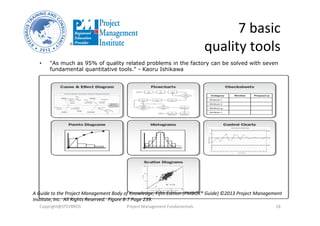
•  "As much as 95% of quality related problems in the factory can be solved with seven
fundamental quantitative tools." - Kaoru Ishikawa
Copyright@STEVBROS	
   Project	
  Management	
  Fundamentals	
   18	
  
A	
  Guide	
  to	
  the	
  Project	
  Management	
  Body	
  of	
  Knowledge,	
  FiTh	
  Edi9on	
  (PMBOK®	
  Guide)	
  ©2013	
  Project	
  Management	
  
Ins9tute,	
  Inc.	
  	
  All	
  Rights	
  Reserved.	
  	
  Figure	
  8-­‐7	
  Page	
  239.	
  
19	
  
Cause	
  &	
  Effect	
  tool	
  can	
  be	
  used	
  to	
  perform	
  5	
  Why	
  ?	
  
Why	
  did	
  the	
  equipment	
  fail?	
  Because	
  the	
  circuit	
  board	
  burned	
  out.	
  
Why	
  did	
  the	
  circuit	
  board	
  burn	
  out?	
  Because	
  it	
  overheated.	
  
Why	
  did	
  it	
  overheat?	
  Because	
  it	
  wasn’t	
  gepng	
  enough	
  air.	
  
Why	
  was	
  it	
  not	
  ge^ng	
  enough	
  air?	
  Because	
  the	
  filter	
  wasn’t	
  changed.	
  
Why	
  was	
  the	
  filter	
  not	
  changed?	
  Because	
  there	
  was	
  no	
  prevenNve	
  maintenance	
  schedule	
  to	
  do	
  so	


7	
  basic	
  
quality	
  tools	
  
•  Cause	
  &	
  Effect	
  Diagram	
  (fishbone	
  diagram,	
  Ishikawa	
  
diagram)	
  -­‐>	
  find	
  root	
  cause	
  of	
  defect	
  
Copyright@STEVBROS	
   Project	
  Management	
  Fundamentals	
  
A	
  Guide	
  to	
  the	
  Project	
  Management	
  Body	
  of	
  Knowledge,	
  FiTh	
  Edi9on	
  (PMBOK®	
  Guide)	
  ©2013	
  Project	
  Management	
  Ins9tute,	
  Inc.	
  	
  All	
  
Rights	
  Reserved.	
  	
  	
  Figure	
  8-­‐6	
  Page	
  237.	
  
Copyright@STEVBROS	
   Project	
  Management	
  Fundamentals	
   20	
  
•  Flow	
  Chart:	
  show	
  how	
  process	
  or	
  system	
  flows	
  from	
  
the	
  beginning	
  to	
  end	
  &	
  how	
  the	
  elements	
  interrelate.	
  
E.g.	
  The	
  SIPOC	
  Model	
  as	
  follow:	
  
7	
  basic	
  
quality	
  tools	
  
21	
  
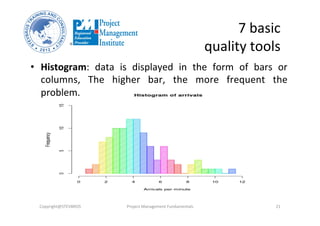
•  Histogram:	
   data	
   is	
   displayed	
   in	
   the	
   form	
   of	
   bars	
   or	
  
columns,	
   The	
   higher	
   bar,	
   the	
   more	
   frequent	
   the	
  
problem.	
  
7	
  basic	
  
quality	
  tools	
  
Copyright@STEVBROS	
   Project	
  Management	
  Fundamentals	
  
22	
  
•  Pareto	
  Diagrams:	
  is	
  a	
  type	
  of	
  histogram,	
  but	
  it	
  arranges	
  
results	
  from	
  most	
  frequent	
  to	
  least	
  frequent.	
  	
  
7	
  basic	
  
quality	
  tools	
  
Ø  80%	
   of	
   problems	
  
are	
   due	
   to	
   20%	
   of	
  
the	
  root	
  cause	
  
Ø  PrioriNze	
   potenNal	
  
“cause”	
   of	
   the	
  
problems	


Copyright@STEVBROS	
   Project	
  Management	
  Fundamentals	
  
7	
  basic	
  
quality	
  tools	
  
•  Check-­‐sheets,	
   which	
   are	
   also	
   known	
   as	
   Tally	
  
sheets	
  and	
  may	
  be	
  used	
  as	
  a	
  checklist	
  when	
  
gathering	
  data.	
  	
  
Copyright@STEVBROS	
   Project	
  Management	
  Fundamentals	
   23	
  
24	
  
•  Scaer	
  diagrams:	
  show	
  how	
  two	
  different	
  types	
  of	
  	
  
data	
  relate	
  to	
  each	
  other	


7	
  basic	
  
quality	
  tools	
  
Copyright@STEVBROS	
   Project	
  Management	
  Fundamentals	
  
25	
  
7	
  basic	
  
quality	
  tools	
  
•  Control	
  charts	
  
–  Graphically	
  help	
  you	
  to	
  determine	
  of	
  a	
  process	
  is	
  within	
  
acceptable	
  limits.	
  
–  Upper	
  &	
  Lower	
  control	
  limits	
  (base	
  on	
  org’	
  standard)	
  
–  In	
  control:	
  data	
  points	
  within	
  this	
  range.	
  
–  Out	
  of	
  control:	
  data	
  points	
  outside	
  this	
  range.	
  
–  SpecificaNon	
   Limits	
   (base	
   on	
   customer’s	
   expectaNon,	
  
assume	
   that	
   spec	
   limit	
   are	
   outside	
   the	
   upper	
   &	
   lower	
  
control	
  limits)	
  
–  Rule	
  of	
  Seven:	
  seven	
  consecuNve	
  data	
  points	
  in	
  a	
  row	
  on	
  
one	
  side	
  of	
  the	
  mean	
  -­‐>	
  out	
  of	
  control	
  
–  Assignable	
   Cause:	
   data	
   point	
   or	
   rule	
   of	
   seven	
   require	
  
invesNgaNon	
  to	
  determine	
  the	
  cause	
  of	
  the	
  variaNon.	
  
Copyright@STEVBROS	
   Project	
  Management	
  Fundamentals	
  
26	
  
7	
  basic	
  
quality	
  tools	
  
•  Control	
  charts	
  
Copyright@STEVBROS	
   Project	
  Management	
  Fundamentals	
  
27	
  
7	
  basic	
  
quality	
  tools	
  
•  Control	
  charts	
  
Copyright@STEVBROS	
   Project	
  Management	
  Fundamentals	
  
Outputs	
  
1.  Quality	
  Management	
  Plan	
  	
  
•  describes	
  how	
  the	
  organizaNon’s	
  quality	
  policies	
  will	
  be	
  implemented	
  and	
  
how	
   the	
   project	
   management	
   team	
   plans	
   to	
   meet	
   the	
   quality	
  
requirements	
  set	
  for	
  the	
  project.	
  	
  
2.  Process	
  Improvement	
  Plan	
  	
  
•  details	
   the	
   steps	
   for	
   analyzing	
   project	
   management	
   and	
   product	
  
development	
   processes	
   to	
   idenNfy	
   acNviNes	
   that	
   enhance	
   their	
   value.	
  
Areas	
   to	
   consider	
   include:	
   Process	
   boundaries,	
   Process	
   configuraNon,	
  
Process	
  metrics,	
  Targets	
  for	
  improved	
  performance.	
  
3.  Quality	
  Metrics	
  	
  
•  some	
   examples	
   of	
   quality	
   metrics	
   include	
   on-­‐Nme	
   performance,	
   cost	
  
control,	
   defect	
   frequency,	
   failure	
   rate,	
   availability,	
   reliability,	
   and	
   test	
  
coverage.	
  	
  
4.  Quality	
  Checklists	
  	
  
•  quality	
  checklists	
  should	
  incorporate	
  the	
  acceptance	
  criteria	
  included	
  in	
  
the	
  scope	
  baseline.	
  	
  
5.  Project	
  Documents	
  Updates	
  	
  
Copyright@STEVBROS	
   Project	
  Management	
  Fundamentals	
   28	
  
Perform	
  
quality	
  assurance	
  
•  The	
   process	
   of	
   audiNng	
   the	
   quality	
   requirements	
   and	
   the	
   results	
   from	
  
quality	
   control	
   measurements	
   to	
   ensure	
   that	
   appropriate	
   quality	
  
standards	
   and	
   operaNonal	
   definiNons	
   are	
   used.	
   The	
   key	
   benefit	
   of	
   this	
  
process	
  is	
  that	
  it	
  facilitates	
  the	
  improvement	
  of	
  quality	
  processes.	
  
Copyright@STEVBROS	
   Project	
  Management	
  Fundamentals	
   29	
  
A	
  Guide	
  to	
  the	
  Project	
  Management	
  Body	
  of	
  Knowledge,	
  FiTh	
  Edi9on	
  (PMBOK®	
  Guide)	
  ©2013	
  Project	
  Management	
  
Ins9tute,	
  Inc.	
  	
  All	
  Rights	
  Reserved.	
  	
  Figure	
  3-­‐8	
  Page	
  404.	
  
Inputs	
  
1.  Quality	
  Management	
  Plan	
  
•  describes	
   the	
   quality	
   assurance	
   and	
   conNnuous	
   process	
   improvement	
  
approaches	
  for	
  the	
  project.	


2.  Process	
  Improvement	
  Plan	
  	
  
•  the	
   project’s	
   quality	
   assurance	
   acNviNes	
   should	
   be	
   supporNve	
   of	
   and	
  
consistent	
  with	
  the	
  performing	
  organizaNon’s	
  process	
  improvement	
  plans.	
  	
  
3.  Quality	
  Metrics	
  	
  
•  provide	
   the	
   atributes	
   that	
   should	
   be	
   measured	
   and	
   the	
   allowable	
  
variaNons.	
  	
  
4.  Quality	
  Control	
  Measurements	
  	
  
•  are	
  the	
  results	
  of	
  control	
  quality	
  acNviNes.	
  They	
  are	
  used	
  to	
  analyze	
  and	
  
evaluate	
  the	
  quality	
  of	
  the	
  processes	
  of	
  the	
  project	
  against	
  the	
  standards	
  
of	
  the	
  performing	
  organizaNon	
  or	
  the	
  requirements	
  specified.	
  
5.  Project	
  Documents	
  	
  
•  project	
   documents	
   may	
   influence	
   quality	
   assurance	
   work	
   and	
   should	
   be	
  
monitored	
  within	
  the	
  context	
  of	
  a	
  system	
  for	
  configuraNon	
  management.	
  	
  
Copyright@STEVBROS	
   Project	
  Management	
  Fundamentals	
   30	
  
Tools	
  and	
  
techniques(1/2)	
  
1.  Quality	
  Management	
  and	
  Control	
  Tools	
  	
  
Copyright@STEVBROS	
   Project	
  Management	
  Fundamentals	
   31	
  
A	
  Guide	
  to	
  the	
  
Project	
  
Management	
  
Body	
  of	
  
Knowledge,	
  
	
  FiTh	
  Edi9on	
  
(PMBOK®	
  
Guide)	
  ©2013	
  
Project	
  
Management	
  
Ins9tute,	
  Inc.	
  	
  
All	
  Rights	
  
Reserved.	


Figure	
  8-­‐10	
  
Page	
  246.	
  
Tools	
  and	
  
techniques(2/2)	
  
2.  Quality	
  Audits	
  	
  
•  The	
  objecNves	
  of	
  a	
  quality	
  audit	
  may	
  include:	
  	
  
ü  IdenNfy	
  all	
  good	
  and	
  best	
  pracNces	
  being	
  implemented;	
  	
  
ü  IdenNfy	
  all	
  nonconformity,	
  gaps,	
  and	
  shortcomings;	
  	
  
ü  Share	
  good	
  pracNces	
  introduced	
  or	
  implemented	
  in	
  similar	
  projects	
  in	
  the	
  
organizaNon	
  and/or	
  industry;	
  	
  
ü  ProacNvely	
  offer	
  assistance	
  in	
  a	
  posiNve	
  manner	
  to	
  improve	
  implementaNon	
  of	
  
processes	
  to	
  help	
  the	
  team	
  raise	
  producNvity;	
  and	
  	
  
ü  Highlight	
  contribuNons	
  of	
  each	
  audit	
  in	
  the	
  lessons	
  learned	
  repository	
  of	
  the	
  
organizaNon	
  
3.  Process	
  Analysis	
  
•  Process	
  analysis	
  follows	
  the	
  steps	
  outlined	
  in	
  the	
  process	
  improvement	
  
plan	
  to	
  idenNfy	
  needed	
  improvements.	
  This	
  analysis	
  also	
  examines	
  
problems	
  experienced,	
  constraints	
  experienced,	
  and	
  non-­‐value-­‐added	
  
acNviNes	
  idenNfied	
  during	
  process	
  operaNon.	
  Process	
  analysis	
  includes	
  
root	
  cause	
  analysis—a	
  specific	
  technique	
  used	
  to	
  idenNfy	
  a	
  problem,	
  
discover	
  the	
  underlying	
  causes	
  that	
  lead	
  to	
  it,	
  and	
  develop	
  prevenNve	
  
acNons.	


   Copyright@STEVBROS	
   Project	
  Management	
  Fundamentals	
   32	
  
Outputs	
  
1.  Change	
  Requests	
  	
  
2.  Project	
  Management	
  Plan	
  Updates	
  	
  
•  Elements	
   of	
   the	
   project	
   management	
   plan	
   that	
   may	
  
be	
  updated	
  include:	
  quality	
  management	
  plan,	
  scope	
  
management	
   plan,	
   schedule	
   management	
   plan,	
   and	
  
cost	
  management	
  plan.	
  
3.  Project	
  Documents	
  Updates	
  	
  
•  Project	
   documents	
   that	
   may	
   be	
   updated	
   include:	
  
quality	
   audit	
   reports,	
   training	
   plans,	
   and	
   process	
  
documentaNon.	
  
4.  Organiza%onal	
  Process	
  Assets	
  Updates	
  	
  
Copyright@STEVBROS	
   Project	
  Management	
  Fundamentals	
   33	
  
Control	
  quality	
  
•  The	
  process	
  of	
  monitoring	
  and	
  recording	
  results	
  of	
  execuNng	
  the	
  quality	
  acNviNes	
  
to	
   assess	
   performance	
   and	
   recommend	
   necessary	
   changes.	
   The	
   key	
   benefits	
   of	
  
this	
  process	
  include:	
  (1)	
  idenNfying	
  the	
  causes	
  of	
  poor	
  process	
  or	
  product	
  quality	
  
and	
  recommending	
  and/or	
  taking	
  acNon	
  to	
  eliminate	
  them;	
  and	
  (2)	
  validaNng	
  that	
  
project	
   deliverables	
   and	
   work	
   meet	
   the	
   requirements	
   specified	
   by	
   key	
  
stakeholders	
  necessary	
  for	
  final	
  acceptance.	
  	
  
Copyright@STEVBROS	
   Project	
  Management	
  Fundamentals	
   34	
  
A	
  Guide	
  to	
  the	
  Project	
  Management	
  Body	
  of	
  Knowledge,	
  FiTh	
  Edi9on	
  
(PMBOK®	
  Guide)	
  ©2013	
  Project	
  Management	
  Ins9tute,	
  Inc.	
  	
  All	
  Rights	
  
Reserved.	
  	
  Figure	
  8-­‐11	
  Page	
  249.	
  
Inputs	
  
1.  Project	
  Management	
  Plan	
  	
  
•  describes	
  how	
  quality	
  control	
  will	
  be	
  performed	
  within	
  the	
  project.	
  	
  
2.  Quality	
  Metrics	
  	
  
•  describes	
  a	
  project	
  or	
  product	
  atribute	
  and	
  how	
  it	
  will	
  be	
  measured.	
  	
  
3.  Quality	
  Checklists	
  	
  
•  are	
   structured	
   lists	
   that	
   help	
   to	
   verify	
   that	
   the	
   work	
   of	
   the	
   project	
   and	
   its	
  
deliverables	
  fulfill	
  a	
  set	
  of	
  requirements.	
  	
  
4.  Work	
  Performance	
  Data	
  	
  
•  include:	
  planned	
  vs.	
  actual	
  technical	
  performance;	
  planned	
  vs.	
  actual	
  schedule	
  
performance;	
  and	
  planned	
  vs.	
  actual	
  cost	
  performance.	
  
5.  Approved	
  Change	
  Requests	
  	
  
•  approved	
  change	
  requests	
  may	
  include	
  modificaNons	
  such	
  as	
  defect	
  repairs,	
  
revised	
  work	
  methods,	
  and	
  revised	
  schedule.	
  
6.  Deliverables	
  	
  
7.  Project	
  Documents	
  
8.  Organiza%onal	
  Process	
  Assets	


Copyright@STEVBROS	
   Project	
  Management	
  Fundamentals	
   35	
  
Tools	
  and	
  
techniques	
  
1.  Seven	
  Basic	
  Quality	
  Tools	
  	
  
2.  Sta%s%cal	
  Sampling	
  	
  
3.  Inspec%on	
  	
  
•  An	
   inspecNon	
   is	
   the	
   examinaNon	
   of	
   a	
   work	
   product	
   to	
  
determine	
   if	
   it	
   conforms	
   to	
   documented	
   standards.	
   For	
  
example,	
  the	
  results	
  of	
  a	
  single	
  acNvity	
  can	
  be	
  inspected,	
  or	
  the	
  
final	
  product	
  of	
  the	
  project	
  can	
  be	
  inspected.	
  	
  
•  InspecNons	
   may	
   be	
   called	
   reviews,	
   peer	
   reviews,	
   audits,	
   or	
  
walkthroughs.	
   In	
   some	
   applicaNon	
   areas,	
   these	
   terms	
   have	
  
narrow	
   and	
   specific	
   meanings.	
   InspecNons	
   also	
   are	
   used	
   to	
  
validate	
  defect	
  repairs	
  
4.  Approved	
  Change	
  Requests	
  Review	
  	
  
•  All	
  approved	
  change	
  requests	
  should	
  be	
  reviewed	
  to	
  verify	
  that	
  
they	
  were	
  implemented	
  as	
  approved.	
  	
  
Copyright@STEVBROS	
   Project	
  Management	
  Fundamentals	
   36	
  
Outputs(1/2)	
  
1.  Quality	
  Control	
  Measurements	
  
•  are	
   the	
   documented	
   results	
   of	
   control	
   quality	
  
acNviNes	
  	
  
2.  Validated	
  Changes	
  	
  
•  Any	
  changed	
  or	
  repaired	
  items	
  are	
  inspected	
  and	
  will	
  
be	
  either	
  accepted	
  or	
  rejected	
  before	
  noNficaNon	
  of	
  
the	
  decision	
  is	
  provided.	
  Rejected	
  items	
  may	
  require	
  
rework.	
  
3.  Verified	
  Deliverables	
  	
  
•  A	
  goal	
  of	
  this	
  process	
  is	
  to	
  determine	
  the	
  correctness	
  
of	
  deliverables.	
  The	
  results	
  of	
  performing	
  this	
  process	
  
are	
  verified	
  deliverables	
  
Copyright@STEVBROS	
   Project	
  Management	
  Fundamentals	
   37	
  
Outputs(2/2)	
  
4.  Work	
  Performance	
  Informa%on	
  
•  is	
   the	
   performance	
   data	
   collected	
   from	
   various	
   controlling	
  
processes,	
   analyzed	
   in	
   context	
   and	
   integrated	
   based	
   on	
  
relaNonships	
  across	
  areas.	
  Examples	
  include	
  informaNon	
  about	
  
the	
   project	
   requirements	
   fulfillment	
   such	
   as	
   causes	
   for	
  
rejecNons,	
   rework	
   required,	
   or	
   the	
   need	
   for	
   process	
  
adjustments	
  
5.  Change	
  Requests	
  (CR)	
  
6.  Project	
  Management	
  Plan	
  Updates	
  	
  
7.  Project	
  Documents	
  Updates	
  	
  
8.  Organiza%onal	
  Process	
  Assets	
  Updates	
  	
  
•  Include	
   completed	
   checklists	
   and	
   lessons	
   learned	
  
documentaNon	
  
Copyright@STEVBROS	
   Project	
  Management	
  Fundamentals	
   38	
  
Deliverables,	
  CRs,	
  
and	
  Control	
  Quality	
  process	
  
Deliverables	
  
Verified	
  	
  
deliverables	
  
Accepted	
  
deliverables	
  
Copyright@STEVBROS	
   STEVBROS	
  -­‐	
  Global	
  PMI	
  R.E.P	
   39	
  
Close	
  
Project	
  
CR	
  
Approved	
  
CR	
  
Validated	
  
CR	
  
Validate	
  
Scope	
  
Control	
  
Quality	
  
Direct	
  and	
  
Manage	
  Project	
  
ExecuNon	
  	
  
Monitor	
  and	
  
Control	
  Project	
  
Work	
  	
  
Control	
  
Quality	
  
Perform	
  
Integrated	
  
Change	
  Control	
  
Summary	
  
•  Grade	
  vs.	
  quality	
  
•  Precision	
  vs.	
  Accuracy	
  
•  Customer	
  saNsfacNon	
  
•  PrevenNon	
  over	
  inspecNon	
  
•  ConNnuous	
  improvement	
  
•  Management	
  responsibility	
  
•  Cost	
  of	
  quality	
  
•  Gold	
  plaNng	
  
•  Marginal	
  analysis	
  
•  JIT	
  
•  TQM	
  
•  7	
  basic	
  quality	
  tools	


Copyright@STEVBROS	
   Project	
  Management	
  Fundamentals	
   40	
  
QuesNons	
  
for	
  review	
  
Copyright@STEVBROS	
   Project	
  Management	
  Fundamentals	
   41	
  
•  You	
  did	
  the	
  good	
  job	
  at	
  this	
  chapter.	
  	
  Please	
  
complete	
  quesNons	
  for	
  review	
  before	
  moving	
  
to	
  next	
  chapter.	
  

Project Quality Management

  • 1.
    Chapter  6:     Project  Quality  Management   Stevbros  Training  &  Consultancy   www.stevbros.edu.vn   Copyright@STEVBROS   Project  Management  Fundamentals   1   PMI,  PMP  and  PMBOK  are  registered  marks  of  the  Project  Management  Ins9tute,  Inc.  
  • 2.
    Overview       Ini%a%ng   process   group   Planning  process   group   Execu%ng   process  group   Monitoring   &   controlling   process   group   Closing   process   group   Project   quality   management       •  Plan  Quality   Management   •  Perform   Quality   Assurance   •  Control   Quality       Copyright@STEVBROS   Project  Management  Fundamentals   2  
  • 3.
    CraLspeople  à  Mass-­‐producNon  &  InspecNon  à  StaNsNcal  QC  à  QA   à  Strategic  Quality  Management  (  Q.  Plan,  Q.  Assurance,  Q.  Control  )   Copyright@STEVBROS   3   Overview   Project  Management  Fundamentals  
  • 4.
    Concepts   •  Quality  and  grade  are  not  the  same  concepts.     –  Quality   as   a   delivered   performance   or   result   is   “the   degree  to  which  a  set  of  inherent  characterisNcs  fulfill   requirements”  (ISO  9000).     –  Grade   as   a   design   intent   is   a   category   assigned   to   deliverables   having   the   same   funcNonal   use   but   different  technical  characterisNcs.     Grade  relates  to  Features  of  the  product,  while  Quality   relates   to   Requirements   of   the   product.   A   high   grade   product   may   be   of   low   quality,   and   a   high   quality   product  may  be  of  low  grade.   Copyright@STEVBROS   STEVBROS  -­‐  Global  PMI  R.E.P   4  
  • 5.
    Concepts   •  Precision  vs.  Accuracy   –  Accuracy  is  an  assessment  of  correctness.     –  Precision  is  a  measure  of  exactness.     Accuracy  refers  to  how  far  you  are  from  the  true  value;   Precision  refers  to  how  close  you  get  to  the  same  value   if  you  repeated  the  exercise  several  Nmes.   Copyright@STEVBROS   STEVBROS  -­‐  Global  PMI  R.E.P   5  
  • 6.
    Concepts   The  basic  approach  to  project  quality  management  is  intended  to  be  compaNble   with   InternaNonal   OrganizaNon   for   StandardizaNon   (ISO)   quality   standards.   Modern   quality   management   approaches   seek   to   minimize   variaNon   and   to   deliver  results  that  meet  defined  requirements.  These  approaches  recognize  the   importance  of:     1.  Customer  saNsfacNon:     o  is   defined   as   “conformance   to   requirements”   (P.   Crosby)   and   “fitness   for   use”  (J.M.  Juran).   2.  PrevenNon  over  inspecNon.   o  Quality  should  be  planned,  designed,  and  built  into—not  inspected  into  the   project’s  management  or  the  project’s  deliverables.     o  The   cost   of   preven9ng   mistakes   is   generally   much   less   than   the   cost   of   correc9ng  mistakes  when  they  are  found  by  inspec9on  or  during  usage.     3.  Management  Responsibility.     o  Success  requires  the  parNcipaNon  of  all  members  of  the  project  team.   o  Management  takes  responsibility  to  provide  suitable  resources  at  adequate   capaciNes.     Copyright@STEVBROS   STEVBROS  -­‐  Global  PMI  R.E.P   6  
  • 7.
    Concepts   4.  ConNnuous  improvement  (Kaizen):   o  The   PDCA   (plan-­‐do-­‐check-­‐act)   cycle   is   the   basis   for   quality   improvement   as   defined   by   Shewhart   and   modified  by  Deming.     o  Quality   improvement   iniNaNves   such   as   Total   Quality   Management  (TQM),  Six  Sigma,  and  Lean  Six  Sigma  could   improve  the  quality  of  the  project’s  management  as  well   as  the  quality  of  the  project’s  product.     o  Commonly   used   process   improvement   models   include   Malcolm   Baldrige,   OrganizaNonal   Project   Management   Maturity  Model  (OPM3®),  and  Capability  Maturity  Model   Integrated  (CMMI®).    (detailed  at  next  slides)   Copyright@STEVBROS   STEVBROS  -­‐  Global  PMI  R.E.P   7  
  • 8.
    ConNnuous     improvement  examples   Project  Management  Fundamentals   8   •  OPM3   Copyright@STEVBROS  
  • 9.
    ConNnuous     improvement  examples   Project  Management  Fundamentals   9   •  Malcolm   Baldrige   Copyright@STEVBROS  
  • 10.
    ConNnuous     improvement  examples   Project  Management  Fundamentals   10   •  CMMI   Copyright@STEVBROS  
  • 11.
    11   •  Sigma:  Sigma  is  another  name  of  standard  deviaNon.  3   or   6   sigma   represents   the   level   of   quality   that   a   company  has  decided  to  try  to  achieve.   §  1  sigma:  68,26%   §  2  sigma:  95,46%   §  3  sigma:  99,73%:  less  than  2,7  out  of  10  thousands  have  problem.   §  6  sigma:  99,99985%:  less  than  1.5  out  of  1  million  products  have  problem.   Continuous improvement examples Copyright@STEVBROS   Project  Management  Fundamentals  
  • 12.
    Concepts   Copyright@STEVBROS  STEVBROS  -­‐  Global  PMI  R.E.P   12   A  Guide  to  the  Project  Management  Body  of  Knowledge,  FiTh  Edi9on  (PMBOK®  Guide)  ©2013  Project  Management   Ins9tute,  Inc.    All  Rights  Reserved.    Figure  8-­‐5  Page  235.   .. should be less then.. <   5.  Cost  of  Quality  
  • 13.
    Plan  quality   management   •  The  process  of  idenNfying  quality  requirements  and/or  standards  for  the   project   and   its   deliverables,   and   documenNng   how   the   project   will   demonstrate   compliance   with   relevant   quality   requirements.   The   key   benefit  of  this  process  is  that  it  provides  guidance  and  direcNon  on  how   quality  will  be  managed  and  validated  throughout  the  project.   Copyright@STEVBROS   Project  Management  Fundamentals   13   A  Guide  to  the  Project  Management  Body  of  Knowledge,  FiTh  Edi9on  (PMBOK®  Guide)  ©2013  Project  Management   Ins9tute,  Inc.    All  Rights  Reserved.    Figure  8-­‐3  Page  232.  
  • 14.
    Inputs(1/2)   1.  Project  Management  Plan   •  includes  scope  baseline,  schedule  baseline,  cost  baseline,   and  other  management  plans   2.  Stakeholder  Register   •  aids   in   idenNfying   those   stakeholders   possessing   a   parNcular  interest  in,  or  having  an  impact  on,  quality.     3.  Risk  Register     •  contains   informaNon   on   threats   and   opportuniNes   that   may  impact  quality  requirements.     4.  Requirements  Documenta%on       •  captures   the   requirements   that   the   project   shall   meet   pertaining  to  stakeholder  expectaNons.     Copyright@STEVBROS   Project  Management  Fundamentals   14  
  • 15.
    Inputs(2/2)   5.  Enterprise  Environmental  Factors   •  include:   governmental   agency   regulaNons;   rules,   standards,  and  guidelines  specific  to  the  applicaNon  area;   working   or   operaNng   condiNons   of   the   project   or   its   deliverables   that   may   affect   project   quality;   and   cultural   percepNons  that  may  influence  expectaNons  about  quality.     6.  Organiza%onal  Process  Assets     •  include:   organizaNonal   quality   policies,   procedures,   and   guidelines;  the  performing  organizaNon’s  quality  policy,  as   endorsed   by   senior   management,   sets   the   organizaNon’s   intended   direcNon   on   implemenNng   its   quality   management   approach;   historical   databases;   and   lessons   learned  from  previous  phases  or  projects.     Copyright@STEVBROS   Project  Management  Fundamentals   15  
  • 16.
    Tools  and   techniques(1/2)   1.  Cost-­‐Benefit  Analysis     •  The   primary   benefits   of   meeNng   quality   requirements   include   less   rework,   higher   producNvity,   lower   costs,   increased   stakeholder   saNsfacNon,   and   increased   profitability.   A   cost-­‐ benefit   analysis   for   each   quality   acNvity   compares   the   cost   of   the  quality  step  to  the  expected  benefit.     2.  Cost  of  Quality  (COQ)  (details  at  previous  slides)   3.  Seven  Basic  Quality  Tools  (details  at  next  slides)   4.  Benchmarking   •  involves  comparing  actual  or  planned  project  pracNces  to  those   of  comparable  projects  to  idenNfy  best  pracNces,  generate  ideas   for   improvement,   and   provide   a   basis   for   measuring   performance.   Copyright@STEVBROS   Project  Management  Fundamentals   16  
  • 17.
    Tools  and   techniques(1/2)   5.  Design  of  Experiments     •  Design   of   experiments   (DOE)   is   a   staNsNcal   method   for   idenNfying   which  factors  may  influence  specific  variables  of  a  product  or  process   under   development   or   in   producNon.   DOE   may   be   used   during   the   Plan  Quality  Management  process  to  determine  the  number  and  type   of  tests  and  their  impact  on  cost  of  quality   6.  Sta%s%cal  Sampling   •  involves  choosing  part  of  a  populaNon  of  interest  for  inspecNon  (for   example,  selecNng  ten  engineering  drawings  at  random  from  a  list  of   seventy-­‐five).   Sample   frequency   and   sizes   should   be   determined   during  the  Plan  Quality  Management  process  so  the  cost  of  quality  will   include  the  number  of  tests,  expected  scrap,  etc.     7.  Addi%onal  Quality  Planning  Tools     8.  Mee%ngs     Copyright@STEVBROS   Project  Management  Fundamentals   17  
  • 18.
    7  basic   quality  tools   •  "As much as 95% of quality related problems in the factory can be solved with seven fundamental quantitative tools." - Kaoru Ishikawa Copyright@STEVBROS   Project  Management  Fundamentals   18   A  Guide  to  the  Project  Management  Body  of  Knowledge,  FiTh  Edi9on  (PMBOK®  Guide)  ©2013  Project  Management   Ins9tute,  Inc.    All  Rights  Reserved.    Figure  8-­‐7  Page  239.  
  • 19.
    19   Cause  &  Effect  tool  can  be  used  to  perform  5  Why  ?   Why  did  the  equipment  fail?  Because  the  circuit  board  burned  out.   Why  did  the  circuit  board  burn  out?  Because  it  overheated.   Why  did  it  overheat?  Because  it  wasn’t  gepng  enough  air.   Why  was  it  not  ge^ng  enough  air?  Because  the  filter  wasn’t  changed.   Why  was  the  filter  not  changed?  Because  there  was  no  prevenNve  maintenance  schedule  to  do  so     7  basic   quality  tools   •  Cause  &  Effect  Diagram  (fishbone  diagram,  Ishikawa   diagram)  -­‐>  find  root  cause  of  defect   Copyright@STEVBROS   Project  Management  Fundamentals  
  • 20.
    A  Guide  to  the  Project  Management  Body  of  Knowledge,  FiTh  Edi9on  (PMBOK®  Guide)  ©2013  Project  Management  Ins9tute,  Inc.    All   Rights  Reserved.      Figure  8-­‐6  Page  237.   Copyright@STEVBROS   Project  Management  Fundamentals   20   •  Flow  Chart:  show  how  process  or  system  flows  from   the  beginning  to  end  &  how  the  elements  interrelate.   E.g.  The  SIPOC  Model  as  follow:   7  basic   quality  tools  
  • 21.
    21   •  Histogram:   data   is   displayed   in   the   form   of   bars   or   columns,   The   higher   bar,   the   more   frequent   the   problem.   7  basic   quality  tools   Copyright@STEVBROS   Project  Management  Fundamentals  
  • 22.
    22   •  Pareto  Diagrams:  is  a  type  of  histogram,  but  it  arranges   results  from  most  frequent  to  least  frequent.     7  basic   quality  tools   Ø  80%   of   problems   are   due   to   20%   of   the  root  cause   Ø  PrioriNze   potenNal   “cause”   of   the   problems       Copyright@STEVBROS   Project  Management  Fundamentals  
  • 23.
    7  basic   quality  tools   •  Check-­‐sheets,   which   are   also   known   as   Tally   sheets  and  may  be  used  as  a  checklist  when   gathering  data.     Copyright@STEVBROS   Project  Management  Fundamentals   23  
  • 24.
    24   •  Scaer  diagrams:  show  how  two  different  types  of     data  relate  to  each  other     7  basic   quality  tools   Copyright@STEVBROS   Project  Management  Fundamentals  
  • 25.
    25   7  basic   quality  tools   •  Control  charts   –  Graphically  help  you  to  determine  of  a  process  is  within   acceptable  limits.   –  Upper  &  Lower  control  limits  (base  on  org’  standard)   –  In  control:  data  points  within  this  range.   –  Out  of  control:  data  points  outside  this  range.   –  SpecificaNon   Limits   (base   on   customer’s   expectaNon,   assume   that   spec   limit   are   outside   the   upper   &   lower   control  limits)   –  Rule  of  Seven:  seven  consecuNve  data  points  in  a  row  on   one  side  of  the  mean  -­‐>  out  of  control   –  Assignable   Cause:   data   point   or   rule   of   seven   require   invesNgaNon  to  determine  the  cause  of  the  variaNon.   Copyright@STEVBROS   Project  Management  Fundamentals  
  • 26.
    26   7  basic   quality  tools   •  Control  charts   Copyright@STEVBROS   Project  Management  Fundamentals  
  • 27.
    27   7  basic   quality  tools   •  Control  charts   Copyright@STEVBROS   Project  Management  Fundamentals  
  • 28.
    Outputs   1.  Quality  Management  Plan     •  describes  how  the  organizaNon’s  quality  policies  will  be  implemented  and   how   the   project   management   team   plans   to   meet   the   quality   requirements  set  for  the  project.     2.  Process  Improvement  Plan     •  details   the   steps   for   analyzing   project   management   and   product   development   processes   to   idenNfy   acNviNes   that   enhance   their   value.   Areas   to   consider   include:   Process   boundaries,   Process   configuraNon,   Process  metrics,  Targets  for  improved  performance.   3.  Quality  Metrics     •  some   examples   of   quality   metrics   include   on-­‐Nme   performance,   cost   control,   defect   frequency,   failure   rate,   availability,   reliability,   and   test   coverage.     4.  Quality  Checklists     •  quality  checklists  should  incorporate  the  acceptance  criteria  included  in   the  scope  baseline.     5.  Project  Documents  Updates     Copyright@STEVBROS   Project  Management  Fundamentals   28  
  • 29.
    Perform   quality  assurance   •  The   process   of   audiNng   the   quality   requirements   and   the   results   from   quality   control   measurements   to   ensure   that   appropriate   quality   standards   and   operaNonal   definiNons   are   used.   The   key   benefit   of   this   process  is  that  it  facilitates  the  improvement  of  quality  processes.   Copyright@STEVBROS   Project  Management  Fundamentals   29   A  Guide  to  the  Project  Management  Body  of  Knowledge,  FiTh  Edi9on  (PMBOK®  Guide)  ©2013  Project  Management   Ins9tute,  Inc.    All  Rights  Reserved.    Figure  3-­‐8  Page  404.  
  • 30.
    Inputs   1.  Quality  Management  Plan   •  describes   the   quality   assurance   and   conNnuous   process   improvement   approaches  for  the  project.       2.  Process  Improvement  Plan     •  the   project’s   quality   assurance   acNviNes   should   be   supporNve   of   and   consistent  with  the  performing  organizaNon’s  process  improvement  plans.     3.  Quality  Metrics     •  provide   the   atributes   that   should   be   measured   and   the   allowable   variaNons.     4.  Quality  Control  Measurements     •  are  the  results  of  control  quality  acNviNes.  They  are  used  to  analyze  and   evaluate  the  quality  of  the  processes  of  the  project  against  the  standards   of  the  performing  organizaNon  or  the  requirements  specified.   5.  Project  Documents     •  project   documents   may   influence   quality   assurance   work   and   should   be   monitored  within  the  context  of  a  system  for  configuraNon  management.     Copyright@STEVBROS   Project  Management  Fundamentals   30  
  • 31.
    Tools  and   techniques(1/2)   1.  Quality  Management  and  Control  Tools     Copyright@STEVBROS   Project  Management  Fundamentals   31   A  Guide  to  the   Project   Management   Body  of   Knowledge,    FiTh  Edi9on   (PMBOK®   Guide)  ©2013   Project   Management   Ins9tute,  Inc.     All  Rights   Reserved.       Figure  8-­‐10   Page  246.  
  • 32.
    Tools  and   techniques(2/2)   2.  Quality  Audits     •  The  objecNves  of  a  quality  audit  may  include:     ü  IdenNfy  all  good  and  best  pracNces  being  implemented;     ü  IdenNfy  all  nonconformity,  gaps,  and  shortcomings;     ü  Share  good  pracNces  introduced  or  implemented  in  similar  projects  in  the   organizaNon  and/or  industry;     ü  ProacNvely  offer  assistance  in  a  posiNve  manner  to  improve  implementaNon  of   processes  to  help  the  team  raise  producNvity;  and     ü  Highlight  contribuNons  of  each  audit  in  the  lessons  learned  repository  of  the   organizaNon   3.  Process  Analysis   •  Process  analysis  follows  the  steps  outlined  in  the  process  improvement   plan  to  idenNfy  needed  improvements.  This  analysis  also  examines   problems  experienced,  constraints  experienced,  and  non-­‐value-­‐added   acNviNes  idenNfied  during  process  operaNon.  Process  analysis  includes   root  cause  analysis—a  specific  technique  used  to  idenNfy  a  problem,   discover  the  underlying  causes  that  lead  to  it,  and  develop  prevenNve   acNons.       Copyright@STEVBROS   Project  Management  Fundamentals   32  
  • 33.
    Outputs   1.  Change  Requests     2.  Project  Management  Plan  Updates     •  Elements   of   the   project   management   plan   that   may   be  updated  include:  quality  management  plan,  scope   management   plan,   schedule   management   plan,   and   cost  management  plan.   3.  Project  Documents  Updates     •  Project   documents   that   may   be   updated   include:   quality   audit   reports,   training   plans,   and   process   documentaNon.   4.  Organiza%onal  Process  Assets  Updates     Copyright@STEVBROS   Project  Management  Fundamentals   33  
  • 34.
    Control  quality   • The  process  of  monitoring  and  recording  results  of  execuNng  the  quality  acNviNes   to   assess   performance   and   recommend   necessary   changes.   The   key   benefits   of   this  process  include:  (1)  idenNfying  the  causes  of  poor  process  or  product  quality   and  recommending  and/or  taking  acNon  to  eliminate  them;  and  (2)  validaNng  that   project   deliverables   and   work   meet   the   requirements   specified   by   key   stakeholders  necessary  for  final  acceptance.     Copyright@STEVBROS   Project  Management  Fundamentals   34   A  Guide  to  the  Project  Management  Body  of  Knowledge,  FiTh  Edi9on   (PMBOK®  Guide)  ©2013  Project  Management  Ins9tute,  Inc.    All  Rights   Reserved.    Figure  8-­‐11  Page  249.  
  • 35.
    Inputs   1.  Project  Management  Plan     •  describes  how  quality  control  will  be  performed  within  the  project.     2.  Quality  Metrics     •  describes  a  project  or  product  atribute  and  how  it  will  be  measured.     3.  Quality  Checklists     •  are   structured   lists   that   help   to   verify   that   the   work   of   the   project   and   its   deliverables  fulfill  a  set  of  requirements.     4.  Work  Performance  Data     •  include:  planned  vs.  actual  technical  performance;  planned  vs.  actual  schedule   performance;  and  planned  vs.  actual  cost  performance.   5.  Approved  Change  Requests     •  approved  change  requests  may  include  modificaNons  such  as  defect  repairs,   revised  work  methods,  and  revised  schedule.   6.  Deliverables     7.  Project  Documents   8.  Organiza%onal  Process  Assets       Copyright@STEVBROS   Project  Management  Fundamentals   35  
  • 36.
    Tools  and   techniques   1.  Seven  Basic  Quality  Tools     2.  Sta%s%cal  Sampling     3.  Inspec%on     •  An   inspecNon   is   the   examinaNon   of   a   work   product   to   determine   if   it   conforms   to   documented   standards.   For   example,  the  results  of  a  single  acNvity  can  be  inspected,  or  the   final  product  of  the  project  can  be  inspected.     •  InspecNons   may   be   called   reviews,   peer   reviews,   audits,   or   walkthroughs.   In   some   applicaNon   areas,   these   terms   have   narrow   and   specific   meanings.   InspecNons   also   are   used   to   validate  defect  repairs   4.  Approved  Change  Requests  Review     •  All  approved  change  requests  should  be  reviewed  to  verify  that   they  were  implemented  as  approved.     Copyright@STEVBROS   Project  Management  Fundamentals   36  
  • 37.
    Outputs(1/2)   1.  Quality  Control  Measurements   •  are   the   documented   results   of   control   quality   acNviNes     2.  Validated  Changes     •  Any  changed  or  repaired  items  are  inspected  and  will   be  either  accepted  or  rejected  before  noNficaNon  of   the  decision  is  provided.  Rejected  items  may  require   rework.   3.  Verified  Deliverables     •  A  goal  of  this  process  is  to  determine  the  correctness   of  deliverables.  The  results  of  performing  this  process   are  verified  deliverables   Copyright@STEVBROS   Project  Management  Fundamentals   37  
  • 38.
    Outputs(2/2)   4.  Work  Performance  Informa%on   •  is   the   performance   data   collected   from   various   controlling   processes,   analyzed   in   context   and   integrated   based   on   relaNonships  across  areas.  Examples  include  informaNon  about   the   project   requirements   fulfillment   such   as   causes   for   rejecNons,   rework   required,   or   the   need   for   process   adjustments   5.  Change  Requests  (CR)   6.  Project  Management  Plan  Updates     7.  Project  Documents  Updates     8.  Organiza%onal  Process  Assets  Updates     •  Include   completed   checklists   and   lessons   learned   documentaNon   Copyright@STEVBROS   Project  Management  Fundamentals   38  
  • 39.
    Deliverables,  CRs,   and  Control  Quality  process   Deliverables   Verified     deliverables   Accepted   deliverables   Copyright@STEVBROS   STEVBROS  -­‐  Global  PMI  R.E.P   39   Close   Project   CR   Approved   CR   Validated   CR   Validate   Scope   Control   Quality   Direct  and   Manage  Project   ExecuNon     Monitor  and   Control  Project   Work     Control   Quality   Perform   Integrated   Change  Control  
  • 40.
    Summary   •  Grade  vs.  quality   •  Precision  vs.  Accuracy   •  Customer  saNsfacNon   •  PrevenNon  over  inspecNon   •  ConNnuous  improvement   •  Management  responsibility   •  Cost  of  quality   •  Gold  plaNng   •  Marginal  analysis   •  JIT   •  TQM   •  7  basic  quality  tools     Copyright@STEVBROS   Project  Management  Fundamentals   40  
  • 41.
    QuesNons   for  review   Copyright@STEVBROS   Project  Management  Fundamentals   41   •  You  did  the  good  job  at  this  chapter.    Please   complete  quesNons  for  review  before  moving   to  next  chapter.