Chapter 7 –
Project Cost Management
PMP
Trainer: Anand BobadePMBOK 6th Edition, 2019, All rights reserved.
Estimate Cost
SIXTH EDITION
By: Anand Bobade (nmbobade@gmail.com)PMBOK 6edition @ All rights reserved .
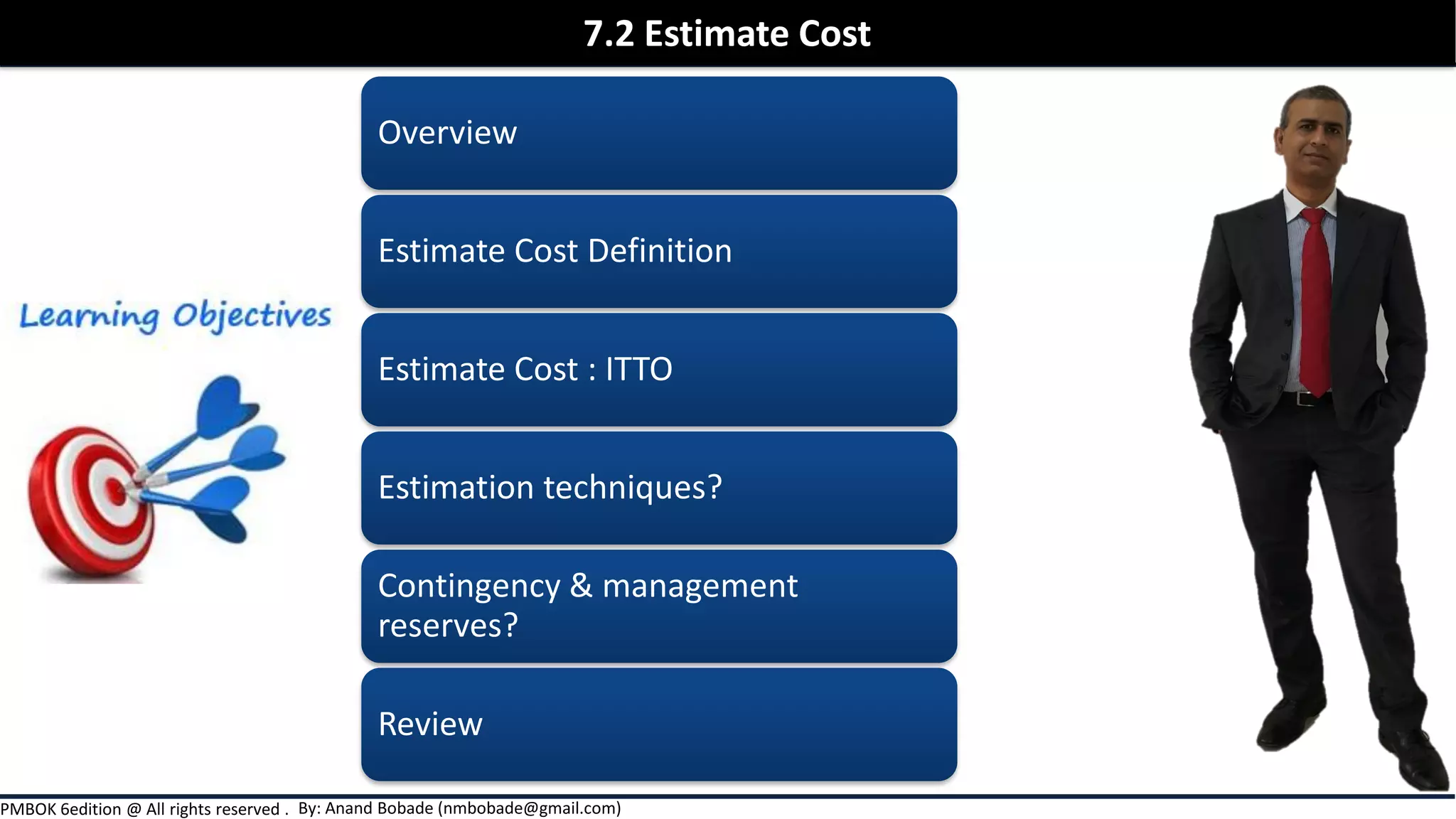
Overview
Estimate Cost Definition
Estimate Cost : ITTO
Estimation techniques?
Contingency & management
reserves?
Review
7.2 Estimate Cost
By: Anand Bobade (nmbobade@gmail.com)PMBOK 6edition @ All rights reserved .
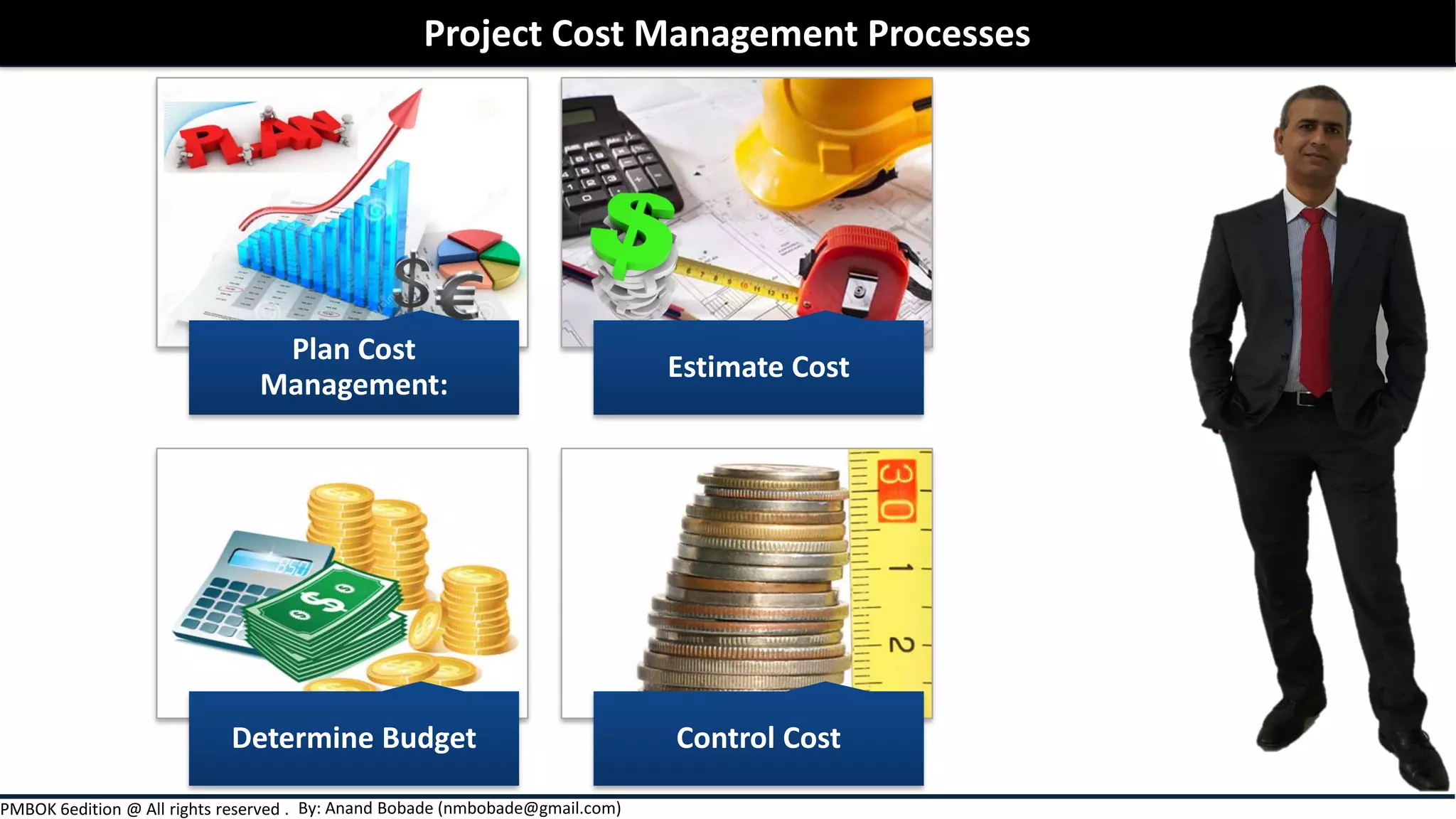
Plan Cost
Management:
Estimate Cost
Determine Budget Control Cost
Project Cost Management Processes
By: Anand Bobade (nmbobade@gmail.com)PMBOK 6edition @ All rights reserved .
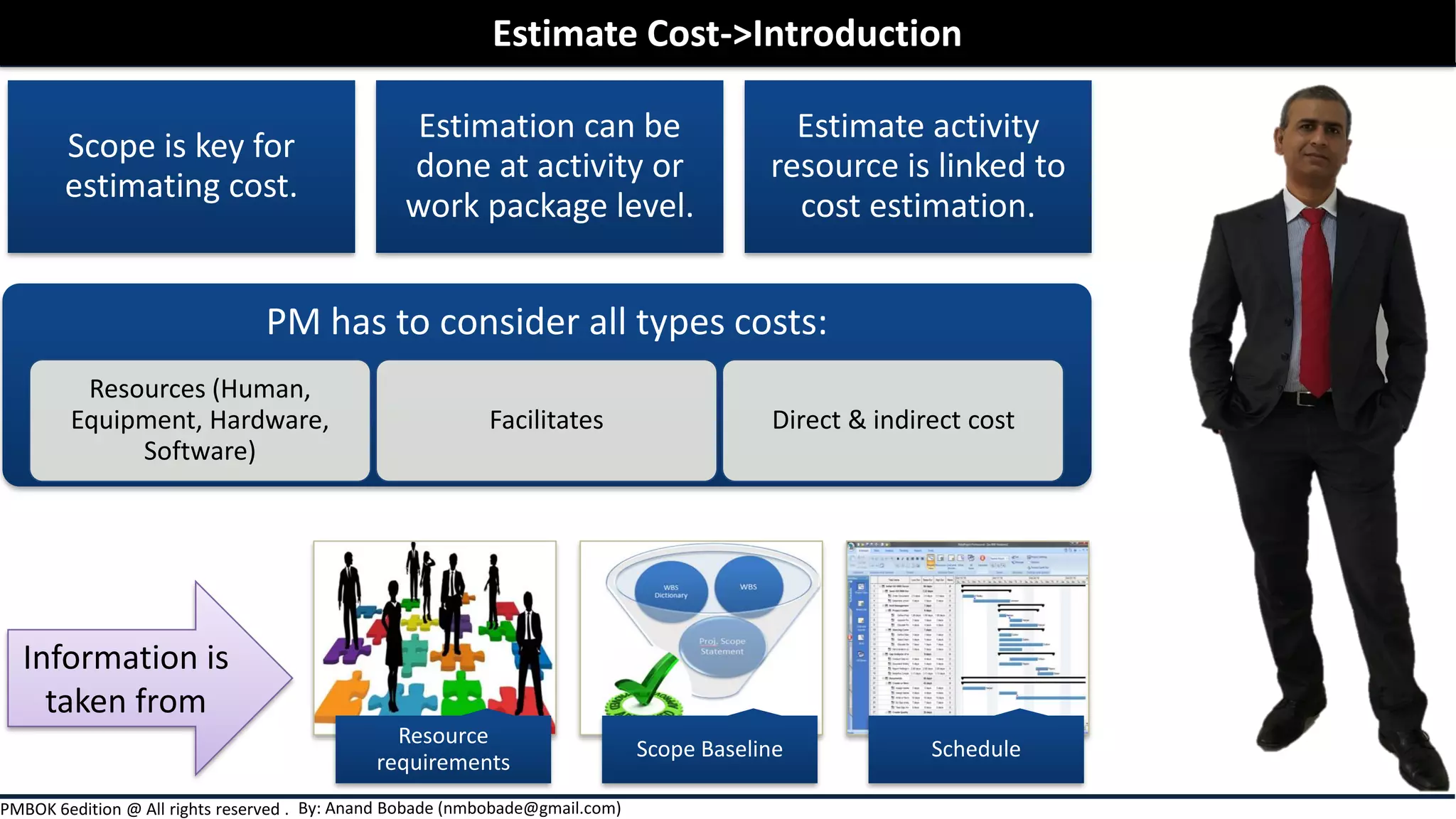
Scope is key for
estimating cost.
Estimation can be
done at activity or
work package level.
Estimate activity
resource is linked to
cost estimation.
PM has to consider all types costs:
Resources (Human,
Equipment, Hardware,
Software)
Facilitates Direct & indirect cost
Estimate Cost->Introduction
Information is
taken from
Resource
requirements
Scope Baseline Schedule
By: Anand Bobade (nmbobade@gmail.com)PMBOK 6edition @ All rights reserved .
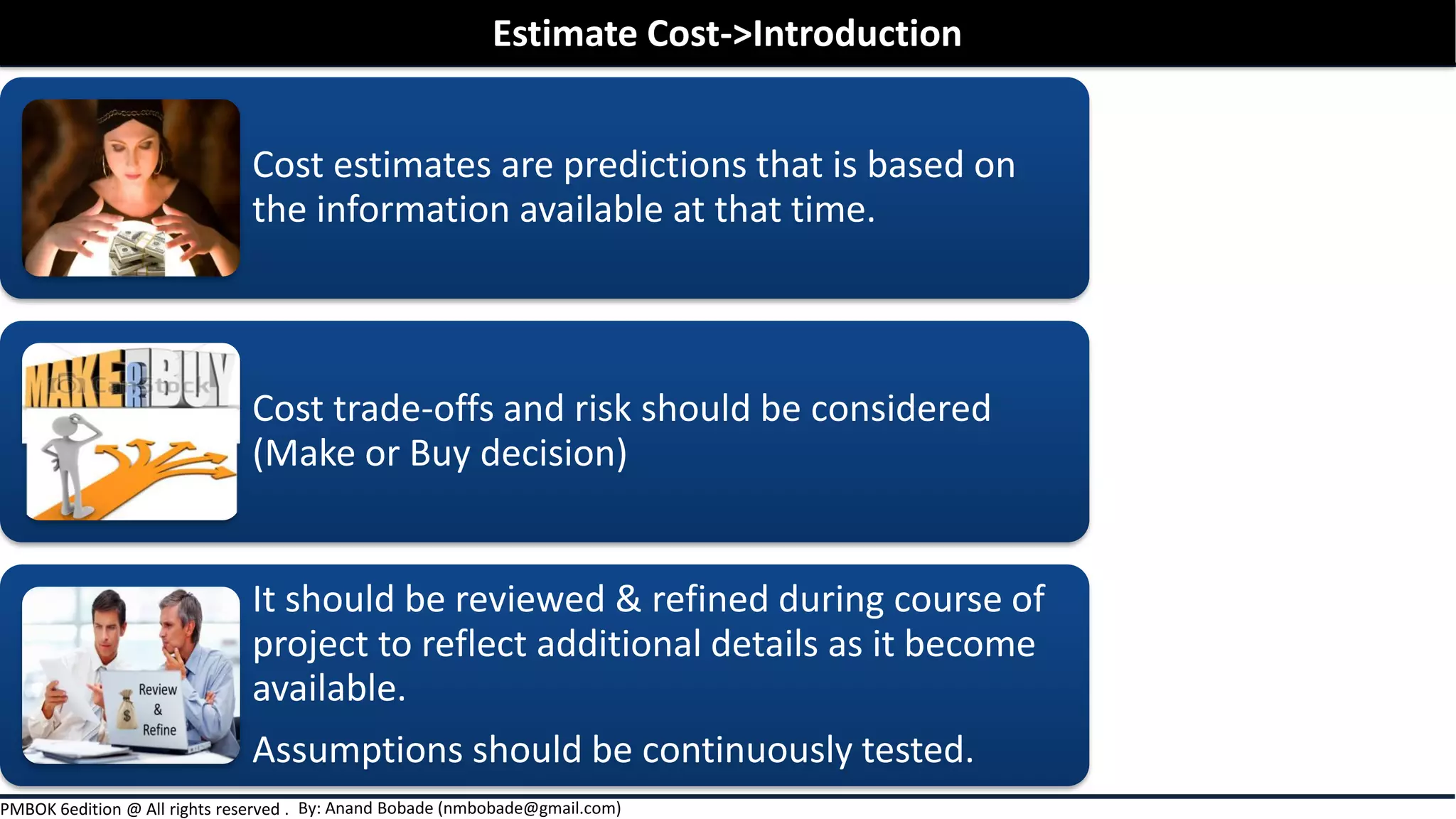
Cost estimates are predictions that is based on
the information available at that time.
Cost trade-offs and risk should be considered
(Make or Buy decision)
It should be reviewed & refined during course of
project to reflect additional details as it become
available.
Assumptions should be continuously tested.
Estimate Cost->Introduction
By: Anand Bobade (nmbobade@gmail.com)PMBOK 6edition @ All rights reserved .
The process of developing an APPROXIMATION of the monetary
resources needed to complete project activities.
It determines the amount of cost required to complete
project work.
Estimate Cost->Definition
Project Cost
Approximation
Schedule & resource Management processes
By: Anand Bobade (nmbobade@gmail.com)PMBOK 6edition @ All rights reserved .
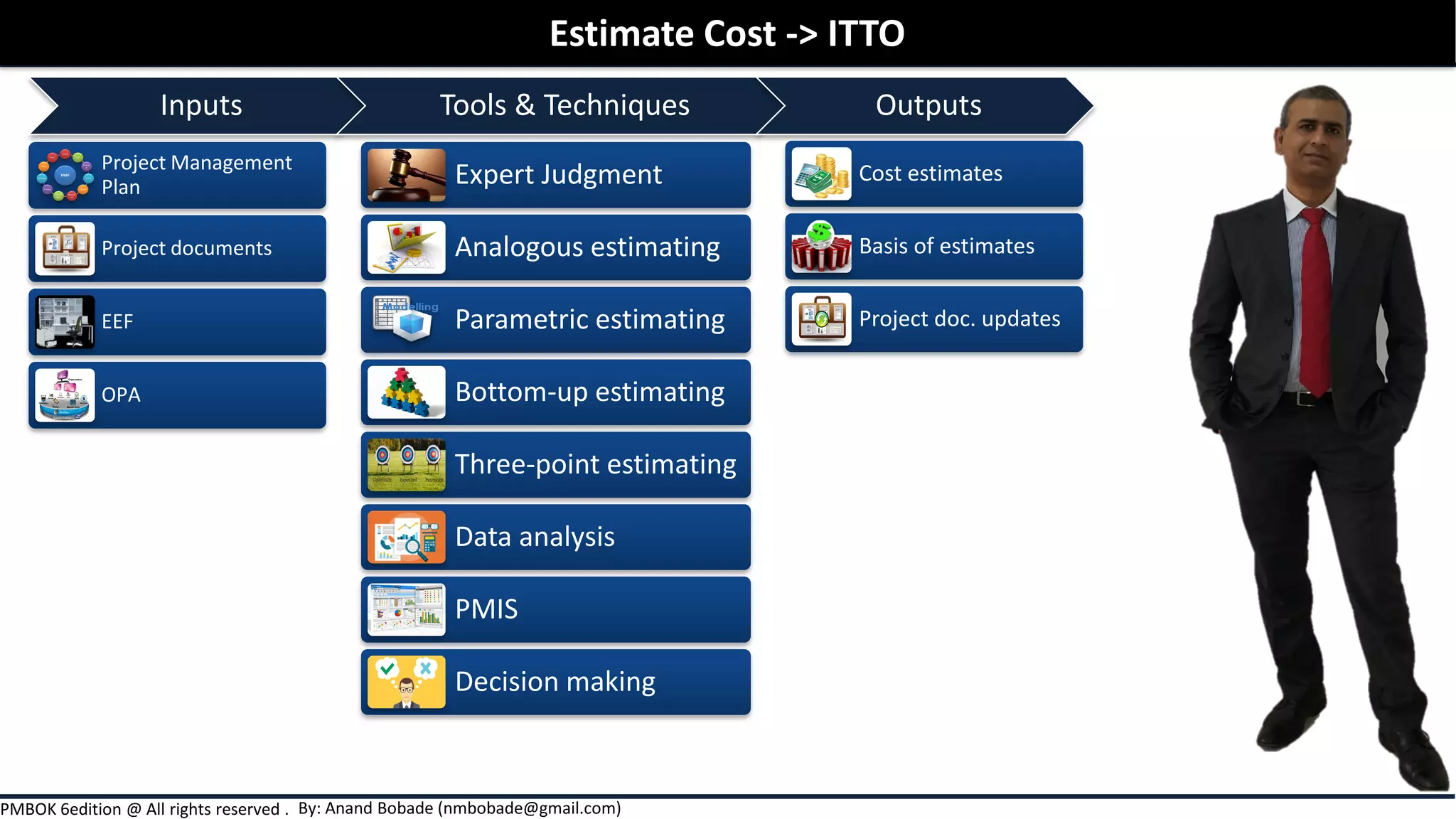
Estimate Cost -> ITTO
Expert Judgment
Analogous estimating
Parametric estimating
Bottom-up estimating
Three-point estimating
Data analysis
PMIS
Decision making
Project Management
Plan
Project documents
EEF
OPA
Cost estimates
Basis of estimates
Project doc. updates
Inputs Tools & Techniques Outputs
By: Anand Bobade (nmbobade@gmail.com)PMBOK 6edition @ All rights reserved .
PMP
Project
documents
EEF OPA
Estimate Cost -> Input
By: Anand Bobade (nmbobade@gmail.com)PMBOK 6edition @ All rights reserved .
Project
Management Plan
Cost Management Plan
• Define how project costs will be planned, structured, and
controlled.
• Define how each Cost Management Process is executed.
• Specify preferred method or techniques to be used.
Quality Management Plan:
• Cost of quality
Scope Baseline:
• Scope Statement: Project Scope (Inclusion & exclusions),
Assumptions and constraints.
• WBS: Activity groups in to deliverables or work packages. WBS
provide framework for cost management.
• WBS Dictionary: Control account. Deliverable details.
Estimate Cost ->Input->Project Management Plan
By: Anand Bobade (nmbobade@gmail.com)PMBOK 6edition @ All rights reserved .
Project
Management Plan
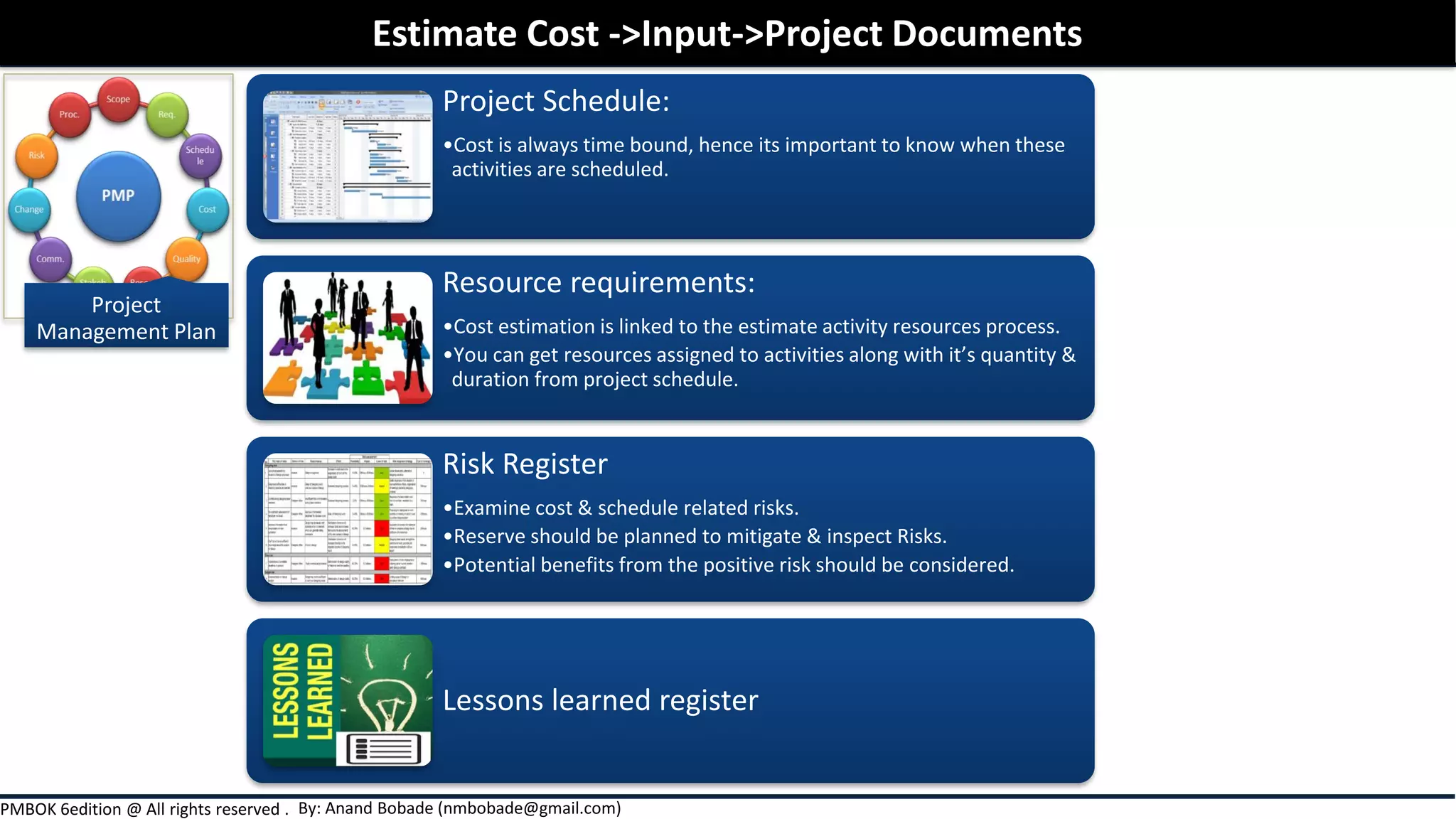
Project Schedule:
•Cost is always time bound, hence its important to know when these
activities are scheduled.
Resource requirements:
•Cost estimation is linked to the estimate activity resources process.
•You can get resources assigned to activities along with it’s quantity &
duration from project schedule.
Risk Register
•Examine cost & schedule related risks.
•Reserve should be planned to mitigate & inspect Risks.
•Potential benefits from the positive risk should be considered.
Lessons learned register
Estimate Cost ->Input->Project Documents
By: Anand Bobade (nmbobade@gmail.com)PMBOK 6edition @ All rights reserved .
EEF
Internal EEF:
• Internal Human resource rates.
• HR policies - Terms & conditions.
• Organizational culture &
structure.
External EEF:
• Market condition.
• Published Commercial
information databases (Rates,
inflation).
• Exchange rates.
Estimate Cost->Input->EEF
By: Anand Bobade (nmbobade@gmail.com)PMBOK 6edition @ All rights reserved .
OPA
Existing cost policies, procedures, and guidelines (e.g., invoicing
process)
Financial controls procedures.
Historical information and lessons learned (e.g., past cost escalation
issues)
Financial databases (Old project finance details)
Estimate Cost->Input->OPA
By: Anand Bobade (nmbobade@gmail.com)PMBOK 6edition @ All rights reserved .
Estimate Cost -> Tools & Techniques
Expert Judgment
Analogous
estimating
Parametric
estimating
Bottom-up
estimating
Three-point
estimating
Data analysis PMIS Decision making
By: Anand Bobade (nmbobade@gmail.com)PMBOK 6edition @ All rights reserved .
Estimate Cost -> Tools & Techniques
Estimation Techniques: Same in Schedule management & Cost management
Analogous estimating Parametric estimating
Three-point
estimating
By: Anand Bobade (nmbobade@gmail.com)PMBOK 6edition @ All rights reserved .
Analogues
Estimation
Estimate cost of the activity using historical data from a similar activity or a
project.
•Something similarThink “Analogy”:
•Cost, budget/measures (size, weight) &
complexity
Uses values:
•Actual cost of previous, similar projectsRelies on:
•Limited amount of information
available
Used when:
•For expert judgment.
Uses historical
information:
•Less costly, less time consuming, less
accurate.
Everything is less:
Estimate Cost->T&T-> Analogues estimation
By: Anand Bobade (nmbobade@gmail.com)PMBOK 6edition @ All rights reserved .
Computer Lab in
School A
Computer Lab in
School B
Used when:
• Only limited information
available.
• Similar project information
available
• Experienced estimator
In this scenarios - Information
available is
• Computer configurations
• Computer installation duration -
30 min
• No of computer configured - 20
Estimate Cost->T&T-> Analogues estimation
Similar
Analogues
Estimation
By: Anand Bobade (nmbobade@gmail.com)PMBOK 6edition @ All rights reserved .
Door A Door B
Estimate Cost->T&T-> Analogues estimation
Similar
Analogues
Estimation
By: Anand Bobade (nmbobade@gmail.com)PMBOK 6edition @ All rights reserved .
Estimate Cost->T&T-> Analogues estimation
Advantages
•Quick
•No need to identify activities
•Less costly to create
•Cost constraints created by
management during project
initiation gives PM data to
evaluate project feasibility
•Management can put cap on
the overall project cost.
Disadvantages
•Less accurate
•Estimation is done based on
limited information & high
level understanding of the
project
•Require considerable
experience
•Possibility of infighting to gain
biggest piece of the budget
without being able to justify
the need.
•Extremely difficult to estimate
projects with high uncertainty
Does not consider difference
between projects.
Analogues
Estimation
By: Anand Bobade (nmbobade@gmail.com)PMBOK 6edition @ All rights reserved .
Parametric
estimating
Sophisticated algorithm are used to calculate Cost based on Historical data
& multiple quantifiable parameters.
•Between historical data & other
variables
Uses statistical
relationship:
•Depending upon the sophistication of
algorithm or tools.
•Underlying data built into the model.
Can produce
higher levels of
accuracy:
•A total project or segments of a project.
•In conjunction with other estimating
methods.
Can be applied
to:
Estimate Cost->T&T-> Parametric estimation
By: Anand Bobade (nmbobade@gmail.com)PMBOK 6edition @ All rights reserved .
Parametric
estimating
E.g., CCS – Construction Computer Software (CANDY)
CANDY Software
Estimate Cost->T&T-> Parametric estimation
By: Anand Bobade (nmbobade@gmail.com)PMBOK 6edition @ All rights reserved .
Project A (completed):
• Installation of 1,000 meter Cable
• Installation type: simple
• Resource:1
• Duration taken: 40 hours
• Productivity: 25 meter’s per
hour’s
• Cost: 40*AED 100/hour = 4,000
Project B (New)
• Installation of 2,000 meter Cable
• Installation type: complex
• Resource:1
• Productivity: 20 meter’s per
hour’s (by applying complexity
factor)
• Duration Required: 100 hours
(2,000 /20)
• Cost: 100 & AED 1000/hour =
10,000
• Function Point Models
• COCOMO II (COnstructive COst MOdel ) Model
• SLOC (Source lines of code) Model
Software
Parametric Cost
Models
Most industries has their own estimation model.
Estimate Cost->T&T-> Parametric estimation
Parametric
estimating
By: Anand Bobade (nmbobade@gmail.com)PMBOK 6edition @ All rights reserved .
Three point
estimation
A technique used to estimate cost by applying an average of optimistic, pessimistic &
most likely estimates
Used when there is uncertainty with the individual activity estimates.
•Based on analysis of the best-case
scenario.
Optimistic
(O):
•Based on realistic effort assessment for
required work & any predicted expenses
(or ML)
Most likely
(M) :
•Based on analysis of the worst-case
scenario.
Pessimistic
(P).
Estimate Cost->T&T-> Three point estimation
By: Anand Bobade (nmbobade@gmail.com)PMBOK 6edition @ All rights reserved .
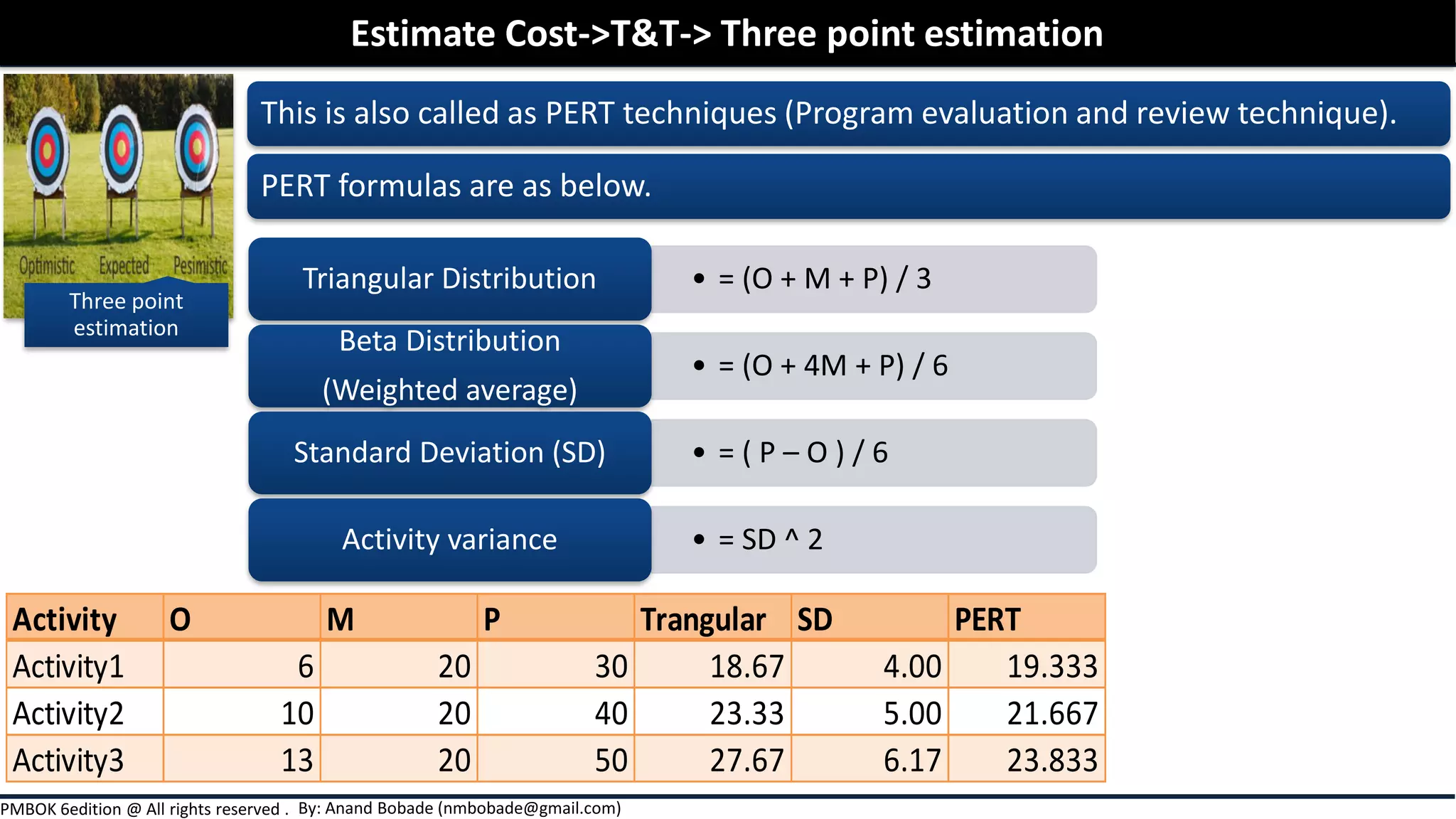
• = (O + M + P) / 3Triangular Distribution
• = (O + 4M + P) / 6
Beta Distribution
(Weighted average)
• = ( P – O ) / 6Standard Deviation (SD)
• = SD ^ 2Activity variance
Activity O M P Trangular SD PERT
Activity1 6 20 30 18.67 4.00 19.333
Activity2 10 20 40 23.33 5.00 21.667
Activity3 13 20 50 27.67 6.17 23.833
This is also called as PERT techniques (Program evaluation and review technique).
PERT formulas are as below.
Estimate Cost->T&T-> Three point estimation
Three point
estimation
By: Anand Bobade (nmbobade@gmail.com)PMBOK 6edition @ All rights reserved .
Bottom up
estimate
Estimating project cost by aggregating the estimates of the lower-level components
of the WBS.
When an activity cannot be estimated with confidence, the work within activity is
decomposed further.
These estimates are then aggregated into a total cost for each of the activity
(Summarised or Rolled-up to higher level)
Estimate Cost->T&T-> Bottom up estimate
By: Anand Bobade (nmbobade@gmail.com)PMBOK 6edition @ All rights reserved .
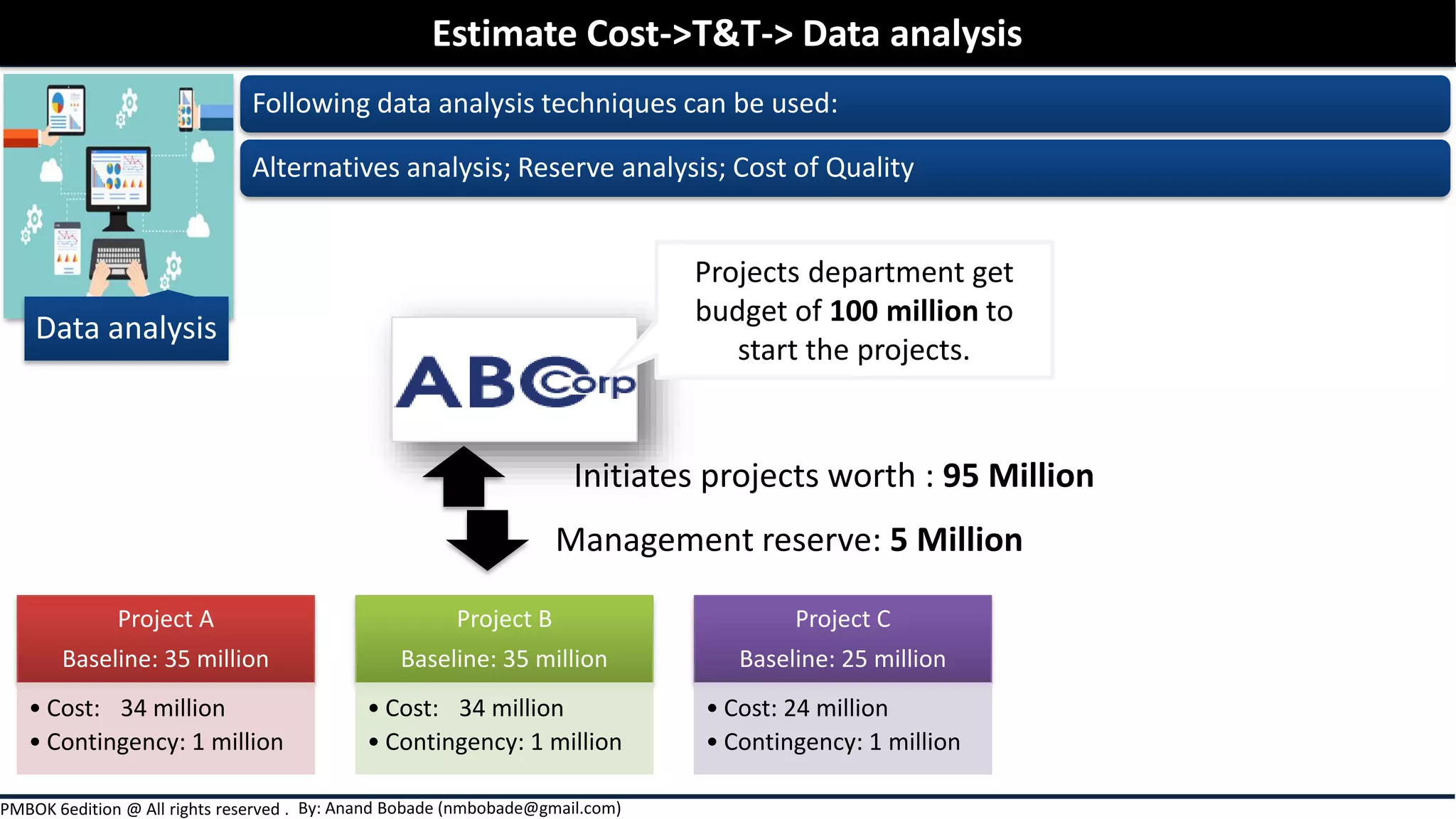
Data analysis
Estimate Cost->T&T-> Data analysis
Project A
Baseline: 35 million
• Cost: 34 million
• Contingency: 1 million
Project B
Baseline: 35 million
• Cost: 34 million
• Contingency: 1 million
Project C
Baseline: 25 million
• Cost: 24 million
• Contingency: 1 million
Projects department get
budget of 100 million to
start the projects.
Initiates projects worth : 95 Million
Management reserve: 5 Million
Following data analysis techniques can be used:
Alternatives analysis; Reserve analysis; Cost of Quality
By: Anand Bobade (nmbobade@gmail.com)PMBOK 6edition @ All rights reserved .
It is a budget within cost
baseline that is allocated for
identified & accepted risks
(known-unknowns)
Contingency Reserve:
Reserved for unforeseen risks
(unknown unknowns) related to
the work that is within scope of
the project.
Management Reserve:
Estimate Cost->T&T-> Data analysis-> Reserve Analysis
Reserve Analysis:
•Refer to analyzing contingency & management reserves to deal with risks.
Data analysis
By: Anand Bobade (nmbobade@gmail.com)PMBOK 6edition @ All rights reserved .
Estimate Cost->T&T-> Data analysis-> Reserve Analysis
575
25
550
50
500
250
150
50 50 50
100
25 25 50
250
100 100 50
250
Cost Budget
Management Reserve
Cost Baseline
Contingency Reserve
Project Estimates
Control Account estimate
Work Package estimate
Activity Estimate
Data analysis
By: Anand Bobade (nmbobade@gmail.com)PMBOK 6edition @ All rights reserved .
Data analysis
Contingency Reserve:
It is a budget within cost baseline that is allocated for identified &
accepted risks (known-unknowns)
Allocation can be for specific activity/ Project, or both.
Allocation can be % of the estimated cost or a fixed number-
Quantitative analysis.
Contingency can be reduced, or eliminated.
Contingency should be clearly documented.
It is a part of the cost baseline & overall funding requirements.
Estimate Cost->T&T-> Data analysis-> Reserve Analysis
By: Anand Bobade (nmbobade@gmail.com)PMBOK 6edition @ All rights reserved .
Management Reserve:
It is project budget withheld for management control
purposes.
Reserved for unforeseen work that is within scope of the
project (unknown unknowns).
Not included in the cost baseline.
But is part of the overall project budget and funding
requirements.
When management reserve used, it is added to cost baseline,
thus requiring an approved change to cost baseline.
Estimate Cost->T&T-> Data analysis-> Reserve Analysis
Data analysis
By: Anand Bobade (nmbobade@gmail.com)PMBOK 6edition @ All rights reserved .
Data analysis
Cost of Quality:
• Cost of quality should be included in estimate.
• Assumptions about costs of quality is used to prepare activity cost
estimate.
Estimate Cost->T&T-> Data analysis-> Cost of Quality
By: Anand Bobade (nmbobade@gmail.com)PMBOK 6edition @ All rights reserved .
PMIS
Assist , simplify, facilitate estimations & helps in rapid alternative estimations.
Plan, organize & manage the resource costs. Develop resource estimates
Estimate Cost->T&T->Project Management Information system
Can automatically aggregate cost
estimates
Can help manage & track cash flow
Can generate reports
By: Anand Bobade (nmbobade@gmail.com)PMBOK 6edition @ All rights reserved .
Decision
Making
Team based estimation approach. Helps to get
commitment on emerging estimates.
Required to improve estimation accuracy.
Brainstorming & Delphi or nominal group techniques.
Estimate Cost->T&T->Decision Making
By: Anand Bobade (nmbobade@gmail.com)PMBOK 6edition @ All rights reserved .
Estimate Cost -> Output
Cost estimates Basis of estimates Project doc. updates
By: Anand Bobade (nmbobade@gmail.com)PMBOK 6edition @ All rights reserved .
Include quantitative assessments of the probable costs required to complete project
work, as well as contingency amounts for identified risks, management reserve for
unplanned work
Estimate Cost -> Output->Cost Estimate
Cost estimates
Direct Cost Indirect Cost
Variable
cost
Fixed Cost
By: Anand Bobade (nmbobade@gmail.com)PMBOK 6edition @ All rights reserved .
Basis of
Estimates
Documentation contain:
The basis of
estimate
All assumptions
made
Any known
constraints
Estimation may be indication of :
Range of possible estimates:
• e.g., AED 1,000 (±10%)
Confidence/Accuracy level (as per PMI):
•Rough order of magnitude – ROM (–25 to
+75%) – During project initiation
•Definite (–5 to +10%) – after baseline.
Supporting documentation detailing how cost estimate was derived.
Estimate Cost -> Output-> Basis of Estimate
By: Anand Bobade (nmbobade@gmail.com)PMBOK 6edition @ All rights reserved .
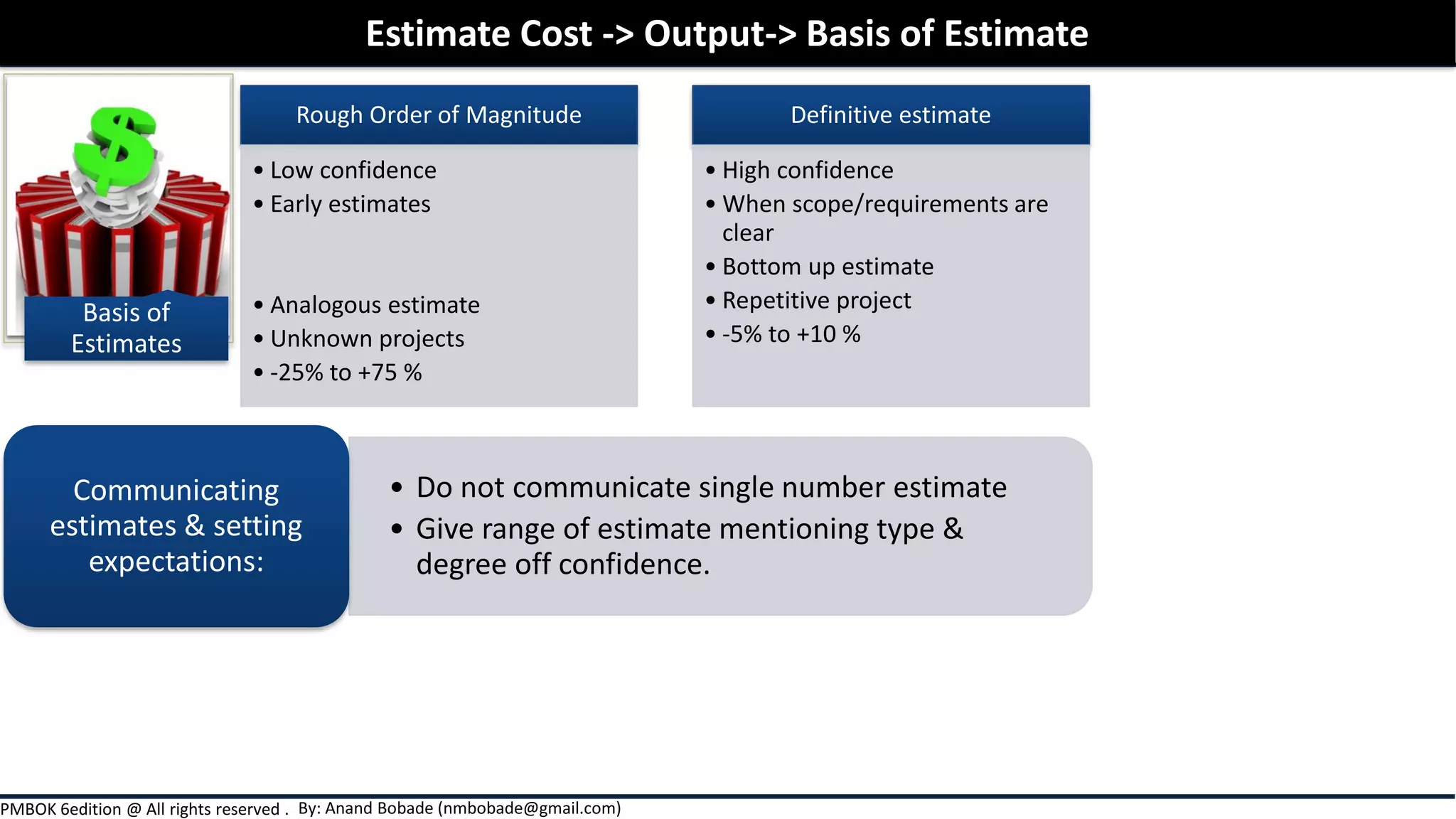
Rough Order of Magnitude
• Low confidence
• Early estimates
• Analogous estimate
• Unknown projects
• -25% to +75 %
Definitive estimate
• High confidence
• When scope/requirements are
clear
• Bottom up estimate
• Repetitive project
• -5% to +10 %
• Do not communicate single number estimate
• Give range of estimate mentioning type &
degree off confidence.
Communicating
estimates & setting
expectations:
Estimate Cost -> Output-> Basis of Estimate
Basis of
Estimates
By: Anand Bobade (nmbobade@gmail.com)PMBOK 6edition @ All rights reserved .
Estimate Cost -> Review
Lot of information gathering need to be
done before estimation
Cost Estimation is tightly linked to time
management
Do not communicate single estimate
(communicate ROM & definitive)
Different type of estimation techniques
Contingency & management reserve
Cost of quality should be considered in
estimation
By: Anand Bobade (nmbobade@gmail.com)PMBOK 6edition @ All rights reserved .

Chap 7.2 Estimate Cost

  • 1.
    Chapter 7 – ProjectCost Management PMP Trainer: Anand BobadePMBOK 6th Edition, 2019, All rights reserved. Estimate Cost SIXTH EDITION
  • 2.
    By: Anand Bobade(nmbobade@gmail.com)PMBOK 6edition @ All rights reserved . Overview Estimate Cost Definition Estimate Cost : ITTO Estimation techniques? Contingency & management reserves? Review 7.2 Estimate Cost
  • 3.
    By: Anand Bobade(nmbobade@gmail.com)PMBOK 6edition @ All rights reserved . Plan Cost Management: Estimate Cost Determine Budget Control Cost Project Cost Management Processes
  • 4.
    By: Anand Bobade(nmbobade@gmail.com)PMBOK 6edition @ All rights reserved . Scope is key for estimating cost. Estimation can be done at activity or work package level. Estimate activity resource is linked to cost estimation. PM has to consider all types costs: Resources (Human, Equipment, Hardware, Software) Facilitates Direct & indirect cost Estimate Cost->Introduction Information is taken from Resource requirements Scope Baseline Schedule
  • 5.
    By: Anand Bobade(nmbobade@gmail.com)PMBOK 6edition @ All rights reserved . Cost estimates are predictions that is based on the information available at that time. Cost trade-offs and risk should be considered (Make or Buy decision) It should be reviewed & refined during course of project to reflect additional details as it become available. Assumptions should be continuously tested. Estimate Cost->Introduction
  • 6.
    By: Anand Bobade(nmbobade@gmail.com)PMBOK 6edition @ All rights reserved . The process of developing an APPROXIMATION of the monetary resources needed to complete project activities. It determines the amount of cost required to complete project work. Estimate Cost->Definition Project Cost Approximation Schedule & resource Management processes
  • 7.
    By: Anand Bobade(nmbobade@gmail.com)PMBOK 6edition @ All rights reserved . Estimate Cost -> ITTO Expert Judgment Analogous estimating Parametric estimating Bottom-up estimating Three-point estimating Data analysis PMIS Decision making Project Management Plan Project documents EEF OPA Cost estimates Basis of estimates Project doc. updates Inputs Tools & Techniques Outputs
  • 8.
    By: Anand Bobade(nmbobade@gmail.com)PMBOK 6edition @ All rights reserved . PMP Project documents EEF OPA Estimate Cost -> Input
  • 9.
    By: Anand Bobade(nmbobade@gmail.com)PMBOK 6edition @ All rights reserved . Project Management Plan Cost Management Plan • Define how project costs will be planned, structured, and controlled. • Define how each Cost Management Process is executed. • Specify preferred method or techniques to be used. Quality Management Plan: • Cost of quality Scope Baseline: • Scope Statement: Project Scope (Inclusion & exclusions), Assumptions and constraints. • WBS: Activity groups in to deliverables or work packages. WBS provide framework for cost management. • WBS Dictionary: Control account. Deliverable details. Estimate Cost ->Input->Project Management Plan
  • 10.
    By: Anand Bobade(nmbobade@gmail.com)PMBOK 6edition @ All rights reserved . Project Management Plan Project Schedule: •Cost is always time bound, hence its important to know when these activities are scheduled. Resource requirements: •Cost estimation is linked to the estimate activity resources process. •You can get resources assigned to activities along with it’s quantity & duration from project schedule. Risk Register •Examine cost & schedule related risks. •Reserve should be planned to mitigate & inspect Risks. •Potential benefits from the positive risk should be considered. Lessons learned register Estimate Cost ->Input->Project Documents
  • 11.
    By: Anand Bobade(nmbobade@gmail.com)PMBOK 6edition @ All rights reserved . EEF Internal EEF: • Internal Human resource rates. • HR policies - Terms & conditions. • Organizational culture & structure. External EEF: • Market condition. • Published Commercial information databases (Rates, inflation). • Exchange rates. Estimate Cost->Input->EEF
  • 12.
    By: Anand Bobade(nmbobade@gmail.com)PMBOK 6edition @ All rights reserved . OPA Existing cost policies, procedures, and guidelines (e.g., invoicing process) Financial controls procedures. Historical information and lessons learned (e.g., past cost escalation issues) Financial databases (Old project finance details) Estimate Cost->Input->OPA
  • 13.
    By: Anand Bobade(nmbobade@gmail.com)PMBOK 6edition @ All rights reserved . Estimate Cost -> Tools & Techniques Expert Judgment Analogous estimating Parametric estimating Bottom-up estimating Three-point estimating Data analysis PMIS Decision making
  • 14.
    By: Anand Bobade(nmbobade@gmail.com)PMBOK 6edition @ All rights reserved . Estimate Cost -> Tools & Techniques Estimation Techniques: Same in Schedule management & Cost management Analogous estimating Parametric estimating Three-point estimating
  • 15.
    By: Anand Bobade(nmbobade@gmail.com)PMBOK 6edition @ All rights reserved . Analogues Estimation Estimate cost of the activity using historical data from a similar activity or a project. •Something similarThink “Analogy”: •Cost, budget/measures (size, weight) & complexity Uses values: •Actual cost of previous, similar projectsRelies on: •Limited amount of information available Used when: •For expert judgment. Uses historical information: •Less costly, less time consuming, less accurate. Everything is less: Estimate Cost->T&T-> Analogues estimation
  • 16.
    By: Anand Bobade(nmbobade@gmail.com)PMBOK 6edition @ All rights reserved . Computer Lab in School A Computer Lab in School B Used when: • Only limited information available. • Similar project information available • Experienced estimator In this scenarios - Information available is • Computer configurations • Computer installation duration - 30 min • No of computer configured - 20 Estimate Cost->T&T-> Analogues estimation Similar Analogues Estimation
  • 17.
    By: Anand Bobade(nmbobade@gmail.com)PMBOK 6edition @ All rights reserved . Door A Door B Estimate Cost->T&T-> Analogues estimation Similar Analogues Estimation
  • 18.
    By: Anand Bobade(nmbobade@gmail.com)PMBOK 6edition @ All rights reserved . Estimate Cost->T&T-> Analogues estimation Advantages •Quick •No need to identify activities •Less costly to create •Cost constraints created by management during project initiation gives PM data to evaluate project feasibility •Management can put cap on the overall project cost. Disadvantages •Less accurate •Estimation is done based on limited information & high level understanding of the project •Require considerable experience •Possibility of infighting to gain biggest piece of the budget without being able to justify the need. •Extremely difficult to estimate projects with high uncertainty Does not consider difference between projects. Analogues Estimation
  • 19.
    By: Anand Bobade(nmbobade@gmail.com)PMBOK 6edition @ All rights reserved . Parametric estimating Sophisticated algorithm are used to calculate Cost based on Historical data & multiple quantifiable parameters. •Between historical data & other variables Uses statistical relationship: •Depending upon the sophistication of algorithm or tools. •Underlying data built into the model. Can produce higher levels of accuracy: •A total project or segments of a project. •In conjunction with other estimating methods. Can be applied to: Estimate Cost->T&T-> Parametric estimation
  • 20.
    By: Anand Bobade(nmbobade@gmail.com)PMBOK 6edition @ All rights reserved . Parametric estimating E.g., CCS – Construction Computer Software (CANDY) CANDY Software Estimate Cost->T&T-> Parametric estimation
  • 21.
    By: Anand Bobade(nmbobade@gmail.com)PMBOK 6edition @ All rights reserved . Project A (completed): • Installation of 1,000 meter Cable • Installation type: simple • Resource:1 • Duration taken: 40 hours • Productivity: 25 meter’s per hour’s • Cost: 40*AED 100/hour = 4,000 Project B (New) • Installation of 2,000 meter Cable • Installation type: complex • Resource:1 • Productivity: 20 meter’s per hour’s (by applying complexity factor) • Duration Required: 100 hours (2,000 /20) • Cost: 100 & AED 1000/hour = 10,000 • Function Point Models • COCOMO II (COnstructive COst MOdel ) Model • SLOC (Source lines of code) Model Software Parametric Cost Models Most industries has their own estimation model. Estimate Cost->T&T-> Parametric estimation Parametric estimating
  • 22.
    By: Anand Bobade(nmbobade@gmail.com)PMBOK 6edition @ All rights reserved . Three point estimation A technique used to estimate cost by applying an average of optimistic, pessimistic & most likely estimates Used when there is uncertainty with the individual activity estimates. •Based on analysis of the best-case scenario. Optimistic (O): •Based on realistic effort assessment for required work & any predicted expenses (or ML) Most likely (M) : •Based on analysis of the worst-case scenario. Pessimistic (P). Estimate Cost->T&T-> Three point estimation
  • 23.
    By: Anand Bobade(nmbobade@gmail.com)PMBOK 6edition @ All rights reserved . • = (O + M + P) / 3Triangular Distribution • = (O + 4M + P) / 6 Beta Distribution (Weighted average) • = ( P – O ) / 6Standard Deviation (SD) • = SD ^ 2Activity variance Activity O M P Trangular SD PERT Activity1 6 20 30 18.67 4.00 19.333 Activity2 10 20 40 23.33 5.00 21.667 Activity3 13 20 50 27.67 6.17 23.833 This is also called as PERT techniques (Program evaluation and review technique). PERT formulas are as below. Estimate Cost->T&T-> Three point estimation Three point estimation
  • 24.
    By: Anand Bobade(nmbobade@gmail.com)PMBOK 6edition @ All rights reserved . Bottom up estimate Estimating project cost by aggregating the estimates of the lower-level components of the WBS. When an activity cannot be estimated with confidence, the work within activity is decomposed further. These estimates are then aggregated into a total cost for each of the activity (Summarised or Rolled-up to higher level) Estimate Cost->T&T-> Bottom up estimate
  • 25.
    By: Anand Bobade(nmbobade@gmail.com)PMBOK 6edition @ All rights reserved . Data analysis Estimate Cost->T&T-> Data analysis Project A Baseline: 35 million • Cost: 34 million • Contingency: 1 million Project B Baseline: 35 million • Cost: 34 million • Contingency: 1 million Project C Baseline: 25 million • Cost: 24 million • Contingency: 1 million Projects department get budget of 100 million to start the projects. Initiates projects worth : 95 Million Management reserve: 5 Million Following data analysis techniques can be used: Alternatives analysis; Reserve analysis; Cost of Quality
  • 26.
    By: Anand Bobade(nmbobade@gmail.com)PMBOK 6edition @ All rights reserved . It is a budget within cost baseline that is allocated for identified & accepted risks (known-unknowns) Contingency Reserve: Reserved for unforeseen risks (unknown unknowns) related to the work that is within scope of the project. Management Reserve: Estimate Cost->T&T-> Data analysis-> Reserve Analysis Reserve Analysis: •Refer to analyzing contingency & management reserves to deal with risks. Data analysis
  • 27.
    By: Anand Bobade(nmbobade@gmail.com)PMBOK 6edition @ All rights reserved . Estimate Cost->T&T-> Data analysis-> Reserve Analysis 575 25 550 50 500 250 150 50 50 50 100 25 25 50 250 100 100 50 250 Cost Budget Management Reserve Cost Baseline Contingency Reserve Project Estimates Control Account estimate Work Package estimate Activity Estimate Data analysis
  • 28.
    By: Anand Bobade(nmbobade@gmail.com)PMBOK 6edition @ All rights reserved . Data analysis Contingency Reserve: It is a budget within cost baseline that is allocated for identified & accepted risks (known-unknowns) Allocation can be for specific activity/ Project, or both. Allocation can be % of the estimated cost or a fixed number- Quantitative analysis. Contingency can be reduced, or eliminated. Contingency should be clearly documented. It is a part of the cost baseline & overall funding requirements. Estimate Cost->T&T-> Data analysis-> Reserve Analysis
  • 29.
    By: Anand Bobade(nmbobade@gmail.com)PMBOK 6edition @ All rights reserved . Management Reserve: It is project budget withheld for management control purposes. Reserved for unforeseen work that is within scope of the project (unknown unknowns). Not included in the cost baseline. But is part of the overall project budget and funding requirements. When management reserve used, it is added to cost baseline, thus requiring an approved change to cost baseline. Estimate Cost->T&T-> Data analysis-> Reserve Analysis Data analysis
  • 30.
    By: Anand Bobade(nmbobade@gmail.com)PMBOK 6edition @ All rights reserved . Data analysis Cost of Quality: • Cost of quality should be included in estimate. • Assumptions about costs of quality is used to prepare activity cost estimate. Estimate Cost->T&T-> Data analysis-> Cost of Quality
  • 31.
    By: Anand Bobade(nmbobade@gmail.com)PMBOK 6edition @ All rights reserved . PMIS Assist , simplify, facilitate estimations & helps in rapid alternative estimations. Plan, organize & manage the resource costs. Develop resource estimates Estimate Cost->T&T->Project Management Information system Can automatically aggregate cost estimates Can help manage & track cash flow Can generate reports
  • 32.
    By: Anand Bobade(nmbobade@gmail.com)PMBOK 6edition @ All rights reserved . Decision Making Team based estimation approach. Helps to get commitment on emerging estimates. Required to improve estimation accuracy. Brainstorming & Delphi or nominal group techniques. Estimate Cost->T&T->Decision Making
  • 33.
    By: Anand Bobade(nmbobade@gmail.com)PMBOK 6edition @ All rights reserved . Estimate Cost -> Output Cost estimates Basis of estimates Project doc. updates
  • 34.
    By: Anand Bobade(nmbobade@gmail.com)PMBOK 6edition @ All rights reserved . Include quantitative assessments of the probable costs required to complete project work, as well as contingency amounts for identified risks, management reserve for unplanned work Estimate Cost -> Output->Cost Estimate Cost estimates Direct Cost Indirect Cost Variable cost Fixed Cost
  • 35.
    By: Anand Bobade(nmbobade@gmail.com)PMBOK 6edition @ All rights reserved . Basis of Estimates Documentation contain: The basis of estimate All assumptions made Any known constraints Estimation may be indication of : Range of possible estimates: • e.g., AED 1,000 (±10%) Confidence/Accuracy level (as per PMI): •Rough order of magnitude – ROM (–25 to +75%) – During project initiation •Definite (–5 to +10%) – after baseline. Supporting documentation detailing how cost estimate was derived. Estimate Cost -> Output-> Basis of Estimate
  • 36.
    By: Anand Bobade(nmbobade@gmail.com)PMBOK 6edition @ All rights reserved . Rough Order of Magnitude • Low confidence • Early estimates • Analogous estimate • Unknown projects • -25% to +75 % Definitive estimate • High confidence • When scope/requirements are clear • Bottom up estimate • Repetitive project • -5% to +10 % • Do not communicate single number estimate • Give range of estimate mentioning type & degree off confidence. Communicating estimates & setting expectations: Estimate Cost -> Output-> Basis of Estimate Basis of Estimates
  • 37.
    By: Anand Bobade(nmbobade@gmail.com)PMBOK 6edition @ All rights reserved . Estimate Cost -> Review Lot of information gathering need to be done before estimation Cost Estimation is tightly linked to time management Do not communicate single estimate (communicate ROM & definitive) Different type of estimation techniques Contingency & management reserve Cost of quality should be considered in estimation
  • 38.
    By: Anand Bobade(nmbobade@gmail.com)PMBOK 6edition @ All rights reserved .