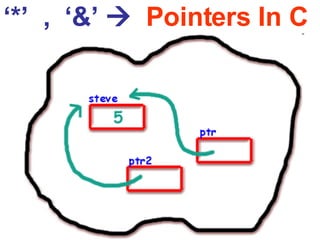
‘ *’  ,  ‘&’     Pointers In C
About me Sriram kumar . K III rd year CSE  Email - Sri2k42002@yahoo.co.in
What is a Pointer ?
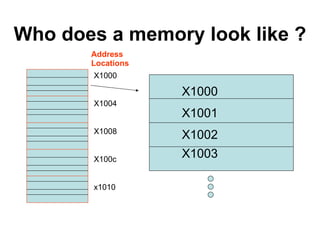
X1000 X1004 X1008 X100c x1010 Who does a memory look like ? X1000 X1001 X1002 X1003   Address Locations
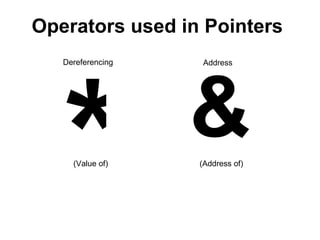
Operators used in Pointers  * & Address Dereferencing (Address of) (Value of)
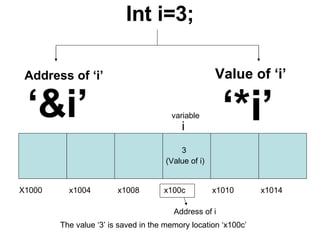
Int i=3; Address of ‘i’ Value of ‘i’ X1000  x1004  x1008  x100c  x1010  x1014 variable i 3 (Value of i) Address of i ‘ &i’ ‘ *i’ The value ‘3’ is saved in the memory location ‘x100c’
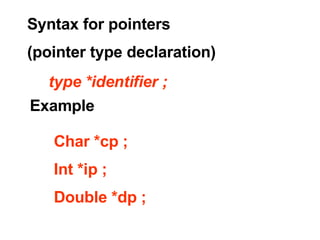
Syntax for pointers (pointer type declaration) type *identifier ; Example  Char *cp ; Int *ip ; Double *dp ;
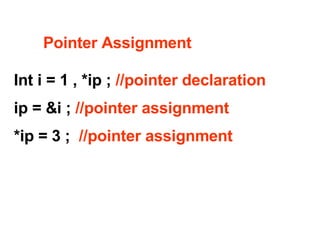
Pointer Assignment   Int i = 1 , *ip ;  //pointer declaration   ip = &i ;  //pointer assignment *ip = 3 ;  //pointer assignment
Pointer Arithmetic Lets take this example program #include<stdio.h> Void main() { Int a [5]={1,2,3,4,5} , b , *pt ; pt = &a[0]; pt = pt + 4 ; b=a[0] ;  b+=4 ; } a[0] X1000  x1004  x1008  x100c  x1010 X1000  x1004  x1008  x100c  x1010 a[2] a[1] a[4] a[3] a[0] a[2] a[1] a[4] a[3] b b = 1  b=1+4  b= 5 pt
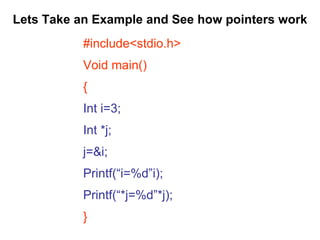
Lets Take an Example and See how pointers work #include<stdio.h> Void main() { Int i=3; Int *j; j=&i; Printf(“i=%d”i); Printf(“*j=%d”*j); }
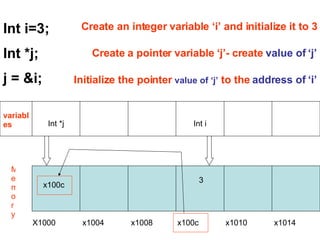
X1000  x1004  x1008  x100c  x1010  x1014 3 Memory variables Int i Int *j Int i=3; Int *j; j = &i; x100c Create an integer variable ‘i’ and initialize it to 3 Create a pointer variable ‘j’- create  value of ‘j’ Initialize the pointer  value of ‘j’  to the  address of ‘i’
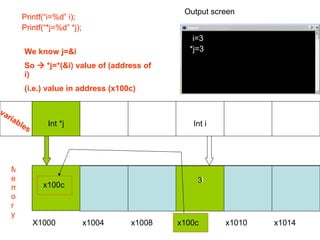
X1000  x1004  x1008  x100c  x1010  x1014 Memory variables Int i Int *j Output screen Printf(“i=%d” i); We know j=&i So    *j=*(&i) value of (address of i) (i.e.) value in address (x100c) Printf(“i=%d” i); i=3 *j=3 Printf(“*j=%d” *j); Printf(“*j=%d” *j); x100c 3 3
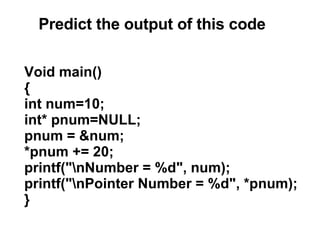
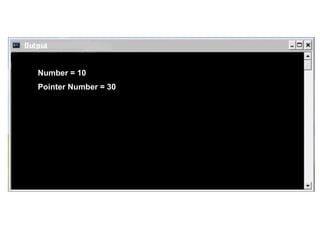
Void main() { int num=10; int* pnum=NULL; pnum = &num; *pnum += 20; printf(&quot;\nNumber = %d&quot;, num); printf(&quot;\nPointer Number = %d&quot;, *pnum); } Predict the output of this code
Number = 10 Pointer Number = 30
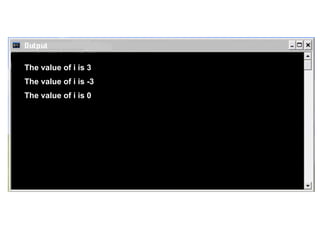
int a[10] = {1,2,3,4,5,6,7,8,9,12} ,*p, *q , i; p = &a[2]; q = &a[5]; i = *q - *p;  Printf(“The value of i is %d” i ); i = *p - *q;  Printf(“The value of i is %d” i ); a[2] = a[5] = 0; Printf(“The value of i is %d” i ); Work to your Brain
The value of i is 3 The value of i is -3 The value of i is 0
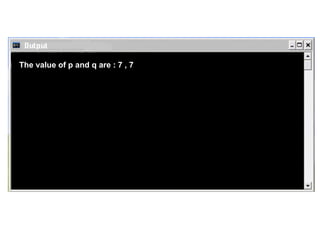
int a[10] = { 2,3,4,5,6,7,8,9,1,0 }, *p, *q; p = &a[2]; q = p + 3;  p = q – 1;  p+ + ;  Printf(“The value of p and q are : %d , %d” *p,*q); Work to your Brain
The value of p and q are : 7 , 7
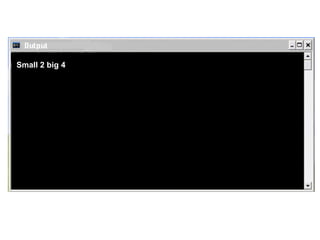
int main() { int x[2]={1,2},y[2]={3,4}; int small,big; small=&x[0]; big=&y[0]; min_max(&small,&big); printf(“small%d big%d&quot;,*small,*big); return 0; } min_max(int *a,int *b) { a++; b++; return (*a,*b); } Work to your Brain
Small 2 big 4


Pointers in C

  • 1.
    ‘ *’ , ‘&’  Pointers In C
  • 2.
    About me Sriramkumar . K III rd year CSE Email - Sri2k42002@yahoo.co.in
  • 3.
    What is aPointer ?
  • 4.
    X1000 X1004 X1008X100c x1010 Who does a memory look like ? X1000 X1001 X1002 X1003 Address Locations
  • 5.
    Operators used inPointers * & Address Dereferencing (Address of) (Value of)
  • 6.
    Int i=3; Addressof ‘i’ Value of ‘i’ X1000 x1004 x1008 x100c x1010 x1014 variable i 3 (Value of i) Address of i ‘ &i’ ‘ *i’ The value ‘3’ is saved in the memory location ‘x100c’
  • 7.
    Syntax for pointers(pointer type declaration) type *identifier ; Example Char *cp ; Int *ip ; Double *dp ;
  • 8.
    Pointer Assignment Int i = 1 , *ip ; //pointer declaration ip = &i ; //pointer assignment *ip = 3 ; //pointer assignment
  • 9.
    Pointer Arithmetic Letstake this example program #include<stdio.h> Void main() { Int a [5]={1,2,3,4,5} , b , *pt ; pt = &a[0]; pt = pt + 4 ; b=a[0] ; b+=4 ; } a[0] X1000 x1004 x1008 x100c x1010 X1000 x1004 x1008 x100c x1010 a[2] a[1] a[4] a[3] a[0] a[2] a[1] a[4] a[3] b b = 1 b=1+4 b= 5 pt
  • 10.
    Lets Take anExample and See how pointers work #include<stdio.h> Void main() { Int i=3; Int *j; j=&i; Printf(“i=%d”i); Printf(“*j=%d”*j); }
  • 11.
    X1000 x1004 x1008 x100c x1010 x1014 3 Memory variables Int i Int *j Int i=3; Int *j; j = &i; x100c Create an integer variable ‘i’ and initialize it to 3 Create a pointer variable ‘j’- create value of ‘j’ Initialize the pointer value of ‘j’ to the address of ‘i’
  • 12.
    X1000 x1004 x1008 x100c x1010 x1014 Memory variables Int i Int *j Output screen Printf(“i=%d” i); We know j=&i So  *j=*(&i) value of (address of i) (i.e.) value in address (x100c) Printf(“i=%d” i); i=3 *j=3 Printf(“*j=%d” *j); Printf(“*j=%d” *j); x100c 3 3
  • 13.
    Void main() {int num=10; int* pnum=NULL; pnum = &num; *pnum += 20; printf(&quot;\nNumber = %d&quot;, num); printf(&quot;\nPointer Number = %d&quot;, *pnum); } Predict the output of this code
  • 14.
    Number = 10Pointer Number = 30
  • 15.
    int a[10] ={1,2,3,4,5,6,7,8,9,12} ,*p, *q , i; p = &a[2]; q = &a[5]; i = *q - *p; Printf(“The value of i is %d” i ); i = *p - *q; Printf(“The value of i is %d” i ); a[2] = a[5] = 0; Printf(“The value of i is %d” i ); Work to your Brain
  • 16.
    The value ofi is 3 The value of i is -3 The value of i is 0
  • 17.
    int a[10] ={ 2,3,4,5,6,7,8,9,1,0 }, *p, *q; p = &a[2]; q = p + 3; p = q – 1; p+ + ; Printf(“The value of p and q are : %d , %d” *p,*q); Work to your Brain
  • 18.
    The value ofp and q are : 7 , 7
  • 19.
    int main() {int x[2]={1,2},y[2]={3,4}; int small,big; small=&x[0]; big=&y[0]; min_max(&small,&big); printf(“small%d big%d&quot;,*small,*big); return 0; } min_max(int *a,int *b) { a++; b++; return (*a,*b); } Work to your Brain
  • 20.
  • 21.
  • 22.