Download to read offline
![For more Https://www.ThesisScientist.com
Unit 9
Structures
Structure Definition
A structure is a collection of variables referenced under one name providing a convenient means of keeping
related information together. The structure definition creates a format that may be used to declare structure
variables in a program later on.
The general format of structure definition is as follows:
struct tag_name
{
data_type member1;
data_type member2;
- - - - - - -;
- - - - - - -;
};
The keyword struct declares a structure to hold the details of fields of different datatypes.
At this time, no variable has actually been created. Only a format of a new data type has been defined.
Consider the following example:
struct addr
{
char name [30];
char street [20];
char city [15];
char state [15];
int pincode;
};
The keyword struct declares a structure to hold the details of fine fields of address, namely, name, street,
city, state, pincode. The first four members are character array and fifth one is an integer.
Creating Structure Variables](https://image.slidesharecdn.com/unit-9focp-170510040637/85/C-structure-and-union-1-320.jpg)
![For more Https://www.ThesisScientist.com
Unit 9
Structures
Structure Definition
A structure is a collection of variables referenced under one name providing a convenient means of keeping
related information together. The structure definition creates a format that may be used to declare structure
variables in a program later on.
The general format of structure definition is as follows:
struct tag_name
{
data_type member1;
data_type member2;
- - - - - - -;
- - - - - - -;
};
The keyword struct declares a structure to hold the details of fields of different datatypes.
At this time, no variable has actually been created. Only a format of a new data type has been defined.
Consider the following example:
struct addr
{
char name [30];
char street [20];
char city [15];
char state [15];
int pincode;
};
The keyword struct declares a structure to hold the details of fine fields of address, namely, name, street,
city, state, pincode. The first four members are character array and fifth one is an integer.
Creating Structure Variables](https://image.slidesharecdn.com/unit-9focp-170510040637/75/C-structure-and-union-1-2048.jpg)
![The structure declaration does not actually create variables. Instead, it defines data type only. For actual use
a structure variable needs to be created. This can be done in two ways:
1. Declaration using tagname anywhere in the program.
e.g.: struct book
{
char name [30];
char author [25];
float price;
};
struct book book1, book2;
2. It is also allowed to combine structure declaration and variable declaration in one statement.
This declaration is given below:
struct person
{
char * name;
int age;
char *address;
} p1, p2, p3;
While declaring structure variables along with their definition, the use of tag_name is optional.
Giving Values to Members
As the members are themselves variables they should be linked to the structure variables. The Link between
a member and a variable is established using member operator '.' which is also known as dot operator.
This can be explained using following example:
e.g.: / * Program to define a structure and assign value to members * /
struct book
{
char * name;
int pages;
char *author;
};
main( )
{
struct book b1;
printf ("n Enter Values:");](https://image.slidesharecdn.com/unit-9focp-170510040637/85/C-structure-and-union-2-320.jpg)
![scanf ("%s %d %s", b1.name, &b1.page, b1.author);
printf ("%s, %d, %s, b1.name, b1.page, b1.author);
}
Structure Initialization
A structure variable can be initialized as any other data type.
main( )
{
static struct
{
int weight;
float height;
}
student = {60, 180.75};
This assigns the value 60 to student.weight and 180.75 to student.height. There is a one-to-one
correspondence between the members and their initializing values.
main( )
{
struct st_record
{
int weight;
float height;
}
static struct st_record student1 = {60, 180.75};
static struct st_record student2 = {53, 170.60};
- - - - - - -;
- - - - - - -;
}
Arrays of Structures
The most common use of structures is in arrays of structures. To declare an array of structures, first the
structure is defined then an array variable of that structure is declared. In such a declaration, each element
of the array represents a structure variable.
e.g.: struct class student [100];
It defines an array called student which consists of 100 elements of structure named class.](https://image.slidesharecdn.com/unit-9focp-170510040637/85/C-structure-and-union-3-320.jpg)
![Array within Structures
Single or multi-dimensional arrays of type int or float can be defined as structure members.
e.g.: struct marks
{
int number;
float subject [3];
}
student [2];
Here the member subject contains three elements, subject [0], subject [1], and subject [2]. These elements
can be accessed using appropriate subscripts. For instance, the name student [1].subject [2];would refer to
the marks obtained in the third subject by the second student.
e.g.: /* Program to implement arrays within a structure. * /
main( )
{
struct marks
{
int sub [3];
int total;
};
static struct marks student [3] = {45, 76, 81, 0, 75, 53, 69, 0, 57, 36, 71,
0};
static struct marks total;
int i, j;
for (i = 0; i < = 2; i++)
{
student [i].total + = student [i].sub[j]
total.sub[j] + = student [i].sub [j];
}
total.total + = student [i].sub[j];
}
total.total + = student [i].total;
}
printf ("STUDENTttTOTAL n");
}
for (i = 0; i < = 2; i++)
printf ("Student [%d]tt%dn", i + 1, student [i].total);
printf("SUBJECTttdn")
for (j = 0; j < = 2; j++)
printf ("Subject %dtt %dn", j+1, total.sub[j]);](https://image.slidesharecdn.com/unit-9focp-170510040637/85/C-structure-and-union-4-320.jpg)
![printf("GRAND TOTAL = tt%dn", total.total);
}
Output: Student Total
Student[1] 193
Student[2] 197
Student[3] 164
Subject Total
Subject1 177
Subject2 156
Subject3 221
GRAND TOTAL 554
Structures within Structures
Structures within a structure means nesting of structures. Let us consider the following structure defined to
store information about the salary of employees.
struct salary
{
char name [20];
char department [10];
int basic_pay;
int dearness_allowance;
int house_rent_allowance;
int city_allowance;
}
employee;
This structure defines name, department, basic pay and three kinds of allowances.
Passing Structures to Functions
There are three methods by which the values of a structure can be transferred from one function to another.
The first method is to pass each member of the structure as an actual argument of the function call.
The actual arguments are then treated independently like ordinary variables.
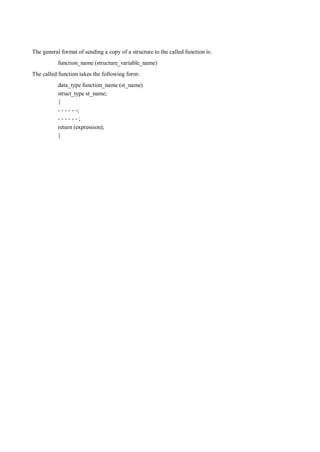
The second method involves passing of a copy of the entire structure to the called function. Since
the function is working on a copy of the entire structure to the called function, changes are not
reflected in the original structure (in the calling function). It is, therefore, necessary for the function
to return the entire structure back to the calling function.
The third approach employs a concept called pointers to pass the structure as an argument. In this
case, the address location of the structure is passed to the called function. The function can access
indirectly the entire structure and work on it.](https://image.slidesharecdn.com/unit-9focp-170510040637/85/C-structure-and-union-5-320.jpg)

The document provides an overview of structures in programming, defining a structure as a collection of variables under a single name for organizing related information. It details how to define a structure, create structure variables, initialize them, and use arrays of structures. Additionally, it covers the concept of passing structures to functions via different methods.


