Chapter 3 Planning, Sales Forecasting, and Budgeting
Learning Objectives To understand  strategic planning , its linkage to  strategic marketing  and marketing management To know how  sales strategy  is developed from marketing strategy To learn  basic terms  used in forecasting,  forecasting approaches , and  methods of sales forecasting To understand purposes and the process of  sales budget
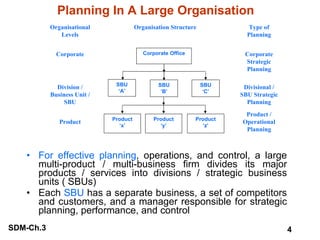
Strategic Planning Planning  is deciding now what, how, and when we are going to do Strategic planning  is deciding about the organisation’s long-term objectives and strategies In a  large organisation , planning is done at three or four organisational levels, as shown in the figure (in the next slide)
Planning In A Large Organisation For effective planning , operations, and control, a large multi-product / multi-business firm divides its major products / services into divisions / strategic business units ( SBUs) Each  SBU  has a separate business, a set of competitors and customers, and a manager responsible for strategic planning, performance, and control Corporate Office SBU ‘ A’ SBU ‘ C’ SBU ‘ B’ Product ‘ x’ Product ‘ y’ Product ‘ z’ Product / Operational Planning Product Divisional / SBU Strategic Planning Division / Business Unit / SBU Corporate Strategic Planning Corporate Type of Planning Organisation Structure Organisational Levels
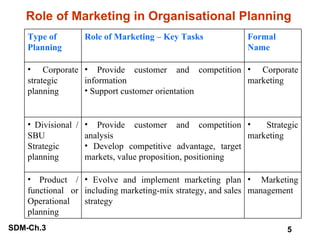
Role of Marketing in Organisational Planning   Marketing management Evolve and implement marketing plan including marketing-mix strategy, and sales strategy Product / functional or Operational planning Strategic marketing Provide customer and competition analysis Develop competitive advantage, target markets, value proposition, positioning Divisional / SBU Strategic planning Corporate marketing Provide customer and competition information Support customer orientation Corporate strategic planning Formal Name Role of Marketing – Key Tasks Type of Planning
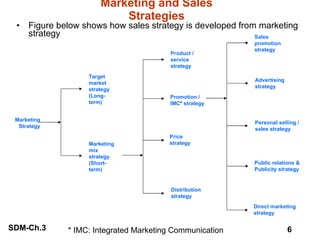
Marketing and Sales Strategies Figure below shows how sales strategy is developed from marketing strategy Marketing Strategy * IMC: Integrated Marketing Communication Target market strategy (Long-term) Marketing mix strategy (Short-term) Product / service strategy Promotion / IMC *  strategy Price strategy Distribution strategy Sales promotion strategy Advertising strategy Personal selling / sales strategy Public relations & Publicity strategy Direct marketing strategy
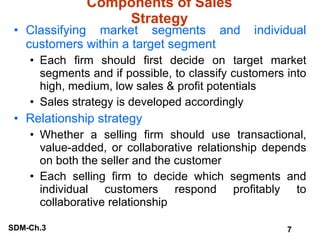
Components of Sales Strategy Classifying market segments and individual customers within a target segment Each firm should first decide on target market segments and if possible, to classify customers into high, medium, low sales & profit potentials  Sales strategy is developed accordingly Relationship strategy Whether a selling firm should use transactional, value-added, or collaborative relationship depends on both the seller and the customer Each selling firm to decide which segments and individual customers respond profitably to collaborative relationship
Components of Sales Strategy (Continued) Selling Methods These are: (1) Stimulus response, (2) formula, (3) need-satisfaction, (4) team selling, (5) consultative Selection of appropriate selling method depends on relationship strategy Channel Strategy There are many sales / marketing channels. For example: company salesforce, distributors, franchisees, agents, the internet, brokers, discount stores Selection of a suitable channel depends on both the buyer and the seller, products / services, and markets
Basic Terms Used in Sales Forecasting Market demand  for a product or service is the estimated total sales volume in a market (or industry) for a specific time period in a defined marketing environment, under a defined marketing program or expenditure. Market demand is a function associated with varying levels of industry marketing expenditure. Market (or industry) forecast (or market size)  is the expected market (or industry) demand at one level of industry marketing expenditure
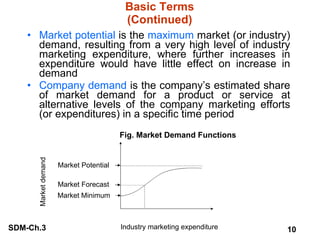
Basic Terms (Continued) Market potential  is the  maximum  market (or industry) demand, resulting from a very high level of industry marketing expenditure, where further increases in expenditure would have little effect on increase in demand Company demand  is the company’s estimated share of market demand for a product or service at alternative levels of the company marketing efforts (or expenditures) in a specific time period Market Potential Market Forecast Market Minimum Fig. Market Demand Functions Industry marketing expenditure Market demand
Basic Terms (Continued) Company sales potential  is the  maximum  estimated company sales of a product or service, based on maximum share (or percentage) of market potential expected by the company Company sales forecast  is the estimated company sales of a product or service, based on a chosen (or proposed) marketing expenditure plan, for a specific time period, in a assumed marketing environment Sales budget  is the estimate of expected sales volume in units or revenues from the company’s products and services, and the selling expenses. It is set slightly lower than the company sales forecast, to avoid excessive risks
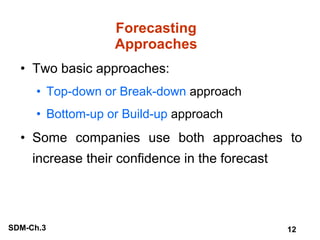
Forecasting Approaches Two basic approaches: Top-down or Break-down  approach Bottom-up or Build-up  approach Some companies use both approaches to increase their confidence in the forecast
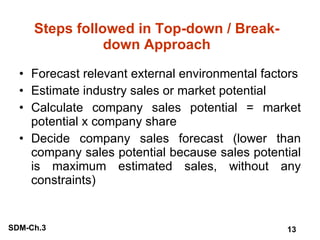
Steps followed in Top-down / Break-down Approach Forecast relevant external environmental factors Estimate industry sales or market potential Calculate company sales potential = market potential x company share Decide company sales forecast (lower than company sales potential because sales potential is maximum estimated sales, without any constraints)
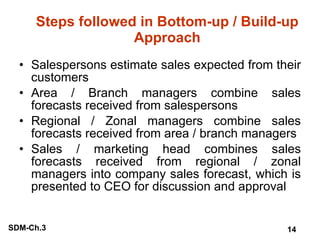
Steps followed in Bottom-up / Build-up Approach Salespersons estimate sales expected from their customers Area / Branch managers combine sales forecasts received from salespersons Regional / Zonal managers combine sales forecasts received from area / branch managers Sales / marketing head combines sales forecasts received from regional / zonal managers into company sales forecast, which is presented to CEO for discussion and approval
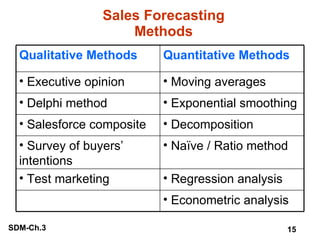
Sales Forecasting Methods Econometric analysis Regression analysis Test marketing Naïve / Ratio method Survey of buyers’ intentions Decomposition Salesforce composite Exponential smoothing Delphi method Moving averages Executive opinion Quantitative Methods Qualitative Methods
Executive opinion method Most widely used Procedure  includes discussions and / or average of all executives’ individual opinion Advantages:  quick forecast, less expensive Disadvantages:  subjective, no breakdown into subunits Accuracy:  fair;  time required:  short to medium (1 – 4 weeks) Delphi method Process  includes a coordinator getting forecasts separately from experts, summarizing the forecasts, giving the summary report to experts, who are asked to make another prediction; the process is repeated till some consensus is reached Experts are company managers, consultants, intermediaries, and trade associations
Delphi Method (Continued) Advantages:  objective, good  accuracy Disadvantages:  getting experts, no breakdown into subunits,  time required:  medium (3/4 weeks) to long (2/3 months) Salesforce composite method An example of bottom-up or grass-roots approach Procedure  consists of each salesperson estimating sales. Company sales forecast is made up of all salespersons’ sales estimates Advantages:  Salespeople are involved, breakdown into subunits possible Disadvantages:  Optimistic or pessimistic forecasts, medium to long  time required Accuracy:  fair to good (if trained)
Survey of Buyers’ Intentions Method Process  includes asking customers about their intentions to buy the company’s products and services Questionnaire may contain other relevant questions Advantages:  gives more market information, can forecast new and existing products, good  accuracy Disadvantages:  some buyers’ unwilling to respond,  time required  is long (3-6 months), medium to high cost Test Marketing Method Methods used for  consumer market testing:  full blown, controlled, and simulated test marketing Methods used for  business market testing:  alpha and beta testing
Test Marketing Method (Continued) Advantages:  used for new or modified products, good  accuracy , minimizes risk of national launch Disadvantages:  Competitors may disturb if some methods are used, medium to high cost, medium to long  time required Moving Average Method Procedure  is to calculate the average company sales for previous years Moving averages name is due to dropping sales in the oldest period and replacing it by sales in the newest period Advantages:  simple and easy to calculate, low cost, less  time , good  accuracy  for short term and stable conditions Disadvantages:  can not predict downturn / upturn, not used for unstable market conditions and long-term forecasts
Exponential Smoothing Method The forecaster allows sales in certain periods to influence the sales forecast more than sales in other periods Equation used: Sales forecast for next period=(L)(actual sales of this year)+(1-L)(this year’s sales forecast), where (L) is a smoothing constant, ranging greater than zero and less than 1 Advantages:  simple method, forecaster’s knowledge used, low cost, less  time , good  accuracy  for short term forecast Disadvantages:  smoothing constant is arbitrary, not used for long-term and new product forecast
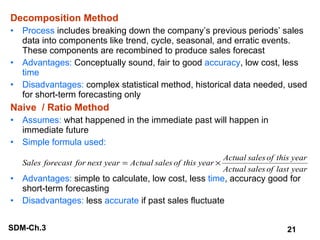
Decomposition Method Process  includes breaking down the company’s previous periods’ sales data into components like trend, cycle, seasonal, and erratic events. These components are recombined to produce sales forecast Advantages:  Conceptually sound, fair to good  accuracy , low cost, less  time Disadvantages:  complex statistical method, historical data needed, used for short-term forecasting only Naive  / Ratio Method Assumes:  what happened in the immediate past will happen in immediate future Simple formula used: Advantages:  simple to calculate, low cost, less  time , accuracy good for short-term forecasting Disadvantages:  less  accurate  if past sales fluctuate
Regression Analysis Method It is a statistical forecasting method Process  consists of identifying causal relationship between company sales (dependent variable, y) and independent variable (x), which influences sales If one independent variable is used, it is called  linear (or simple) regression , using formula;  y=a+bx , where ‘a’ is the intercept and ‘b’ is the slope of the trend line In practice , company sales are influenced by several independent variables, like price, population, promotional expenditure. The method used is  multiple regression analysis Advantages:  Objective, good  accuracy , predicts upturn / downturn, short to medium  time , low to medium cost Disadvantages:  technically complex, large historical data needed, software packages essential
Econometric Analysis Method Procedure  includes developing many regression equations representing (i) relationships between sales and independent variables which influence sales, and (ii) interrelationships between variables. Forecast is prepared by solving these equations Computers and software packages are used Advantages:  Good  accuracy  of forecasts of economic conditions and industry sales Disadvantages:  need expertise & large historical data, medium to long  time , medium to high cost
How to Improve Forecasting Accuracy? Sales forecasting is an important & difficult task Following  guidelines  may help in improving its accuracy Use multiple (2/3) forecasting methods Select suitable forecasting methods, based on application, cost, and available time Use few independent variables / factors, based on discussions with salespeople & customers Establish a range of sales forecasts – minimum, intermediate, and maximum Use computer software forecasting packages
What is a Sales Budget? It includes estimates of sales volume and selling expenses Sales volume budget is derived from the company sales forecast – generally slightly lower than the company sales forecast, to avoid excessive risks Selling expenses budget consists of personal selling expenses budget and sales administration expenses budget Sales budget gives a detailed break-down of estimates of sales revenue and selling expenditure Purposes of the Sales Budget Planning Coordination Control
Sales Budget Process Many firms follow a process for preparation of annual sales and company budgets. It generally includes: Review  past, current, and future situations Communicate  information to all managers on budget preparation – guidelines, formats, timetable Use build-up approach , starting with first-line sales managers Get approval  of sales budget from top management Prepare budgets of other departments
Key Learnings Strategic planning  is deciding about the organization’s long-term objectives and strategies Strategic marketing  has a role at divisional or strategic business unit (SBU) level of strategic planning by providing market information and developing competitive advantage, target markets, value proposition Sales strategy  is developed from marketing strategy through marketing-mix and promotional strategies Components of sales strategy  includes classification of market segments / customers, relationship strategy, selling methods, & channel strategy
Key Learnings (Continued) Two basic  approaches of forecasting  are: top-down (or breakdown), and bottom-up (or build-up) Sales forecasting methods  are broadly classified as: qualitative and quantitative Qualitative methods  include executive opinion, delphi method, salesforce composite, survey of buyers’ intentions, test marketing Quantitative methods  consist of moving averages, exponential smoothing, decomposition, naïve/ratio, regression analysis, econometric analysis Sales budget  gives a detailed estimates of sales volume and selling expenses. Its purposes are planning, coordination, and control

Ch3: Planning, Sales Forecasting, and Budgeting

  • 1.
    Chapter 3 Planning,Sales Forecasting, and Budgeting
  • 2.
    Learning Objectives Tounderstand strategic planning , its linkage to strategic marketing and marketing management To know how sales strategy is developed from marketing strategy To learn basic terms used in forecasting, forecasting approaches , and methods of sales forecasting To understand purposes and the process of sales budget
  • 3.
    Strategic Planning Planning is deciding now what, how, and when we are going to do Strategic planning is deciding about the organisation’s long-term objectives and strategies In a large organisation , planning is done at three or four organisational levels, as shown in the figure (in the next slide)
  • 4.
    Planning In ALarge Organisation For effective planning , operations, and control, a large multi-product / multi-business firm divides its major products / services into divisions / strategic business units ( SBUs) Each SBU has a separate business, a set of competitors and customers, and a manager responsible for strategic planning, performance, and control Corporate Office SBU ‘ A’ SBU ‘ C’ SBU ‘ B’ Product ‘ x’ Product ‘ y’ Product ‘ z’ Product / Operational Planning Product Divisional / SBU Strategic Planning Division / Business Unit / SBU Corporate Strategic Planning Corporate Type of Planning Organisation Structure Organisational Levels
  • 5.
    Role of Marketingin Organisational Planning Marketing management Evolve and implement marketing plan including marketing-mix strategy, and sales strategy Product / functional or Operational planning Strategic marketing Provide customer and competition analysis Develop competitive advantage, target markets, value proposition, positioning Divisional / SBU Strategic planning Corporate marketing Provide customer and competition information Support customer orientation Corporate strategic planning Formal Name Role of Marketing – Key Tasks Type of Planning
  • 6.
    Marketing and SalesStrategies Figure below shows how sales strategy is developed from marketing strategy Marketing Strategy * IMC: Integrated Marketing Communication Target market strategy (Long-term) Marketing mix strategy (Short-term) Product / service strategy Promotion / IMC * strategy Price strategy Distribution strategy Sales promotion strategy Advertising strategy Personal selling / sales strategy Public relations & Publicity strategy Direct marketing strategy
  • 7.
    Components of SalesStrategy Classifying market segments and individual customers within a target segment Each firm should first decide on target market segments and if possible, to classify customers into high, medium, low sales & profit potentials Sales strategy is developed accordingly Relationship strategy Whether a selling firm should use transactional, value-added, or collaborative relationship depends on both the seller and the customer Each selling firm to decide which segments and individual customers respond profitably to collaborative relationship
  • 8.
    Components of SalesStrategy (Continued) Selling Methods These are: (1) Stimulus response, (2) formula, (3) need-satisfaction, (4) team selling, (5) consultative Selection of appropriate selling method depends on relationship strategy Channel Strategy There are many sales / marketing channels. For example: company salesforce, distributors, franchisees, agents, the internet, brokers, discount stores Selection of a suitable channel depends on both the buyer and the seller, products / services, and markets
  • 9.
    Basic Terms Usedin Sales Forecasting Market demand for a product or service is the estimated total sales volume in a market (or industry) for a specific time period in a defined marketing environment, under a defined marketing program or expenditure. Market demand is a function associated with varying levels of industry marketing expenditure. Market (or industry) forecast (or market size) is the expected market (or industry) demand at one level of industry marketing expenditure
  • 10.
    Basic Terms (Continued)Market potential is the maximum market (or industry) demand, resulting from a very high level of industry marketing expenditure, where further increases in expenditure would have little effect on increase in demand Company demand is the company’s estimated share of market demand for a product or service at alternative levels of the company marketing efforts (or expenditures) in a specific time period Market Potential Market Forecast Market Minimum Fig. Market Demand Functions Industry marketing expenditure Market demand
  • 11.
    Basic Terms (Continued)Company sales potential is the maximum estimated company sales of a product or service, based on maximum share (or percentage) of market potential expected by the company Company sales forecast is the estimated company sales of a product or service, based on a chosen (or proposed) marketing expenditure plan, for a specific time period, in a assumed marketing environment Sales budget is the estimate of expected sales volume in units or revenues from the company’s products and services, and the selling expenses. It is set slightly lower than the company sales forecast, to avoid excessive risks
  • 12.
    Forecasting Approaches Twobasic approaches: Top-down or Break-down approach Bottom-up or Build-up approach Some companies use both approaches to increase their confidence in the forecast
  • 13.
    Steps followed inTop-down / Break-down Approach Forecast relevant external environmental factors Estimate industry sales or market potential Calculate company sales potential = market potential x company share Decide company sales forecast (lower than company sales potential because sales potential is maximum estimated sales, without any constraints)
  • 14.
    Steps followed inBottom-up / Build-up Approach Salespersons estimate sales expected from their customers Area / Branch managers combine sales forecasts received from salespersons Regional / Zonal managers combine sales forecasts received from area / branch managers Sales / marketing head combines sales forecasts received from regional / zonal managers into company sales forecast, which is presented to CEO for discussion and approval
  • 15.
    Sales Forecasting MethodsEconometric analysis Regression analysis Test marketing Naïve / Ratio method Survey of buyers’ intentions Decomposition Salesforce composite Exponential smoothing Delphi method Moving averages Executive opinion Quantitative Methods Qualitative Methods
  • 16.
    Executive opinion methodMost widely used Procedure includes discussions and / or average of all executives’ individual opinion Advantages: quick forecast, less expensive Disadvantages: subjective, no breakdown into subunits Accuracy: fair; time required: short to medium (1 – 4 weeks) Delphi method Process includes a coordinator getting forecasts separately from experts, summarizing the forecasts, giving the summary report to experts, who are asked to make another prediction; the process is repeated till some consensus is reached Experts are company managers, consultants, intermediaries, and trade associations
  • 17.
    Delphi Method (Continued)Advantages: objective, good accuracy Disadvantages: getting experts, no breakdown into subunits, time required: medium (3/4 weeks) to long (2/3 months) Salesforce composite method An example of bottom-up or grass-roots approach Procedure consists of each salesperson estimating sales. Company sales forecast is made up of all salespersons’ sales estimates Advantages: Salespeople are involved, breakdown into subunits possible Disadvantages: Optimistic or pessimistic forecasts, medium to long time required Accuracy: fair to good (if trained)
  • 18.
    Survey of Buyers’Intentions Method Process includes asking customers about their intentions to buy the company’s products and services Questionnaire may contain other relevant questions Advantages: gives more market information, can forecast new and existing products, good accuracy Disadvantages: some buyers’ unwilling to respond, time required is long (3-6 months), medium to high cost Test Marketing Method Methods used for consumer market testing: full blown, controlled, and simulated test marketing Methods used for business market testing: alpha and beta testing
  • 19.
    Test Marketing Method(Continued) Advantages: used for new or modified products, good accuracy , minimizes risk of national launch Disadvantages: Competitors may disturb if some methods are used, medium to high cost, medium to long time required Moving Average Method Procedure is to calculate the average company sales for previous years Moving averages name is due to dropping sales in the oldest period and replacing it by sales in the newest period Advantages: simple and easy to calculate, low cost, less time , good accuracy for short term and stable conditions Disadvantages: can not predict downturn / upturn, not used for unstable market conditions and long-term forecasts
  • 20.
    Exponential Smoothing MethodThe forecaster allows sales in certain periods to influence the sales forecast more than sales in other periods Equation used: Sales forecast for next period=(L)(actual sales of this year)+(1-L)(this year’s sales forecast), where (L) is a smoothing constant, ranging greater than zero and less than 1 Advantages: simple method, forecaster’s knowledge used, low cost, less time , good accuracy for short term forecast Disadvantages: smoothing constant is arbitrary, not used for long-term and new product forecast
  • 21.
    Decomposition Method Process includes breaking down the company’s previous periods’ sales data into components like trend, cycle, seasonal, and erratic events. These components are recombined to produce sales forecast Advantages: Conceptually sound, fair to good accuracy , low cost, less time Disadvantages: complex statistical method, historical data needed, used for short-term forecasting only Naive / Ratio Method Assumes: what happened in the immediate past will happen in immediate future Simple formula used: Advantages: simple to calculate, low cost, less time , accuracy good for short-term forecasting Disadvantages: less accurate if past sales fluctuate
  • 22.
    Regression Analysis MethodIt is a statistical forecasting method Process consists of identifying causal relationship between company sales (dependent variable, y) and independent variable (x), which influences sales If one independent variable is used, it is called linear (or simple) regression , using formula; y=a+bx , where ‘a’ is the intercept and ‘b’ is the slope of the trend line In practice , company sales are influenced by several independent variables, like price, population, promotional expenditure. The method used is multiple regression analysis Advantages: Objective, good accuracy , predicts upturn / downturn, short to medium time , low to medium cost Disadvantages: technically complex, large historical data needed, software packages essential
  • 23.
    Econometric Analysis MethodProcedure includes developing many regression equations representing (i) relationships between sales and independent variables which influence sales, and (ii) interrelationships between variables. Forecast is prepared by solving these equations Computers and software packages are used Advantages: Good accuracy of forecasts of economic conditions and industry sales Disadvantages: need expertise & large historical data, medium to long time , medium to high cost
  • 24.
    How to ImproveForecasting Accuracy? Sales forecasting is an important & difficult task Following guidelines may help in improving its accuracy Use multiple (2/3) forecasting methods Select suitable forecasting methods, based on application, cost, and available time Use few independent variables / factors, based on discussions with salespeople & customers Establish a range of sales forecasts – minimum, intermediate, and maximum Use computer software forecasting packages
  • 25.
    What is aSales Budget? It includes estimates of sales volume and selling expenses Sales volume budget is derived from the company sales forecast – generally slightly lower than the company sales forecast, to avoid excessive risks Selling expenses budget consists of personal selling expenses budget and sales administration expenses budget Sales budget gives a detailed break-down of estimates of sales revenue and selling expenditure Purposes of the Sales Budget Planning Coordination Control
  • 26.
    Sales Budget ProcessMany firms follow a process for preparation of annual sales and company budgets. It generally includes: Review past, current, and future situations Communicate information to all managers on budget preparation – guidelines, formats, timetable Use build-up approach , starting with first-line sales managers Get approval of sales budget from top management Prepare budgets of other departments
  • 27.
    Key Learnings Strategicplanning is deciding about the organization’s long-term objectives and strategies Strategic marketing has a role at divisional or strategic business unit (SBU) level of strategic planning by providing market information and developing competitive advantage, target markets, value proposition Sales strategy is developed from marketing strategy through marketing-mix and promotional strategies Components of sales strategy includes classification of market segments / customers, relationship strategy, selling methods, & channel strategy
  • 28.
    Key Learnings (Continued)Two basic approaches of forecasting are: top-down (or breakdown), and bottom-up (or build-up) Sales forecasting methods are broadly classified as: qualitative and quantitative Qualitative methods include executive opinion, delphi method, salesforce composite, survey of buyers’ intentions, test marketing Quantitative methods consist of moving averages, exponential smoothing, decomposition, naïve/ratio, regression analysis, econometric analysis Sales budget gives a detailed estimates of sales volume and selling expenses. Its purposes are planning, coordination, and control