STRATEGIC PLANNING
AND FORECASTING
PLANNING OVERVIEW
 Formal Planning
 The process by which marketing activities are identified and
decided upon
 Identifies the customer wants and anticipates his future needs
and wants
 Sound Planning
 Helps the organization to anticipate and make responsive
action to marketing problems and changes in the business
environment
THREE IMPORTANT
PLANNING STRATEGIES
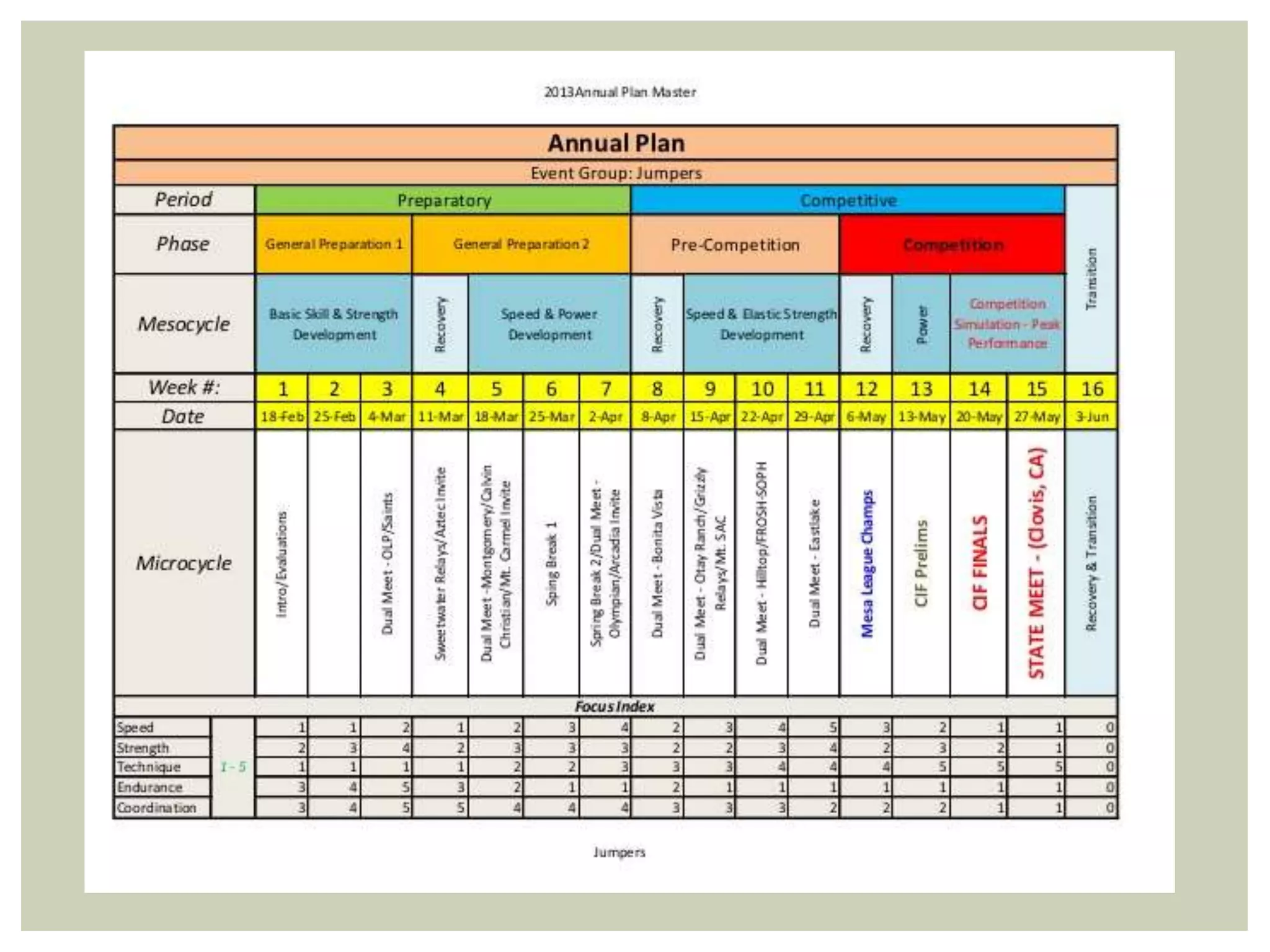
 An annual plan is an organization’s financial plan for
the fiscal year.
 The current marketing situation is identified and the
company sets its goals and objectives towards the
currently prevailing situation in the marketing
environment.
 The company sets control mechanism as bases for
performance evaluation.
THE ANNUAL PLAN
 Long-range planning (LRP) is a process and discipline
that companies use to determine the best strategy
for succeeding in the markets they serve and to
ensure they have the capabilities needed to support
their strategic objectives.
 It covers a period of about five (5) years or more.
 It sets the company direction for a longer period
which shall be updated by the annual plan.
 Budgets and targets are set within the five (5) year
level.
THE LONG-RANGE PLAN
 Strategic planning is the process of anticipating and
developing long-range objectives and goals.
 It is the set of all planning activities that identifies
its vision and mission, its company portfolio and
attendant strategies.
STRATEGIC PLANNING PROCESS
THE THREE LEVELS IN
STRATEGIC MARKETING
PLANNING
Define the
organizational
mission
Analyze the
marketing solution
Set the organizational
objectives
Define the suitable
strategies to achieve
the desired objectives
STRATEGIC COMPANY PLANNING
Four Essential
Steps in Strategic
Company Planning
Conduct
situation
analysis
Develop
specific
marketing
objectives
Determine
product
positioning
and
establishing
differential
advantage
Select
target
market and
measure
market
demand
Design a
strategic
marketing
mix
STRATEGIC MARKETING
PLANNING
Five Steps in
Marketing Planning
Define the annual
specific target
objectives for
accomplishments
Develop specific
measurable and
achievable plans
Develop strategies
and tactics to
achieve the plans
Prepare annual
budgetary
requirements
Assign
responsible
personnel to carry
out the plan
Develop
evaluation
strategies for
implementation
STRATEGIC ANNUAL PLANNING
Responsibilities of Managers in Annual
Planning
FACTORS TO CONSIDER
IN PREPARING ANNUAL
PLANNING STRATEGIES
1. Analyze Previous Year Performance
 The previous year performance must be analyzed in terms of
variances in the allocation of resources and the success or failure in
the implementation of the program objectives.
2. Set Accurate Timelines
 The timing in the marketing industry must consider the celebration of
the different holidays such as Christmas, New Year, fiestas, wedding
months, Valentine’s Day or many occasions in the local calendar.
3. Develop Distribution Strategies
 After analyzing the past marketing campaign, it is important that the
marketing channels and promotional programs be revised to provide
a new twist in the marketing campaign.
4. Create a Workable Financial Budget
 Budgeting financial resources for the annual plan takes time and
careful analysis.
TIPS FOR BETTER RESULTS
CONTENTS OF THE
ANNUAL MARKETING
PLAN
 The executive summary contains the annual trust of the program
prepared by the higher management as a guide for junior
executives in the preparation of the annual plan.
EXECUTIVE SUMMARY
 Managers of each brand
analysis or strategic
business unit (SBU) make
a detailed program
analysis as to variances in
the program
implementation together
with budgetary
expenditures.
SITUATION ANALYSIS
 The program objectives are specific and detailed set of goals that
are derived from the annual program objectives prepared by the top
executives.
PROGRAM OBJECTIVES
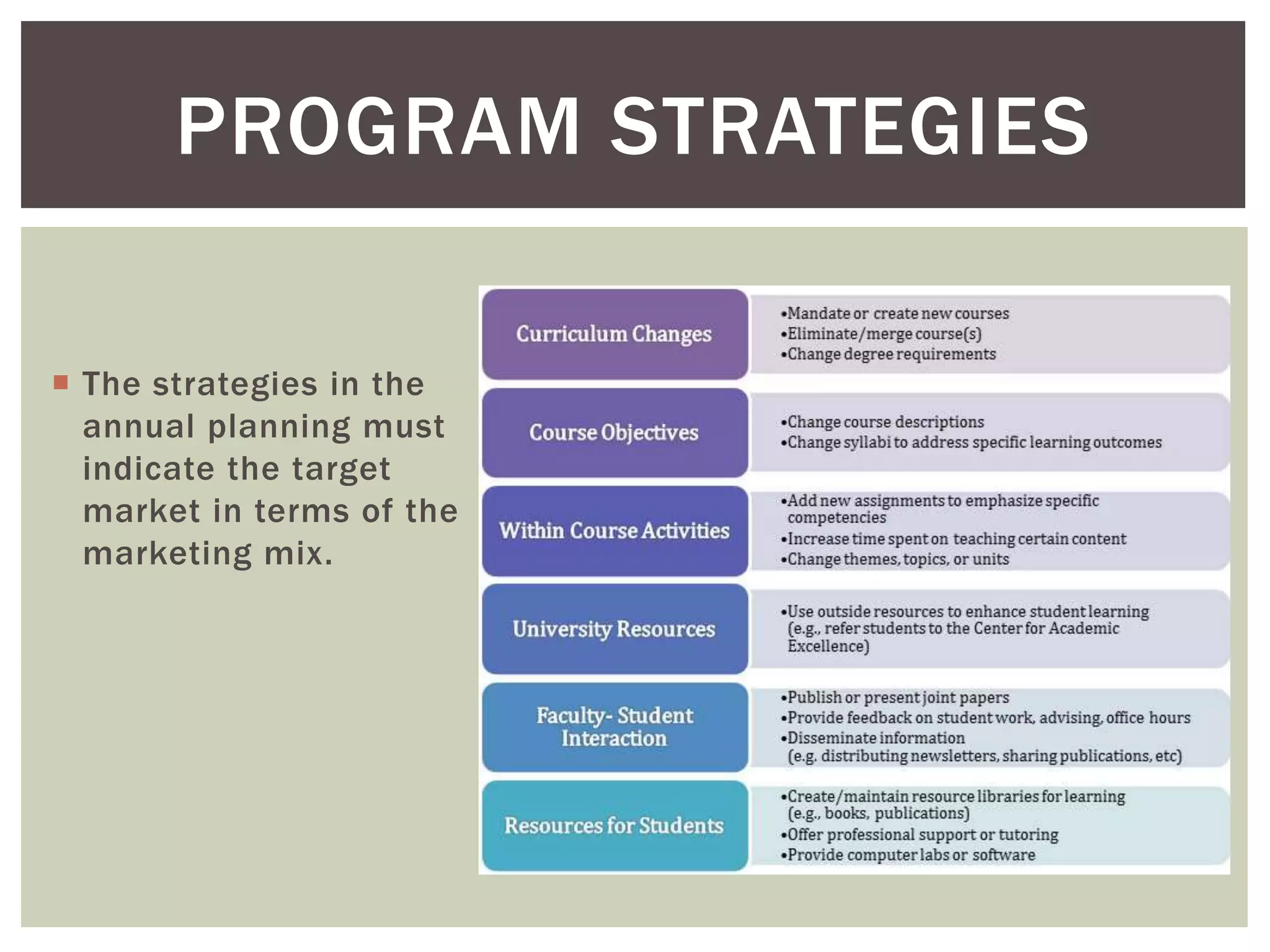
 The strategies in the
annual planning must
indicate the target
market in terms of the
marketing mix.
PROGRAM STRATEGIES
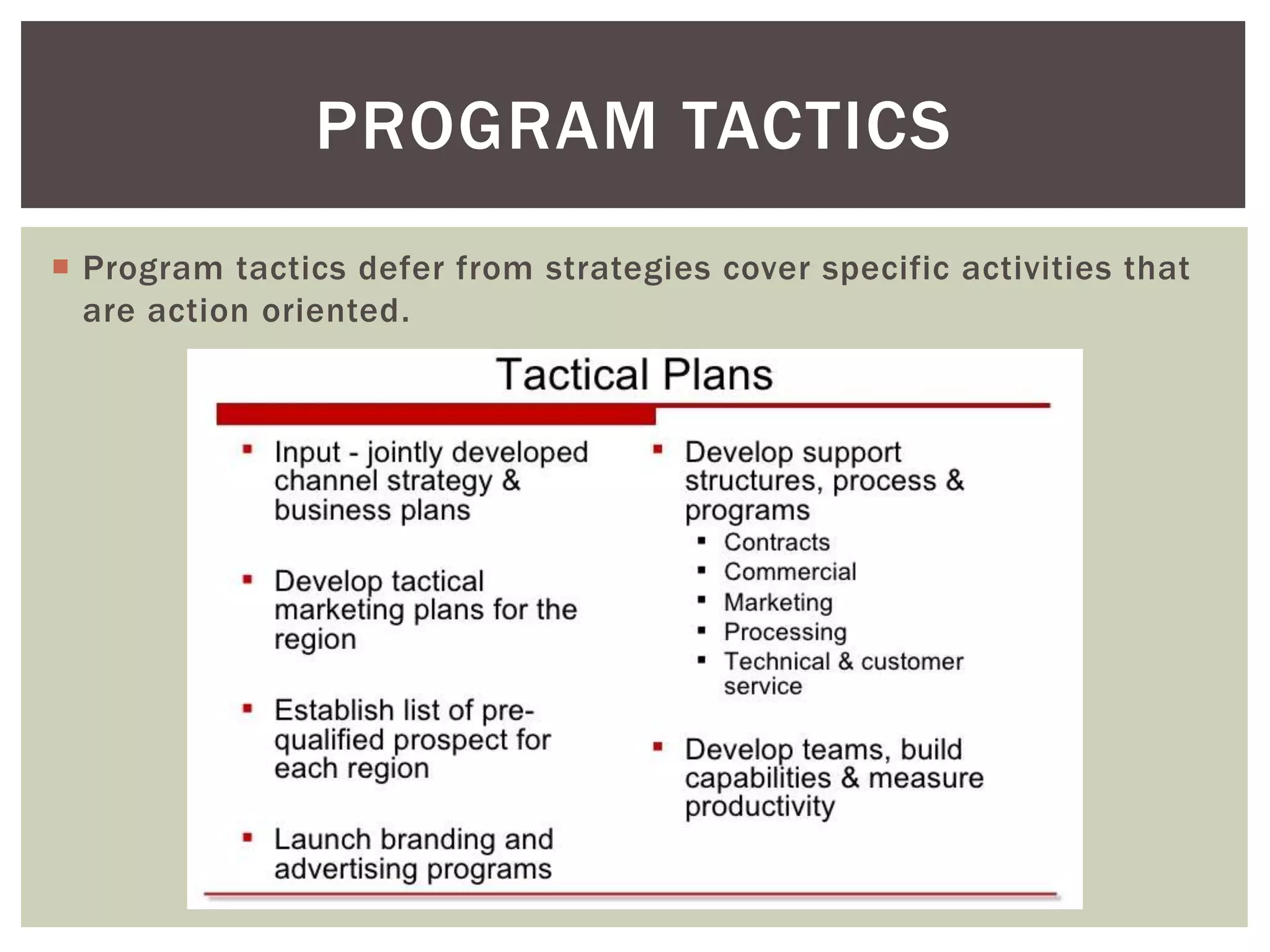
 Program tactics defer from strategies cover specific activities that
are action oriented.
PROGRAM TACTICS
 It is a financial program that
defines the projected sales
target, expenses to carry out the
sales program, and the
supposed profitable index that
will be generated.
FINANCIAL SCHEDULE
 The manager must
prepare a time plan
chart or time diagram
on specific dates for
its activities.
PROGRAM TIMETABLE
 It is a measuring instrument that will serve as a guide in the total
accomplishment of the program.
EVALUATION PROCEDURE
FORECASTING FUTURE
DEMAND
Demand forecasting is the establishment of product
sales in the future or a period of one year. It is the
basis in the development of strategic plans. It will
serve as a guide in the preparation of the annual
marketing budget and in allocating material resources
in the production of marketing goods.
DEFINING THE MARKET
It is a physical place where people meet to sell
and buy the product for their needs and
consumption.
OLD DEFINITION
 The marketing definition had enlarged its connotation to
mean the market is a set of all actual buyers of the product
or services.
 A market is a set of buyers while the company that handles
the product distribution is a set of sellers.
 Market potential is the total sales volume that all
organizations selling a product during the specified time
and place could expect to achieve under the ideal sales
condition. It also refers to the customer in the market
population for the various products available, while sales
potential refers to one particular brand of product.
 Sales potential is the portion of the market share that the
marketing organization expects to penetrate and make
sale.
METHODS OF
FORECASTING DEMAND
 It is the major activity of top management in forecasting market
demand based on the analysis of the total market condition and
analysis.
TOP-DOWN APPROACH
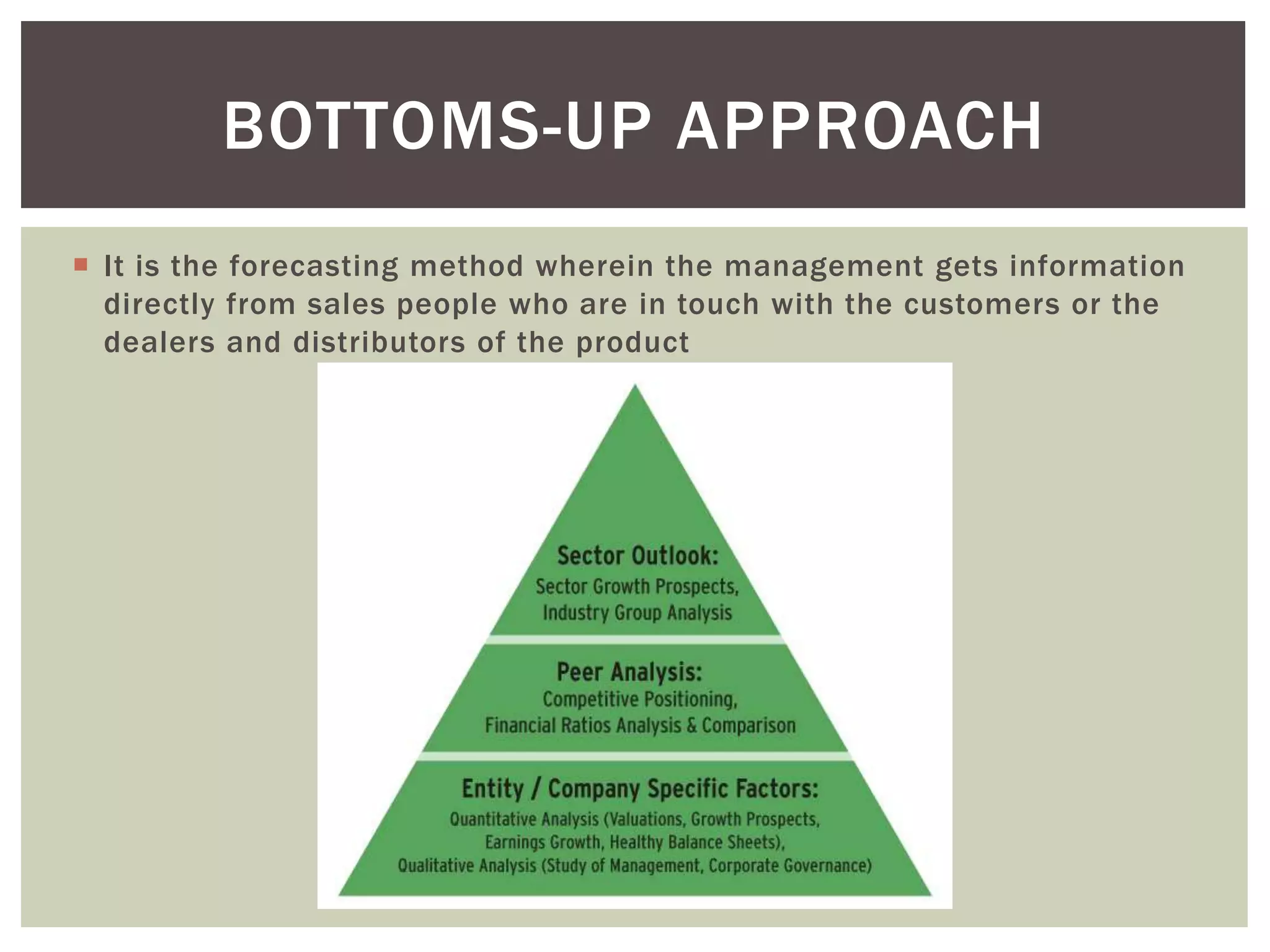
 It is the forecasting method wherein the management gets information
directly from sales people who are in touch with the customers or the
dealers and distributors of the product
BOTTOMS-UP APPROACH
Forecasting is the art of estimating future demands by
anticipating what the buyers want to buy under a given
set of situation.
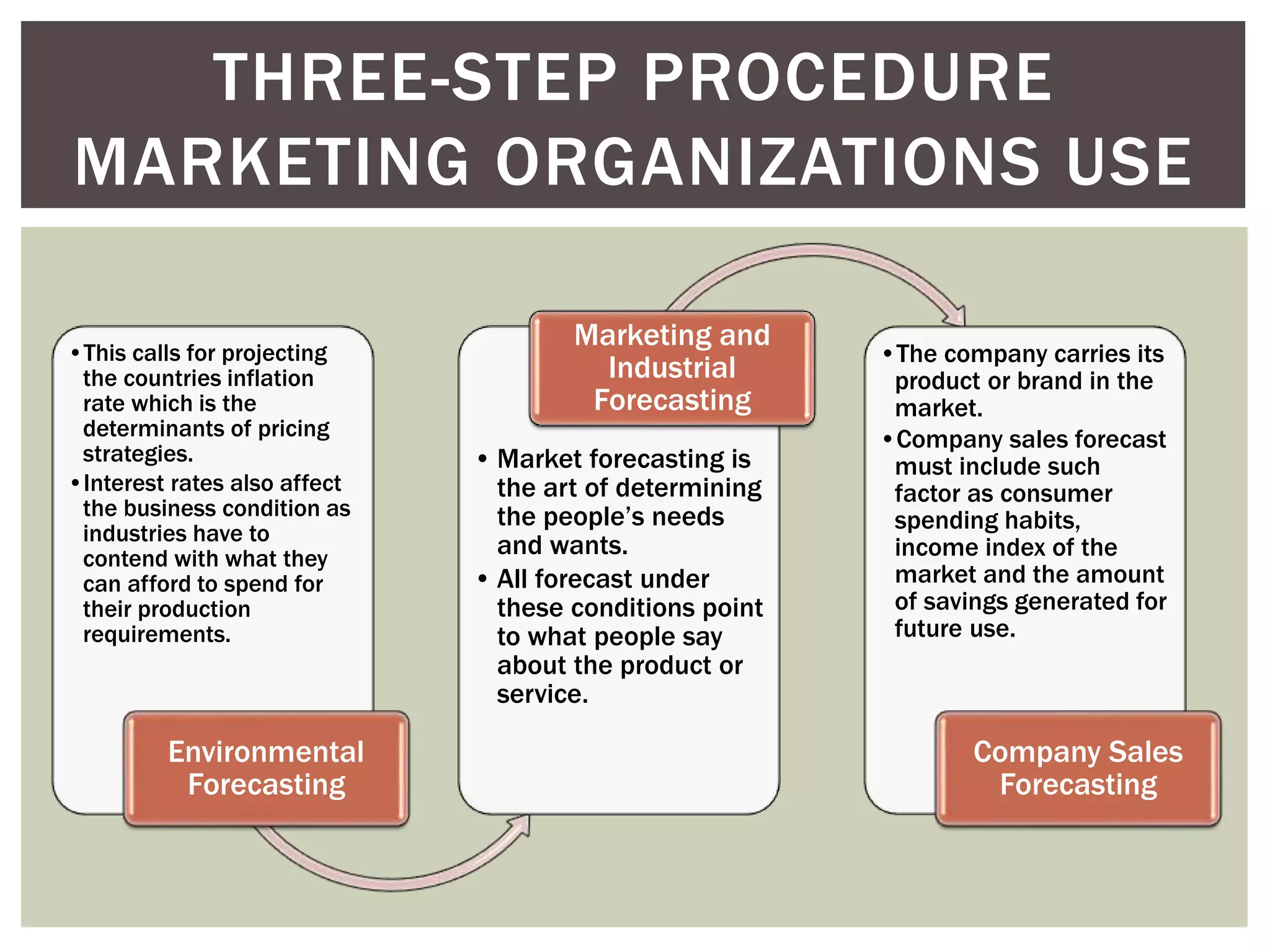
•This calls for projecting
the countries inflation
rate which is the
determinants of pricing
strategies.
•Interest rates also affect
the business condition as
industries have to
contend with what they
can afford to spend for
their production
requirements.
Environmental
Forecasting
• Market forecasting is
the art of determining
the people’s needs
and wants.
• All forecast under
these conditions point
to what people say
about the product or
service.
Marketing and
Industrial
Forecasting
•The company carries its
product or brand in the
market.
•Company sales forecast
must include such
factor as consumer
spending habits,
income index of the
market and the amount
of savings generated for
future use.
Company Sales
Forecasting
THREE-STEP PROCEDURE
MARKETING ORGANIZATIONS USE
DEMAND FORECASTING
ANALYSIS
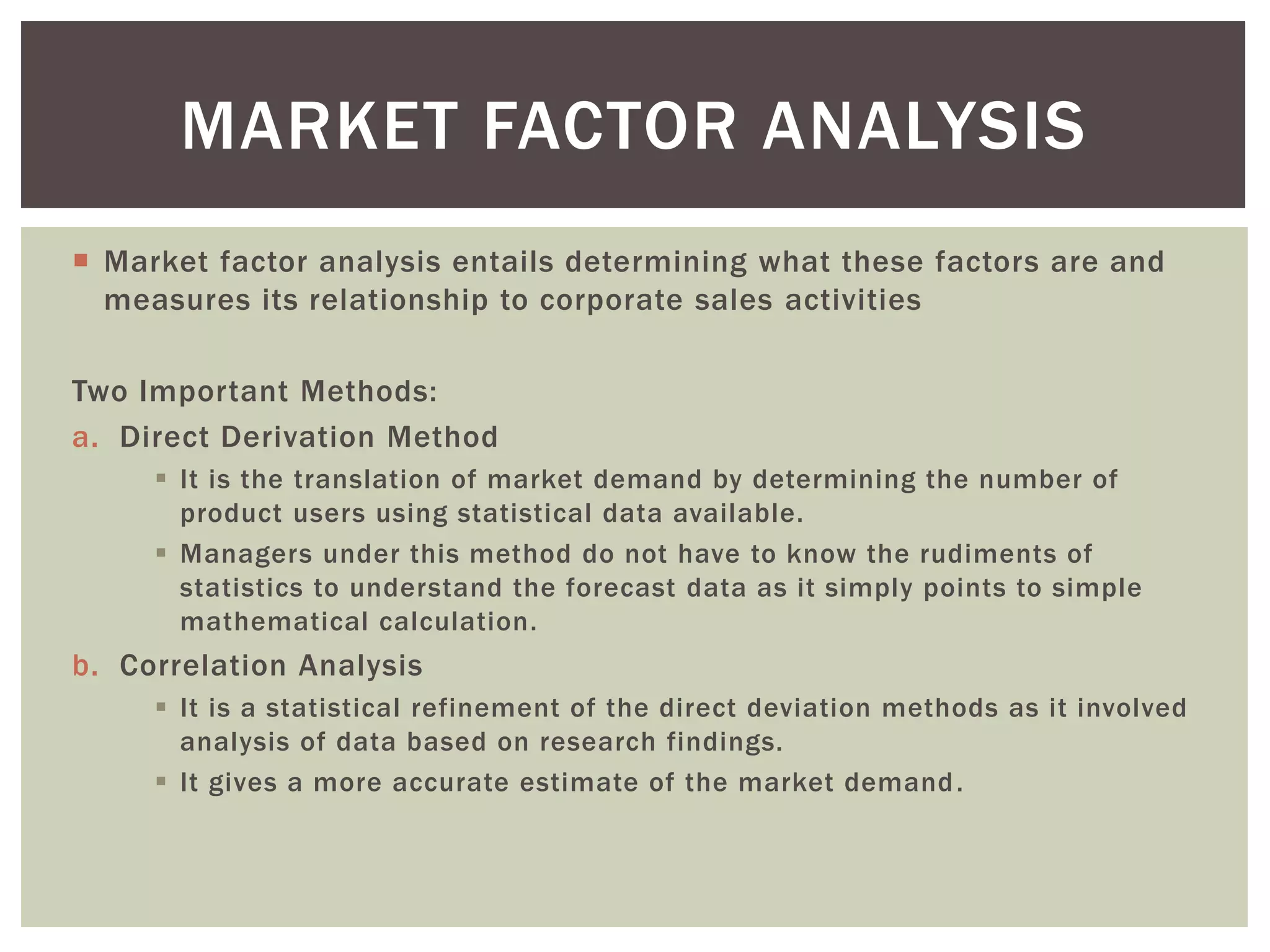
 Market factor analysis entails determining what these factors are and
measures its relationship to corporate sales activities
Two Important Methods:
a. Direct Derivation Method
 It is the translation of market demand by determining the number of
product users using statistical data available.
 Managers under this method do not have to know the rudiments of
statistics to understand the forecast data as it simply points to simple
mathematical calculation.
b. Correlation Analysis
 It is a statistical refinement of the direct deviation methods as it involved
analysis of data based on research findings.
 It gives a more accurate estimate of the market demand.
MARKET FACTOR ANALYSIS
 This process involves asking potential customers about the
product that the marketing organization produces at the price
index at a given time.
Three Important Conditions when Survey Results tend to be
Accurate:
a. There are relatively few buyers in the market
b. The buyers are honest with their buying intentions
c. A record exists that shows a consistent relationship between
their actual buying behavior and their stated intentions
SURVEY OF THE BUYERS
INTENTION
 This method is used when the marketing
organization is launching a new product or the
innovation of an existing product
 The research process will determine the total market
perceptions of its acceptability for wider population
TEST MARKETING METHOD
 This method is entirely based on the previous year’s
total sales and the profit index generated.
 It is the simplest and easiest to apply and
understand.
POST SALES DATA ANALYSIS
 This is the Bottom-Up Approach where the sales force
provides the information about the forecast demand for
the product.
SALES FORCE OPINION AND ITS
COMPOSITE INDEX
 Participative executives may get the opinion of experts,
salesman, dealers, and distributors to drum up a more
reliable sales forecast and develop marketing
strategies to achieve the sales target.
EXECUTIVE JUDGMENT AND
EXPERT OPINION
CHARACTERISTICS OF
POTENTIAL BUYERS
 It is the state of mind of the potential buyer who
likes to buy the product for his needs and wants.
 Potential market is the set of consumers who profess
some level of interest for a particular product or
service.
INTEREST
Potential buyers must have the money to buy the
product or service.
INCOME OR MONEY TO BUY
The potential buyer must have access to the goods or
product he wanted.
ACCESS OR PLACE OF
DISTRIBUTION

Strategic Planning and Forecasting

  • 1.
  • 2.
  • 3.
     Formal Planning The process by which marketing activities are identified and decided upon  Identifies the customer wants and anticipates his future needs and wants  Sound Planning  Helps the organization to anticipate and make responsive action to marketing problems and changes in the business environment
  • 4.
  • 5.
     An annualplan is an organization’s financial plan for the fiscal year.  The current marketing situation is identified and the company sets its goals and objectives towards the currently prevailing situation in the marketing environment.  The company sets control mechanism as bases for performance evaluation. THE ANNUAL PLAN
  • 8.
     Long-range planning(LRP) is a process and discipline that companies use to determine the best strategy for succeeding in the markets they serve and to ensure they have the capabilities needed to support their strategic objectives.  It covers a period of about five (5) years or more.  It sets the company direction for a longer period which shall be updated by the annual plan.  Budgets and targets are set within the five (5) year level. THE LONG-RANGE PLAN
  • 10.
     Strategic planningis the process of anticipating and developing long-range objectives and goals.  It is the set of all planning activities that identifies its vision and mission, its company portfolio and attendant strategies. STRATEGIC PLANNING PROCESS
  • 12.
    THE THREE LEVELSIN STRATEGIC MARKETING PLANNING
  • 13.
    Define the organizational mission Analyze the marketingsolution Set the organizational objectives Define the suitable strategies to achieve the desired objectives STRATEGIC COMPANY PLANNING Four Essential Steps in Strategic Company Planning
  • 14.
  • 15.
    Define the annual specifictarget objectives for accomplishments Develop specific measurable and achievable plans Develop strategies and tactics to achieve the plans Prepare annual budgetary requirements Assign responsible personnel to carry out the plan Develop evaluation strategies for implementation STRATEGIC ANNUAL PLANNING Responsibilities of Managers in Annual Planning
  • 16.
    FACTORS TO CONSIDER INPREPARING ANNUAL PLANNING STRATEGIES
  • 17.
    1. Analyze PreviousYear Performance  The previous year performance must be analyzed in terms of variances in the allocation of resources and the success or failure in the implementation of the program objectives. 2. Set Accurate Timelines  The timing in the marketing industry must consider the celebration of the different holidays such as Christmas, New Year, fiestas, wedding months, Valentine’s Day or many occasions in the local calendar. 3. Develop Distribution Strategies  After analyzing the past marketing campaign, it is important that the marketing channels and promotional programs be revised to provide a new twist in the marketing campaign. 4. Create a Workable Financial Budget  Budgeting financial resources for the annual plan takes time and careful analysis. TIPS FOR BETTER RESULTS
  • 18.
    CONTENTS OF THE ANNUALMARKETING PLAN
  • 19.
     The executivesummary contains the annual trust of the program prepared by the higher management as a guide for junior executives in the preparation of the annual plan. EXECUTIVE SUMMARY
  • 20.
     Managers ofeach brand analysis or strategic business unit (SBU) make a detailed program analysis as to variances in the program implementation together with budgetary expenditures. SITUATION ANALYSIS
  • 21.
     The programobjectives are specific and detailed set of goals that are derived from the annual program objectives prepared by the top executives. PROGRAM OBJECTIVES
  • 22.
     The strategiesin the annual planning must indicate the target market in terms of the marketing mix. PROGRAM STRATEGIES
  • 23.
     Program tacticsdefer from strategies cover specific activities that are action oriented. PROGRAM TACTICS
  • 24.
     It isa financial program that defines the projected sales target, expenses to carry out the sales program, and the supposed profitable index that will be generated. FINANCIAL SCHEDULE
  • 25.
     The managermust prepare a time plan chart or time diagram on specific dates for its activities. PROGRAM TIMETABLE
  • 26.
     It isa measuring instrument that will serve as a guide in the total accomplishment of the program. EVALUATION PROCEDURE
  • 28.
  • 29.
    Demand forecasting isthe establishment of product sales in the future or a period of one year. It is the basis in the development of strategic plans. It will serve as a guide in the preparation of the annual marketing budget and in allocating material resources in the production of marketing goods.
  • 30.
  • 31.
    It is aphysical place where people meet to sell and buy the product for their needs and consumption. OLD DEFINITION
  • 32.
     The marketingdefinition had enlarged its connotation to mean the market is a set of all actual buyers of the product or services.  A market is a set of buyers while the company that handles the product distribution is a set of sellers.  Market potential is the total sales volume that all organizations selling a product during the specified time and place could expect to achieve under the ideal sales condition. It also refers to the customer in the market population for the various products available, while sales potential refers to one particular brand of product.  Sales potential is the portion of the market share that the marketing organization expects to penetrate and make sale.
  • 33.
  • 34.
     It isthe major activity of top management in forecasting market demand based on the analysis of the total market condition and analysis. TOP-DOWN APPROACH
  • 35.
     It isthe forecasting method wherein the management gets information directly from sales people who are in touch with the customers or the dealers and distributors of the product BOTTOMS-UP APPROACH
  • 36.
    Forecasting is theart of estimating future demands by anticipating what the buyers want to buy under a given set of situation.
  • 39.
    •This calls forprojecting the countries inflation rate which is the determinants of pricing strategies. •Interest rates also affect the business condition as industries have to contend with what they can afford to spend for their production requirements. Environmental Forecasting • Market forecasting is the art of determining the people’s needs and wants. • All forecast under these conditions point to what people say about the product or service. Marketing and Industrial Forecasting •The company carries its product or brand in the market. •Company sales forecast must include such factor as consumer spending habits, income index of the market and the amount of savings generated for future use. Company Sales Forecasting THREE-STEP PROCEDURE MARKETING ORGANIZATIONS USE
  • 40.
  • 41.
     Market factoranalysis entails determining what these factors are and measures its relationship to corporate sales activities Two Important Methods: a. Direct Derivation Method  It is the translation of market demand by determining the number of product users using statistical data available.  Managers under this method do not have to know the rudiments of statistics to understand the forecast data as it simply points to simple mathematical calculation. b. Correlation Analysis  It is a statistical refinement of the direct deviation methods as it involved analysis of data based on research findings.  It gives a more accurate estimate of the market demand. MARKET FACTOR ANALYSIS
  • 42.
     This processinvolves asking potential customers about the product that the marketing organization produces at the price index at a given time. Three Important Conditions when Survey Results tend to be Accurate: a. There are relatively few buyers in the market b. The buyers are honest with their buying intentions c. A record exists that shows a consistent relationship between their actual buying behavior and their stated intentions SURVEY OF THE BUYERS INTENTION
  • 43.
     This methodis used when the marketing organization is launching a new product or the innovation of an existing product  The research process will determine the total market perceptions of its acceptability for wider population TEST MARKETING METHOD
  • 44.
     This methodis entirely based on the previous year’s total sales and the profit index generated.  It is the simplest and easiest to apply and understand. POST SALES DATA ANALYSIS
  • 45.
     This isthe Bottom-Up Approach where the sales force provides the information about the forecast demand for the product. SALES FORCE OPINION AND ITS COMPOSITE INDEX
  • 46.
     Participative executivesmay get the opinion of experts, salesman, dealers, and distributors to drum up a more reliable sales forecast and develop marketing strategies to achieve the sales target. EXECUTIVE JUDGMENT AND EXPERT OPINION
  • 47.
  • 48.
     It isthe state of mind of the potential buyer who likes to buy the product for his needs and wants.  Potential market is the set of consumers who profess some level of interest for a particular product or service. INTEREST
  • 49.
    Potential buyers musthave the money to buy the product or service. INCOME OR MONEY TO BUY
  • 50.
    The potential buyermust have access to the goods or product he wanted. ACCESS OR PLACE OF DISTRIBUTION