SALES FORECASTING
• To do the entire selling job (as when there are no other elements in the
promotional mix).
• To “service” existing accounts (that is, to maintain contacts with present
customers, take orders, and so forth).
• To search out and obtain new customers.
• To secure and maintain customers’ cooperation in stocking and promoting
the product line.
• To keep customers informed on changes in the product line and other
aspects of marketing strategy.
• To assist customers in selling the product line (as through “missionary
selling”).
TYPES OF PERSONAL SELLING
OBJECTIVES
• To provide technical advice and assistance to customers (as with
complicated products and where products are especially designed to fit
buyers specifications).
• To assist with (or handle) the training of middlemen’s sales personnel.
• To provide advice and assistance to middlemen on management
problems.
• To collect and report market information of interest and use to
company management.
TYPES OF PERSONAL SELLING
OBJECTIVES
A market potential is an estimate of the maximum possible sales opportunities present in a
particular market segment and open to all sellers of a good or service during a stated future
period.
Analyzing Market Potential
• Market Identification
1) Who buys the product?
2) Who uses it?
3) Who are the prospective buyers and/or users?
• Market Motivation
1) How best to present the product in sales talks.
2) The relative effectiveness of different selling appeals.
• Analysis of Market Potential
1) Select the market factor(s) associated with the product’s demand.
2) Eliminate those market segments that do not contain prospective buyers of the product
• Market Indexes (numeric expression)
MARKET POTENTIAL
• A sales potential is an estimate of the maximum possible sales
opportunities present in a particular market segment open to a
specified company selling a good or service during a stated future
period.
• A sales potential represents sales opportunities available to a
particular manufacturer, while a market potential indicates sales
opportunities available to an entire industry.
SALES POTENTIAL
• A sales forecast is an estimate of sales, in rupees or physical units, in a future
period under a particular marketing program and an assumed set of economic
and other factors outside the unit for which the forecast is made.
• A sales forecast may be for a single product or for an entire product line.
• It may be for a manufacturer’s entire marketing area, or for any subdivision of
it.
• Keep in mind, then, that an operating sales forecast is a prediction of how
much of a company’s particular product (or product line) can be sold during a
future period under a given marketing program and an assumed set of outside
factors.
SALES FORECAST
A firm’s sales potential and its sales forecast are not usually identical – in most
instances, the sales potential is larger than the sales forecast. There are several
reasons for this:
• “Some companies do not have sufficient production capacity to capitalize on the
full sales potential;
• “Other firms have not yet developed distributive networks capable of reaching every
potential customer;
• “Others do not attempt to realize their total sales potentials because of limited
financial resources; and
• “Still others, being more profit oriented than sales oriented, seek to maximize
profitable sales and not possible sales.
SALES POTENTIAL AND FORECAST
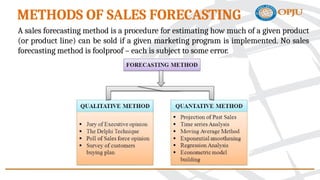
A sales forecasting method is a procedure for estimating how much of a given product
(or product line) can be sold if a given marketing program is implemented. No sales
forecasting method is foolproof – each is subject to some error.
METHODS OF SALES FORECASTING
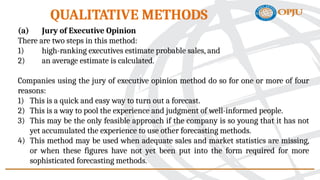
(a) Jury of Executive Opinion
There are two steps in this method:
1) high-ranking executives estimate probable sales, and
2) an average estimate is calculated.
Companies using the jury of executive opinion method do so for one or more of four
reasons:
1) This is a quick and easy way to turn out a forecast.
2) This is a way to pool the experience and judgment of well-informed people.
3) This may be the only feasible approach if the company is so young that it has not
yet accumulated the experience to use other forecasting methods.
4) This method may be used when adequate sales and market statistics are missing,
or when these figures have not yet been put into the form required for more
sophisticated forecasting methods.
QUALITATIVE METHODS
(b) The Delphi Technique
• Several years ago researchers at the Rand Corporation developed a technique for
predicting the future that is called the Delphi technique.
• This is a version of the jury of executive opinion method in which those giving
opinions are selected for their “expertise”.
• The panel of experts responds to a sequence of questionnaires in which the responses
to one questionnaire are used to produce the next questionnaire.
• Thus, information available to some and not to other experts is disseminated to all,
enabling all to base their final forecasts on “all available” information.
• Some contend that “this technique eliminates the bandwagon effect of majority
opinion.”
QUALITATIVE METHODS
(c) Poll of Sales Force Opinion
In the poll of sales force opinion method, often tagged “the grass-roots approach,”
individual sales personnel forecast sales for their territories; then individual forecasts
are combined and modified, as management thinks necessary, to form the company
sales forecast. This approach appeals to practical sales managers because:
 Forecasting responsibility is assigned to those who produce the results.
 Furthermore, there is merit in utilizing the specialized knowledge of those in closet
touch with market conditions. Because the salespeople help to develop the forecast,
they should have greater confidence in quotas based upon it.
 Another attractive feature is that forecasts developed by this method are easy to
break down according to products, territories, customers, middlemen, and sales
force.
QUALITATIVE METHODS
(a) Projection of Past Sales
The projection of past sales method of sales forecasting takes a variety to forms.
The simplest is to set the sales forecast for the coming year at the same figure as the
current year’s actual sales, or the forecast may be made by adding a set percentage to
last year’s sales, or to a moving average of the sales figure for several past years.
next year’s sales = this year’s sales X this year’s sales/last year’s sales
QUANTITATIVE METHODS
(b) Time-Series Analysis
Not greatly different in principle from the simple projection of past sales in
time-series analysis, a statistical procedure for studying historical sales data.
This procedure involves isolating and measuring four chief types of sales
variations: long-term trends, cyclical changes, seasonal variations, and
irregular fluctuations.
Then a mathematical model describing the past behavior of the series is
selected, assumed values for each type of sales variation are inserted, and the
sales forecast is ‘cranked out.”
QUANTITATIVE METHODS
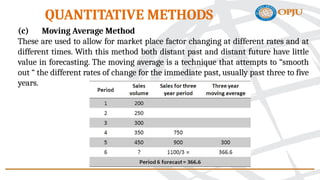
(c) Moving Average Method
These are used to allow for market place factor changing at different rates and at
different times. With this method both distant past and distant future have little
value in forecasting. The moving average is a technique that attempts to “smooth
out “ the different rates of change for the immediate past, usually past three to five
years.
QUANTITATIVE METHODS
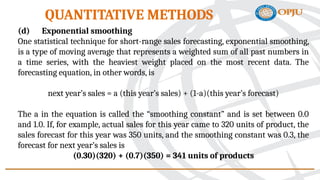
(d) Exponential smoothing
One statistical technique for short-range sales forecasting, exponential smoothing,
is a type of moving average that represents a weighted sum of all past numbers in
a time series, with the heaviest weight placed on the most recent data. The
forecasting equation, in other words, is
next year’s sales = a (this year’s sales) + (1-a)(this year’s forecast)
The a in the equation is called the “smoothing constant” and is set between 0.0
and 1.0. If, for example, actual sales for this year came to 320 units of product, the
sales forecast for this year was 350 units, and the smoothing constant was 0.3, the
forecast for next year’s sales is
(0.30)(320) + (0.7)(350) = 341 units of products
QUANTITATIVE METHODS
(e) Regression Analysis
Regression analysis is a statistical process and, as used in sales forecasting,
determines and measures the association between company sales and other
variables. It involves fitting an equation to explain sales fluctuations in terms of
related and presumably causal variables, substituting for these variables values
considered likely during the period to be forecasted, and solving for sales.
In other words, there are three major steps in forecasting sales through regression
analysis:
i. Identify variables causally related to company sales.
ii. Determine or estimate the values of these variables related to sales.
iii. Derive the sales forecast from these estimates.
QUANTITATIVE METHODS
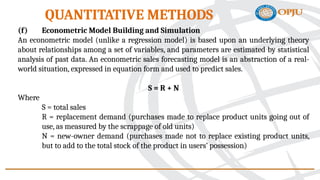
(f) Econometric Model Building and Simulation
An econometric model (unlike a regression model) is based upon an underlying theory
about relationships among a set of variables, and parameters are estimated by statistical
analysis of past data. An econometric sales forecasting model is an abstraction of a real-
world situation, expressed in equation form and used to predict sales.
S = R + N
Where
S = total sales
R = replacement demand (purchases made to replace product units going out of
use, as measured by the scrappage of old units)
N = new-owner demand (purchases made not to replace existing product units,
but to add to the total stock of the product in users’ possession)
QUANTITATIVE METHODS
THANK YOU

Sales Forecasting Techniques in Sales Management

  • 1.
  • 2.
    • To dothe entire selling job (as when there are no other elements in the promotional mix). • To “service” existing accounts (that is, to maintain contacts with present customers, take orders, and so forth). • To search out and obtain new customers. • To secure and maintain customers’ cooperation in stocking and promoting the product line. • To keep customers informed on changes in the product line and other aspects of marketing strategy. • To assist customers in selling the product line (as through “missionary selling”). TYPES OF PERSONAL SELLING OBJECTIVES
  • 3.
    • To providetechnical advice and assistance to customers (as with complicated products and where products are especially designed to fit buyers specifications). • To assist with (or handle) the training of middlemen’s sales personnel. • To provide advice and assistance to middlemen on management problems. • To collect and report market information of interest and use to company management. TYPES OF PERSONAL SELLING OBJECTIVES
  • 4.
    A market potentialis an estimate of the maximum possible sales opportunities present in a particular market segment and open to all sellers of a good or service during a stated future period. Analyzing Market Potential • Market Identification 1) Who buys the product? 2) Who uses it? 3) Who are the prospective buyers and/or users? • Market Motivation 1) How best to present the product in sales talks. 2) The relative effectiveness of different selling appeals. • Analysis of Market Potential 1) Select the market factor(s) associated with the product’s demand. 2) Eliminate those market segments that do not contain prospective buyers of the product • Market Indexes (numeric expression) MARKET POTENTIAL
  • 5.
    • A salespotential is an estimate of the maximum possible sales opportunities present in a particular market segment open to a specified company selling a good or service during a stated future period. • A sales potential represents sales opportunities available to a particular manufacturer, while a market potential indicates sales opportunities available to an entire industry. SALES POTENTIAL
  • 6.
    • A salesforecast is an estimate of sales, in rupees or physical units, in a future period under a particular marketing program and an assumed set of economic and other factors outside the unit for which the forecast is made. • A sales forecast may be for a single product or for an entire product line. • It may be for a manufacturer’s entire marketing area, or for any subdivision of it. • Keep in mind, then, that an operating sales forecast is a prediction of how much of a company’s particular product (or product line) can be sold during a future period under a given marketing program and an assumed set of outside factors. SALES FORECAST
  • 7.
    A firm’s salespotential and its sales forecast are not usually identical – in most instances, the sales potential is larger than the sales forecast. There are several reasons for this: • “Some companies do not have sufficient production capacity to capitalize on the full sales potential; • “Other firms have not yet developed distributive networks capable of reaching every potential customer; • “Others do not attempt to realize their total sales potentials because of limited financial resources; and • “Still others, being more profit oriented than sales oriented, seek to maximize profitable sales and not possible sales. SALES POTENTIAL AND FORECAST
  • 8.
    A sales forecastingmethod is a procedure for estimating how much of a given product (or product line) can be sold if a given marketing program is implemented. No sales forecasting method is foolproof – each is subject to some error. METHODS OF SALES FORECASTING
  • 9.
    (a) Jury ofExecutive Opinion There are two steps in this method: 1) high-ranking executives estimate probable sales, and 2) an average estimate is calculated. Companies using the jury of executive opinion method do so for one or more of four reasons: 1) This is a quick and easy way to turn out a forecast. 2) This is a way to pool the experience and judgment of well-informed people. 3) This may be the only feasible approach if the company is so young that it has not yet accumulated the experience to use other forecasting methods. 4) This method may be used when adequate sales and market statistics are missing, or when these figures have not yet been put into the form required for more sophisticated forecasting methods. QUALITATIVE METHODS
  • 10.
    (b) The DelphiTechnique • Several years ago researchers at the Rand Corporation developed a technique for predicting the future that is called the Delphi technique. • This is a version of the jury of executive opinion method in which those giving opinions are selected for their “expertise”. • The panel of experts responds to a sequence of questionnaires in which the responses to one questionnaire are used to produce the next questionnaire. • Thus, information available to some and not to other experts is disseminated to all, enabling all to base their final forecasts on “all available” information. • Some contend that “this technique eliminates the bandwagon effect of majority opinion.” QUALITATIVE METHODS
  • 11.
    (c) Poll ofSales Force Opinion In the poll of sales force opinion method, often tagged “the grass-roots approach,” individual sales personnel forecast sales for their territories; then individual forecasts are combined and modified, as management thinks necessary, to form the company sales forecast. This approach appeals to practical sales managers because:  Forecasting responsibility is assigned to those who produce the results.  Furthermore, there is merit in utilizing the specialized knowledge of those in closet touch with market conditions. Because the salespeople help to develop the forecast, they should have greater confidence in quotas based upon it.  Another attractive feature is that forecasts developed by this method are easy to break down according to products, territories, customers, middlemen, and sales force. QUALITATIVE METHODS
  • 12.
    (a) Projection ofPast Sales The projection of past sales method of sales forecasting takes a variety to forms. The simplest is to set the sales forecast for the coming year at the same figure as the current year’s actual sales, or the forecast may be made by adding a set percentage to last year’s sales, or to a moving average of the sales figure for several past years. next year’s sales = this year’s sales X this year’s sales/last year’s sales QUANTITATIVE METHODS
  • 13.
    (b) Time-Series Analysis Notgreatly different in principle from the simple projection of past sales in time-series analysis, a statistical procedure for studying historical sales data. This procedure involves isolating and measuring four chief types of sales variations: long-term trends, cyclical changes, seasonal variations, and irregular fluctuations. Then a mathematical model describing the past behavior of the series is selected, assumed values for each type of sales variation are inserted, and the sales forecast is ‘cranked out.” QUANTITATIVE METHODS
  • 14.
    (c) Moving AverageMethod These are used to allow for market place factor changing at different rates and at different times. With this method both distant past and distant future have little value in forecasting. The moving average is a technique that attempts to “smooth out “ the different rates of change for the immediate past, usually past three to five years. QUANTITATIVE METHODS
  • 15.
    (d) Exponential smoothing Onestatistical technique for short-range sales forecasting, exponential smoothing, is a type of moving average that represents a weighted sum of all past numbers in a time series, with the heaviest weight placed on the most recent data. The forecasting equation, in other words, is next year’s sales = a (this year’s sales) + (1-a)(this year’s forecast) The a in the equation is called the “smoothing constant” and is set between 0.0 and 1.0. If, for example, actual sales for this year came to 320 units of product, the sales forecast for this year was 350 units, and the smoothing constant was 0.3, the forecast for next year’s sales is (0.30)(320) + (0.7)(350) = 341 units of products QUANTITATIVE METHODS
  • 16.
    (e) Regression Analysis Regressionanalysis is a statistical process and, as used in sales forecasting, determines and measures the association between company sales and other variables. It involves fitting an equation to explain sales fluctuations in terms of related and presumably causal variables, substituting for these variables values considered likely during the period to be forecasted, and solving for sales. In other words, there are three major steps in forecasting sales through regression analysis: i. Identify variables causally related to company sales. ii. Determine or estimate the values of these variables related to sales. iii. Derive the sales forecast from these estimates. QUANTITATIVE METHODS
  • 17.
    (f) Econometric ModelBuilding and Simulation An econometric model (unlike a regression model) is based upon an underlying theory about relationships among a set of variables, and parameters are estimated by statistical analysis of past data. An econometric sales forecasting model is an abstraction of a real- world situation, expressed in equation form and used to predict sales. S = R + N Where S = total sales R = replacement demand (purchases made to replace product units going out of use, as measured by the scrappage of old units) N = new-owner demand (purchases made not to replace existing product units, but to add to the total stock of the product in users’ possession) QUANTITATIVE METHODS
  • 18.