CHEMICAL 
KINETICS
HOMOGENEOUS REACTIONS 
in which all reactants and products are in one 
phase 
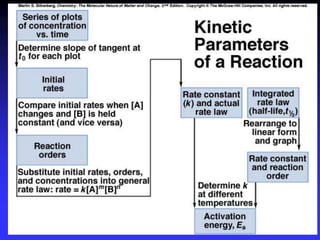
KINETICS Chemical kinetics, also known as 
reaction kinetics, is the study of rates of 
chemical processes
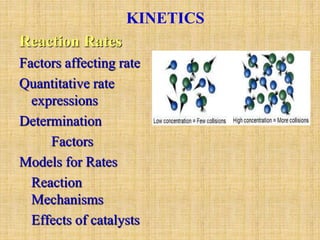
KINETICS 
Reaction Rates 
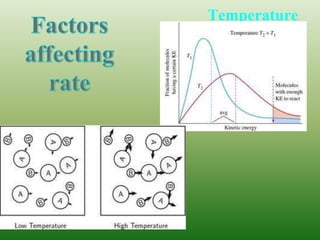
Factors affecting rate 
Quantitative rate 
expressions 
Determination 
Factors 
Models for Rates 
Reaction 
Mechanisms 
Effects of catalysts
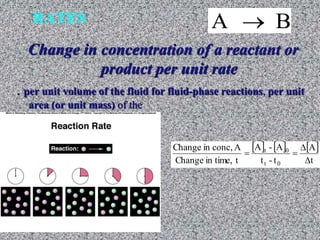
RATES 
B A  
Change in concentration of a reactant or 
product per unit rate 
. per unit volume of the fluid for fluid-phase reactions, per unit 
area (or unit mass) of the 
     A 
 
t 
A - A 
t 0 
t - t 
Change in conc, A 
Change in time, t 
t 0 
 
 
 
Temperature
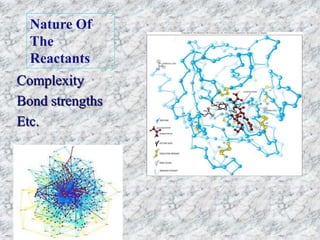
Nature Of 
The 
Reactants 
Complexity 
Bond strengths 
Etc.
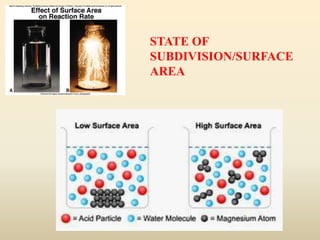
STATE OF 
SUBDIVISION/SURFACE 
AREA
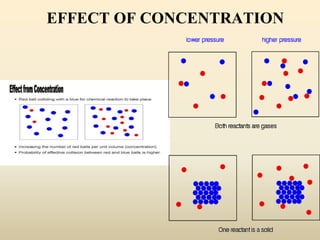
EFFECT OF CONCENTRATION
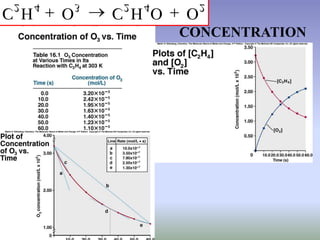
2 4 3 2 4 2 C H  O  C H O  O 
CONCENTRATION
Time(s) [NO2] [NO] [O2] 
0 0.0100 0.0000 0.0000 
50 0.0079 0.0021 0.0011 
100 0.0065 0.0035 0.0018 
150 0.0055 0.0045 0.0023 
200 0.0048 0.0052 0.0026 
250 0.0043 0.0057 0.0029 
300 0.0038 0.0062 0.0031 
350 0.0034 0.0066 0.0033 
400 0.0031 0.0069 0.0035 
2 2 2NO 2NO  O
Graph: Concentration vs. time 
   NO  -  NO 
     
2 2 400 2 0       
Concentration vs Time 
0.012 
0.01 
0.008 
0.006 
0.004 
0.002 
0 
NO 
0 50 100 150 200 250 300 350 400 450 
Time, sec 
Conc.,mol/L 
[NO2] 
[NO] 
[O2] 
2 2 2NO 2NO  O 
1.725 10 M 
0.0031 - 0.0100 
400 - 0 
t - t 
t 
5 
400 0 
 
 
-[NO2]/t time period(s) 
–4.20E-05 0 - 50 
–2.80E-05 50 - 100 
–2.00E-05 100 - 150 
–1.40E-05 150 - 200 
–1.00E-05 200 - 250 
–1.00E-05 250 - 300 
–8.00E-06 300 - 350 
–6.00E-06 350 - 400 
–1.75E-05 0 - 400 Concentration vs Time 
0.012 
0.01 
0.008 
0.006 
0.004 
0.002 
0 
0 50 100 150 200 250 300 350 400 450 
Time, sec 
Conc.,mol/L 
[NO2] 
[NO] 
[O2]
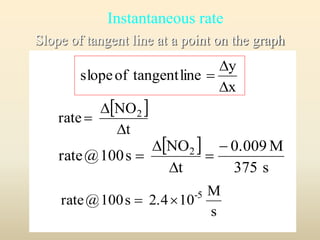
Instantaneous rate 
Slope of tangent line at a point on the graph 
 
 
y 
x 
slope of tangent line 
 
 NO 
 
rate 2 
 
t 
 
 
  
0.009M 
375 s 
NO 
rate @ 100 s 2  
 
 
t 
 
 
M 
s 
rate @ 100 s 2.4 10 -5  
INSTANTANEOUS RATE 
Concentration vs Time 
0.012 
0.01 
0.008 
0.006 
0.004 
0.002 
0 
0 50 100 150 200 250 300 350 400 450 
Time, sec 
Conc.,mol/L 
[NO2] 
[NO] 
[O2] 
12_291 
0.0003 
70s 
O2 
0.0100 
0.0075 
0.005 
0.0025 
0.0006 
70s 
0.0026 
110 s 
NO2 
NO 
50 100 150 200 250 300 350 400 
Concentrations (mol/L) 
Time (s) 
[NO2 ] 
 t
Concentration vs Time 
0.012 
0.01 
0.008 
0.006 
0.004 
0.002 
0 
0 50 100 150 200 250 300 350 400 450 
Time, sec 
Conc.,mol/L 
[NO2] 
[NO] 
[O2] 
 NO 
 
rate 2 
 
t 
 
 
 
 
y 
x 
slope of tangent line 
 
  
0.010M 
225 s 
NO 
rate @ 0 s 2  
 
 
t 
 
 
M 
s 
rate @ 0 s 4.4 10 -5   
Slope of tangent line at time 
0 (y intercept) 
Initial Rate (t = 0)
RATE LAWS 
 m n rate  k A B 
k = rate constant 
m, n = order 
2 2 2NO 2NO  O 
rate = k[NO2]n 
Order of Reaction In chemical kinetics, the order of 
reaction with respect to a certain reactant, is defined 
as the power to which its concentration term.
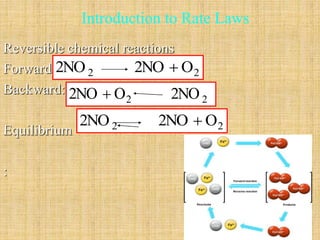
Introduction to Rate Laws 
Reversible chemical reactions 
Forward: 
Backward: 
Equilibrium 
: 
2 2 2NO 2NO  O 
2NO O 2NO 2 2  
2 2 2NO 2NO  O
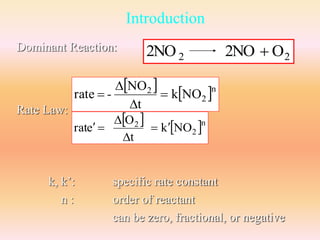
Introduction 
Dominant Reaction: 
Rate Law: 
2 2 2NO 2NO  O 
  
 n 
2 
NO 
2 k NO 
t 
 
rate  
 
O 
k, k’: specific rate constant 
n : order of reactant 
can be zero, fractional, or negative 
 - 
  
 n 
2 
2 k NO 
t 
rate   
 
 
 
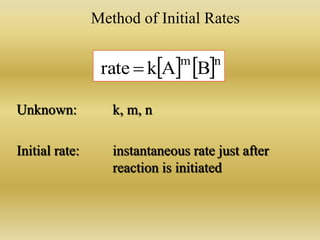
Method of Initial Rates 
 m n rate  k A B 
Unknown: k, m, n 
Initial rate: instantaneous rate just after 
reaction is initiated
Initial Rates, NO2 decomposition 
2 2 2NO 2NO  O 
 
 - 
rate  
Experiment 
 NO 
 
2 k NO 
t 
 
Initial Conc. 
[NO2] 
 n 
2 
Rate [O2] 
Formation 
1 0.01 7.1 x 10⁻⁵ 
2 0.02 2.8 x 10⁻⁴
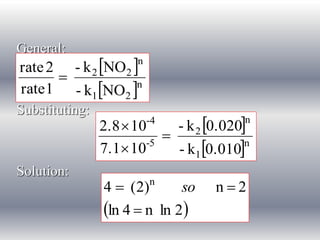
General: 
- k NO 
rate 2 
Substituting: 
Solution: 
n 
  
2 2 
 n 
1 2 
- k NO 
rate 1 
 
n 
  
 n 
1 
- k 0.020 
2 
-4 
2.8 10 
-5 
- k 0.010 
 
7.1 10 
 
 
4  (2) n 
so n  
2 ln 4  
n ln 2
Rate constant 
Rate 1 
  
 n 
2 
NO 
2 k NO 
t 
 
 - 
rate  
 
7.1 x 10⁻⁵ M s-1 = -k[0.01 M]2 
k = 0.71 M-1 s-1 
Rate 2 
2.8 x 10⁻⁴ M s-1 = -k[0.02 M]2 
k = 0.70 M-1 s-1 
  
 2 
2 
NO 
2 0.70 NO 
t 
rate law   
 
 

Experiment 
H I 2HI 2 2   
Initial Conc. 
[H2] 
Initial Conc. 
[I2] Rate 
1 0.0113 0.0011 1.9 x 10⁻²³ 
2 0.0220 0.0033 1.1 x 10⁻²² 
3 0.0550 0.0011 9.3 x 10⁻²³ 
4 0.0220 0.0056 1.9 x 10⁻²²
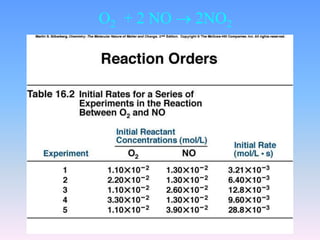
O2 + 2 NO  2NO2
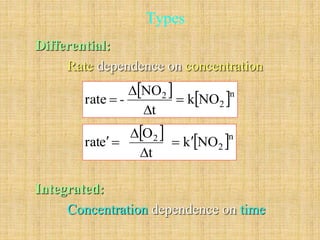
Types 
Differential: 
Rate dependence on concentration 
 
 - 
rate  
 
rate   
Integrated: 
  
 n 
2 
NO 
2 k NO 
t 
 
  
 n 
2 
O 
2 k NO 
t 
 
  
Concentration dependence on time
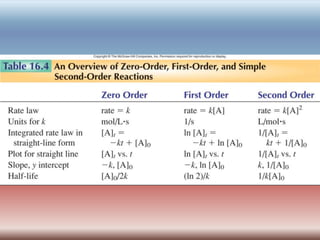
First Order Reactions 
For aA  products 
Differential: 
  
kA 
A 
 
 - 
rate  
 
t 
   0 ln A  - kt  ln A t 
Integrated: first order reaction (order = 1) has a 
rate proportional to the concentration of one of 
the reactants. A common example of a first-order 
reaction is the phenomenon of  A 
radioactive  
0 decay. 
The rate law is: 
ln  
kt 
 A 
 
rate = k[A] (or B instead of A), with t 
k having the 
The rate of reaction is proportional to the 
concentration of A
Half-life, first order reactions 
Integrated law: 
Half-life: 
Half of initial reacted 
[A]t = ½[A]0 
Independent of [A]0 
  
  
kt 
A 
ln 0  
A 
t 
ln2 
0.693 
k 
t 
k 
t 
2 
1 
2 
1 
 

First order 
Plot: 
ln[A] vs. time 
ln[A] 
ln[A]0 
slope = -k 
time 
lnA  - kt  lnA0 t 
y mx  b
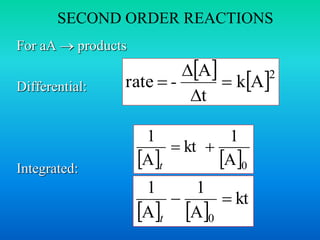
SECOND-ORDER REACTION 
A second-order reaction (order = 2) has a rate 
proportional to the concentration of the square 
of a single reactant or the product of the 
concentration of two reactants: 
rate = k[A]2 (or substitute B for A or k multiplied 
by the concentration of A times the 
concentration of B), with the units of the rate 
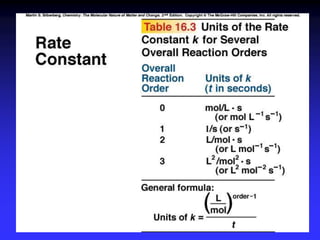
constant M-1sec-1
SECOND ORDER 
1 
kt 
1 
   0 A 
Plot: 
1 vs. time 
[A] 
1 
[A]o 
slope = k 
time 
y mx  b 
A 
  
t 
1 
[A]
SECOND ORDER REACTIONS 
For aA  products 
Differential: 
Integrated: 
  
kA2 
A 
rate  
 
t 
 
 - 
1 
   0 A 
1 
1 
  
    
kt 
A 
A 
0 
t 
1 
kt 
A 
  
t
HALF-LIFE, SECOND ORDER 
REACTIONS 
Integrated law: 
Half-life: 
Half of initial reacted 
[A]t = ½[A]0 
1 
1 
  
    
Inversely proportional to [A]0 
kt 
A 
A 
0 
t 
1 
 0 k A 
t 
2 
1 

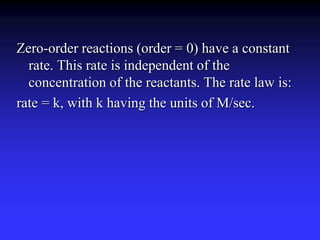
Zero-order reactions (order = 0) have a constant 
rate. This rate is independent of the 
concentration of the reactants. The rate law is: 
rate = k, with k having the units of M/sec.
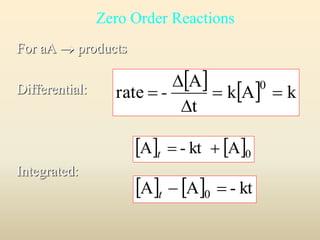
Zero Order Reactions 
For aA  products 
Differential: 
Integrated: 
  
rate 0   
kA k 
A 
 
t 
 
 - 
   0 A  - kt  A t 
A A - kt 0   t
Zero order 
   0 A  - kt  A t 
Plot: 
[A] vs. time 
[A] 
[A]0 
slope = -k 
time 
y mx  b
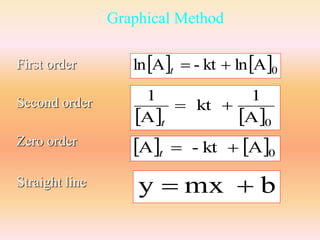
Graphical Method 
First order 
Second order 
Zero order 
Straight line 
lnA  - kt  lnA0 t 
1 
kt 
1 
 A 
  A 
0   
t 
   0 A  - kt  A t 
y  mx  b
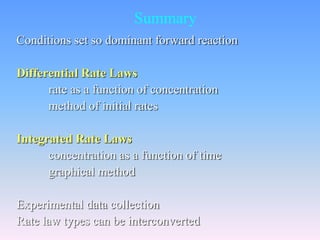
Summary 
Conditions set so dominant forward reaction 
Differential Rate Laws 
rate as a function of concentration 
method of initial rates 
Integrated Rate Laws 
concentration as a function of time 
graphical method 
Experimental data collection 
Rate law types can be interconverted
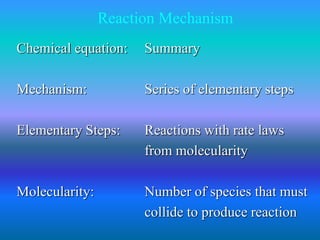
Reaction Mechanism 
Chemical equation: Summary 
Mechanism: Series of elementary steps 
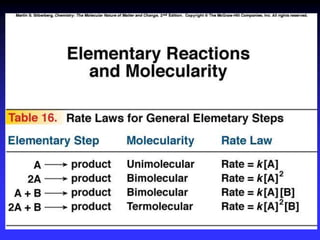
Elementary Steps: Reactions with rate laws 
from molecularity 
Molecularity: Number of species that must 
collide to produce reaction
Reaction Mechanism 
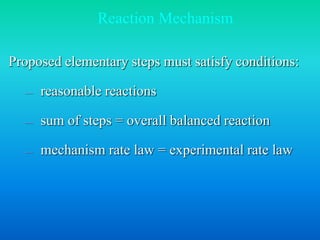
Proposed elementary steps must satisfy conditions: 
— reasonable reactions 
— sum of steps = overall balanced reaction 
— mechanism rate law = experimental rate law
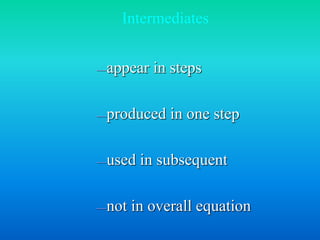
Intermediates 
—appear in steps 
—produced in one step 
—used in subsequent 
—not in overall equation
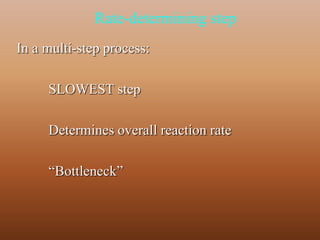
Rate-determining step 
In a multi-step process: 
SLOWEST step 
Determines overall reaction rate 
“Bottleneck”
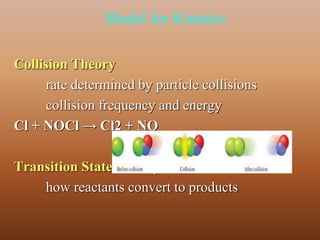
Model for Kinetics 
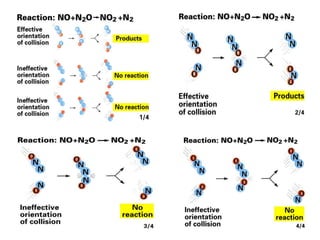
Collision Theory 
rate determined by particle collisions 
collision frequency and energy 
Cl + NOCl → Cl2 + NO 
Transition State Theory 
how reactants convert to products
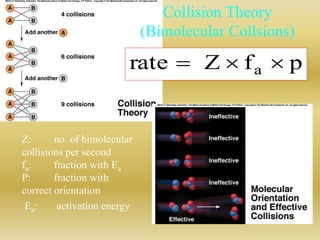
rate Z f p a    
Z: no. of bimolecular 
collisions per second 
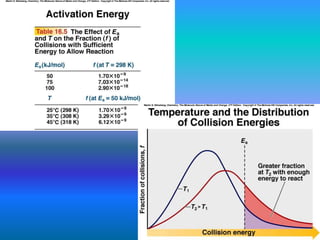
fa: fraction with Ea 
P: fraction with 
correct orientation 
Ea: activation energy 
Collision Theory 
(Bimolecular Collsions)
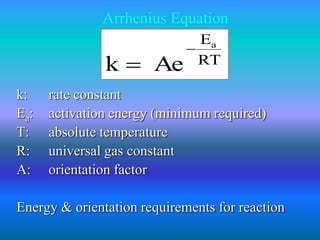
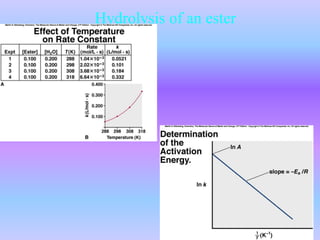
Arrhenius Equation 
Ea 
RT 
k Ae 
 
 
k: rate constant 
Ea: activation energy (minimum required) 
T: absolute temperature 
R: universal gas constant 
A: orientation factor 
Energy & orientation requirements for reaction
Hydrolysis of an ester
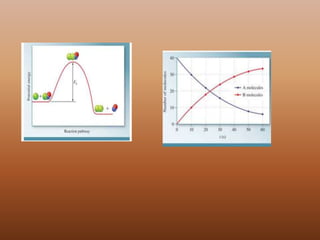
Transition State Theory 
Ea and internal energy: 
Bonds breaking and forming 
Atoms rearranging 
“Transition State” 
Unstable intermediate 
At point of highest energy
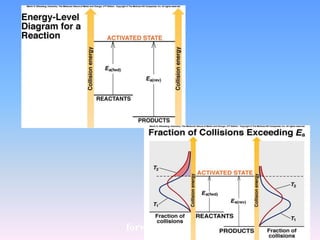
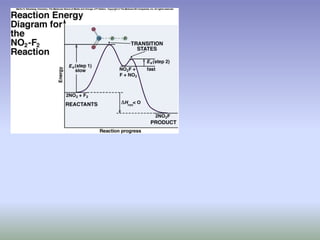
forward reaction reverse reaction
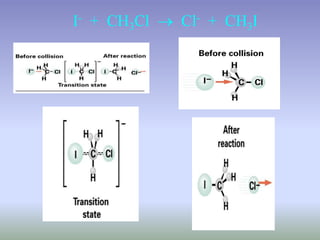
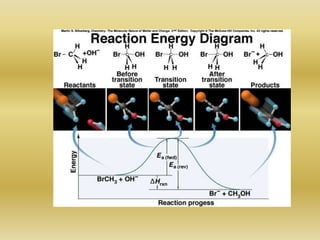
I- + CH3Cl  Cl- + CH3I
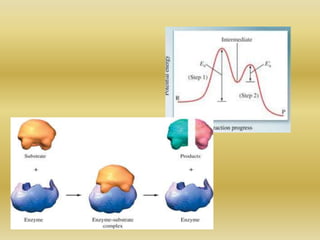
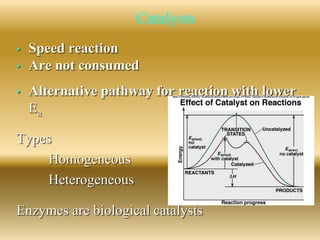
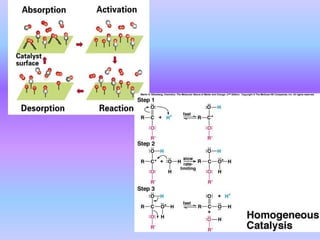
Catalysts 
• Speed reaction 
• Are not consumed 
• Alternative pathway for reaction with lower 
Ea 
Types 
Homogeneous 
Heterogeneous 
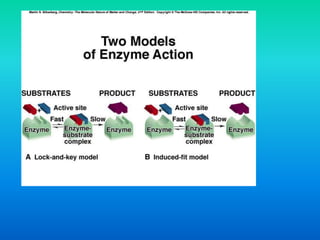
Enzymes are biological catalysts
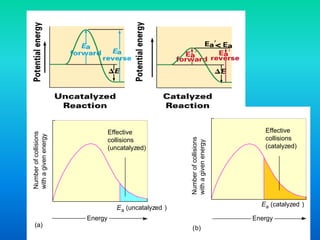
12_304 
Effective 
collisions 
(uncatalyzed) 
Ea (uncatalyzed ) 
Effective 
collisions 
(catalyzed) 
Ea (catalyzed ) 
Number of collisions 
with a given energy 
Number of collisions 
with a given energy 
Energy Energy 
(a) (b)
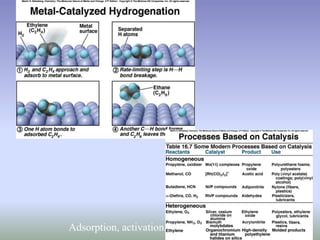
Adsorption, activation, reaction, desorption
Ch16 kinetics 1

Ch16 kinetics 1

  • 1.
  • 2.
    HOMOGENEOUS REACTIONS inwhich all reactants and products are in one phase KINETICS Chemical kinetics, also known as reaction kinetics, is the study of rates of chemical processes
  • 3.
    KINETICS Reaction Rates Factors affecting rate Quantitative rate expressions Determination Factors Models for Rates Reaction Mechanisms Effects of catalysts
  • 4.
    RATES B A Change in concentration of a reactant or product per unit rate . per unit volume of the fluid for fluid-phase reactions, per unit area (or unit mass) of the      A  t A - A t 0 t - t Change in conc, A Change in time, t t 0    
  • 5.
  • 6.
    Nature Of The Reactants Complexity Bond strengths Etc.
  • 7.
  • 8.
  • 9.
    2 4 32 4 2 C H  O  C H O  O CONCENTRATION
  • 10.
    Time(s) [NO2] [NO][O2] 0 0.0100 0.0000 0.0000 50 0.0079 0.0021 0.0011 100 0.0065 0.0035 0.0018 150 0.0055 0.0045 0.0023 200 0.0048 0.0052 0.0026 250 0.0043 0.0057 0.0029 300 0.0038 0.0062 0.0031 350 0.0034 0.0066 0.0033 400 0.0031 0.0069 0.0035 2 2 2NO 2NO  O
  • 11.
    Graph: Concentration vs.time    NO  -  NO      2 2 400 2 0       Concentration vs Time 0.012 0.01 0.008 0.006 0.004 0.002 0 NO 0 50 100 150 200 250 300 350 400 450 Time, sec Conc.,mol/L [NO2] [NO] [O2] 2 2 2NO 2NO  O 1.725 10 M 0.0031 - 0.0100 400 - 0 t - t t 5 400 0   -[NO2]/t time period(s) –4.20E-05 0 - 50 –2.80E-05 50 - 100 –2.00E-05 100 - 150 –1.40E-05 150 - 200 –1.00E-05 200 - 250 –1.00E-05 250 - 300 –8.00E-06 300 - 350 –6.00E-06 350 - 400 –1.75E-05 0 - 400 Concentration vs Time 0.012 0.01 0.008 0.006 0.004 0.002 0 0 50 100 150 200 250 300 350 400 450 Time, sec Conc.,mol/L [NO2] [NO] [O2]
  • 12.
    Instantaneous rate Slopeof tangent line at a point on the graph   y x slope of tangent line   NO  rate 2  t     0.009M 375 s NO rate @ 100 s 2    t   M s rate @ 100 s 2.4 10 -5  
  • 13.
    INSTANTANEOUS RATE Concentrationvs Time 0.012 0.01 0.008 0.006 0.004 0.002 0 0 50 100 150 200 250 300 350 400 450 Time, sec Conc.,mol/L [NO2] [NO] [O2] 12_291 0.0003 70s O2 0.0100 0.0075 0.005 0.0025 0.0006 70s 0.0026 110 s NO2 NO 50 100 150 200 250 300 350 400 Concentrations (mol/L) Time (s) [NO2 ]  t
  • 14.
    Concentration vs Time 0.012 0.01 0.008 0.006 0.004 0.002 0 0 50 100 150 200 250 300 350 400 450 Time, sec Conc.,mol/L [NO2] [NO] [O2]  NO  rate 2  t     y x slope of tangent line    0.010M 225 s NO rate @ 0 s 2    t   M s rate @ 0 s 4.4 10 -5   Slope of tangent line at time 0 (y intercept) Initial Rate (t = 0)
  • 15.
    RATE LAWS m n rate  k A B k = rate constant m, n = order 2 2 2NO 2NO  O rate = k[NO2]n Order of Reaction In chemical kinetics, the order of reaction with respect to a certain reactant, is defined as the power to which its concentration term.
  • 16.
    Introduction to RateLaws Reversible chemical reactions Forward: Backward: Equilibrium : 2 2 2NO 2NO  O 2NO O 2NO 2 2  2 2 2NO 2NO  O
  • 17.
    Introduction Dominant Reaction: Rate Law: 2 2 2NO 2NO  O    n 2 NO 2 k NO t  rate   O k, k’: specific rate constant n : order of reactant can be zero, fractional, or negative  -    n 2 2 k NO t rate      
  • 18.
    Method of InitialRates  m n rate  k A B Unknown: k, m, n Initial rate: instantaneous rate just after reaction is initiated
  • 19.
    Initial Rates, NO2decomposition 2 2 2NO 2NO  O   - rate  Experiment  NO  2 k NO t  Initial Conc. [NO2]  n 2 Rate [O2] Formation 1 0.01 7.1 x 10⁻⁵ 2 0.02 2.8 x 10⁻⁴
  • 20.
    General: - kNO rate 2 Substituting: Solution: n   2 2  n 1 2 - k NO rate 1  n    n 1 - k 0.020 2 -4 2.8 10 -5 - k 0.010  7.1 10   4  (2) n so n  2 ln 4  n ln 2
  • 21.
    Rate constant Rate1    n 2 NO 2 k NO t   - rate   7.1 x 10⁻⁵ M s-1 = -k[0.01 M]2 k = 0.71 M-1 s-1 Rate 2 2.8 x 10⁻⁴ M s-1 = -k[0.02 M]2 k = 0.70 M-1 s-1    2 2 NO 2 0.70 NO t rate law     
  • 22.
    Experiment H I2HI 2 2   Initial Conc. [H2] Initial Conc. [I2] Rate 1 0.0113 0.0011 1.9 x 10⁻²³ 2 0.0220 0.0033 1.1 x 10⁻²² 3 0.0550 0.0011 9.3 x 10⁻²³ 4 0.0220 0.0056 1.9 x 10⁻²²
  • 23.
    O2 + 2NO  2NO2
  • 24.
    Types Differential: Ratedependence on concentration   - rate   rate   Integrated:    n 2 NO 2 k NO t     n 2 O 2 k NO t    Concentration dependence on time
  • 25.
    First Order Reactions For aA  products Differential:   kA A   - rate   t    0 ln A  - kt  ln A t Integrated: first order reaction (order = 1) has a rate proportional to the concentration of one of the reactants. A common example of a first-order reaction is the phenomenon of  A radioactive  0 decay. The rate law is: ln  kt  A  rate = k[A] (or B instead of A), with t k having the The rate of reaction is proportional to the concentration of A
  • 26.
    Half-life, first orderreactions Integrated law: Half-life: Half of initial reacted [A]t = ½[A]0 Independent of [A]0     kt A ln 0  A t ln2 0.693 k t k t 2 1 2 1  
  • 27.
    First order Plot: ln[A] vs. time ln[A] ln[A]0 slope = -k time lnA  - kt  lnA0 t y mx  b
  • 30.
    SECOND-ORDER REACTION Asecond-order reaction (order = 2) has a rate proportional to the concentration of the square of a single reactant or the product of the concentration of two reactants: rate = k[A]2 (or substitute B for A or k multiplied by the concentration of A times the concentration of B), with the units of the rate constant M-1sec-1
  • 31.
    SECOND ORDER 1 kt 1    0 A Plot: 1 vs. time [A] 1 [A]o slope = k time y mx  b A   t 1 [A]
  • 32.
    SECOND ORDER REACTIONS For aA  products Differential: Integrated:   kA2 A rate   t   - 1    0 A 1 1       kt A A 0 t 1 kt A   t
  • 33.
    HALF-LIFE, SECOND ORDER REACTIONS Integrated law: Half-life: Half of initial reacted [A]t = ½[A]0 1 1       Inversely proportional to [A]0 kt A A 0 t 1  0 k A t 2 1 
  • 34.
    Zero-order reactions (order= 0) have a constant rate. This rate is independent of the concentration of the reactants. The rate law is: rate = k, with k having the units of M/sec.
  • 35.
    Zero Order Reactions For aA  products Differential: Integrated:   rate 0   kA k A  t   -    0 A  - kt  A t A A - kt 0   t
  • 36.
    Zero order   0 A  - kt  A t Plot: [A] vs. time [A] [A]0 slope = -k time y mx  b
  • 38.
    Graphical Method Firstorder Second order Zero order Straight line lnA  - kt  lnA0 t 1 kt 1  A   A 0   t    0 A  - kt  A t y  mx  b
  • 41.
    Summary Conditions setso dominant forward reaction Differential Rate Laws rate as a function of concentration method of initial rates Integrated Rate Laws concentration as a function of time graphical method Experimental data collection Rate law types can be interconverted
  • 42.
    Reaction Mechanism Chemicalequation: Summary Mechanism: Series of elementary steps Elementary Steps: Reactions with rate laws from molecularity Molecularity: Number of species that must collide to produce reaction
  • 44.
    Reaction Mechanism Proposedelementary steps must satisfy conditions: — reasonable reactions — sum of steps = overall balanced reaction — mechanism rate law = experimental rate law
  • 45.
    Intermediates —appear insteps —produced in one step —used in subsequent —not in overall equation
  • 46.
    Rate-determining step Ina multi-step process: SLOWEST step Determines overall reaction rate “Bottleneck”
  • 47.
    Model for Kinetics Collision Theory rate determined by particle collisions collision frequency and energy Cl + NOCl → Cl2 + NO Transition State Theory how reactants convert to products
  • 50.
    rate Z fp a    Z: no. of bimolecular collisions per second fa: fraction with Ea P: fraction with correct orientation Ea: activation energy Collision Theory (Bimolecular Collsions)
  • 52.
    Arrhenius Equation Ea RT k Ae   k: rate constant Ea: activation energy (minimum required) T: absolute temperature R: universal gas constant A: orientation factor Energy & orientation requirements for reaction
  • 53.
  • 55.
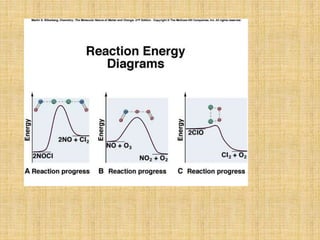
    Transition State Theory Ea and internal energy: Bonds breaking and forming Atoms rearranging “Transition State” Unstable intermediate At point of highest energy
  • 56.
  • 58.
    I- + CH3Cl Cl- + CH3I
  • 61.
    Catalysts • Speedreaction • Are not consumed • Alternative pathway for reaction with lower Ea Types Homogeneous Heterogeneous Enzymes are biological catalysts
  • 62.
    12_304 Effective collisions (uncatalyzed) Ea (uncatalyzed ) Effective collisions (catalyzed) Ea (catalyzed ) Number of collisions with a given energy Number of collisions with a given energy Energy Energy (a) (b)
  • 64.