1
Chemical
Kinetics
Chapter 14
Chemical Kinetics
Chemistry, The Central Science, 10th edition
Theodore L. Brown; H. Eugene LeMay, Jr.;
and Bruce E. Bursten
PDFCreatedwithdeskPDFPDFWriter-Trial::http://www.docudesk.com
2
Chemical
Kinetics
Kinetics
• Chemical Kinetics is the study of the
rate at which a chemical process
occurs.
• Besides information about the speed at
which reactions occur, kinetics also
sheds light on the reaction mechanism
(exactly how the reaction occurs).
PDFCreatedwithdeskPDFPDFWriter-Trial::http://www.docudesk.com
3
Chemical
Kinetics
Factors That Affect Reaction Rates
• Physical State of the Reactants
In order to react, molecules must come in
contact with each other. If the reaction is
happening between a solid and a liquid it
will react only on the surface.
The more homogeneous the mixture of
reactants, the faster the molecules can
react.
PDFCreatedwithdeskPDFPDFWriter-Trial::http://www.docudesk.com
4
Chemical
Kinetics
Factors That Affect Reaction Rates
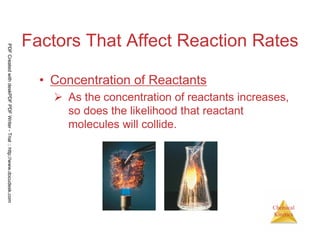
• Concentration of Reactants
As the concentration of reactants increases,
so does the likelihood that reactant
molecules will collide.
PDFCreatedwithdeskPDFPDFWriter-Trial::http://www.docudesk.com
5
Chemical
Kinetics
Factors That Affect Reaction Rates
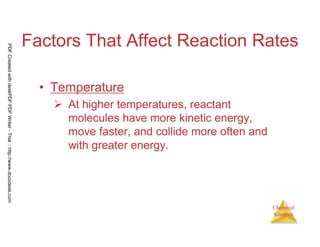
• Temperature
At higher temperatures, reactant
molecules have more kinetic energy,
move faster, and collide more often and
with greater energy.
PDFCreatedwithdeskPDFPDFWriter-Trial::http://www.docudesk.com
6
Chemical
Kinetics
Factors That Affect Reaction Rates
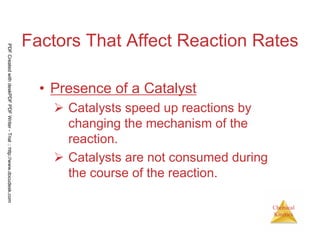
• Presence of a Catalyst
Catalysts speed up reactions by
changing the mechanism of the
reaction.
Catalysts are not consumed during
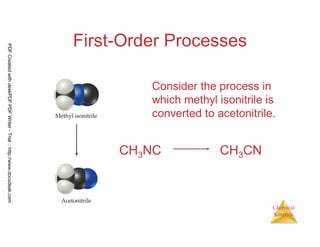
the course of the reaction.
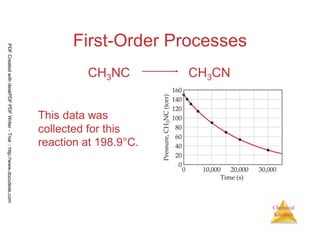
PDFCreatedwithdeskPDFPDFWriter-Trial::http://www.docudesk.com
7
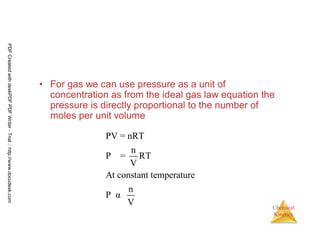
Chemical
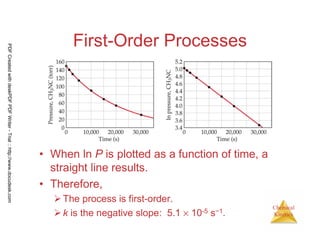
Kinetics
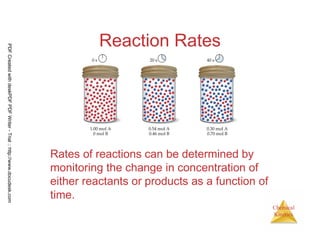
Reaction Rates
Rates of reactions can be determined by
monitoring the change in concentration of
either reactants or products as a function of
time.
PDFCreatedwithdeskPDFPDFWriter-Trial::http://www.docudesk.com
8
Chemical
Kinetics
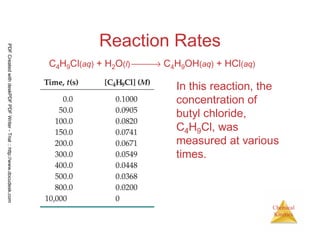
Reaction Rates
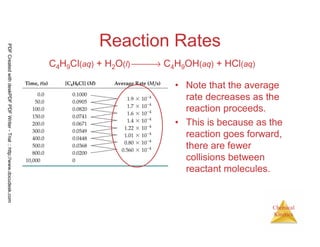
In this reaction, the
concentration of
butyl chloride,
C4H9Cl, was
measured at various
times.
C4H9Cl(aq) + H2O(l) → C4H9OH(aq) + HCl(aq)
PDFCreatedwithdeskPDFPDFWriter-Trial::http://www.docudesk.com
9
Chemical
Kinetics
The average rate of the
reaction over each
interval is the change in
concentration divided
by the change in time:
•
Average rate =
∆[C4H9Cl]
∆t
[ ] [ ] [ ]t2 t1
2 1
X - X ∆ X
Average rate = =
t -t ∆t
PDFCreatedwithdeskPDFPDFWriter-Trial::http://www.docudesk.com
10
Chemical
Kinetics
Reaction Rates
C4H9Cl(aq) + H2O(l) → C4H9OH(aq) + HCl(aq)
[ ] [ ] -4
0.0905 - 0.1000 0.0095
Average rate = = - 1.9 x 10
50-0 50
= −
PDFCreatedwithdeskPDFPDFWriter-Trial::http://www.docudesk.com
11
Chemical
Kinetics
Reaction Rates
• Note that the average
rate decreases as the
reaction proceeds.
• This is because as the
reaction goes forward,
there are fewer
collisions between
reactant molecules.
C4H9Cl(aq) + H2O(l) → C4H9OH(aq) + HCl(aq)
PDFCreatedwithdeskPDFPDFWriter-Trial::http://www.docudesk.com
12
Chemical
Kinetics
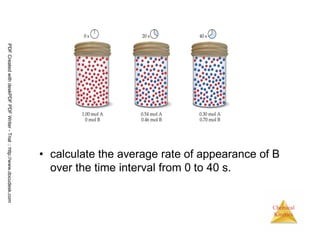
• calculate the average rate of appearance of B
over the time interval from 0 to 40 s.
PDFCreatedwithdeskPDFPDFWriter-Trial::http://www.docudesk.com
13
Chemical
Kinetics
Reaction Rates
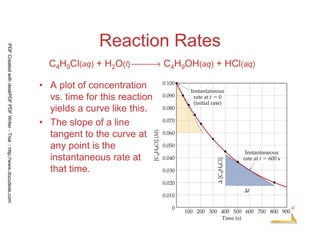
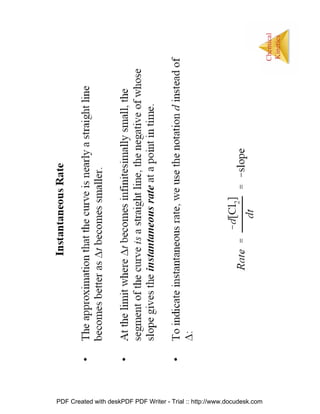
• A plot of concentration
vs. time for this reaction
yields a curve like this.
• The slope of a line
tangent to the curve at
any point is the
instantaneous rate at
that time.
C4H9Cl(aq) + H2O(l) → C4H9OH(aq) + HCl(aq)
PDFCreatedwithdeskPDFPDFWriter-Trial::http://www.docudesk.com
14
Chemical
Kinetics
Reaction Rates
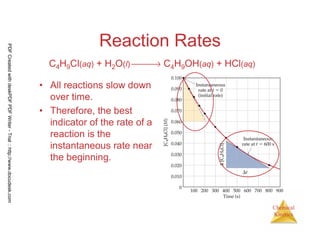
• All reactions slow down
over time.
• Therefore, the best
indicator of the rate of a
reaction is the
instantaneous rate near
the beginning.
C4H9Cl(aq) + H2O(l) → C4H9OH(aq) + HCl(aq)
PDFCreatedwithdeskPDFPDFWriter-Trial::http://www.docudesk.com
15
Chemical
Kinetics
Average vs. instantaneous rxn
rate
• Average rxn rate
• Instantaneous rxn rate (tangent to curve)
Usually in chemistry, we are interested in the instantaneous rxn rate at the very
beginning (at t = 0)
INITIAL REACTION RATE
∆t
∆
rate
]A[
elapsedtimetotal
endandrxnofbeginningbetween
ionconcentratchemicalofchange
)(reactionofrate =






=
∆t
∆
rate
]A[
elapsedshort timethe
timeofperiodshortaover
ionconcentratchemicalofchange
)(reactionofrate =






=
PDFCreatedwithdeskPDFPDFWriter-Trial::http://www.docudesk.com
16
Chemical
Kinetics
Average vs. instantaneous rxn
rateNaHCO3 + citric acid --> sodium citrate + H2O + CO2
0
0.2
0.4
0.6
0.8
1
1.2
1.4
1.6
1.8
2
0 0.5 1 1.5 2
time (minutes)
concentration(tablet/100mL)
initial [A] = 1 tablet
initial [A] = 2 tablets
Average rate
Instantaneous
rate at t = 0
(initial rate)
PDFCreatedwithdeskPDFPDFWriter-Trial::http://www.docudesk.com
17
Chemical
Kinetics
Comparing concentrations
of chemicals in a reaction
A --> B
0
0.2
0.4
0.6
0.8
1
1.2
1.4
1.6
1.8
2
0 0.5 1 1.5 2
time (hours)
concentration(mol/L)
[A]
[B]
A --> 2 C
0
0.2
0.4
0.6
0.8
1
1.2
1.4
1.6
1.8
2
0 0.5 1 1.5 2
time (hours)
concentration(mol/L)
[A]
[C]
PDFCreatedwithdeskPDFPDFWriter-Trial::http://www.docudesk.com
18
Chemical
Kinetics
What we’re after in kinetics
• We want to be able to understand and predict how much reactants
remain (or products get formed) in a certain amount of time
• Change with time is rate
• Rate means calculus must be used, so we need to be careful which
rate we are talking about
• We will use instantaneous rate at the start of a reaction (initial rate)
• Several factors affect the rate of a reaction
Initial concentration
Temperature
Amount of reactant exposed (surface area)
Presence of a catalyst
• A theory (equations) that predicts kinetics must explain these
PDFCreatedwithdeskPDFPDFWriter-Trial::http://www.docudesk.com
19
Chemical
Kinetics
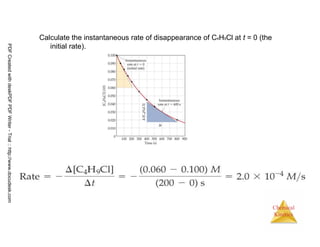
Calculate the instantaneous rate of disappearance of C4H9Cl at t = 0 (the
initial rate).
PDFCreatedwithdeskPDFPDFWriter-Trial::http://www.docudesk.com
20
Chemical
Kinetics
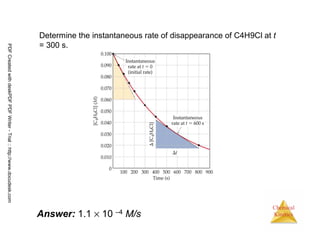
Determine the instantaneous rate of disappearance of C4H9Cl at t
= 300 s.
Answer: 1.1 × 10 –4 M/s
PDFCreatedwithdeskPDFPDFWriter-Trial::http://www.docudesk.com
21
Chemical
Kinetics
Reaction Rates and Stoichiometry
• In this reaction, the ratio
of C4H9Cl to C4H9OH is
1:1.
• Thus, the rate of
disappearance of
C4H9Cl is the same as
the rate of appearance
of C4H9OH.
C4H9Cl(aq) + H2O(l) → C4H9OH(aq) + HCl(aq)
Rate =
-∆[C4H9Cl]
∆t
=
∆[C4H9OH]
∆t
PDFCreatedwithdeskPDFPDFWriter-Trial::http://www.docudesk.com
22
Chemical
Kinetics
Reaction Rates and Stoichiometry
• What if the ratio is not 1:1?
2 HI(g) → H2(g) + I2(g)
in such a case ,
[ ] [ ] [ ]2 2
HI H I1
Rate = - =
2 t t t
∆ ∆ ∆
=
∆ ∆ ∆
PDFCreatedwithdeskPDFPDFWriter-Trial::http://www.docudesk.com
23
Chemical
Kinetics
Reaction Rates and Stoichiometry
• To generalize, then, for the reaction
aA + bB cC + dD
Rate = −
1
a
∆[A]
∆t
= −
1
b
∆[B]
∆t
=
1
c
∆[C]
∆t
1
d
∆[D]
∆t
=
PDFCreatedwithdeskPDFPDFWriter-Trial::http://www.docudesk.com
24
Chemical
Kinetics
Key points about kinetics so far
• Study the vocabulary
• Reaction rate has weird units
• Be clear whether you are talking about average reaction rate or
instantaneous reaction rate
• The equations which we will study all talk about instantaneous
reaction rate, most easily measured at the beginning of a
reaction (initial rate)
• Relating rates at which products appear (+) and reactants
disappear (-) has to do with inverse stoichiometric coefficients
• Reaction rate depends on several factors: initial concentration,
temperature, surface area of reactants exposed, presence of a
catalyst
PDFCreatedwithdeskPDFPDFWriter-Trial::http://www.docudesk.com
25
Chemical
Kinetics
(a) How is the rate at which ozone disappears related to
the rate at which oxygen appears in the reaction
(b) If the rate at which O2 appears, Δ[O2]/Δ t, is 6.0 × 10⁻⁵ M/s
at a particular instant, at what rate is O3 disappearing at this
same time, –Δ[O3] /Δ t?
PDFCreatedwithdeskPDFPDFWriter-Trial::http://www.docudesk.com
26
Chemical
Kinetics
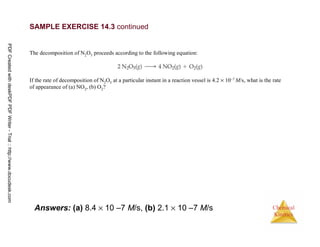
Answers: (a) 8.4 × 10 –7 M/s, (b) 2.1 × 10 –7 M/s
SAMPLE EXERCISE 14.3 continued
The decomposition of N2O5 proceeds according to the following equation:
If the rate of decomposition of N2O5 at a particular instant in a reaction vessel is 4.2 × 10⁻⁷ M/s, what is the rate
of appearance of (a) NO2, (b) O2?
PDFCreatedwithdeskPDFPDFWriter-Trial::http://www.docudesk.com
27
Chemical
Kinetics
Concentration and Rate
One can gain information about the rate
of a reaction by seeing how the rate
changes with changes in concentration.
PDFCreatedwithdeskPDFPDFWriter-Trial::http://www.docudesk.com
28
Chemical
Kinetics
Concentration and Rate
Comparing Experiments 1 and 2, when [NH4
+]
doubles, the initial rate doubles.
NH4
+(aq) + NO2
−(aq) N2(g) + 2 H2O(l)
PDFCreatedwithdeskPDFPDFWriter-Trial::http://www.docudesk.com
29
Chemical
Kinetics
Concentration and Rate
Likewise, comparing Experiments 5 and 6,
when [NO2
−] doubles, the initial rate doubles.
NH4
+(aq) + NO2
−(aq) N2(g) + 2 H2O(l)
PDFCreatedwithdeskPDFPDFWriter-Trial::http://www.docudesk.com
30
Chemical
Kinetics
Concentration and Rate
• This means
Rate ∝ [NH4
+]
Rate ∝ [NO2
−]
Rate ∝ [NH+] [NO2
−]
or
Rate = k [NH4
+] [NO2
−]
• This equation is called the rate law, and
k is the rate constant.
PDFCreatedwithdeskPDFPDFWriter-Trial::http://www.docudesk.com
31
Chemical
Kinetics
• If you want your concepts to be clearer
do the visualizing concepts part of the
problems at the back of your chapter.
PDFCreatedwithdeskPDFPDFWriter-Trial::http://www.docudesk.com
32
Chemical
Kinetics
Rate Law
• An equation that shows how the rate
depends on the concentration of the
reactants is called the rate law
• The exponents tell the order of the
reaction with respect to each reactant.
• This reaction is
First-order in [NH4
+]
First-order in [NO2
−]
PDFCreatedwithdeskPDFPDFWriter-Trial::http://www.docudesk.com
33
Chemical
Kinetics
Rate Laws
• The overall reaction order can be found
by adding the exponents on the
reactants in the rate law.
• This reaction is second-order overall.
PDFCreatedwithdeskPDFPDFWriter-Trial::http://www.docudesk.com
34
Chemical
Kinetics
• For a general reaction:
aA + bB cC + dD
Rate law has the form
Rate =k [A]m[B]n
where k is the rate constant and is
dependant on temperature.
PDFCreatedwithdeskPDFPDFWriter-Trial::http://www.docudesk.com
35
Chemical
Kinetics
If we know the rate law and the rate for a
set of reaction conditions we can
calculate the value of k.
PDFCreatedwithdeskPDFPDFWriter-Trial::http://www.docudesk.com
36
Chemical
Kinetics
To calculate the rate constant:
Rate law
Rate = k [A]m [B]n
Rate = k[NH4] [NO2]
For experiment 1:
5.4X10⁻⁷ M/s = k (0.0100M)(0.200M)
k = 5.4X10⁻⁷ M/s
k (0.0100M)(0.200M)
= 2.7X10 -4 /Ms
PDFCreatedwithdeskPDFPDFWriter-Trial::http://www.docudesk.com
37
Chemical
Kinetics
Exponents in the rate law
The exponent in the rate law indicates
how the rate is affected by the
concentration of each reactant.
PDFCreatedwithdeskPDFPDFWriter-Trial::http://www.docudesk.com
38
Chemical
Kinetics
SAMPLE EXERCISE 14.4 Relating a Rate Law to the Effect of Concentration on Rate
Consider a reaction for which rate = k[A][B]2. Each of the following boxes represents a
reaction mixture in which A is shown as red spheres and B as purple ones. Rank these mixtures in order of
increasing rate of reaction.
PDFCreatedwithdeskPDFPDFWriter-Trial::http://www.docudesk.com
39
Chemical
Kinetics
SAMPLE EXERCISE 14.4 Relating a Rate Law to the Effect of Concentration on Rate
Consider a reaction for which rate = k[A][B]2. Each of the following boxes represents a
reaction mixture in which A is shown as red spheres and B as purple ones. Rank these mixtures in order of
increasing rate of reaction.
Each box contains 10 spheres. The rate law indicates that in this case [B] has
a greater influence on rate than [A] because B has a higher reaction order.
Hence, the mixture with the highest concentration of B (most purple spheres)
should react fastest. This analysis confirms the order 2 < 1 < 3.
PDFCreatedwithdeskPDFPDFWriter-Trial::http://www.docudesk.com
40
Chemical
Kinetics
Assuming that rate = k[A][B], rank the mixtures represented in this
Sample Exercise in order of increasing rate.
Answer: 2 = 3 < 1
PDFCreatedwithdeskPDFPDFWriter-Trial::http://www.docudesk.com
41
Chemical
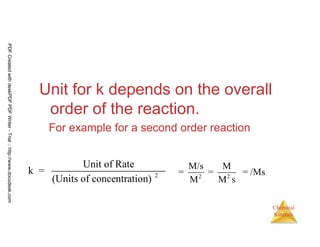
Kinetics
Unit for k depends on the overall
order of the reaction.
For example for a second order reaction
2
Unit of Rate
k =
(Units of concentration) 2 2
M/s M
= = = /Ms
M M s
PDFCreatedwithdeskPDFPDFWriter-Trial::http://www.docudesk.com
42
Chemical
Kinetics
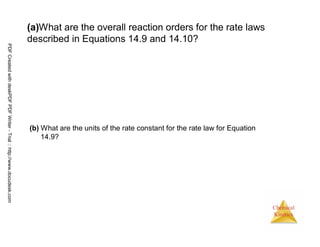
(a)What are the overall reaction orders for the rate laws
described in Equations 14.9 and 14.10?
(b) What are the units of the rate constant for the rate law for Equation
14.9?
PDFCreatedwithdeskPDFPDFWriter-Trial::http://www.docudesk.com
43
Chemical
Kinetics
(a)What are the overall reaction orders for the rate laws
described in Equations 14.9 and 14.10?
(b) What are the units of the rate constant for the rate law for Equation
14.9?
Answer:
[ ]2 5 2 2 2 4
1/2
3 2 4 3 2
2N O (g) 4NO (g) + O (g) Rate = k N O
CHCl (g) + Cl (g) CCl (g) + HCl(g) Rate = k[CHCl ] [Cl ]
→
→
Answer:
The rate of the reaction in Equation 14.9 is first order in N2O5 and first order
overall. The reaction in Equation 14.10 is first order in CHCl3 and one-half
order in Cl2. The overall reaction order is three halves.
So
Notice that the units of the rate constant change as the overall order of the reaction changes.
[ ]2 4Rate = k N O
PDFCreatedwithdeskPDFPDFWriter-Trial::http://www.docudesk.com
44
Chemical
Kinetics
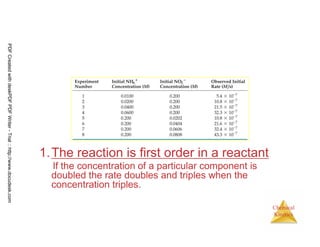
1.The reaction is first order in a reactant
If the concentration of a particular component is
doubled the rate doubles and triples when the
concentration triples.
PDFCreatedwithdeskPDFPDFWriter-Trial::http://www.docudesk.com
45
Chemical
Kinetics
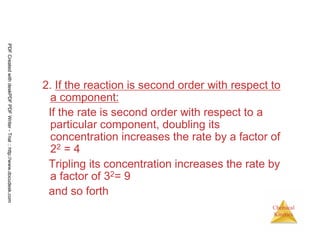
2. If the reaction is second order with respect to
a component:
If the rate is second order with respect to a
particular component, doubling its
concentration increases the rate by a factor of
22 = 4
Tripling its concentration increases the rate by
a factor of 32= 9
and so forth
PDFCreatedwithdeskPDFPDFWriter-Trial::http://www.docudesk.com
46
Chemical
Kinetics
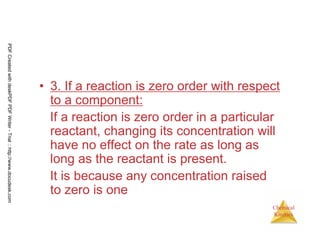
• 3. If a reaction is zero order with respect
to a component:
If a reaction is zero order in a particular
reactant, changing its concentration will
have no effect on the rate as long as
long as the reactant is present.
It is because any concentration raised
to zero is one
PDFCreatedwithdeskPDFPDFWriter-Trial::http://www.docudesk.com
47
Chemical
Kinetics
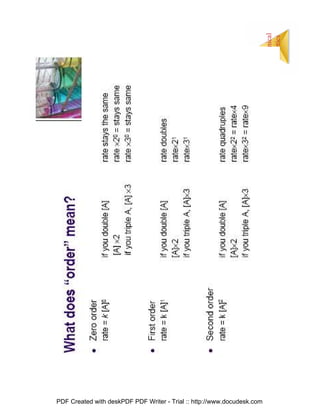
Order of reaction rate
• Rate of reaction can depend on how much
reactant is present in more than one way:
Zero order: rate ∝ [A]0
First order: rate ∝ [A]
Second order: rate ∝ [A]2
PDFCreatedwithdeskPDFPDFWriter-Trial::http://www.docudesk.com
48
Chemical
Kinetics
PDF Created with deskPDF PDF Writer - Trial :: http://www.docudesk.com
49
Chemical
Kinetics
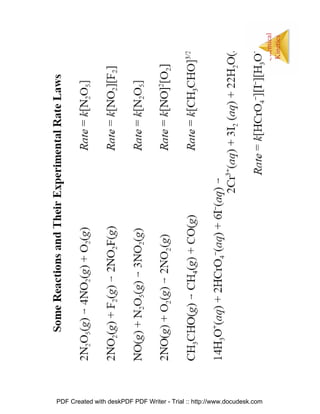
[ ]2 5 2 2 2 4
1/2
3 2 4 3 2
2 2 2 2
2N O (g) 4NO (g) + O (g) Rate = k N O
CHCl (g) + Cl (g) CCl (g) + HCl(g) Rate = k[CHCl ] [Cl ]
H (g) + I (g) 2HI(g) Rate = k[H ][I ]
→
→
→
PDFCreatedwithdeskPDFPDFWriter-Trial::http://www.docudesk.com
50
Chemical
Kinetics
PDF Created with deskPDF PDF Writer - Trial :: http://www.docudesk.com
51
Chemical
Kinetics
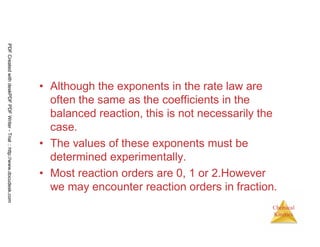
• Although the exponents in the rate law are
often the same as the coefficients in the
balanced reaction, this is not necessarily the
case.
• The values of these exponents must be
determined experimentally.
• Most reaction orders are 0, 1 or 2.However
we may encounter reaction orders in fraction.
PDFCreatedwithdeskPDFPDFWriter-Trial::http://www.docudesk.com
52
Chemical
Kinetics
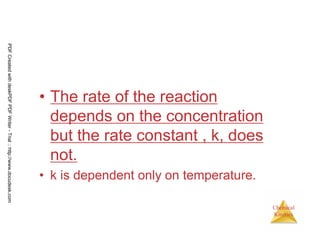
• The rate of the reaction
depends on the concentration
but the rate constant , k, does
not.
• k is dependent only on temperature.
PDFCreatedwithdeskPDFPDFWriter-Trial::http://www.docudesk.com
53
Chemical
Kinetics
4 2 4
4
CH + 4 Cl CCl + 4HCl
1 [CH4] 1 [ ]
Rate = -
1 4
1
Rate = - rate of disappearence of CH = rate of appearence of HCl
4
Rate x 4 = Rate of appearence of HCl
HCl
t t
→
∆ ∆
=
∆ ∆
PDFCreatedwithdeskPDFPDFWriter-Trial::http://www.docudesk.com
54
Chemical
Kinetics
Change in Concentration with Time
From the rate law we can calculate the rate of the
reaction if we know the the rate constant and the
reactant concentration
Rate = k [A]
Rate laws can also be converted into equations that tell
us what the concentration of reactants and products
are at any time during the reaction.
PDFCreatedwithdeskPDFPDFWriter-Trial::http://www.docudesk.com
55
Chemical
Kinetics
Change of Concentration with Time for
the First Order Reactions
The first order reaction is one whose rate depends on the
concentration of a single reactant raised to the first power
reactant A product
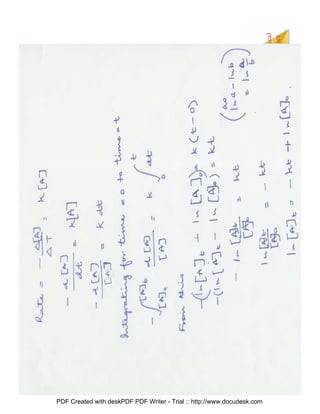
Rate = -Δ[A] = k [A]
Δt
This form of rate law, which expresses how rate
depends upon concentration is called differential rate
law.
PDFCreatedwithdeskPDFPDFWriter-Trial::http://www.docudesk.com
56
Chemical
Kinetics
PDF Created with deskPDF PDF Writer - Trial :: http://www.docudesk.com
57
Chemical
Kinetics
PDF Created with deskPDF PDF Writer - Trial :: http://www.docudesk.com
58
Chemical
Kinetics
Integrated Rate Laws
Using calculus to integrate the rate law
for a first-order process we get:
ln
[A]t
[A]0
= −kt
Where
[A]0 is the initial concentration of A.
[A]t is the concentration of A at some time, t,
during the course of the reaction.
PDFCreatedwithdeskPDFPDFWriter-Trial::http://www.docudesk.com
59
Chemical
Kinetics
Integrated Rate Laws
Manipulating this equation produces…
ln
[A]t
[A]0
= −kt
ln [A]t − ln [A]0 = − kt
ln [A]t = − kt + ln [A]0
Where m is the slope of the line and b is th ey intersept of the line.
Which is a general equation of
a straight line.
…which is in the form y = mx + b
PDFCreatedwithdeskPDFPDFWriter-Trial::http://www.docudesk.com
60
Chemical
Kinetics
Integrated Rate Laws
ln [A]t = − kt + ln [A]0
Where m is the slope of the line
and b is the y intersept of the
line.
Which is a general equation of
a straight line.
…which is in the form y = mx + b
PDFCreatedwithdeskPDFPDFWriter-Trial::http://www.docudesk.com
61
Chemical
Kinetics
First-Order Processes
Therefore, if a reaction is first-order, a
plot of ln [A]t vs. t will yield a straight
line, and the slope of the line will be -k.
ln [A]t = -kt + ln [A]0
PDFCreatedwithdeskPDFPDFWriter-Trial::http://www.docudesk.com
62
Chemical
Kinetics
First-Order Processes
Consider the process in
which methyl isonitrile is
converted to acetonitrile.
CH3NC CH3CN
PDFCreatedwithdeskPDFPDFWriter-Trial::http://www.docudesk.com
63
Chemical
Kinetics
First-Order Processes
This data was
collected for this
reaction at 198.9°C.
CH3NC CH3CN
PDFCreatedwithdeskPDFPDFWriter-Trial::http://www.docudesk.com
64
Chemical
Kinetics
• The experiments show this reaction to
be first order so we can write the rate
equation as
In[CH3NC]t= - kt + ln [CH3NC]o
PDFCreatedwithdeskPDFPDFWriter-Trial::http://www.docudesk.com
65
Chemical
Kinetics
• For gas we can use pressure as a unit of
concentration as from the ideal gas law equation the
pressure is directly proportional to the number of
moles per unit volume
PV = nRT
n
P = RT
V
At constant temperature
n
P α
V
PDFCreatedwithdeskPDFPDFWriter-Trial::http://www.docudesk.com
66
Chemical
Kinetics
First-Order Processes
• When ln P is plotted as a function of time, a
straight line results.
• Therefore,
The process is first-order.
k is the negative slope: 5.1 × 10⁻⁵ s−1.
PDFCreatedwithdeskPDFPDFWriter-Trial::http://www.docudesk.com
67
Chemical
Kinetics
• How to get the natural log value on your
calculator
LN will give the natural log value.
Pressing LN will show
In ( key in the value)
and press enter
PDFCreatedwithdeskPDFPDFWriter-Trial::http://www.docudesk.com
68
Chemical
Kinetics
The initial rate of a reaction was measured for several different starting concentrations of A and
B, and the results are as follows:
Using these data, determine
(a) the rate law for the reaction,
(b) the magnitude of the rate constant,
(c) the rate of the reaction when [A] = 0.050 M and [B] = 0.100 M.
PDFCreatedwithdeskPDFPDFWriter-Trial::http://www.docudesk.com
69
Chemical
Kinetics
The initial rate of a reaction was measured for several different starting concentrations of A and
B, and the results are as follows:
Using these data, determine
(a) the rate law for the reaction,
(b) the magnitude of the rate constant,
(c) the rate of the reaction when [A] = 0.050 M and [B] = 0.100 M
a.
(b) Using the rate law and the data from experiment 1, we have
(c) Using the rate law from part (a) and the rate constant from part (b), we have
PDFCreatedwithdeskPDFPDFWriter-Trial::http://www.docudesk.com
70
Chemical
Kinetics
PRACTICE EXERCISE
The following data were measured for the reaction of nitric oxide with hydrogen:
(a) Determine the rate law for this reaction. (b) Calculate the rate constant. (c) Calculate the rate when
[NO] = 0.050 M and [H2] = 0.150 M.
PDFCreatedwithdeskPDFPDFWriter-Trial::http://www.docudesk.com
71
Chemical
Kinetics
PRACTICE EXERCISE
The following data were measured for the reaction of nitric oxide with hydrogen:
Answers: (a) rate = k[NO]2[H2]; (b) k =1.2 M–2s–1; (c) rate = 4.5 × 10⁻⁴ M/s
(a) Determine the rate law for this reaction. (b) Calculate the rate constant. (c) Calculate the rate when
[NO] = 0.050 M and [H2] = 0.150 M.
PDFCreatedwithdeskPDFPDFWriter-Trial::http://www.docudesk.com
72
Chemical
Kinetics
PRACTICE EXERCISE
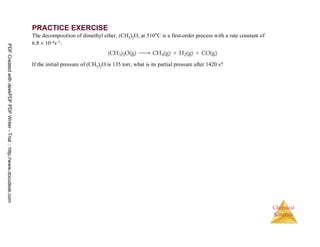
The decomposition of dimethyl ether, (CH3)2O, at 510°C is a first-order process with a rate constant of
6.8 × 10⁻⁴s–1:
If the initial pressure of (CH3)2O is 135 torr, what is its partial pressure after 1420 s?
PDFCreatedwithdeskPDFPDFWriter-Trial::http://www.docudesk.com
73
Chemical
Kinetics
PRACTICE EXERCISE
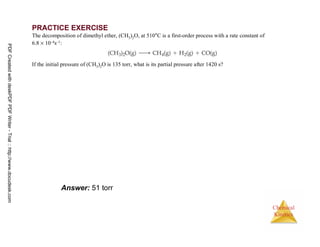
The decomposition of dimethyl ether, (CH3)2O, at 510°C is a first-order process with a rate constant of
6.8 × 10⁻⁴s–1:
If the initial pressure of (CH3)2O is 135 torr, what is its partial pressure after 1420 s?
Answer: 51 torr
PDFCreatedwithdeskPDFPDFWriter-Trial::http://www.docudesk.com
74
Chemical
Kinetics
Half-Life
• Half-life is defined
as the time required
for one-half of a
reactant to react.
• Because [A] at t1/2 is
one-half of the
original [A],
[A]t = 1/2 [A]0.
PDFCreatedwithdeskPDFPDFWriter-Trial::http://www.docudesk.com
75
Chemical
Kinetics
Half-Life
For a first-order process, this becomes
0.5 [A]0
[A]0
ln = −kt1/2
ln 0.5 = −kt1/2
−0.693 = −kt1/2
= t1/2
0.693
kNOTE: For a first-order
process, the half-life
does not depend on [A]0.
ln
[A]t
[A]0
= −kt
PDFCreatedwithdeskPDFPDFWriter-Trial::http://www.docudesk.com
76
Chemical
Kinetics
• The half life of a first order reaction
remains the same throughout the
reaction.
• The concentration of the reactant keeps
becoming half of the previous value
after every half life.
PDFCreatedwithdeskPDFPDFWriter-Trial::http://www.docudesk.com
77
Chemical
Kinetics
• In the first order reaction, the
concentration of reactant decreases by
½ in each of a series of regularly
spaced time intervals, namely t1/2
• The concept of a first order reaction is
widely used in describing radioactive
decay, a first order process.
PDFCreatedwithdeskPDFPDFWriter-Trial::http://www.docudesk.com
78
Chemical
Kinetics
SAMPLE EXERCISE 14.7 Using the Integrated First-Order Rate Law
• The decomposition of a certain insecticide in water follows first-order kinetics with a rate
constant of 1.45 yr–1 at 12°C. A quantity of this insecticide is washed into a lake on June 1,
leading to a concentration of 5.0 × 10⁻⁷ g/cm3. Assume that the average temperature of the
lake is 12°C.
• (a) What is the concentration of the insecticide on June 1 of the following year?
• (b) How long will it take for the concentration of the insecticide to drop to 3.0 × 10⁻⁷ g/cm3?
PDFCreatedwithdeskPDFPDFWriter-Trial::http://www.docudesk.com
79
Chemical
Kinetics
SAMPLE EXERCISE 14.7 Using the Integrated First-Order Rate Law
• The decomposition of a certain insecticide in water follows first-order kinetics with a rate
constant of 1.45 yr–1 at 12°C. A quantity of this insecticide is washed into a lake on June 1,
leading to a concentration of 5.0 × 10⁻⁷ g/cm3. Assume that the average temperature of the
lake is 12°C.
• (a) What is the concentration of the insecticide on June 1 of the following year?
• (b) How long will it take for the concentration of the insecticide to drop to 3.0 × 10⁻⁷ g/cm3?
ln [A]t = -kt + ln [A]0
Solve: (a) Substituting the known quantities into Equation 14.13, we have
Note that the concentration units for [A]t and [A]0 must be the same.
(b) Again substituting into Equation 14.13, with [insecticide]t = 3.0 × 10⁻⁷ g/cm3, gives
Solving for t gives
PDFCreatedwithdeskPDFPDFWriter-Trial::http://www.docudesk.com
80
Chemical
Kinetics
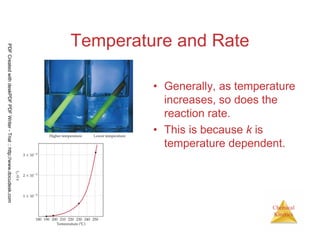
Temperature and Rate
• Generally, as temperature
increases, so does the
reaction rate.
• This is because k is
temperature dependent.
PDFCreatedwithdeskPDFPDFWriter-Trial::http://www.docudesk.com
81
Chemical
Kinetics
The Collision Model
• In a chemical reaction, bonds are
broken and new bonds are formed.
• Molecules can only react if they collide
with each other.
PDFCreatedwithdeskPDFPDFWriter-Trial::http://www.docudesk.com
82
Chemical
Kinetics
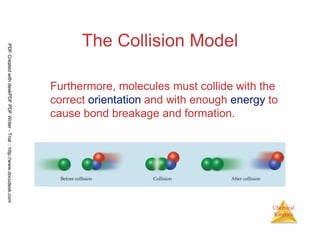
The Collision Model
Furthermore, molecules must collide with the
correct orientation and with enough energy to
cause bond breakage and formation.
PDFCreatedwithdeskPDFPDFWriter-Trial::http://www.docudesk.com
83
Chemical
Kinetics
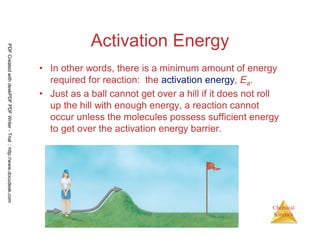
Activation Energy
• In other words, there is a minimum amount of energy
required for reaction: the activation energy, Ea.
• Just as a ball cannot get over a hill if it does not roll
up the hill with enough energy, a reaction cannot
occur unless the molecules possess sufficient energy
to get over the activation energy barrier.
PDFCreatedwithdeskPDFPDFWriter-Trial::http://www.docudesk.com
84
Chemical
Kinetics
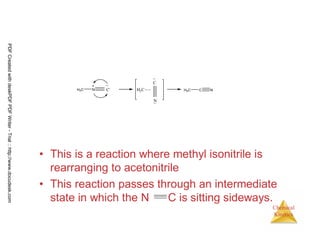
H3C N H3C
C
N
H3C C NC-
• This is a reaction where methyl isonitrile is
rearranging to acetonitrile
• This reaction passes through an intermediate
state in which the N C is sitting sideways.
PDFCreatedwithdeskPDFPDFWriter-Trial::http://www.docudesk.com
85
Chemical
Kinetics
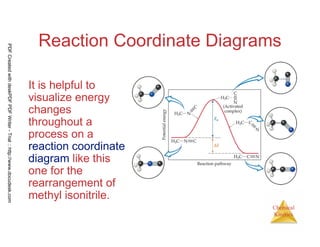
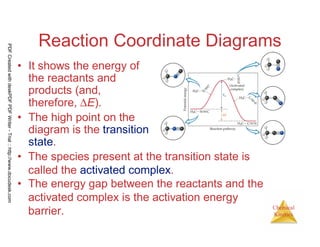
Reaction Coordinate Diagrams
It is helpful to
visualize energy
changes
throughout a
process on a
reaction coordinate
diagram like this
one for the
rearrangement of
methyl isonitrile.
PDFCreatedwithdeskPDFPDFWriter-Trial::http://www.docudesk.com
86
Chemical
Kinetics
Reaction Coordinate Diagrams
• It shows the energy of
the reactants and
products (and,
therefore, ∆E).
• The high point on the
diagram is the transition
state.
• The species present at the transition state is
called the activated complex.
• The energy gap between the reactants and the
activated complex is the activation energy
barrier.
PDFCreatedwithdeskPDFPDFWriter-Trial::http://www.docudesk.com
87
Chemical
Kinetics
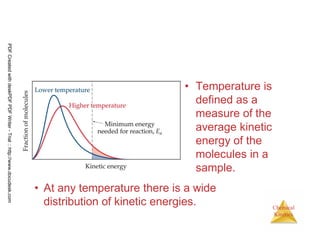
• Temperature is
defined as a
measure of the
average kinetic
energy of the
molecules in a
sample.
• At any temperature there is a wide
distribution of kinetic energies.
PDFCreatedwithdeskPDFPDFWriter-Trial::http://www.docudesk.com
88
Chemical
Kinetics
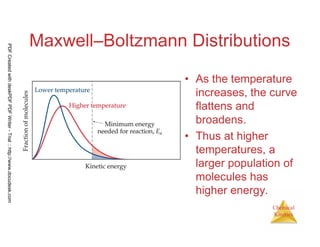
Maxwell–Boltzmann Distributions
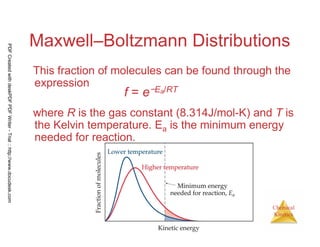
• As the temperature
increases, the curve
flattens and
broadens.
• Thus at higher
temperatures, a
larger population of
molecules has
higher energy.
PDFCreatedwithdeskPDFPDFWriter-Trial::http://www.docudesk.com
89
Chemical
Kinetics
Maxwell–Boltzmann Distributions
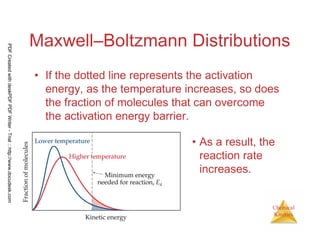
• If the dotted line represents the activation
energy, as the temperature increases, so does
the fraction of molecules that can overcome
the activation energy barrier.
• As a result, the
reaction rate
increases.
PDFCreatedwithdeskPDFPDFWriter-Trial::http://www.docudesk.com
90
Chemical
Kinetics
Maxwell–Boltzmann Distributions
This fraction of molecules can be found through the
expression
where R is the gas constant (8.314J/mol-K) and T is
the Kelvin temperature. Ea is the minimum energy
needed for reaction.
f = e−Ea/RT
PDFCreatedwithdeskPDFPDFWriter-Trial::http://www.docudesk.com
91
Chemical
Kinetics
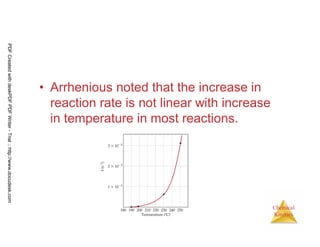
• Arrhenious noted that the increase in
reaction rate is not linear with increase
in temperature in most reactions.
PDFCreatedwithdeskPDFPDFWriter-Trial::http://www.docudesk.com
92
Chemical
Kinetics
• Arrhenius observed that most reaction rates
depend on the following three factors
A. Fraction of molecules possessing Ea or
greater
B. number of collisions per second
C. fraction of molecules having the correct
orientation
PDFCreatedwithdeskPDFPDFWriter-Trial::http://www.docudesk.com
93
Chemical
Kinetics
Arrhenius Equation
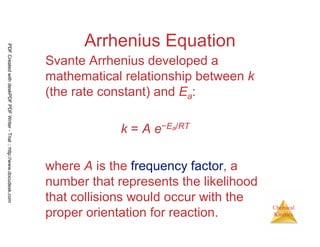
Svante Arrhenius developed a
mathematical relationship between k
(the rate constant) and Ea:
k = A e−Ea/RT
where A is the frequency factor, a
number that represents the likelihood
that collisions would occur with the
proper orientation for reaction.
PDFCreatedwithdeskPDFPDFWriter-Trial::http://www.docudesk.com
94
Chemical
Kinetics
Arrhenius Equation
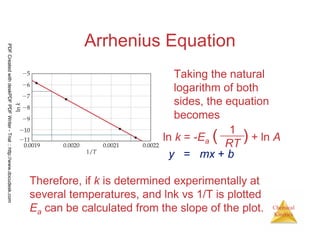
Taking the natural
logarithm of both
sides, the equation
becomes
ln k = -Ea ( ) + ln A
1
RT
y = mx + b
Therefore, if k is determined experimentally at
several temperatures, and lnk vs 1/T is plotted
Ea can be calculated from the slope of the plot.
PDFCreatedwithdeskPDFPDFWriter-Trial::http://www.docudesk.com
95
Chemical
Kinetics
• If we know the constant k at two or more temperatures
At temperatures T1 and T2 the rate constant is k1 and k
,
ln k1 = -Ea + lnA and ln k2 = -Ea + lnA
RT1 RT2
lnk1-lnk2 = [ -Ea/RT1 +lnA] - [ -Ea/RT2+lnA]
lnk1/k2 = Ea (1/T1-1/T2)
R
PDFCreatedwithdeskPDFPDFWriter-Trial::http://www.docudesk.com
96
Chemical
Kinetics
•lnk1=Ea(1/T2-1/T1)
•R
PDF Created with deskPDF PDF Writer - Trial :: http://www.docudesk.com
97
Chemical
Kinetics
PDF Created with deskPDF PDF Writer - Trial :: http://www.docudesk.com
98
Chemical
Kinetics
Reaction Mechanisms
The sequence of events that describes
the actual process by which reactants
become products is called the reaction
mechanism.
PDFCreatedwithdeskPDFPDFWriter-Trial::http://www.docudesk.com
99
Chemical
Kinetics
Reaction Mechanisms
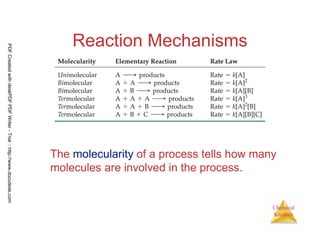
• Reactions may occur all at once or
through several discrete steps.
• Each of these processes is known as an
elementary reaction or elementary
process.
PDFCreatedwithdeskPDFPDFWriter-Trial::http://www.docudesk.com
100
Chemical
Kinetics
Rate laws for elementary
reactions
• The rate law of an elementary reaction
is directly based on its molecularity or
concentration.
PDFCreatedwithdeskPDFPDFWriter-Trial::http://www.docudesk.com
101
Chemical
Kinetics
Reaction Mechanisms
The molecularity of a process tells how many
molecules are involved in the process.
PDFCreatedwithdeskPDFPDFWriter-Trial::http://www.docudesk.com
102
Chemical
Kinetics
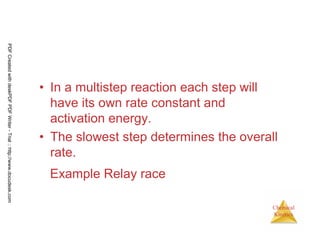
• In a multistep reaction each step will
have its own rate constant and
activation energy.
• The slowest step determines the overall
rate.
Example Relay race
PDFCreatedwithdeskPDFPDFWriter-Trial::http://www.docudesk.com
103
Chemical
Kinetics
Multistep Mechanisms
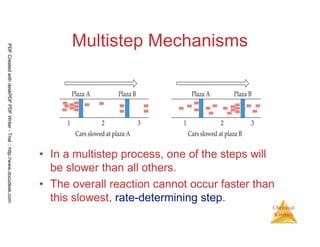
• In a multistep process, one of the steps will
be slower than all others.
• The overall reaction cannot occur faster than
this slowest, rate-determining step.
PDFCreatedwithdeskPDFPDFWriter-Trial::http://www.docudesk.com
104
Chemical
Kinetics
• A balanced chemical equation often
occurs in a series of elementary reactions
• A balanced chemical reaction itself could
have a multi step mechanism
PDFCreatedwithdeskPDFPDFWriter-Trial::http://www.docudesk.com
105
Chemical
Kinetics
Slow Initial Step
• The rate law for this reaction is found
experimentally to be
Rate = k [NO2]2
• CO is necessary for this reaction to occur, but the
rate of the reaction does not depend on its
concentration.
• This suggests the reaction occurs in two steps.
NO2 (g) + CO (g) → NO (g) + CO2 (g)
PDFCreatedwithdeskPDFPDFWriter-Trial::http://www.docudesk.com
106
Chemical
Kinetics
Slow Initial Step
• A proposed mechanism for this reaction is
Step 1: NO2 + NO2 → NO3 + NO (slow)
Step 2: NO3 + CO → NO2 + CO2 (fast)
• The NO3 intermediate is consumed in the second step.
• As CO is not involved in the slow, rate-determining step, it does not appear in the rate law.
• Since step 1 is the slow rate determining step the rate law is going to be
Rate = [NO2] 2
NO2 (g) + CO (g) → NO (g) + CO2 (g)
PDFCreatedwithdeskPDFPDFWriter-Trial::http://www.docudesk.com
107
Chemical
Kinetics
Practice exercise
Ozone reacts with NO2 to give dinitrogen pentoxide and
oxygen:
O3 (g) + 2NO2 (g) N2O5(g) + O2 (g)
The reaction occurs in the following two steps:
O3(g) + NO2 (g) NO3 (g) + O2(g)
NO3(g) + NO2(g) N2O5 (g)
The experimental rate law is
Rate = [ O3][NO2]
What can you sat about the relative rate of the two steps
of the mechanism?
PDFCreatedwithdeskPDFPDFWriter-Trial::http://www.docudesk.com
108
Chemical
Kinetics
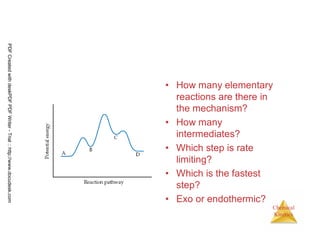
• How many elementary
reactions are there in
the mechanism?
• How many
intermediates?
• Which step is rate
limiting?
• Which is the fastest
step?
• Exo or endothermic?
PDFCreatedwithdeskPDFPDFWriter-Trial::http://www.docudesk.com
109
Chemical
Kinetics
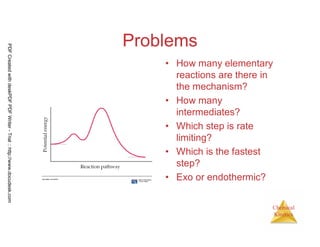
Problems
• How many elementary
reactions are there in
the mechanism?
• How many
intermediates?
• Which step is rate
limiting?
• Which is the fastest
step?
• Exo or endothermic?
PDFCreatedwithdeskPDFPDFWriter-Trial::http://www.docudesk.com
110
Chemical
Kinetics
Fast Initial Step
• Experimentally the rate law for this
reaction is found to be
Rate = k [NO]2 [Br2]
• Because ter molecular processes are
rare, this rate law suggests a two-step
mechanism.
2 NO (g) + Br2 (g) → 2 NOBr (g)
PDFCreatedwithdeskPDFPDFWriter-Trial::http://www.docudesk.com
111
Chemical
Kinetics
Fast Initial Step
• A proposed mechanism is
Step 2: NOBr2 + NO → 2 NOBr (slow)
Step 1 includes the forward and reverse
reactions.
The rate of the overall reaction depends upon the rate of
the slow step.
The rate law for that step would be
Rate = k2 [NOBr2] [NO]
But how can we find [NOBr2]?
Step 1: NO + Br2 NOBr2 (fast)
2 NO (g) + Br2 (g) → 2 NOBr (g)
PDFCreatedwithdeskPDFPDFWriter-Trial::http://www.docudesk.com
112
Chemical
Kinetics
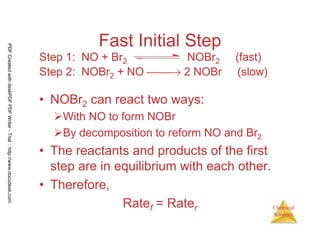
Fast Initial Step
• NOBr2 can react two ways:
With NO to form NOBr
By decomposition to reform NO and Br2
• The reactants and products of the first
step are in equilibrium with each other.
• Therefore,
Ratef = Rater
Step 1: NO + Br2 NOBr2 (fast)
Step 2: NOBr2 + NO → 2 NOBr (slow)
PDFCreatedwithdeskPDFPDFWriter-Trial::http://www.docudesk.com
113
Chemical
Kinetics
Fast Initial Step
• Because Ratef = Rater ,
k1 [NO] [Br2] = k−1 [NOBr2]
Pay attention to the fact that the reverse k
is k-1
• Solving for [NOBr2] gives us
k1
k−1
[NO] [Br2] = [NOBr2]
PDFCreatedwithdeskPDFPDFWriter-Trial::http://www.docudesk.com
114
Chemical
Kinetics
Fast Initial Step
From before Rate = k2 [NOBr2] [NO]
From the previous equation:
Substituting this expression for [NOBr2] in the rate law for
the rate-determining step gives
k2k1
k−1
Rate = [NO] [Br2] [NO]
= k [NO]2 [Br2]
k1
k−1
[NO] [Br2] = [NOBr2]
PDFCreatedwithdeskPDFPDFWriter-Trial::http://www.docudesk.com
115
Chemical
Kinetics
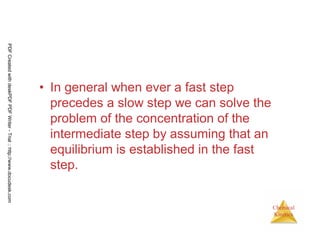
• In general when ever a fast step
precedes a slow step we can solve the
problem of the concentration of the
intermediate step by assuming that an
equilibrium is established in the fast
step.
PDFCreatedwithdeskPDFPDFWriter-Trial::http://www.docudesk.com
116
Chemical
Kinetics
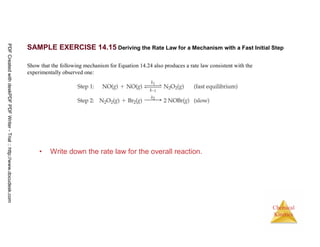
• Write down the rate law for the overall reaction.
SAMPLE EXERCISE 14.15 Deriving the Rate Law for a Mechanism with a Fast Initial Step
Show that the following mechanism for Equation 14.24 also produces a rate law consistent with the
experimentally observed one:
PDFCreatedwithdeskPDFPDFWriter-Trial::http://www.docudesk.com
117
Chemical
Kinetics
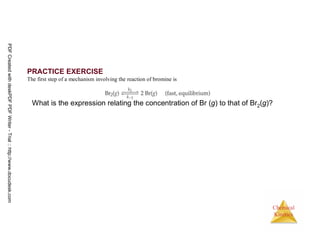
PRACTICE EXERCISE
The first step of a mechanism involving the reaction of bromine is
What is the expression relating the concentration of Br (g) to that of Br2(g)?
PDFCreatedwithdeskPDFPDFWriter-Trial::http://www.docudesk.com
118
Chemical
Kinetics
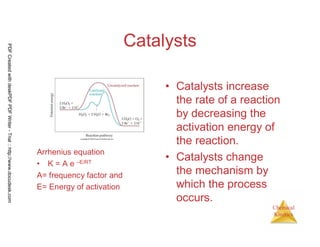
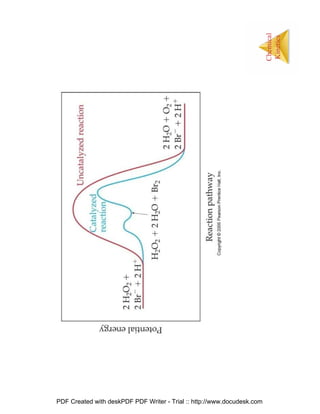
Catalysts
Arrhenius equation
• K = A e –E/RT
A= frequency factor and
E= Energy of activation
• Catalysts increase
the rate of a reaction
by decreasing the
activation energy of
the reaction.
• Catalysts change
the mechanism by
which the process
occurs.
PDFCreatedwithdeskPDFPDFWriter-Trial::http://www.docudesk.com
119
Chemical
Kinetics
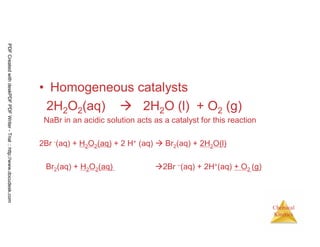
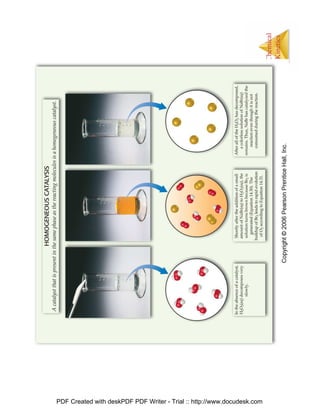
• Homogeneous catalysts
2H2O2(aq) 2H2O (l) + O2 (g)
NaBr in an acidic solution acts as a catalyst for this reaction
2Br -(aq) + H2O2(aq) + 2 H+ (aq) Br2(aq) + 2H2O(l)
Br2(aq) + H2O2(aq) 2Br –(aq) + 2H+(aq) + O2 (g)
PDFCreatedwithdeskPDFPDFWriter-Trial::http://www.docudesk.com
120
Chemical
Kinetics
PDF Created with deskPDF PDF Writer - Trial :: http://www.docudesk.com
121
Chemical
Kinetics
PDF Created with deskPDF PDF Writer - Trial :: http://www.docudesk.com
122
Chemical
Kinetics
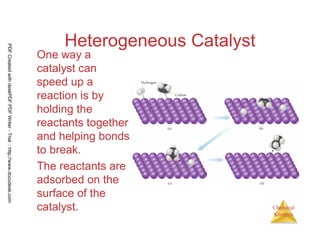
Heterogeneous Catalyst
One way a
catalyst can
speed up a
reaction is by
holding the
reactants together
and helping bonds
to break.
The reactants are
adsorbed on the
surface of the
catalyst.
PDFCreatedwithdeskPDFPDFWriter-Trial::http://www.docudesk.com
123
Chemical
Kinetics
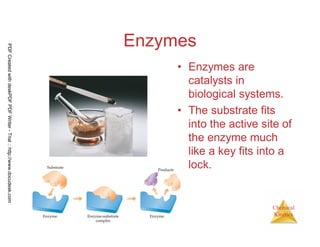
Enzymes
• Enzymes are
catalysts in
biological systems.
• The substrate fits
into the active site of
the enzyme much
like a key fits into a
lock.
PDFCreatedwithdeskPDFPDFWriter-Trial::http://www.docudesk.com

Chemical kinetics

  • 1.
    1 Chemical Kinetics Chapter 14 Chemical Kinetics Chemistry,The Central Science, 10th edition Theodore L. Brown; H. Eugene LeMay, Jr.; and Bruce E. Bursten PDFCreatedwithdeskPDFPDFWriter-Trial::http://www.docudesk.com
  • 2.
    2 Chemical Kinetics Kinetics • Chemical Kineticsis the study of the rate at which a chemical process occurs. • Besides information about the speed at which reactions occur, kinetics also sheds light on the reaction mechanism (exactly how the reaction occurs). PDFCreatedwithdeskPDFPDFWriter-Trial::http://www.docudesk.com
  • 3.
    3 Chemical Kinetics Factors That AffectReaction Rates • Physical State of the Reactants In order to react, molecules must come in contact with each other. If the reaction is happening between a solid and a liquid it will react only on the surface. The more homogeneous the mixture of reactants, the faster the molecules can react. PDFCreatedwithdeskPDFPDFWriter-Trial::http://www.docudesk.com
  • 4.
    4 Chemical Kinetics Factors That AffectReaction Rates • Concentration of Reactants As the concentration of reactants increases, so does the likelihood that reactant molecules will collide. PDFCreatedwithdeskPDFPDFWriter-Trial::http://www.docudesk.com
  • 5.
    5 Chemical Kinetics Factors That AffectReaction Rates • Temperature At higher temperatures, reactant molecules have more kinetic energy, move faster, and collide more often and with greater energy. PDFCreatedwithdeskPDFPDFWriter-Trial::http://www.docudesk.com
  • 6.
    6 Chemical Kinetics Factors That AffectReaction Rates • Presence of a Catalyst Catalysts speed up reactions by changing the mechanism of the reaction. Catalysts are not consumed during the course of the reaction. PDFCreatedwithdeskPDFPDFWriter-Trial::http://www.docudesk.com
  • 7.
    7 Chemical Kinetics Reaction Rates Rates ofreactions can be determined by monitoring the change in concentration of either reactants or products as a function of time. PDFCreatedwithdeskPDFPDFWriter-Trial::http://www.docudesk.com
  • 8.
    8 Chemical Kinetics Reaction Rates In thisreaction, the concentration of butyl chloride, C4H9Cl, was measured at various times. C4H9Cl(aq) + H2O(l) → C4H9OH(aq) + HCl(aq) PDFCreatedwithdeskPDFPDFWriter-Trial::http://www.docudesk.com
  • 9.
    9 Chemical Kinetics The average rateof the reaction over each interval is the change in concentration divided by the change in time: • Average rate = ∆[C4H9Cl] ∆t [ ] [ ] [ ]t2 t1 2 1 X - X ∆ X Average rate = = t -t ∆t PDFCreatedwithdeskPDFPDFWriter-Trial::http://www.docudesk.com
  • 10.
    10 Chemical Kinetics Reaction Rates C4H9Cl(aq) +H2O(l) → C4H9OH(aq) + HCl(aq) [ ] [ ] -4 0.0905 - 0.1000 0.0095 Average rate = = - 1.9 x 10 50-0 50 = − PDFCreatedwithdeskPDFPDFWriter-Trial::http://www.docudesk.com
  • 11.
    11 Chemical Kinetics Reaction Rates • Notethat the average rate decreases as the reaction proceeds. • This is because as the reaction goes forward, there are fewer collisions between reactant molecules. C4H9Cl(aq) + H2O(l) → C4H9OH(aq) + HCl(aq) PDFCreatedwithdeskPDFPDFWriter-Trial::http://www.docudesk.com
  • 12.
    12 Chemical Kinetics • calculate theaverage rate of appearance of B over the time interval from 0 to 40 s. PDFCreatedwithdeskPDFPDFWriter-Trial::http://www.docudesk.com
  • 13.
    13 Chemical Kinetics Reaction Rates • Aplot of concentration vs. time for this reaction yields a curve like this. • The slope of a line tangent to the curve at any point is the instantaneous rate at that time. C4H9Cl(aq) + H2O(l) → C4H9OH(aq) + HCl(aq) PDFCreatedwithdeskPDFPDFWriter-Trial::http://www.docudesk.com
  • 14.
    14 Chemical Kinetics Reaction Rates • Allreactions slow down over time. • Therefore, the best indicator of the rate of a reaction is the instantaneous rate near the beginning. C4H9Cl(aq) + H2O(l) → C4H9OH(aq) + HCl(aq) PDFCreatedwithdeskPDFPDFWriter-Trial::http://www.docudesk.com
  • 15.
    15 Chemical Kinetics Average vs. instantaneousrxn rate • Average rxn rate • Instantaneous rxn rate (tangent to curve) Usually in chemistry, we are interested in the instantaneous rxn rate at the very beginning (at t = 0) INITIAL REACTION RATE ∆t ∆ rate ]A[ elapsedtimetotal endandrxnofbeginningbetween ionconcentratchemicalofchange )(reactionofrate =       = ∆t ∆ rate ]A[ elapsedshort timethe timeofperiodshortaover ionconcentratchemicalofchange )(reactionofrate =       = PDFCreatedwithdeskPDFPDFWriter-Trial::http://www.docudesk.com
  • 16.
    16 Chemical Kinetics Average vs. instantaneousrxn rateNaHCO3 + citric acid --> sodium citrate + H2O + CO2 0 0.2 0.4 0.6 0.8 1 1.2 1.4 1.6 1.8 2 0 0.5 1 1.5 2 time (minutes) concentration(tablet/100mL) initial [A] = 1 tablet initial [A] = 2 tablets Average rate Instantaneous rate at t = 0 (initial rate) PDFCreatedwithdeskPDFPDFWriter-Trial::http://www.docudesk.com
  • 17.
    17 Chemical Kinetics Comparing concentrations of chemicalsin a reaction A --> B 0 0.2 0.4 0.6 0.8 1 1.2 1.4 1.6 1.8 2 0 0.5 1 1.5 2 time (hours) concentration(mol/L) [A] [B] A --> 2 C 0 0.2 0.4 0.6 0.8 1 1.2 1.4 1.6 1.8 2 0 0.5 1 1.5 2 time (hours) concentration(mol/L) [A] [C] PDFCreatedwithdeskPDFPDFWriter-Trial::http://www.docudesk.com
  • 18.
    18 Chemical Kinetics What we’re afterin kinetics • We want to be able to understand and predict how much reactants remain (or products get formed) in a certain amount of time • Change with time is rate • Rate means calculus must be used, so we need to be careful which rate we are talking about • We will use instantaneous rate at the start of a reaction (initial rate) • Several factors affect the rate of a reaction Initial concentration Temperature Amount of reactant exposed (surface area) Presence of a catalyst • A theory (equations) that predicts kinetics must explain these PDFCreatedwithdeskPDFPDFWriter-Trial::http://www.docudesk.com
  • 19.
    19 Chemical Kinetics Calculate the instantaneousrate of disappearance of C4H9Cl at t = 0 (the initial rate). PDFCreatedwithdeskPDFPDFWriter-Trial::http://www.docudesk.com
  • 20.
    20 Chemical Kinetics Determine the instantaneousrate of disappearance of C4H9Cl at t = 300 s. Answer: 1.1 × 10 –4 M/s PDFCreatedwithdeskPDFPDFWriter-Trial::http://www.docudesk.com
  • 21.
    21 Chemical Kinetics Reaction Rates andStoichiometry • In this reaction, the ratio of C4H9Cl to C4H9OH is 1:1. • Thus, the rate of disappearance of C4H9Cl is the same as the rate of appearance of C4H9OH. C4H9Cl(aq) + H2O(l) → C4H9OH(aq) + HCl(aq) Rate = -∆[C4H9Cl] ∆t = ∆[C4H9OH] ∆t PDFCreatedwithdeskPDFPDFWriter-Trial::http://www.docudesk.com
  • 22.
    22 Chemical Kinetics Reaction Rates andStoichiometry • What if the ratio is not 1:1? 2 HI(g) → H2(g) + I2(g) in such a case , [ ] [ ] [ ]2 2 HI H I1 Rate = - = 2 t t t ∆ ∆ ∆ = ∆ ∆ ∆ PDFCreatedwithdeskPDFPDFWriter-Trial::http://www.docudesk.com
  • 23.
    23 Chemical Kinetics Reaction Rates andStoichiometry • To generalize, then, for the reaction aA + bB cC + dD Rate = − 1 a ∆[A] ∆t = − 1 b ∆[B] ∆t = 1 c ∆[C] ∆t 1 d ∆[D] ∆t = PDFCreatedwithdeskPDFPDFWriter-Trial::http://www.docudesk.com
  • 24.
    24 Chemical Kinetics Key points aboutkinetics so far • Study the vocabulary • Reaction rate has weird units • Be clear whether you are talking about average reaction rate or instantaneous reaction rate • The equations which we will study all talk about instantaneous reaction rate, most easily measured at the beginning of a reaction (initial rate) • Relating rates at which products appear (+) and reactants disappear (-) has to do with inverse stoichiometric coefficients • Reaction rate depends on several factors: initial concentration, temperature, surface area of reactants exposed, presence of a catalyst PDFCreatedwithdeskPDFPDFWriter-Trial::http://www.docudesk.com
  • 25.
    25 Chemical Kinetics (a) How isthe rate at which ozone disappears related to the rate at which oxygen appears in the reaction (b) If the rate at which O2 appears, Δ[O2]/Δ t, is 6.0 × 10⁻⁵ M/s at a particular instant, at what rate is O3 disappearing at this same time, –Δ[O3] /Δ t? PDFCreatedwithdeskPDFPDFWriter-Trial::http://www.docudesk.com
  • 26.
    26 Chemical Kinetics Answers: (a) 8.4× 10 –7 M/s, (b) 2.1 × 10 –7 M/s SAMPLE EXERCISE 14.3 continued The decomposition of N2O5 proceeds according to the following equation: If the rate of decomposition of N2O5 at a particular instant in a reaction vessel is 4.2 × 10⁻⁷ M/s, what is the rate of appearance of (a) NO2, (b) O2? PDFCreatedwithdeskPDFPDFWriter-Trial::http://www.docudesk.com
  • 27.
    27 Chemical Kinetics Concentration and Rate Onecan gain information about the rate of a reaction by seeing how the rate changes with changes in concentration. PDFCreatedwithdeskPDFPDFWriter-Trial::http://www.docudesk.com
  • 28.
    28 Chemical Kinetics Concentration and Rate ComparingExperiments 1 and 2, when [NH4 +] doubles, the initial rate doubles. NH4 +(aq) + NO2 −(aq) N2(g) + 2 H2O(l) PDFCreatedwithdeskPDFPDFWriter-Trial::http://www.docudesk.com
  • 29.
    29 Chemical Kinetics Concentration and Rate Likewise,comparing Experiments 5 and 6, when [NO2 −] doubles, the initial rate doubles. NH4 +(aq) + NO2 −(aq) N2(g) + 2 H2O(l) PDFCreatedwithdeskPDFPDFWriter-Trial::http://www.docudesk.com
  • 30.
    30 Chemical Kinetics Concentration and Rate •This means Rate ∝ [NH4 +] Rate ∝ [NO2 −] Rate ∝ [NH+] [NO2 −] or Rate = k [NH4 +] [NO2 −] • This equation is called the rate law, and k is the rate constant. PDFCreatedwithdeskPDFPDFWriter-Trial::http://www.docudesk.com
  • 31.
    31 Chemical Kinetics • If youwant your concepts to be clearer do the visualizing concepts part of the problems at the back of your chapter. PDFCreatedwithdeskPDFPDFWriter-Trial::http://www.docudesk.com
  • 32.
    32 Chemical Kinetics Rate Law • Anequation that shows how the rate depends on the concentration of the reactants is called the rate law • The exponents tell the order of the reaction with respect to each reactant. • This reaction is First-order in [NH4 +] First-order in [NO2 −] PDFCreatedwithdeskPDFPDFWriter-Trial::http://www.docudesk.com
  • 33.
    33 Chemical Kinetics Rate Laws • Theoverall reaction order can be found by adding the exponents on the reactants in the rate law. • This reaction is second-order overall. PDFCreatedwithdeskPDFPDFWriter-Trial::http://www.docudesk.com
  • 34.
    34 Chemical Kinetics • For ageneral reaction: aA + bB cC + dD Rate law has the form Rate =k [A]m[B]n where k is the rate constant and is dependant on temperature. PDFCreatedwithdeskPDFPDFWriter-Trial::http://www.docudesk.com
  • 35.
    35 Chemical Kinetics If we knowthe rate law and the rate for a set of reaction conditions we can calculate the value of k. PDFCreatedwithdeskPDFPDFWriter-Trial::http://www.docudesk.com
  • 36.
    36 Chemical Kinetics To calculate therate constant: Rate law Rate = k [A]m [B]n Rate = k[NH4] [NO2] For experiment 1: 5.4X10⁻⁷ M/s = k (0.0100M)(0.200M) k = 5.4X10⁻⁷ M/s k (0.0100M)(0.200M) = 2.7X10 -4 /Ms PDFCreatedwithdeskPDFPDFWriter-Trial::http://www.docudesk.com
  • 37.
    37 Chemical Kinetics Exponents in therate law The exponent in the rate law indicates how the rate is affected by the concentration of each reactant. PDFCreatedwithdeskPDFPDFWriter-Trial::http://www.docudesk.com
  • 38.
    38 Chemical Kinetics SAMPLE EXERCISE 14.4Relating a Rate Law to the Effect of Concentration on Rate Consider a reaction for which rate = k[A][B]2. Each of the following boxes represents a reaction mixture in which A is shown as red spheres and B as purple ones. Rank these mixtures in order of increasing rate of reaction. PDFCreatedwithdeskPDFPDFWriter-Trial::http://www.docudesk.com
  • 39.
    39 Chemical Kinetics SAMPLE EXERCISE 14.4Relating a Rate Law to the Effect of Concentration on Rate Consider a reaction for which rate = k[A][B]2. Each of the following boxes represents a reaction mixture in which A is shown as red spheres and B as purple ones. Rank these mixtures in order of increasing rate of reaction. Each box contains 10 spheres. The rate law indicates that in this case [B] has a greater influence on rate than [A] because B has a higher reaction order. Hence, the mixture with the highest concentration of B (most purple spheres) should react fastest. This analysis confirms the order 2 < 1 < 3. PDFCreatedwithdeskPDFPDFWriter-Trial::http://www.docudesk.com
  • 40.
    40 Chemical Kinetics Assuming that rate= k[A][B], rank the mixtures represented in this Sample Exercise in order of increasing rate. Answer: 2 = 3 < 1 PDFCreatedwithdeskPDFPDFWriter-Trial::http://www.docudesk.com
  • 41.
    41 Chemical Kinetics Unit for kdepends on the overall order of the reaction. For example for a second order reaction 2 Unit of Rate k = (Units of concentration) 2 2 M/s M = = = /Ms M M s PDFCreatedwithdeskPDFPDFWriter-Trial::http://www.docudesk.com
  • 42.
    42 Chemical Kinetics (a)What are theoverall reaction orders for the rate laws described in Equations 14.9 and 14.10? (b) What are the units of the rate constant for the rate law for Equation 14.9? PDFCreatedwithdeskPDFPDFWriter-Trial::http://www.docudesk.com
  • 43.
    43 Chemical Kinetics (a)What are theoverall reaction orders for the rate laws described in Equations 14.9 and 14.10? (b) What are the units of the rate constant for the rate law for Equation 14.9? Answer: [ ]2 5 2 2 2 4 1/2 3 2 4 3 2 2N O (g) 4NO (g) + O (g) Rate = k N O CHCl (g) + Cl (g) CCl (g) + HCl(g) Rate = k[CHCl ] [Cl ] → → Answer: The rate of the reaction in Equation 14.9 is first order in N2O5 and first order overall. The reaction in Equation 14.10 is first order in CHCl3 and one-half order in Cl2. The overall reaction order is three halves. So Notice that the units of the rate constant change as the overall order of the reaction changes. [ ]2 4Rate = k N O PDFCreatedwithdeskPDFPDFWriter-Trial::http://www.docudesk.com
  • 44.
    44 Chemical Kinetics 1.The reaction isfirst order in a reactant If the concentration of a particular component is doubled the rate doubles and triples when the concentration triples. PDFCreatedwithdeskPDFPDFWriter-Trial::http://www.docudesk.com
  • 45.
    45 Chemical Kinetics 2. If thereaction is second order with respect to a component: If the rate is second order with respect to a particular component, doubling its concentration increases the rate by a factor of 22 = 4 Tripling its concentration increases the rate by a factor of 32= 9 and so forth PDFCreatedwithdeskPDFPDFWriter-Trial::http://www.docudesk.com
  • 46.
    46 Chemical Kinetics • 3. Ifa reaction is zero order with respect to a component: If a reaction is zero order in a particular reactant, changing its concentration will have no effect on the rate as long as long as the reactant is present. It is because any concentration raised to zero is one PDFCreatedwithdeskPDFPDFWriter-Trial::http://www.docudesk.com
  • 47.
    47 Chemical Kinetics Order of reactionrate • Rate of reaction can depend on how much reactant is present in more than one way: Zero order: rate ∝ [A]0 First order: rate ∝ [A] Second order: rate ∝ [A]2 PDFCreatedwithdeskPDFPDFWriter-Trial::http://www.docudesk.com
  • 48.
    48 Chemical Kinetics PDF Created withdeskPDF PDF Writer - Trial :: http://www.docudesk.com
  • 49.
    49 Chemical Kinetics [ ]2 52 2 2 4 1/2 3 2 4 3 2 2 2 2 2 2N O (g) 4NO (g) + O (g) Rate = k N O CHCl (g) + Cl (g) CCl (g) + HCl(g) Rate = k[CHCl ] [Cl ] H (g) + I (g) 2HI(g) Rate = k[H ][I ] → → → PDFCreatedwithdeskPDFPDFWriter-Trial::http://www.docudesk.com
  • 50.
    50 Chemical Kinetics PDF Created withdeskPDF PDF Writer - Trial :: http://www.docudesk.com
  • 51.
    51 Chemical Kinetics • Although theexponents in the rate law are often the same as the coefficients in the balanced reaction, this is not necessarily the case. • The values of these exponents must be determined experimentally. • Most reaction orders are 0, 1 or 2.However we may encounter reaction orders in fraction. PDFCreatedwithdeskPDFPDFWriter-Trial::http://www.docudesk.com
  • 52.
    52 Chemical Kinetics • The rateof the reaction depends on the concentration but the rate constant , k, does not. • k is dependent only on temperature. PDFCreatedwithdeskPDFPDFWriter-Trial::http://www.docudesk.com
  • 53.
    53 Chemical Kinetics 4 2 4 4 CH+ 4 Cl CCl + 4HCl 1 [CH4] 1 [ ] Rate = - 1 4 1 Rate = - rate of disappearence of CH = rate of appearence of HCl 4 Rate x 4 = Rate of appearence of HCl HCl t t → ∆ ∆ = ∆ ∆ PDFCreatedwithdeskPDFPDFWriter-Trial::http://www.docudesk.com
  • 54.
    54 Chemical Kinetics Change in Concentrationwith Time From the rate law we can calculate the rate of the reaction if we know the the rate constant and the reactant concentration Rate = k [A] Rate laws can also be converted into equations that tell us what the concentration of reactants and products are at any time during the reaction. PDFCreatedwithdeskPDFPDFWriter-Trial::http://www.docudesk.com
  • 55.
    55 Chemical Kinetics Change of Concentrationwith Time for the First Order Reactions The first order reaction is one whose rate depends on the concentration of a single reactant raised to the first power reactant A product Rate = -Δ[A] = k [A] Δt This form of rate law, which expresses how rate depends upon concentration is called differential rate law. PDFCreatedwithdeskPDFPDFWriter-Trial::http://www.docudesk.com
  • 56.
    56 Chemical Kinetics PDF Created withdeskPDF PDF Writer - Trial :: http://www.docudesk.com
  • 57.
    57 Chemical Kinetics PDF Created withdeskPDF PDF Writer - Trial :: http://www.docudesk.com
  • 58.
    58 Chemical Kinetics Integrated Rate Laws Usingcalculus to integrate the rate law for a first-order process we get: ln [A]t [A]0 = −kt Where [A]0 is the initial concentration of A. [A]t is the concentration of A at some time, t, during the course of the reaction. PDFCreatedwithdeskPDFPDFWriter-Trial::http://www.docudesk.com
  • 59.
    59 Chemical Kinetics Integrated Rate Laws Manipulatingthis equation produces… ln [A]t [A]0 = −kt ln [A]t − ln [A]0 = − kt ln [A]t = − kt + ln [A]0 Where m is the slope of the line and b is th ey intersept of the line. Which is a general equation of a straight line. …which is in the form y = mx + b PDFCreatedwithdeskPDFPDFWriter-Trial::http://www.docudesk.com
  • 60.
    60 Chemical Kinetics Integrated Rate Laws ln[A]t = − kt + ln [A]0 Where m is the slope of the line and b is the y intersept of the line. Which is a general equation of a straight line. …which is in the form y = mx + b PDFCreatedwithdeskPDFPDFWriter-Trial::http://www.docudesk.com
  • 61.
    61 Chemical Kinetics First-Order Processes Therefore, ifa reaction is first-order, a plot of ln [A]t vs. t will yield a straight line, and the slope of the line will be -k. ln [A]t = -kt + ln [A]0 PDFCreatedwithdeskPDFPDFWriter-Trial::http://www.docudesk.com
  • 62.
    62 Chemical Kinetics First-Order Processes Consider theprocess in which methyl isonitrile is converted to acetonitrile. CH3NC CH3CN PDFCreatedwithdeskPDFPDFWriter-Trial::http://www.docudesk.com
  • 63.
    63 Chemical Kinetics First-Order Processes This datawas collected for this reaction at 198.9°C. CH3NC CH3CN PDFCreatedwithdeskPDFPDFWriter-Trial::http://www.docudesk.com
  • 64.
    64 Chemical Kinetics • The experimentsshow this reaction to be first order so we can write the rate equation as In[CH3NC]t= - kt + ln [CH3NC]o PDFCreatedwithdeskPDFPDFWriter-Trial::http://www.docudesk.com
  • 65.
    65 Chemical Kinetics • For gaswe can use pressure as a unit of concentration as from the ideal gas law equation the pressure is directly proportional to the number of moles per unit volume PV = nRT n P = RT V At constant temperature n P α V PDFCreatedwithdeskPDFPDFWriter-Trial::http://www.docudesk.com
  • 66.
    66 Chemical Kinetics First-Order Processes • Whenln P is plotted as a function of time, a straight line results. • Therefore, The process is first-order. k is the negative slope: 5.1 × 10⁻⁵ s−1. PDFCreatedwithdeskPDFPDFWriter-Trial::http://www.docudesk.com
  • 67.
    67 Chemical Kinetics • How toget the natural log value on your calculator LN will give the natural log value. Pressing LN will show In ( key in the value) and press enter PDFCreatedwithdeskPDFPDFWriter-Trial::http://www.docudesk.com
  • 68.
    68 Chemical Kinetics The initial rateof a reaction was measured for several different starting concentrations of A and B, and the results are as follows: Using these data, determine (a) the rate law for the reaction, (b) the magnitude of the rate constant, (c) the rate of the reaction when [A] = 0.050 M and [B] = 0.100 M. PDFCreatedwithdeskPDFPDFWriter-Trial::http://www.docudesk.com
  • 69.
    69 Chemical Kinetics The initial rateof a reaction was measured for several different starting concentrations of A and B, and the results are as follows: Using these data, determine (a) the rate law for the reaction, (b) the magnitude of the rate constant, (c) the rate of the reaction when [A] = 0.050 M and [B] = 0.100 M a. (b) Using the rate law and the data from experiment 1, we have (c) Using the rate law from part (a) and the rate constant from part (b), we have PDFCreatedwithdeskPDFPDFWriter-Trial::http://www.docudesk.com
  • 70.
    70 Chemical Kinetics PRACTICE EXERCISE The followingdata were measured for the reaction of nitric oxide with hydrogen: (a) Determine the rate law for this reaction. (b) Calculate the rate constant. (c) Calculate the rate when [NO] = 0.050 M and [H2] = 0.150 M. PDFCreatedwithdeskPDFPDFWriter-Trial::http://www.docudesk.com
  • 71.
    71 Chemical Kinetics PRACTICE EXERCISE The followingdata were measured for the reaction of nitric oxide with hydrogen: Answers: (a) rate = k[NO]2[H2]; (b) k =1.2 M–2s–1; (c) rate = 4.5 × 10⁻⁴ M/s (a) Determine the rate law for this reaction. (b) Calculate the rate constant. (c) Calculate the rate when [NO] = 0.050 M and [H2] = 0.150 M. PDFCreatedwithdeskPDFPDFWriter-Trial::http://www.docudesk.com
  • 72.
    72 Chemical Kinetics PRACTICE EXERCISE The decompositionof dimethyl ether, (CH3)2O, at 510°C is a first-order process with a rate constant of 6.8 × 10⁻⁴s–1: If the initial pressure of (CH3)2O is 135 torr, what is its partial pressure after 1420 s? PDFCreatedwithdeskPDFPDFWriter-Trial::http://www.docudesk.com
  • 73.
    73 Chemical Kinetics PRACTICE EXERCISE The decompositionof dimethyl ether, (CH3)2O, at 510°C is a first-order process with a rate constant of 6.8 × 10⁻⁴s–1: If the initial pressure of (CH3)2O is 135 torr, what is its partial pressure after 1420 s? Answer: 51 torr PDFCreatedwithdeskPDFPDFWriter-Trial::http://www.docudesk.com
  • 74.
    74 Chemical Kinetics Half-Life • Half-life isdefined as the time required for one-half of a reactant to react. • Because [A] at t1/2 is one-half of the original [A], [A]t = 1/2 [A]0. PDFCreatedwithdeskPDFPDFWriter-Trial::http://www.docudesk.com
  • 75.
    75 Chemical Kinetics Half-Life For a first-orderprocess, this becomes 0.5 [A]0 [A]0 ln = −kt1/2 ln 0.5 = −kt1/2 −0.693 = −kt1/2 = t1/2 0.693 kNOTE: For a first-order process, the half-life does not depend on [A]0. ln [A]t [A]0 = −kt PDFCreatedwithdeskPDFPDFWriter-Trial::http://www.docudesk.com
  • 76.
    76 Chemical Kinetics • The halflife of a first order reaction remains the same throughout the reaction. • The concentration of the reactant keeps becoming half of the previous value after every half life. PDFCreatedwithdeskPDFPDFWriter-Trial::http://www.docudesk.com
  • 77.
    77 Chemical Kinetics • In thefirst order reaction, the concentration of reactant decreases by ½ in each of a series of regularly spaced time intervals, namely t1/2 • The concept of a first order reaction is widely used in describing radioactive decay, a first order process. PDFCreatedwithdeskPDFPDFWriter-Trial::http://www.docudesk.com
  • 78.
    78 Chemical Kinetics SAMPLE EXERCISE 14.7Using the Integrated First-Order Rate Law • The decomposition of a certain insecticide in water follows first-order kinetics with a rate constant of 1.45 yr–1 at 12°C. A quantity of this insecticide is washed into a lake on June 1, leading to a concentration of 5.0 × 10⁻⁷ g/cm3. Assume that the average temperature of the lake is 12°C. • (a) What is the concentration of the insecticide on June 1 of the following year? • (b) How long will it take for the concentration of the insecticide to drop to 3.0 × 10⁻⁷ g/cm3? PDFCreatedwithdeskPDFPDFWriter-Trial::http://www.docudesk.com
  • 79.
    79 Chemical Kinetics SAMPLE EXERCISE 14.7Using the Integrated First-Order Rate Law • The decomposition of a certain insecticide in water follows first-order kinetics with a rate constant of 1.45 yr–1 at 12°C. A quantity of this insecticide is washed into a lake on June 1, leading to a concentration of 5.0 × 10⁻⁷ g/cm3. Assume that the average temperature of the lake is 12°C. • (a) What is the concentration of the insecticide on June 1 of the following year? • (b) How long will it take for the concentration of the insecticide to drop to 3.0 × 10⁻⁷ g/cm3? ln [A]t = -kt + ln [A]0 Solve: (a) Substituting the known quantities into Equation 14.13, we have Note that the concentration units for [A]t and [A]0 must be the same. (b) Again substituting into Equation 14.13, with [insecticide]t = 3.0 × 10⁻⁷ g/cm3, gives Solving for t gives PDFCreatedwithdeskPDFPDFWriter-Trial::http://www.docudesk.com
  • 80.
    80 Chemical Kinetics Temperature and Rate •Generally, as temperature increases, so does the reaction rate. • This is because k is temperature dependent. PDFCreatedwithdeskPDFPDFWriter-Trial::http://www.docudesk.com
  • 81.
    81 Chemical Kinetics The Collision Model •In a chemical reaction, bonds are broken and new bonds are formed. • Molecules can only react if they collide with each other. PDFCreatedwithdeskPDFPDFWriter-Trial::http://www.docudesk.com
  • 82.
    82 Chemical Kinetics The Collision Model Furthermore,molecules must collide with the correct orientation and with enough energy to cause bond breakage and formation. PDFCreatedwithdeskPDFPDFWriter-Trial::http://www.docudesk.com
  • 83.
    83 Chemical Kinetics Activation Energy • Inother words, there is a minimum amount of energy required for reaction: the activation energy, Ea. • Just as a ball cannot get over a hill if it does not roll up the hill with enough energy, a reaction cannot occur unless the molecules possess sufficient energy to get over the activation energy barrier. PDFCreatedwithdeskPDFPDFWriter-Trial::http://www.docudesk.com
  • 84.
    84 Chemical Kinetics H3C N H3C C N H3CC NC- • This is a reaction where methyl isonitrile is rearranging to acetonitrile • This reaction passes through an intermediate state in which the N C is sitting sideways. PDFCreatedwithdeskPDFPDFWriter-Trial::http://www.docudesk.com
  • 85.
    85 Chemical Kinetics Reaction Coordinate Diagrams Itis helpful to visualize energy changes throughout a process on a reaction coordinate diagram like this one for the rearrangement of methyl isonitrile. PDFCreatedwithdeskPDFPDFWriter-Trial::http://www.docudesk.com
  • 86.
    86 Chemical Kinetics Reaction Coordinate Diagrams •It shows the energy of the reactants and products (and, therefore, ∆E). • The high point on the diagram is the transition state. • The species present at the transition state is called the activated complex. • The energy gap between the reactants and the activated complex is the activation energy barrier. PDFCreatedwithdeskPDFPDFWriter-Trial::http://www.docudesk.com
  • 87.
    87 Chemical Kinetics • Temperature is definedas a measure of the average kinetic energy of the molecules in a sample. • At any temperature there is a wide distribution of kinetic energies. PDFCreatedwithdeskPDFPDFWriter-Trial::http://www.docudesk.com
  • 88.
    88 Chemical Kinetics Maxwell–Boltzmann Distributions • Asthe temperature increases, the curve flattens and broadens. • Thus at higher temperatures, a larger population of molecules has higher energy. PDFCreatedwithdeskPDFPDFWriter-Trial::http://www.docudesk.com
  • 89.
    89 Chemical Kinetics Maxwell–Boltzmann Distributions • Ifthe dotted line represents the activation energy, as the temperature increases, so does the fraction of molecules that can overcome the activation energy barrier. • As a result, the reaction rate increases. PDFCreatedwithdeskPDFPDFWriter-Trial::http://www.docudesk.com
  • 90.
    90 Chemical Kinetics Maxwell–Boltzmann Distributions This fractionof molecules can be found through the expression where R is the gas constant (8.314J/mol-K) and T is the Kelvin temperature. Ea is the minimum energy needed for reaction. f = e−Ea/RT PDFCreatedwithdeskPDFPDFWriter-Trial::http://www.docudesk.com
  • 91.
    91 Chemical Kinetics • Arrhenious notedthat the increase in reaction rate is not linear with increase in temperature in most reactions. PDFCreatedwithdeskPDFPDFWriter-Trial::http://www.docudesk.com
  • 92.
    92 Chemical Kinetics • Arrhenius observedthat most reaction rates depend on the following three factors A. Fraction of molecules possessing Ea or greater B. number of collisions per second C. fraction of molecules having the correct orientation PDFCreatedwithdeskPDFPDFWriter-Trial::http://www.docudesk.com
  • 93.
    93 Chemical Kinetics Arrhenius Equation Svante Arrheniusdeveloped a mathematical relationship between k (the rate constant) and Ea: k = A e−Ea/RT where A is the frequency factor, a number that represents the likelihood that collisions would occur with the proper orientation for reaction. PDFCreatedwithdeskPDFPDFWriter-Trial::http://www.docudesk.com
  • 94.
    94 Chemical Kinetics Arrhenius Equation Taking thenatural logarithm of both sides, the equation becomes ln k = -Ea ( ) + ln A 1 RT y = mx + b Therefore, if k is determined experimentally at several temperatures, and lnk vs 1/T is plotted Ea can be calculated from the slope of the plot. PDFCreatedwithdeskPDFPDFWriter-Trial::http://www.docudesk.com
  • 95.
    95 Chemical Kinetics • If weknow the constant k at two or more temperatures At temperatures T1 and T2 the rate constant is k1 and k , ln k1 = -Ea + lnA and ln k2 = -Ea + lnA RT1 RT2 lnk1-lnk2 = [ -Ea/RT1 +lnA] - [ -Ea/RT2+lnA] lnk1/k2 = Ea (1/T1-1/T2) R PDFCreatedwithdeskPDFPDFWriter-Trial::http://www.docudesk.com
  • 96.
    96 Chemical Kinetics •lnk1=Ea(1/T2-1/T1) •R PDF Created withdeskPDF PDF Writer - Trial :: http://www.docudesk.com
  • 97.
    97 Chemical Kinetics PDF Created withdeskPDF PDF Writer - Trial :: http://www.docudesk.com
  • 98.
    98 Chemical Kinetics Reaction Mechanisms The sequenceof events that describes the actual process by which reactants become products is called the reaction mechanism. PDFCreatedwithdeskPDFPDFWriter-Trial::http://www.docudesk.com
  • 99.
    99 Chemical Kinetics Reaction Mechanisms • Reactionsmay occur all at once or through several discrete steps. • Each of these processes is known as an elementary reaction or elementary process. PDFCreatedwithdeskPDFPDFWriter-Trial::http://www.docudesk.com
  • 100.
    100 Chemical Kinetics Rate laws forelementary reactions • The rate law of an elementary reaction is directly based on its molecularity or concentration. PDFCreatedwithdeskPDFPDFWriter-Trial::http://www.docudesk.com
  • 101.
    101 Chemical Kinetics Reaction Mechanisms The molecularityof a process tells how many molecules are involved in the process. PDFCreatedwithdeskPDFPDFWriter-Trial::http://www.docudesk.com
  • 102.
    102 Chemical Kinetics • In amultistep reaction each step will have its own rate constant and activation energy. • The slowest step determines the overall rate. Example Relay race PDFCreatedwithdeskPDFPDFWriter-Trial::http://www.docudesk.com
  • 103.
    103 Chemical Kinetics Multistep Mechanisms • Ina multistep process, one of the steps will be slower than all others. • The overall reaction cannot occur faster than this slowest, rate-determining step. PDFCreatedwithdeskPDFPDFWriter-Trial::http://www.docudesk.com
  • 104.
    104 Chemical Kinetics • A balancedchemical equation often occurs in a series of elementary reactions • A balanced chemical reaction itself could have a multi step mechanism PDFCreatedwithdeskPDFPDFWriter-Trial::http://www.docudesk.com
  • 105.
    105 Chemical Kinetics Slow Initial Step •The rate law for this reaction is found experimentally to be Rate = k [NO2]2 • CO is necessary for this reaction to occur, but the rate of the reaction does not depend on its concentration. • This suggests the reaction occurs in two steps. NO2 (g) + CO (g) → NO (g) + CO2 (g) PDFCreatedwithdeskPDFPDFWriter-Trial::http://www.docudesk.com
  • 106.
    106 Chemical Kinetics Slow Initial Step •A proposed mechanism for this reaction is Step 1: NO2 + NO2 → NO3 + NO (slow) Step 2: NO3 + CO → NO2 + CO2 (fast) • The NO3 intermediate is consumed in the second step. • As CO is not involved in the slow, rate-determining step, it does not appear in the rate law. • Since step 1 is the slow rate determining step the rate law is going to be Rate = [NO2] 2 NO2 (g) + CO (g) → NO (g) + CO2 (g) PDFCreatedwithdeskPDFPDFWriter-Trial::http://www.docudesk.com
  • 107.
    107 Chemical Kinetics Practice exercise Ozone reactswith NO2 to give dinitrogen pentoxide and oxygen: O3 (g) + 2NO2 (g) N2O5(g) + O2 (g) The reaction occurs in the following two steps: O3(g) + NO2 (g) NO3 (g) + O2(g) NO3(g) + NO2(g) N2O5 (g) The experimental rate law is Rate = [ O3][NO2] What can you sat about the relative rate of the two steps of the mechanism? PDFCreatedwithdeskPDFPDFWriter-Trial::http://www.docudesk.com
  • 108.
    108 Chemical Kinetics • How manyelementary reactions are there in the mechanism? • How many intermediates? • Which step is rate limiting? • Which is the fastest step? • Exo or endothermic? PDFCreatedwithdeskPDFPDFWriter-Trial::http://www.docudesk.com
  • 109.
    109 Chemical Kinetics Problems • How manyelementary reactions are there in the mechanism? • How many intermediates? • Which step is rate limiting? • Which is the fastest step? • Exo or endothermic? PDFCreatedwithdeskPDFPDFWriter-Trial::http://www.docudesk.com
  • 110.
    110 Chemical Kinetics Fast Initial Step •Experimentally the rate law for this reaction is found to be Rate = k [NO]2 [Br2] • Because ter molecular processes are rare, this rate law suggests a two-step mechanism. 2 NO (g) + Br2 (g) → 2 NOBr (g) PDFCreatedwithdeskPDFPDFWriter-Trial::http://www.docudesk.com
  • 111.
    111 Chemical Kinetics Fast Initial Step •A proposed mechanism is Step 2: NOBr2 + NO → 2 NOBr (slow) Step 1 includes the forward and reverse reactions. The rate of the overall reaction depends upon the rate of the slow step. The rate law for that step would be Rate = k2 [NOBr2] [NO] But how can we find [NOBr2]? Step 1: NO + Br2 NOBr2 (fast) 2 NO (g) + Br2 (g) → 2 NOBr (g) PDFCreatedwithdeskPDFPDFWriter-Trial::http://www.docudesk.com
  • 112.
    112 Chemical Kinetics Fast Initial Step •NOBr2 can react two ways: With NO to form NOBr By decomposition to reform NO and Br2 • The reactants and products of the first step are in equilibrium with each other. • Therefore, Ratef = Rater Step 1: NO + Br2 NOBr2 (fast) Step 2: NOBr2 + NO → 2 NOBr (slow) PDFCreatedwithdeskPDFPDFWriter-Trial::http://www.docudesk.com
  • 113.
    113 Chemical Kinetics Fast Initial Step •Because Ratef = Rater , k1 [NO] [Br2] = k−1 [NOBr2] Pay attention to the fact that the reverse k is k-1 • Solving for [NOBr2] gives us k1 k−1 [NO] [Br2] = [NOBr2] PDFCreatedwithdeskPDFPDFWriter-Trial::http://www.docudesk.com
  • 114.
    114 Chemical Kinetics Fast Initial Step Frombefore Rate = k2 [NOBr2] [NO] From the previous equation: Substituting this expression for [NOBr2] in the rate law for the rate-determining step gives k2k1 k−1 Rate = [NO] [Br2] [NO] = k [NO]2 [Br2] k1 k−1 [NO] [Br2] = [NOBr2] PDFCreatedwithdeskPDFPDFWriter-Trial::http://www.docudesk.com
  • 115.
    115 Chemical Kinetics • In generalwhen ever a fast step precedes a slow step we can solve the problem of the concentration of the intermediate step by assuming that an equilibrium is established in the fast step. PDFCreatedwithdeskPDFPDFWriter-Trial::http://www.docudesk.com
  • 116.
    116 Chemical Kinetics • Write downthe rate law for the overall reaction. SAMPLE EXERCISE 14.15 Deriving the Rate Law for a Mechanism with a Fast Initial Step Show that the following mechanism for Equation 14.24 also produces a rate law consistent with the experimentally observed one: PDFCreatedwithdeskPDFPDFWriter-Trial::http://www.docudesk.com
  • 117.
    117 Chemical Kinetics PRACTICE EXERCISE The firststep of a mechanism involving the reaction of bromine is What is the expression relating the concentration of Br (g) to that of Br2(g)? PDFCreatedwithdeskPDFPDFWriter-Trial::http://www.docudesk.com
  • 118.
    118 Chemical Kinetics Catalysts Arrhenius equation • K= A e –E/RT A= frequency factor and E= Energy of activation • Catalysts increase the rate of a reaction by decreasing the activation energy of the reaction. • Catalysts change the mechanism by which the process occurs. PDFCreatedwithdeskPDFPDFWriter-Trial::http://www.docudesk.com
  • 119.
    119 Chemical Kinetics • Homogeneous catalysts 2H2O2(aq)2H2O (l) + O2 (g) NaBr in an acidic solution acts as a catalyst for this reaction 2Br -(aq) + H2O2(aq) + 2 H+ (aq) Br2(aq) + 2H2O(l) Br2(aq) + H2O2(aq) 2Br –(aq) + 2H+(aq) + O2 (g) PDFCreatedwithdeskPDFPDFWriter-Trial::http://www.docudesk.com
  • 120.
    120 Chemical Kinetics PDF Created withdeskPDF PDF Writer - Trial :: http://www.docudesk.com
  • 121.
    121 Chemical Kinetics PDF Created withdeskPDF PDF Writer - Trial :: http://www.docudesk.com
  • 122.
    122 Chemical Kinetics Heterogeneous Catalyst One waya catalyst can speed up a reaction is by holding the reactants together and helping bonds to break. The reactants are adsorbed on the surface of the catalyst. PDFCreatedwithdeskPDFPDFWriter-Trial::http://www.docudesk.com
  • 123.
    123 Chemical Kinetics Enzymes • Enzymes are catalystsin biological systems. • The substrate fits into the active site of the enzyme much like a key fits into a lock. PDFCreatedwithdeskPDFPDFWriter-Trial::http://www.docudesk.com