Chemical Kinetics
                                                Goal

                                                                    Model the Chemical

                                                             and Thermodynamic Behavior

                                                                of a Combustion Process


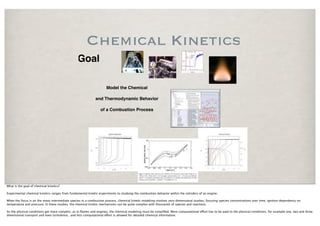
What is the goal of chemical kinetics?

Experimental chemical kinetics ranges from fundamental kinetic experiments to studying the combustion behavior within the cylinders of an engine.

When the focus is on the many intermediate species in a combustion process, chemical kinetic modeling involves zero dimensional studies, focusing species concentrations over time, ignition dependency on
temperature and pressure. In these studies, the chemical kinetic mechanisms can be quite complex with thousands of species and reactions.

As the physical conditions get more complex, as in flames and engines, the chemical modeling must be simplified. More computational e!ort has to be paid to the physical conditions, for example one, two and three
dimensional transport and even turbulence, and less computational e!ort is allowed for detailed chemical information.
Why Combustion Modeling?
                          Improving the efficiency of everyday processes
             Food                                                Power and Heat                                                                         Transport


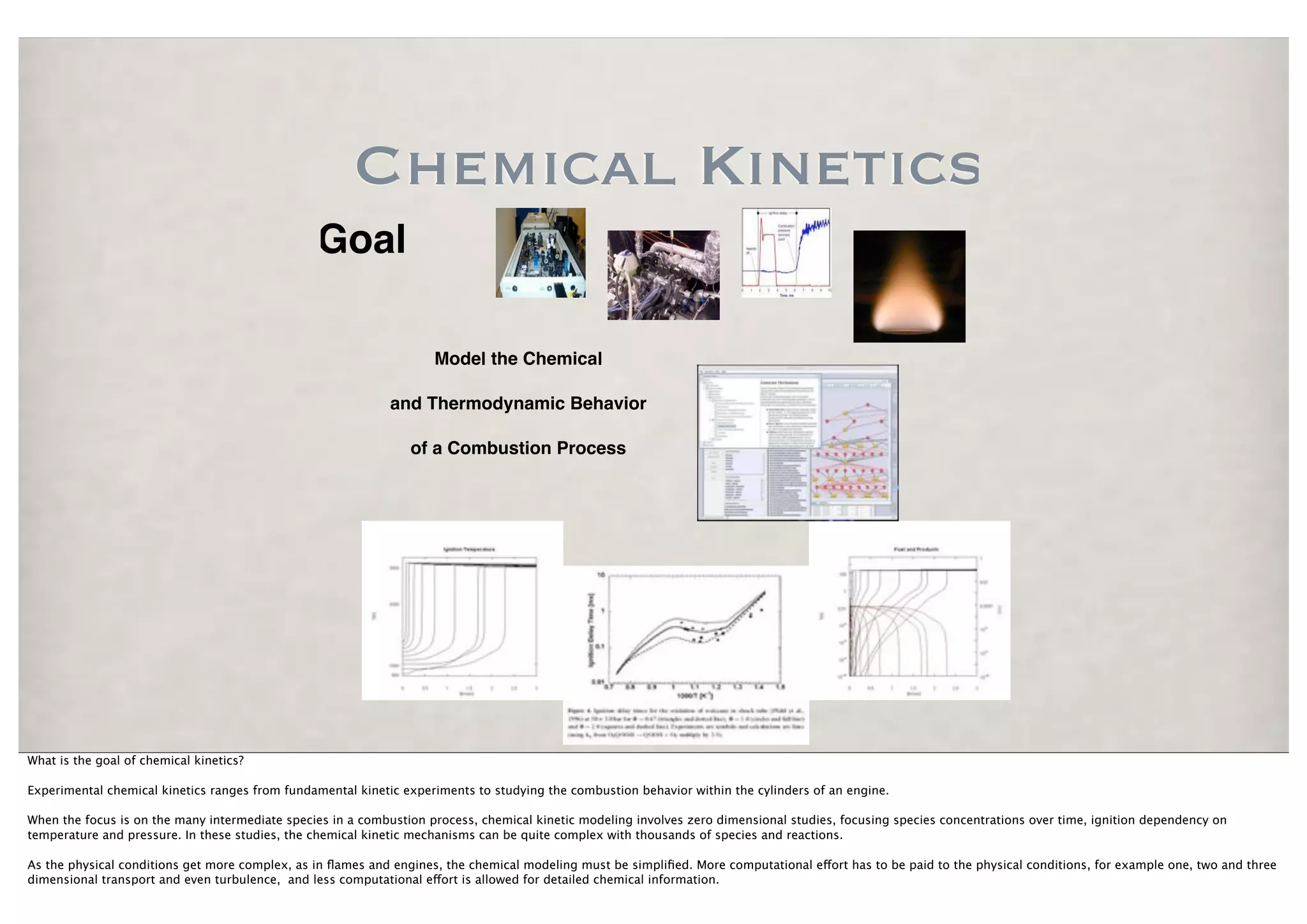
Why should we study combustion?
Combustion e!ects all aspects of society, from the cooking our pizzas we each, to powering our iPods, to warming the house and to getting us to where we want to go.
In a society that is trying to use less energy and reduce global warming, the study of combustion is essential to improve the e"ciency of all these processes.
Why Chemical Kinetics?
                                                           Necessary for 'Clean' future
                     Auto and Plant Emissions


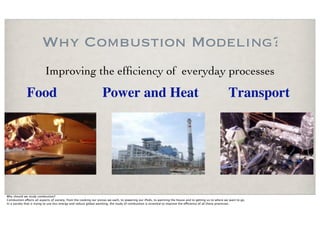
With an ever increasing emphasis on clean energy and clean transport, the study of chemical kinetics is crucial for understanding the chemical origins of emissions and essential in optimizing the combustion process
to reduce these emissions.
Thermal Event
                              Chemical Kinetics: a means to create thermal energy

            Food                               Power and Heat                                           Transport


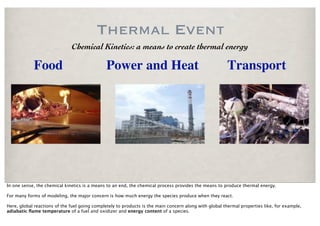
In one sense, the chemical kinetics is a means to an end, the chemical process provides the means to produce thermal energy.

For many forms of modeling, the major concern is how much energy the species produce when they react.

Here, global reactions of the fuel going completely to products is the main concern along with global thermal properties like, for example,
adiabatic flame temperature of a fuel and oxidizer and energy content of a species.
Thermal Event
         Time Scale Difference
                                                                                               Products
          If Chemistry fast:
       Fuel -> Products directly                          Fuel

         Tabulation Method:
    Just temperature evolution
    (not detail about chemistry)
                                                            Large Time Scale


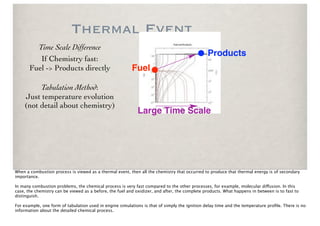
When a combustion process is viewed as a thermal event, then all the chemistry that occurred to produce that thermal energy is of secondary
importance.

In many combustion problems, the chemical process is very fast compared to the other processes, for example, molecular di!usion. In this
case, the chemistry can be viewed as a before, the fuel and oxidizer, and after, the complete products. What happens in between is to fast to
distinguish.

For example, one form of tabulation used in engine simulations is that of simply the ignition delay time and the temperature profile. There is no
information about the detailed chemical process.
Chemical Event
           Auto and Plant Emissions


          Understanding the Chemical Processes of Pollutants
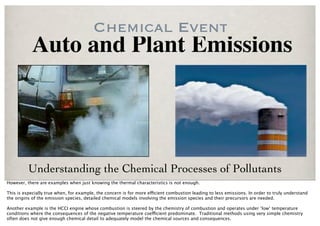
However, there are examples when just knowing the thermal characteristics is not enough.

This is especially true when, for example, the concern is for more e!cient combustion leading to less emissions. In order to truly understand
the origins of the emission species, detailed chemical models involving the emission species and their precursors are needed.

Another example is the HCCI engine whose combustion is steered by the chemistry of combustion and operates under ‘low’ temperature
conditions where the consequences of the negative temperature coe!cient predominate. Traditional methods using very simple chemistry
often does not give enough chemical detail to adequately model the chemical sources and consequences.
Chemical Event
                                                                                                                 CH                      CO
                                                                                                                  2 4 Abstractions       CH2
                                                                                              Addition
                                                                                           CH4 CH3               CH3OH
                                                                                                                    H Abstraction
                                                                               Reverse                                H,OH

                                                                    (S)
                                                                  CH2                      CH3                   CH2OH


                                                                                                                       H Abstraction
                                                                                                                             H,OH
                                                                  CH2


                                                             O2                            CH2O      Third Body CH3 O
                                                                   CH
                                                                                                       H Loss


                                                          HCO                              CO2


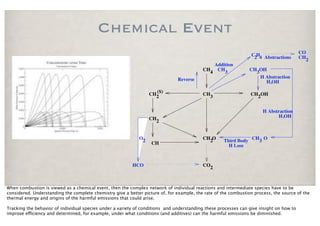
When combustion is viewed as a chemical event, then the complex network of individual reactions and intermediate species have to be
considered. Understanding the complete chemistry give a better picture of, for example, the rate of the combustion process, the source of the
thermal energy and origins of the harmful emissions that could arise.

Tracking the behavior of individual species under a variety of conditions and understanding these processes can give insight on how to
improve e!ciency and determined, for example, under what conditions (and additives) can the harmful emissions be diminished.
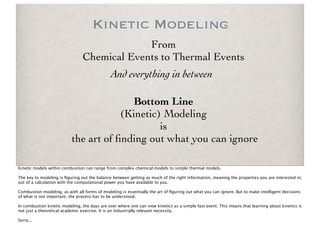
Kinetic Modeling
                                             From
                                Chemical Events to Thermal Events
                                               And everything in between

                                          Bottom Line
                                       (Kinetic) Modeling
                                                is
                           the art of finding out what you can ignore

Kinetic models within combustion can range from complex chemical models to simple thermal models.

The key to modeling is figuring out the balance between getting as much of the right information, meaning the properties you are interested in,
out of a calculation with the computational power you have available to you.

Combustion modeling, as with all forms of modeling is essentially the art of figuring out what you can ignore. But to make intelligent decisions
of what is not important, the process has to be understood.

In combustion kinetic modeling, the days are over where one can view kinetics as a simple fast event. This means that learning about kinetics is
not just a theoretical academic exercise. It is an industrially relevant necessity.

Sorry...

Combustion Introduction

  • 1.
    Chemical Kinetics Goal Model the Chemical and Thermodynamic Behavior of a Combustion Process What is the goal of chemical kinetics? Experimental chemical kinetics ranges from fundamental kinetic experiments to studying the combustion behavior within the cylinders of an engine. When the focus is on the many intermediate species in a combustion process, chemical kinetic modeling involves zero dimensional studies, focusing species concentrations over time, ignition dependency on temperature and pressure. In these studies, the chemical kinetic mechanisms can be quite complex with thousands of species and reactions. As the physical conditions get more complex, as in flames and engines, the chemical modeling must be simplified. More computational e!ort has to be paid to the physical conditions, for example one, two and three dimensional transport and even turbulence, and less computational e!ort is allowed for detailed chemical information.
  • 2.
    Why Combustion Modeling? Improving the efficiency of everyday processes Food Power and Heat Transport Why should we study combustion? Combustion e!ects all aspects of society, from the cooking our pizzas we each, to powering our iPods, to warming the house and to getting us to where we want to go. In a society that is trying to use less energy and reduce global warming, the study of combustion is essential to improve the e"ciency of all these processes.
  • 3.
    Why Chemical Kinetics? Necessary for 'Clean' future Auto and Plant Emissions With an ever increasing emphasis on clean energy and clean transport, the study of chemical kinetics is crucial for understanding the chemical origins of emissions and essential in optimizing the combustion process to reduce these emissions.
  • 4.
    Thermal Event Chemical Kinetics: a means to create thermal energy Food Power and Heat Transport In one sense, the chemical kinetics is a means to an end, the chemical process provides the means to produce thermal energy. For many forms of modeling, the major concern is how much energy the species produce when they react. Here, global reactions of the fuel going completely to products is the main concern along with global thermal properties like, for example, adiabatic flame temperature of a fuel and oxidizer and energy content of a species.
  • 5.
    Thermal Event Time Scale Difference Products If Chemistry fast: Fuel -> Products directly Fuel Tabulation Method: Just temperature evolution (not detail about chemistry) Large Time Scale When a combustion process is viewed as a thermal event, then all the chemistry that occurred to produce that thermal energy is of secondary importance. In many combustion problems, the chemical process is very fast compared to the other processes, for example, molecular di!usion. In this case, the chemistry can be viewed as a before, the fuel and oxidizer, and after, the complete products. What happens in between is to fast to distinguish. For example, one form of tabulation used in engine simulations is that of simply the ignition delay time and the temperature profile. There is no information about the detailed chemical process.
  • 6.
    Chemical Event Auto and Plant Emissions Understanding the Chemical Processes of Pollutants However, there are examples when just knowing the thermal characteristics is not enough. This is especially true when, for example, the concern is for more e!cient combustion leading to less emissions. In order to truly understand the origins of the emission species, detailed chemical models involving the emission species and their precursors are needed. Another example is the HCCI engine whose combustion is steered by the chemistry of combustion and operates under ‘low’ temperature conditions where the consequences of the negative temperature coe!cient predominate. Traditional methods using very simple chemistry often does not give enough chemical detail to adequately model the chemical sources and consequences.
  • 7.
    Chemical Event CH CO 2 4 Abstractions CH2 Addition CH4 CH3 CH3OH H Abstraction Reverse H,OH (S) CH2 CH3 CH2OH H Abstraction H,OH CH2 O2 CH2O Third Body CH3 O CH H Loss HCO CO2 When combustion is viewed as a chemical event, then the complex network of individual reactions and intermediate species have to be considered. Understanding the complete chemistry give a better picture of, for example, the rate of the combustion process, the source of the thermal energy and origins of the harmful emissions that could arise. Tracking the behavior of individual species under a variety of conditions and understanding these processes can give insight on how to improve e!ciency and determined, for example, under what conditions (and additives) can the harmful emissions be diminished.
  • 8.
    Kinetic Modeling From Chemical Events to Thermal Events And everything in between Bottom Line (Kinetic) Modeling is the art of finding out what you can ignore Kinetic models within combustion can range from complex chemical models to simple thermal models. The key to modeling is figuring out the balance between getting as much of the right information, meaning the properties you are interested in, out of a calculation with the computational power you have available to you. Combustion modeling, as with all forms of modeling is essentially the art of figuring out what you can ignore. But to make intelligent decisions of what is not important, the process has to be understood. In combustion kinetic modeling, the days are over where one can view kinetics as a simple fast event. This means that learning about kinetics is not just a theoretical academic exercise. It is an industrially relevant necessity. Sorry...