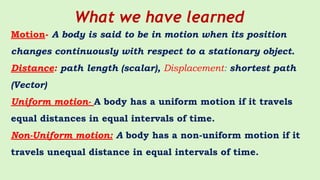
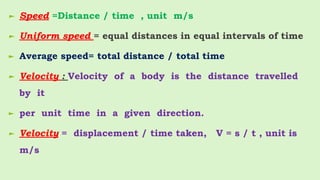
1) Motion can be uniform or non-uniform, depending on whether the body travels equal or unequal distances in equal time intervals. Speed, velocity, and acceleration are defined in terms of distance, displacement, and time.
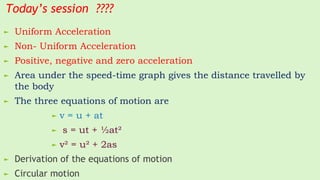
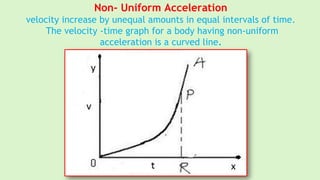
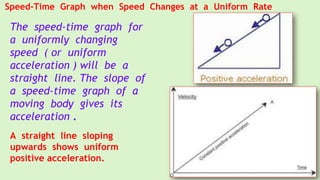
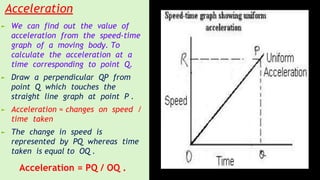
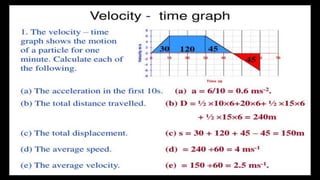
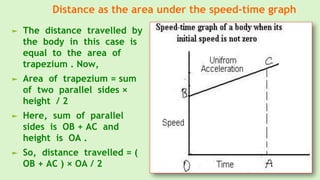
2) The area under a speed-time graph provides the distance traveled, while the slope of the line in such a graph gives the acceleration. The three equations of motion relate the variables of displacement, velocity, acceleration, and time.
3) Circular motion occurs when a body moves along a circular path, changing direction continuously. Uniform circular motion refers to constant speed around the path.










![8motion [autosaved]](https://cdn.slidesharecdn.com/ss_thumbnails/8motionautosaved-150707124342-lva1-app6891-thumbnail.jpg?width=640&height=640&fit=bounds)


![Human Reproduction [ Reproductive System ] Notes @irfanullah_mehar Irfanullah...](https://cdn.slidesharecdn.com/ss_thumbnails/humanreproductionreproductivesystemnotesirfanullahmeharirfanullahmeharjanantantra-260111172350-56e85778-thumbnail.jpg?width=640&height=640&fit=bounds)


