• Review of quantum mechanical concept
• Review of solid state physics
Unit-I
Prepared by
S.Vijayakumar, AP/ECE
Ramco Institute of Technology
Academic year
(2017-2018 odd sem)
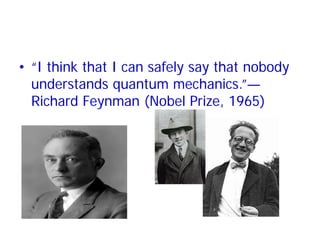
• “I think that I can safely say that nobody
understands quantum mechanics.”—
Richard Feynman (Nobel Prize, 1965)
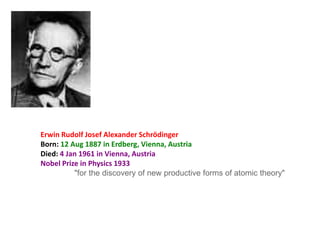
Erwin Rudolf Josef Alexander Schrödinger
Born: 12 Aug 1887 in Erdberg, Vienna, Austria
Died: 4 Jan 1961 in Vienna, Austria
Nobel Prize in Physics 1933
"for the discovery of new productive forms of atomic theory"
An equation for matter waves?
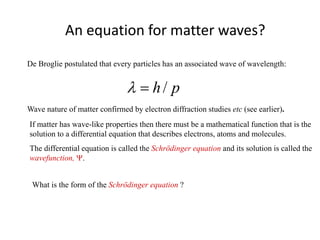
De Broglie postulated that every particles has an associated wave of wavelength:
ph/=λ
Wave nature of matter confirmed by electron diffraction studies etc (see earlier).
If matter has wave-like properties then there must be a mathematical function that is the
solution to a differential equation that describes electrons, atoms and molecules.
The differential equation is called the Schrödinger equation and its solution is called the
wavefunction, Ψ.
What is the form of the Schrödinger equation ?
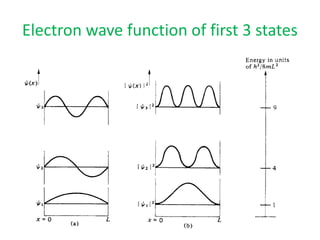
Electron wave function of first 3 states
Interpretation of Ψ(x,t)
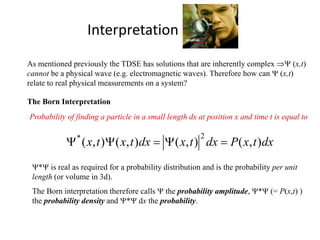
As mentioned previously the TDSE has solutions that are inherently complex ⇒Ψ (x,t)
cannot be a physical wave (e.g. electromagnetic waves). Therefore how can Ψ (x,t)
relate to real physical measurements on a system?
The Born Interpretation
dxtxPdxtxdxtxtx ),(),(),(),(
2*
=Ψ=ΨΨ
Ψ*Ψ is real as required for a probability distribution and is the probability per unit
length (or volume in 3d).
The Born interpretation therefore calls Ψ the probability amplitude, Ψ*Ψ (= P(x,t) )
the probability density and Ψ*Ψ dx the probability.
Probability of finding a particle in a small length dx at position x and time t is equal to
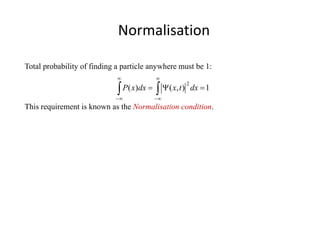
Normalisation
∫∫
∞
∞−
∞
∞−
=Ψ= 1),()(
2
dxtxdxxP
Total probability of finding a particle anywhere must be 1:
This requirement is known as the Normalisation condition.
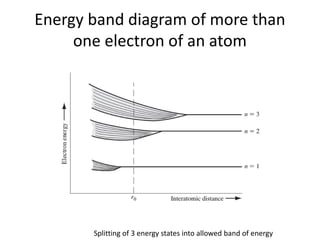
Energy band diagram of more than
one electron of an atom
Splitting of 3 energy states into allowed band of energy
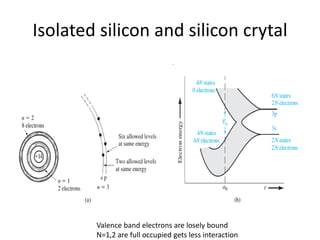
Isolated silicon and silicon crytal
Valence band electrons are losely bound
N=1,2 are full occupied gets less interaction
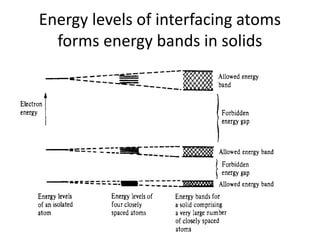
Energy levels of interfacing atoms
forms energy bands in solids
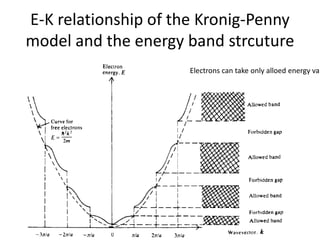
E-K relationship of the Kronig-Penny
model and the energy band strcuture
Electrons can take only alloed energy va
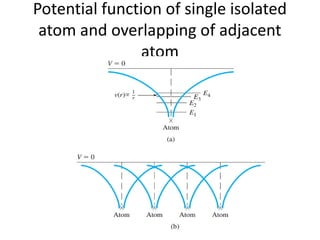
Potential function of single isolated
atom and overlapping of adjacent
atom
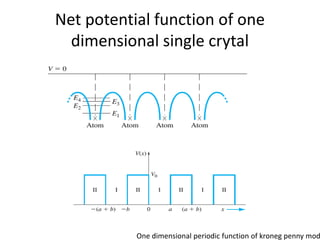
Net potential function of one
dimensional single crytal
One dimensional periodic function of kroneg penny mod
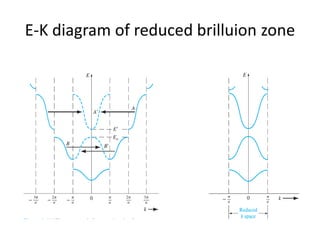
E-K diagram of reduced brilluion zone
Electron wave function of first 3 states

Electron wave function of first 3 states

  • 1.
    • Review ofquantum mechanical concept • Review of solid state physics Unit-I Prepared by S.Vijayakumar, AP/ECE Ramco Institute of Technology Academic year (2017-2018 odd sem)
  • 2.
    • “I thinkthat I can safely say that nobody understands quantum mechanics.”— Richard Feynman (Nobel Prize, 1965)
  • 3.
    Erwin Rudolf JosefAlexander Schrödinger Born: 12 Aug 1887 in Erdberg, Vienna, Austria Died: 4 Jan 1961 in Vienna, Austria Nobel Prize in Physics 1933 "for the discovery of new productive forms of atomic theory"
  • 4.
    An equation formatter waves? De Broglie postulated that every particles has an associated wave of wavelength: ph/=λ Wave nature of matter confirmed by electron diffraction studies etc (see earlier). If matter has wave-like properties then there must be a mathematical function that is the solution to a differential equation that describes electrons, atoms and molecules. The differential equation is called the Schrödinger equation and its solution is called the wavefunction, Ψ. What is the form of the Schrödinger equation ?
  • 5.
    Electron wave functionof first 3 states
  • 6.
    Interpretation of Ψ(x,t) Asmentioned previously the TDSE has solutions that are inherently complex ⇒Ψ (x,t) cannot be a physical wave (e.g. electromagnetic waves). Therefore how can Ψ (x,t) relate to real physical measurements on a system? The Born Interpretation dxtxPdxtxdxtxtx ),(),(),(),( 2* =Ψ=ΨΨ Ψ*Ψ is real as required for a probability distribution and is the probability per unit length (or volume in 3d). The Born interpretation therefore calls Ψ the probability amplitude, Ψ*Ψ (= P(x,t) ) the probability density and Ψ*Ψ dx the probability. Probability of finding a particle in a small length dx at position x and time t is equal to
  • 7.
    Normalisation ∫∫ ∞ ∞− ∞ ∞− =Ψ= 1),()( 2 dxtxdxxP Total probabilityof finding a particle anywhere must be 1: This requirement is known as the Normalisation condition.
  • 8.
    Energy band diagramof more than one electron of an atom Splitting of 3 energy states into allowed band of energy
  • 9.
    Isolated silicon andsilicon crytal Valence band electrons are losely bound N=1,2 are full occupied gets less interaction
  • 10.
    Energy levels ofinterfacing atoms forms energy bands in solids
  • 11.
    E-K relationship ofthe Kronig-Penny model and the energy band strcuture Electrons can take only alloed energy va
  • 12.
    Potential function ofsingle isolated atom and overlapping of adjacent atom
  • 13.
    Net potential functionof one dimensional single crytal One dimensional periodic function of kroneg penny mod
  • 14.
    E-K diagram ofreduced brilluion zone