Practice Problems: Chapter 9, Layout Strategy
Problem 1:
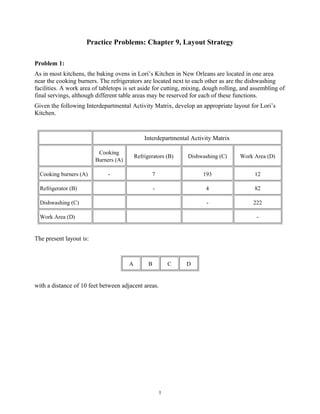
As in most kitchens, the baking ovens in Lori’s Kitchen in New Orleans are located in one area
near the cooking burners. The refrigerators are located next to each other as are the dishwashing
facilities. A work area of tabletops is set aside for cutting, mixing, dough rolling, and assembling of
final servings, although different table areas may be reserved for each of these functions.
Given the following Interdepartmental Activity Matrix, develop an appropriate layout for Lori’s
Kitchen.

Interdepartmental Activity Matrix
Cooking
Burners (A)
Cooking burners (A)

Refrigerators (B)

Dishwashing (C)

Work Area (D)

-

7

193

12

-

4

82

-

222

Refrigerator (B)
Dishwashing (C)
Work Area (D)

-

The present layout is:

A

B

C

with a distance of 10 feet between adjacent areas.

1

D
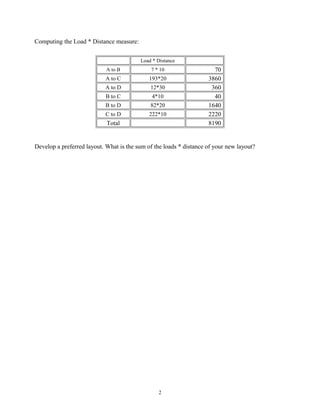
Computing the Load * Distance measure:
Load * Distance
A to B

7 * 10

A to C

193*20

A to D

12*30

B to C

4*10

B to D

82*20

C to D

222*10

Total

70
3860
360
40
1640
2220
8190

Develop a preferred layout. What is the sum of the loads * distance of your new layout?

2
Problem 2:
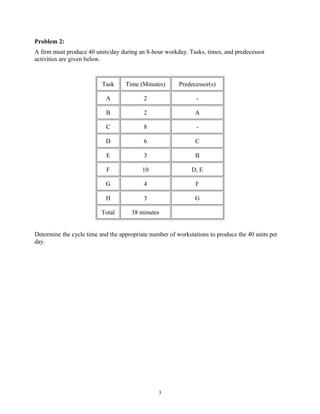
A firm must produce 40 units/day during an 8-hour workday. Tasks, times, and predecessor
activities are given below.

Task

Time (Minutes)

Predecessor(s)

A

2

-

B

2

A

C

8

-

D

6

C

E

3

B

F

10

D, E

G

4

F

H

3

G

Total

38 minutes

Determine the cycle time and the appropriate number of workstations to produce the 40 units per
day.

3
ANSWERS
Problem 1:
From the Activity Matrix, C and D should be next to each other and A should be next to C. The
other relationships are minor by comparison. One possible solution is:

B

A

C

D

with a distance of 10 feet between adjacent areas.
Computing the Load * Distance measure:

Load * Distance
A to B

7 * 10

70

A to C

193*10

1930

A to D

12*20

240

B to C

4*20

80

B to D

82*30

2460

C to D

222*10

2220

Total

7000

Further improvement is possible. Try analyzing the following layouts.

A

C

B

D

A

C

D

B

4
Problem 2:

Cycle time =

Production time available 8 hrs *60 minutes/hr 480
=
=
= 12 minutes/cycle
Units required
40 units
40

Minimum number of workstations =
=

∑t

i

Cycle time

=

Work time required
Cycle time

38 minutes
= 3.17 station
12 minutes/cycle

3.17 workstations must be rounded up to 4 as 3 workstations would not be able to produce the
required output.
One layout – not necessarily optimal

5
Problem 2:

Cycle time =

Production time available 8 hrs *60 minutes/hr 480
=
=
= 12 minutes/cycle
Units required
40 units
40

Minimum number of workstations =
=

∑t

i

Cycle time

=

Work time required
Cycle time

38 minutes
= 3.17 station
12 minutes/cycle

3.17 workstations must be rounded up to 4 as 3 workstations would not be able to produce the
required output.
One layout – not necessarily optimal

5

Ch09pp

  • 1.
    Practice Problems: Chapter9, Layout Strategy Problem 1: As in most kitchens, the baking ovens in Lori’s Kitchen in New Orleans are located in one area near the cooking burners. The refrigerators are located next to each other as are the dishwashing facilities. A work area of tabletops is set aside for cutting, mixing, dough rolling, and assembling of final servings, although different table areas may be reserved for each of these functions. Given the following Interdepartmental Activity Matrix, develop an appropriate layout for Lori’s Kitchen. Interdepartmental Activity Matrix Cooking Burners (A) Cooking burners (A) Refrigerators (B) Dishwashing (C) Work Area (D) - 7 193 12 - 4 82 - 222 Refrigerator (B) Dishwashing (C) Work Area (D) - The present layout is: A B C with a distance of 10 feet between adjacent areas. 1 D
  • 2.
    Computing the Load* Distance measure: Load * Distance A to B 7 * 10 A to C 193*20 A to D 12*30 B to C 4*10 B to D 82*20 C to D 222*10 Total 70 3860 360 40 1640 2220 8190 Develop a preferred layout. What is the sum of the loads * distance of your new layout? 2
  • 3.
    Problem 2: A firmmust produce 40 units/day during an 8-hour workday. Tasks, times, and predecessor activities are given below. Task Time (Minutes) Predecessor(s) A 2 - B 2 A C 8 - D 6 C E 3 B F 10 D, E G 4 F H 3 G Total 38 minutes Determine the cycle time and the appropriate number of workstations to produce the 40 units per day. 3
  • 4.
    ANSWERS Problem 1: From theActivity Matrix, C and D should be next to each other and A should be next to C. The other relationships are minor by comparison. One possible solution is: B A C D with a distance of 10 feet between adjacent areas. Computing the Load * Distance measure: Load * Distance A to B 7 * 10 70 A to C 193*10 1930 A to D 12*20 240 B to C 4*20 80 B to D 82*30 2460 C to D 222*10 2220 Total 7000 Further improvement is possible. Try analyzing the following layouts. A C B D A C D B 4
  • 5.
    Problem 2: Cycle time= Production time available 8 hrs *60 minutes/hr 480 = = = 12 minutes/cycle Units required 40 units 40 Minimum number of workstations = = ∑t i Cycle time = Work time required Cycle time 38 minutes = 3.17 station 12 minutes/cycle 3.17 workstations must be rounded up to 4 as 3 workstations would not be able to produce the required output. One layout – not necessarily optimal 5
  • 6.
    Problem 2: Cycle time= Production time available 8 hrs *60 minutes/hr 480 = = = 12 minutes/cycle Units required 40 units 40 Minimum number of workstations = = ∑t i Cycle time = Work time required Cycle time 38 minutes = 3.17 station 12 minutes/cycle 3.17 workstations must be rounded up to 4 as 3 workstations would not be able to produce the required output. One layout – not necessarily optimal 5