Clean room technology
Outline
• Introduction
• Importance
• Methods
• Filters
• conclusion
Definition
• A room in which the concentration of airborne particles is controlled,
and which is constructed and used in a manner to minimize the
introduction, generation, and retention of particles inside the room
and in which other relevant parameters, e.g. temperature, humidity,
and pressure, are controlled as necessary.
History
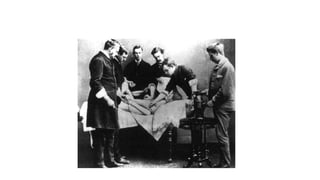
• Lord lister realized that elimination of bacteria can reduce infection.
• In 1860’s he used carbolic acid on instruments, wound and surgeons hands and prevent airborne
by spraying into air.
• The use of nuclear fission, as well as the biological and chemical warfare research carried out
during the 1939-1945 Second World War, were the driving forces for the production of High
Efficiency Particulate Air (HEPA) filters necessary to contain the dangerous microbial or
radioactive contaminants.
• In the early 1950s the Western Electric Company in Winston-Salem, NC, USA was having a major
problem in manufacturing missile gyroscopes. About 99 out of 100 gyroscopes were being
rejected, the problem being identified as dust.
• Cleanroom technology can be divided into three parts: design, testing
and operation.
• Cleanrooms have to be first designed and constructed; they then have
to be tested to ensure they achieve their design specification and
continue to do so.
• Finally they have to be operated in such a way as to minimise
contamination.
Importance
• A major user of cleanrooms is the semiconductor fabrication industry,
where processors are produced for use in computers, cars and other
machines.
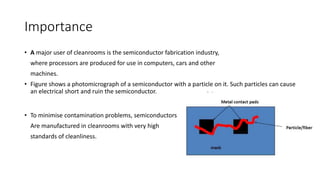
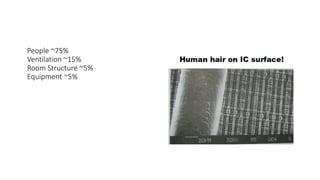
• Figure shows a photomicrograph of a semiconductor with a particle on it. Such particles can cause
an electrical short and ruin the semiconductor.
• To minimise contamination problems, semiconductors
Are manufactured in cleanrooms with very high
standards of cleanliness.
• Molecular contaminants (Out gassing, Oil vapour, Alcohols, Paints, glues, & epoxies, Aromatics; If
you can smell it, suspect it as a contaminant.
• Surface contaminants Finger prints - Oil & grease Skin oil Hand cream Wax
• Particulate contaminants
People (skin, scales, hair, clothing lint, etc.)
Particle shedding materials (cardboard boxes, paper)
Abrading actions (drilling, sawing, sanding, etc.)
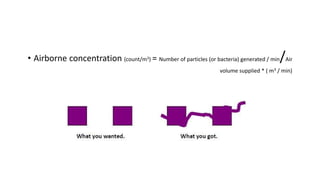
• Airborne concentration (count/m3) = Number of particles (or bacteria) generated / min/Air
volume supplied * ( m3 / min)
People ~75%
Ventilation ~15%
Room Structure ~5%
Equipment ~5%
Types of Cleanrooms
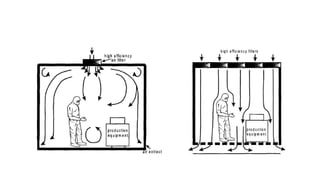
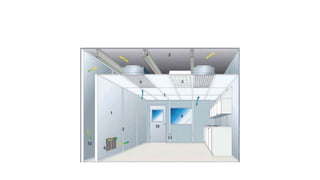
• Cleanrooms have evolved into two major types and they are
differentiated by their method of ventilation. These are turbulently
ventilated and unidirectional flow cleanrooms.
• Turbulently ventilated cleanrooms are also known as ‘non uni-
directional’. Unidirectional flow cleanrooms were originally known as
‘laminar flow’ cleanrooms.
• This air sweeps across the room in a unidirectional way at and exits
through the floor, thus removing the airborne contamination from the
room. This type of clean room uses very much more air than the
turbulently ventilated type, and gives superior cleanliness.
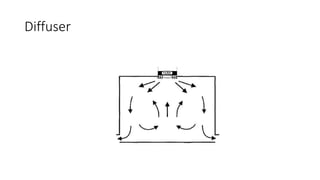
• The type, number and placement of air supply diffusers, as well as the
extract grilles, is an important consideration in a turbulently
ventilated cleanroom.
• Air diffusers are used in many air conditioned rooms and situated
where the supply air enters a room; they are designed to minimize
the draught caused by high air velocities and ensure good air mixing.
• It is possible to supply the air to a cleanroom with, or without, a
diffuser.
Diffuser
• In some conventionally ventilated cleanrooms, diffusers are not used
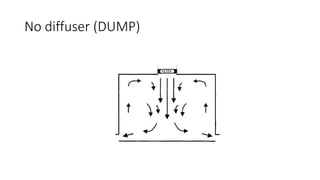
and the supply air is ‘dumped’ down directly from the air filter into
the cleanroom.
• This method is chosen to obtain unidirectional flow and good
contamination control conditions under the filter
No diffuser (DUMP)
• ‘Dump’ methods will give enhanced conditions below the supply area,
but must therefore give poorer conditions elsewhere in the room.
• If enhanced conditions are required at critical areas, then it is better
to ensure good air mixing in the cleanroom by means of diffusers, and
use unidirectional cabinets or workstations at the critical areas.
• Diffusers should, however, be selected so that there are a sufficient
number and size to give good mixing and draught free conditions.
• If the ‘dump’ method is chosen then the filters should preferably be
distributed evenly about the room. There may be an advantage in
grouping the filters together to protect an area that must be kept
clean.
• However, if grouping is employed, it should be remembered that the
standard of the cleanroom is determined by the dirtiest part and this
may give a lower classification.
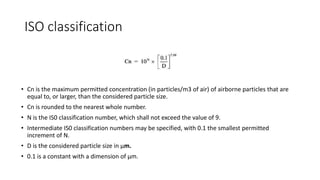
ISO classification
• Cn is the maximum permitted concentration (in particles/m3 of air) of airborne particles that are
equal to, or larger, than the considered particle size.
• Cn is rounded to the nearest whole number.
• N is the IS0 classification number, which shall not exceed the value of 9.
• Intermediate IS0 classification numbers may be specified, with 0.1 the smallest permitted
increment of N.
• D is the considered particle size in µm.
• 0.1 is a constant with a dimension of µm.
Room pressurisation and air movement
control between rooms
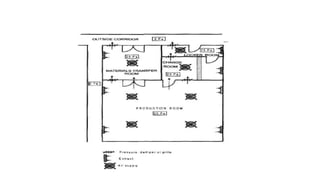
• A cleanroom must be designed to ensure that contaminated air does not come into the room
from dirtier adjacent areas.
• Air should therefore always move from the cleanroom to less-clean adjacent areas. This means
that the highest pressure should be in the production area
• If a cleanroom is at a higher pressure than an adjacent area then air will flow from the cleanroom
to the adjacent area. Differential pressures of 10 Pa between two cleanrooms, and 15 Pa between
a cleanroom and an unclassified area, are reasonable design pressures
High efficiency FILTERS
• HEPA and ULPA
• High-Efficiency Particulate Air Filter
• Ultra Low Penetration Air Filter
• HEPA Collection Efficiency ≥ 99.97% (for 0.3 μm particles)
• ULPA Collection Efficiency ≥ 99.999%(for 0.1-0.2 μm particles)
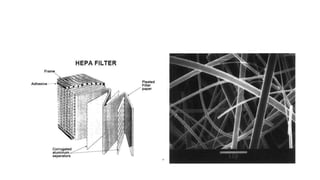
• Paper-like mat of glass fibers perpendicular to airflow.
• Fibers randomly oriented in the mat.
• Organic binder is added for strength.
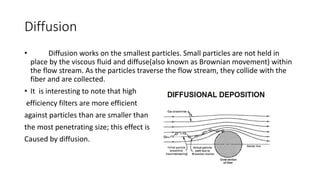
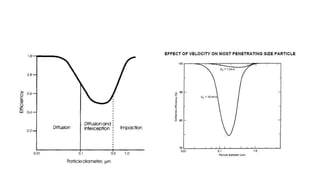
Diffusion
• Diffusion works on the smallest particles. Small particles are not held in
place by the viscous fluid and diffuse(also known as Brownian movement) within
the flow stream. As the particles traverse the flow stream, they collide with the
fiber and are collected.
• It is interesting to note that high
efficiency filters are more efficient
against particles than are smaller than
the most penetrating size; this effect is
Caused by diffusion.
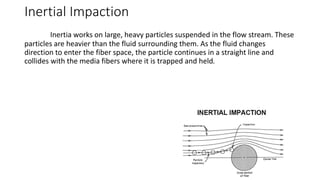
Inertial Impaction
Inertia works on large, heavy particles suspended in the flow stream. These
particles are heavier than the fluid surrounding them. As the fluid changes
direction to enter the fiber space, the particle continues in a straight line and
collides with the media fibers where it is trapped and held.
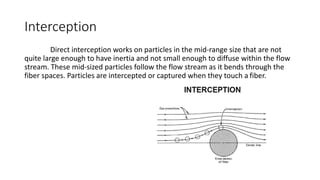
Interception
Direct interception works on particles in the mid-range size that are not
quite large enough to have inertia and not small enough to diffuse within the flow
stream. These mid-sized particles follow the flow stream as it bends through the
fiber spaces. Particles are intercepted or captured when they touch a fiber.
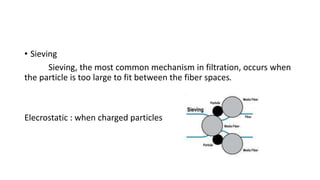
• Sieving
Sieving, the most common mechanism in filtration, occurs when
the particle is too large to fit between the fiber spaces.
Elecrostatic : when charged particles
Don’t:
– touch your face or skin with gloves
– touch building hardware, oily machinery, or wafer loading areas
– lean on equipment
– wear cosmetics, powders, or colognes
– wear anything on fingers-- remove all rings and bracelets
– use paper, pencils or markers that leave dust or lint
Do:
– change gloves whenever they get dirty or torn
– use a fresh pair of gloves whenever handling wafers
– wipe down wafer handling areas with isopropanol
– use clean room paper and dust-free ball point pens
REFERENCE:
• Cleanroom Technology: Fundamentals of Design, Testing and Operation, W.Whyte, Copyright 2001 John Wiley & Sons Ltd
Print ISBN 0-471-86842-6 Online ISBN 0--470-84777-8
Thank you

Clean room technology

  • 1.
  • 2.
    Outline • Introduction • Importance •Methods • Filters • conclusion
  • 3.
    Definition • A roomin which the concentration of airborne particles is controlled, and which is constructed and used in a manner to minimize the introduction, generation, and retention of particles inside the room and in which other relevant parameters, e.g. temperature, humidity, and pressure, are controlled as necessary.
  • 4.
    History • Lord listerrealized that elimination of bacteria can reduce infection. • In 1860’s he used carbolic acid on instruments, wound and surgeons hands and prevent airborne by spraying into air. • The use of nuclear fission, as well as the biological and chemical warfare research carried out during the 1939-1945 Second World War, were the driving forces for the production of High Efficiency Particulate Air (HEPA) filters necessary to contain the dangerous microbial or radioactive contaminants. • In the early 1950s the Western Electric Company in Winston-Salem, NC, USA was having a major problem in manufacturing missile gyroscopes. About 99 out of 100 gyroscopes were being rejected, the problem being identified as dust.
  • 6.
    • Cleanroom technologycan be divided into three parts: design, testing and operation. • Cleanrooms have to be first designed and constructed; they then have to be tested to ensure they achieve their design specification and continue to do so. • Finally they have to be operated in such a way as to minimise contamination.
  • 7.
    Importance • A majoruser of cleanrooms is the semiconductor fabrication industry, where processors are produced for use in computers, cars and other machines. • Figure shows a photomicrograph of a semiconductor with a particle on it. Such particles can cause an electrical short and ruin the semiconductor. • To minimise contamination problems, semiconductors Are manufactured in cleanrooms with very high standards of cleanliness.
  • 8.
    • Molecular contaminants(Out gassing, Oil vapour, Alcohols, Paints, glues, & epoxies, Aromatics; If you can smell it, suspect it as a contaminant. • Surface contaminants Finger prints - Oil & grease Skin oil Hand cream Wax • Particulate contaminants People (skin, scales, hair, clothing lint, etc.) Particle shedding materials (cardboard boxes, paper) Abrading actions (drilling, sawing, sanding, etc.)
  • 9.
    • Airborne concentration(count/m3) = Number of particles (or bacteria) generated / min/Air volume supplied * ( m3 / min)
  • 10.
    People ~75% Ventilation ~15% RoomStructure ~5% Equipment ~5%
  • 12.
    Types of Cleanrooms •Cleanrooms have evolved into two major types and they are differentiated by their method of ventilation. These are turbulently ventilated and unidirectional flow cleanrooms. • Turbulently ventilated cleanrooms are also known as ‘non uni- directional’. Unidirectional flow cleanrooms were originally known as ‘laminar flow’ cleanrooms. • This air sweeps across the room in a unidirectional way at and exits through the floor, thus removing the airborne contamination from the room. This type of clean room uses very much more air than the turbulently ventilated type, and gives superior cleanliness.
  • 14.
    • The type,number and placement of air supply diffusers, as well as the extract grilles, is an important consideration in a turbulently ventilated cleanroom. • Air diffusers are used in many air conditioned rooms and situated where the supply air enters a room; they are designed to minimize the draught caused by high air velocities and ensure good air mixing. • It is possible to supply the air to a cleanroom with, or without, a diffuser.
  • 15.
  • 16.
    • In someconventionally ventilated cleanrooms, diffusers are not used and the supply air is ‘dumped’ down directly from the air filter into the cleanroom. • This method is chosen to obtain unidirectional flow and good contamination control conditions under the filter
  • 17.
  • 18.
    • ‘Dump’ methodswill give enhanced conditions below the supply area, but must therefore give poorer conditions elsewhere in the room. • If enhanced conditions are required at critical areas, then it is better to ensure good air mixing in the cleanroom by means of diffusers, and use unidirectional cabinets or workstations at the critical areas. • Diffusers should, however, be selected so that there are a sufficient number and size to give good mixing and draught free conditions.
  • 19.
    • If the‘dump’ method is chosen then the filters should preferably be distributed evenly about the room. There may be an advantage in grouping the filters together to protect an area that must be kept clean. • However, if grouping is employed, it should be remembered that the standard of the cleanroom is determined by the dirtiest part and this may give a lower classification.
  • 20.
    ISO classification • Cnis the maximum permitted concentration (in particles/m3 of air) of airborne particles that are equal to, or larger, than the considered particle size. • Cn is rounded to the nearest whole number. • N is the IS0 classification number, which shall not exceed the value of 9. • Intermediate IS0 classification numbers may be specified, with 0.1 the smallest permitted increment of N. • D is the considered particle size in µm. • 0.1 is a constant with a dimension of µm.
  • 21.
    Room pressurisation andair movement control between rooms • A cleanroom must be designed to ensure that contaminated air does not come into the room from dirtier adjacent areas. • Air should therefore always move from the cleanroom to less-clean adjacent areas. This means that the highest pressure should be in the production area • If a cleanroom is at a higher pressure than an adjacent area then air will flow from the cleanroom to the adjacent area. Differential pressures of 10 Pa between two cleanrooms, and 15 Pa between a cleanroom and an unclassified area, are reasonable design pressures
  • 23.
    High efficiency FILTERS •HEPA and ULPA • High-Efficiency Particulate Air Filter • Ultra Low Penetration Air Filter • HEPA Collection Efficiency ≥ 99.97% (for 0.3 μm particles) • ULPA Collection Efficiency ≥ 99.999%(for 0.1-0.2 μm particles) • Paper-like mat of glass fibers perpendicular to airflow. • Fibers randomly oriented in the mat. • Organic binder is added for strength.
  • 25.
    Diffusion • Diffusion workson the smallest particles. Small particles are not held in place by the viscous fluid and diffuse(also known as Brownian movement) within the flow stream. As the particles traverse the flow stream, they collide with the fiber and are collected. • It is interesting to note that high efficiency filters are more efficient against particles than are smaller than the most penetrating size; this effect is Caused by diffusion.
  • 26.
    Inertial Impaction Inertia workson large, heavy particles suspended in the flow stream. These particles are heavier than the fluid surrounding them. As the fluid changes direction to enter the fiber space, the particle continues in a straight line and collides with the media fibers where it is trapped and held.
  • 27.
    Interception Direct interception workson particles in the mid-range size that are not quite large enough to have inertia and not small enough to diffuse within the flow stream. These mid-sized particles follow the flow stream as it bends through the fiber spaces. Particles are intercepted or captured when they touch a fiber.
  • 28.
    • Sieving Sieving, themost common mechanism in filtration, occurs when the particle is too large to fit between the fiber spaces. Elecrostatic : when charged particles
  • 31.
    Don’t: – touch yourface or skin with gloves – touch building hardware, oily machinery, or wafer loading areas – lean on equipment – wear cosmetics, powders, or colognes – wear anything on fingers-- remove all rings and bracelets – use paper, pencils or markers that leave dust or lint Do: – change gloves whenever they get dirty or torn – use a fresh pair of gloves whenever handling wafers – wipe down wafer handling areas with isopropanol – use clean room paper and dust-free ball point pens
  • 32.
    REFERENCE: • Cleanroom Technology:Fundamentals of Design, Testing and Operation, W.Whyte, Copyright 2001 John Wiley & Sons Ltd Print ISBN 0-471-86842-6 Online ISBN 0--470-84777-8
  • 33.