DARK MATTER
What is dark matter??
• Dark matter is a hypothetical kind of matter that cannot be seen with
telescopes but would account for most of the matter in the universe.
• Dark matter neither emits nor absorbs light or any other
electromagnetic radiation at any significant level. According to the
Planck mission team, and based on the standard model of cosmology,
the total mass–energy of the known universe contains 4.9% ordinary
matter, 26.8% dark matter and 68.3% dark energy.
• Dark matter was postulated by Jan Oort in 1932,based upon
insufficient evidence, to account for the orbital velocities of stars in
the Milky Way.
How do you know it’s in there??
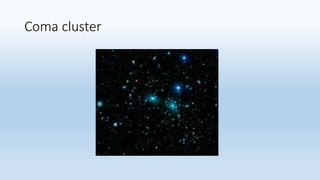
• Clusters of galaxies(coma cluster):
• In 1933, the Swiss astrophysicist Fritz Zwicky, who studied clusters of
galaxies applied virial theorem to to the Coma cluster of galaxies.
• By the virial theorem, the total kinetic energy should be half the total
gravitational binding energy of the galaxies.
• Observations show that kinetic energy is large compared to the
corresponding mass.
• MISSING MASS!!
Coma cluster
How do you know it’s in there??
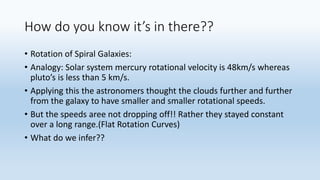
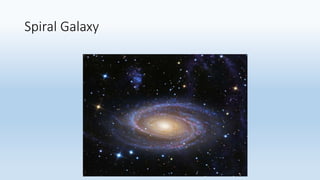
• Rotation of Spiral Galaxies:
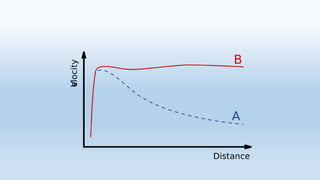
• Analogy: Solar system mercury rotational velocity is 48km/s whereas
pluto’s is less than 5 km/s.
• Applying this the astronomers thought the clouds further and further
from the galaxy to have smaller and smaller rotational speeds.
• But the speeds aree not dropping off!! Rather they stayed constant
over a long range.(Flat Rotation Curves)
• What do we infer??
Spiral Galaxy
How do you know it’s in there??
• Gravitational Lensing: (from Einstein’s relativity theory)
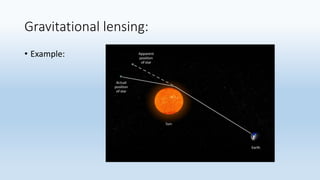
• A gravitational lens is formed when the light from a more distant
source (such as a quasar) is "bent" around a massive object (such as a
cluster of galaxies) lying inline between the source object and the
observer. The process is known as gravitational lensing.
• By measuring the distortion geometry, the mass of the intervening
cluster causing the phenomena can be obtained.
• By the luminosity calculations we find the mass of the cluster(bodies)
as whole.
• MASS MISSING!!
Gravitational lensing:
• Example:
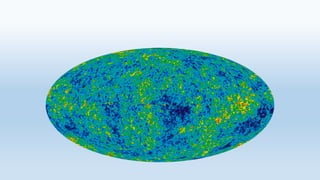
• The cosmic microwave background (CMB) is the thermal radiation left
over from the time of recombination in Big Bang cosmology.
• It is the oldest light in the universe.
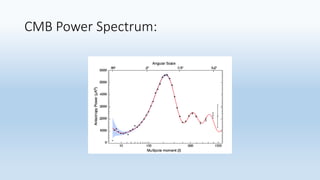
• The CMB power spectrum shows a large first peak and smaller
successive peaks, with three peaks resolved as of 2009.The first peak
tells mostly about the density of baryonic matter and the third peak
mostly about the density of dark matter.
• Ordinary (baryonic) matter interacts strongly by way of radiation
whereas dark matter particles, such as WIMPs for example, do not;
both affect the oscillations by way of their gravity, so the two forms of
matter will have different effects.
CMB Power Spectrum:
Types of Dark Matter
• Baryonic
• A small proportion of dark matter may be baryonic dark matter:
astronomical bodies, such as massive compact halo objects, which are
composed of ordinary matter but emit little or no electromagnetic
radiation.
• Normal baryonic matter include brown dwarfs, other stellar remnants
such as white dwarfs, or perhaps small, dense chunks of heavy
elements.
• These are also called MACHO’s(Massive compact halo object)
• Non Baryonic
• Candidates for nonbaryonic dark matter are hypothetical particles
such as gravitons,axions, or supersymmetric particles; neutrinos form
a small fraction of the dark matter.
• The most widely discussed models for nonbaryonic dark matter are
based on the cold dark matter hypothesis, and the corresponding
particle is most commonly assumed to be a weakly interacting
massive particle (WIMP).
• Hot dark matter may include (massive) neutrinos.
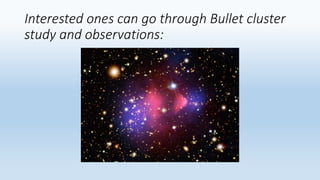
Interested ones can go through Bullet cluster
study and observations:
Conclusion:
• Dark matter is still a hypothesis, and a burning issue in astrophysics as
of now.
• To explain the previous phenomenons, theories challenging
Newtonian Mechanics and Einstein’s theory of Relativity have been
proposed. But, none of them were successful in explaining all.
• Eg: MOND(Modified Newtonian Dynamics)
• Though the CMB explains it a little bit, the concept of dark matter is
still a mystery.
Questions:
• Q)Gravitational lensing depends on which theory?
• Newtons laws
• Relativity theory
• Keplers laws
• Hubble law
• According to virial theorem the total KE of system is _____ times that
of the Gravitional Energy.
• ¼
• ½
• 1/3
• 3/4
• Which of the following is not a baryonic dark matter??
• Brown dwarf
• Black hole
• Nuetrino
• Nuetron star

Dark matter ~ Introduction

  • 1.
  • 2.
    What is darkmatter?? • Dark matter is a hypothetical kind of matter that cannot be seen with telescopes but would account for most of the matter in the universe. • Dark matter neither emits nor absorbs light or any other electromagnetic radiation at any significant level. According to the Planck mission team, and based on the standard model of cosmology, the total mass–energy of the known universe contains 4.9% ordinary matter, 26.8% dark matter and 68.3% dark energy. • Dark matter was postulated by Jan Oort in 1932,based upon insufficient evidence, to account for the orbital velocities of stars in the Milky Way.
  • 3.
    How do youknow it’s in there?? • Clusters of galaxies(coma cluster): • In 1933, the Swiss astrophysicist Fritz Zwicky, who studied clusters of galaxies applied virial theorem to to the Coma cluster of galaxies. • By the virial theorem, the total kinetic energy should be half the total gravitational binding energy of the galaxies. • Observations show that kinetic energy is large compared to the corresponding mass. • MISSING MASS!!
  • 4.
  • 5.
    How do youknow it’s in there?? • Rotation of Spiral Galaxies: • Analogy: Solar system mercury rotational velocity is 48km/s whereas pluto’s is less than 5 km/s. • Applying this the astronomers thought the clouds further and further from the galaxy to have smaller and smaller rotational speeds. • But the speeds aree not dropping off!! Rather they stayed constant over a long range.(Flat Rotation Curves) • What do we infer??
  • 6.
  • 8.
    How do youknow it’s in there?? • Gravitational Lensing: (from Einstein’s relativity theory) • A gravitational lens is formed when the light from a more distant source (such as a quasar) is "bent" around a massive object (such as a cluster of galaxies) lying inline between the source object and the observer. The process is known as gravitational lensing. • By measuring the distortion geometry, the mass of the intervening cluster causing the phenomena can be obtained. • By the luminosity calculations we find the mass of the cluster(bodies) as whole. • MASS MISSING!!
  • 9.
  • 10.
    • The cosmicmicrowave background (CMB) is the thermal radiation left over from the time of recombination in Big Bang cosmology. • It is the oldest light in the universe. • The CMB power spectrum shows a large first peak and smaller successive peaks, with three peaks resolved as of 2009.The first peak tells mostly about the density of baryonic matter and the third peak mostly about the density of dark matter. • Ordinary (baryonic) matter interacts strongly by way of radiation whereas dark matter particles, such as WIMPs for example, do not; both affect the oscillations by way of their gravity, so the two forms of matter will have different effects.
  • 11.
  • 13.
    Types of DarkMatter • Baryonic • A small proportion of dark matter may be baryonic dark matter: astronomical bodies, such as massive compact halo objects, which are composed of ordinary matter but emit little or no electromagnetic radiation. • Normal baryonic matter include brown dwarfs, other stellar remnants such as white dwarfs, or perhaps small, dense chunks of heavy elements. • These are also called MACHO’s(Massive compact halo object)
  • 14.
    • Non Baryonic •Candidates for nonbaryonic dark matter are hypothetical particles such as gravitons,axions, or supersymmetric particles; neutrinos form a small fraction of the dark matter. • The most widely discussed models for nonbaryonic dark matter are based on the cold dark matter hypothesis, and the corresponding particle is most commonly assumed to be a weakly interacting massive particle (WIMP). • Hot dark matter may include (massive) neutrinos.
  • 15.
    Interested ones cango through Bullet cluster study and observations:
  • 16.
    Conclusion: • Dark matteris still a hypothesis, and a burning issue in astrophysics as of now. • To explain the previous phenomenons, theories challenging Newtonian Mechanics and Einstein’s theory of Relativity have been proposed. But, none of them were successful in explaining all. • Eg: MOND(Modified Newtonian Dynamics) • Though the CMB explains it a little bit, the concept of dark matter is still a mystery.
  • 17.
    Questions: • Q)Gravitational lensingdepends on which theory? • Newtons laws • Relativity theory • Keplers laws • Hubble law
  • 18.
    • According tovirial theorem the total KE of system is _____ times that of the Gravitional Energy. • ¼ • ½ • 1/3 • 3/4
  • 19.
    • Which ofthe following is not a baryonic dark matter?? • Brown dwarf • Black hole • Nuetrino • Nuetron star