Cryptography and Network Security Third Edition by William Stallings Lecture slides by Lawrie Brown
Chapter 5 – Advanced Encryption Standard "It seems very simple." "It is very simple. But if you don't know what the key is it's virtually indecipherable." — Talking to Strange Men,  Ruth Rendell
Origins clear a replacement for DES was needed have theoretical attacks that can break it have demonstrated exhaustive key search attacks can use Triple-DES – but slow with small blocks US NIST issued call for ciphers in 1997 15 candidates accepted in Jun 98  5 were shortlisted in Aug-99  Rijndael was selected as the AES in Oct-2000 issued as FIPS PUB 197 standard in Nov-2001
AES Requirements private key symmetric block cipher  128-bit data, 128/192/256-bit keys  stronger & faster than Triple-DES  active life of 20-30 years (+ archival use)  provide full specification & design details  both C & Java implementations NIST have released all submissions & unclassified analyses
AES Evaluation Criteria initial criteria: security – effort to practically cryptanalyse cost – computational algorithm & implementation characteristics final criteria general security software & hardware implementation ease implementation attacks flexibility (in en/decrypt, keying, other factors)
AES Shortlist after testing and evaluation, shortlist in Aug-99:  MARS (IBM) - complex, fast, high security margin  RC6 (USA) - v. simple, v. fast, low security margin  Rijndael (Belgium) - clean, fast, good security margin  Serpent (Euro) - slow, clean, v. high security margin  Twofish (USA) - complex, v. fast, high security margin  then subject to further analysis & comment saw contrast between algorithms with  few complex rounds verses many simple rounds  which refined existing ciphers verses new proposals
The AES Cipher - Rijndael  designed by Rijmen-Daemen in Belgium  has 128/192/256 bit keys, 128 bit data  an  iterative  rather than  feistel  cipher treats data in 4 groups of 4 bytes operates an entire block in every round designed to be: resistant against known attacks speed and code compactness on many CPUs design simplicity
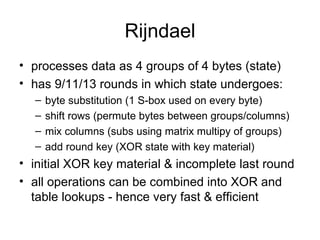
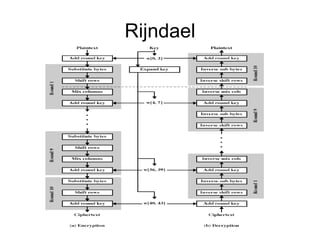
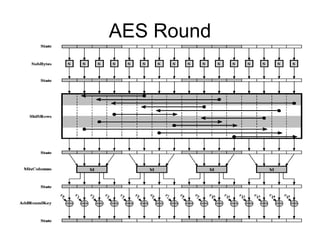
Rijndael processes data as  4 groups of 4 bytes (state) has 9/11/13 rounds in which state undergoes:  byte substitution (1 S-box used on every byte)  shift rows (permute bytes between groups/columns)  mix columns (subs using matrix multipy of groups)  add round key (XOR state with key material)  initial XOR key material & incomplete last round all operations can be combined into XOR and table lookups - hence very fast & efficient
Rijndael
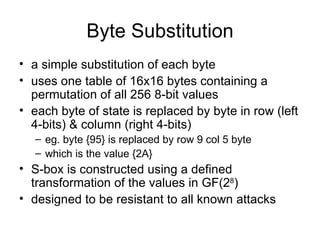
Byte Substitution a simple substitution of each byte uses one table of 16x16 bytes containing a permutation of all 256 8-bit values each byte of state is replaced by byte in row (left 4-bits) & column (right 4-bits) eg. byte {95} is replaced by row 9 col 5 byte which is the value {2A} S-box is constructed using a defined transformation of the values in GF(2 8 ) designed to be resistant to all known attacks
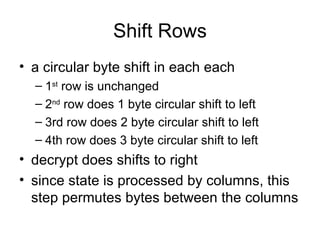
Shift Rows a circular byte shift in each each 1 st  row is unchanged 2 nd  row does 1 byte circular shift to left 3rd row does 2 byte circular shift to left 4th row does 3 byte circular shift to left decrypt does shifts to right since state is processed by columns, this step permutes bytes between the columns
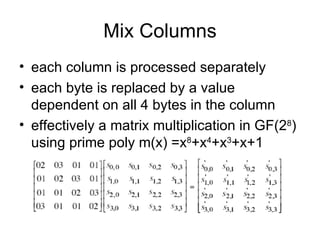
Mix Columns each column is processed separately each byte is replaced by a value dependent on all 4 bytes in the column effectively a matrix multiplication in GF(2 8 ) using prime poly m(x) =x 8 +x 4 +x 3 +x+1
Add Round Key XOR state with 128-bits of the round key again processed by column (though effectively a series of byte operations) inverse for decryption is identical since XOR is own inverse, just with correct round key designed to be as simple as possible
AES Round
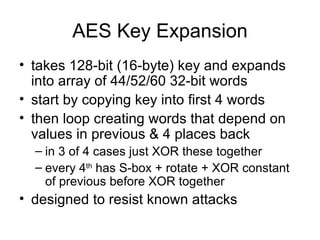
AES Key Expansion takes 128-bit (16-byte) key and expands into array of 44/52/60 32-bit words start by copying key into first 4 words then loop creating words that depend on values in previous & 4 places back in 3 of 4 cases just XOR these together every 4 th  has S-box + rotate + XOR constant of previous before XOR together designed to resist known attacks
AES Decryption AES decryption is not identical to encryption since steps done in reverse but can define an equivalent inverse cipher with steps as for encryption but using inverses of each step with a different key schedule works since result is unchanged when swap byte substitution & shift rows swap mix columns & add (tweaked) round key
Implementation Aspects can efficiently implement on 8-bit CPU byte substitution works on bytes using a table of 256 entries shift rows is simple byte shifting add round key works on byte XORs mix columns requires matrix multiply in  GF(2 8 ) which works on byte values, can be simplified to use a table lookup
Implementation Aspects can efficiently implement on 32-bit CPU redefine steps to use 32-bit words can precompute 4 tables of 256-words then each column in each round can be computed using 4 table lookups + 4 XORs at a cost of 16Kb to store tables designers believe this very efficient implementation was a key factor in its selection as the AES cipher
Summary have considered: the AES selection process the details of Rijndael – the AES cipher looked at the steps in each round the key expansion implementation aspects

Ch05

  • 1.
    Cryptography and NetworkSecurity Third Edition by William Stallings Lecture slides by Lawrie Brown
  • 2.
    Chapter 5 –Advanced Encryption Standard "It seems very simple." "It is very simple. But if you don't know what the key is it's virtually indecipherable." — Talking to Strange Men, Ruth Rendell
  • 3.
    Origins clear areplacement for DES was needed have theoretical attacks that can break it have demonstrated exhaustive key search attacks can use Triple-DES – but slow with small blocks US NIST issued call for ciphers in 1997 15 candidates accepted in Jun 98 5 were shortlisted in Aug-99 Rijndael was selected as the AES in Oct-2000 issued as FIPS PUB 197 standard in Nov-2001
  • 4.
    AES Requirements privatekey symmetric block cipher 128-bit data, 128/192/256-bit keys stronger & faster than Triple-DES active life of 20-30 years (+ archival use) provide full specification & design details both C & Java implementations NIST have released all submissions & unclassified analyses
  • 5.
    AES Evaluation Criteriainitial criteria: security – effort to practically cryptanalyse cost – computational algorithm & implementation characteristics final criteria general security software & hardware implementation ease implementation attacks flexibility (in en/decrypt, keying, other factors)
  • 6.
    AES Shortlist aftertesting and evaluation, shortlist in Aug-99: MARS (IBM) - complex, fast, high security margin RC6 (USA) - v. simple, v. fast, low security margin Rijndael (Belgium) - clean, fast, good security margin Serpent (Euro) - slow, clean, v. high security margin Twofish (USA) - complex, v. fast, high security margin then subject to further analysis & comment saw contrast between algorithms with few complex rounds verses many simple rounds which refined existing ciphers verses new proposals
  • 7.
    The AES Cipher- Rijndael designed by Rijmen-Daemen in Belgium has 128/192/256 bit keys, 128 bit data an iterative rather than feistel cipher treats data in 4 groups of 4 bytes operates an entire block in every round designed to be: resistant against known attacks speed and code compactness on many CPUs design simplicity
  • 8.
    Rijndael processes dataas 4 groups of 4 bytes (state) has 9/11/13 rounds in which state undergoes: byte substitution (1 S-box used on every byte) shift rows (permute bytes between groups/columns) mix columns (subs using matrix multipy of groups) add round key (XOR state with key material) initial XOR key material & incomplete last round all operations can be combined into XOR and table lookups - hence very fast & efficient
  • 9.
  • 10.
    Byte Substitution asimple substitution of each byte uses one table of 16x16 bytes containing a permutation of all 256 8-bit values each byte of state is replaced by byte in row (left 4-bits) & column (right 4-bits) eg. byte {95} is replaced by row 9 col 5 byte which is the value {2A} S-box is constructed using a defined transformation of the values in GF(2 8 ) designed to be resistant to all known attacks
  • 11.
    Shift Rows acircular byte shift in each each 1 st row is unchanged 2 nd row does 1 byte circular shift to left 3rd row does 2 byte circular shift to left 4th row does 3 byte circular shift to left decrypt does shifts to right since state is processed by columns, this step permutes bytes between the columns
  • 12.
    Mix Columns eachcolumn is processed separately each byte is replaced by a value dependent on all 4 bytes in the column effectively a matrix multiplication in GF(2 8 ) using prime poly m(x) =x 8 +x 4 +x 3 +x+1
  • 13.
    Add Round KeyXOR state with 128-bits of the round key again processed by column (though effectively a series of byte operations) inverse for decryption is identical since XOR is own inverse, just with correct round key designed to be as simple as possible
  • 14.
  • 15.
    AES Key Expansiontakes 128-bit (16-byte) key and expands into array of 44/52/60 32-bit words start by copying key into first 4 words then loop creating words that depend on values in previous & 4 places back in 3 of 4 cases just XOR these together every 4 th has S-box + rotate + XOR constant of previous before XOR together designed to resist known attacks
  • 16.
    AES Decryption AESdecryption is not identical to encryption since steps done in reverse but can define an equivalent inverse cipher with steps as for encryption but using inverses of each step with a different key schedule works since result is unchanged when swap byte substitution & shift rows swap mix columns & add (tweaked) round key
  • 17.
    Implementation Aspects canefficiently implement on 8-bit CPU byte substitution works on bytes using a table of 256 entries shift rows is simple byte shifting add round key works on byte XORs mix columns requires matrix multiply in GF(2 8 ) which works on byte values, can be simplified to use a table lookup
  • 18.
    Implementation Aspects canefficiently implement on 32-bit CPU redefine steps to use 32-bit words can precompute 4 tables of 256-words then each column in each round can be computed using 4 table lookups + 4 XORs at a cost of 16Kb to store tables designers believe this very efficient implementation was a key factor in its selection as the AES cipher
  • 19.
    Summary have considered:the AES selection process the details of Rijndael – the AES cipher looked at the steps in each round the key expansion implementation aspects