Our loyal companion
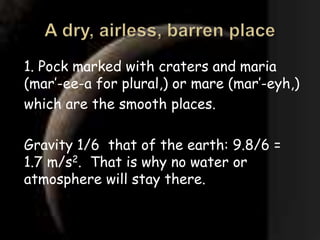
1. Pock marked with craters and maria 
(mar’-ee-a for plural,) or mare (mar’-eyh,) 
which are the smooth places. 
Gravity 1/6 that of the earth: 9.8/6 = 
1.7 m/s2. That is why no water or 
atmosphere will stay there.
We always see the same side of the 
moon because it rotates on its axis at 
the same rate it revolves around the 
earth. 
Try the dime/quarter experiment.
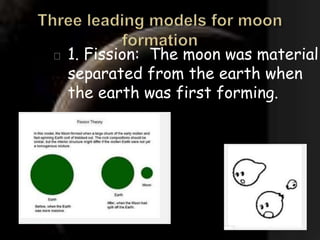
1. Fission: The moon was material 
separated from the earth when 
the earth was first forming.
2. Capture: The moon was formed 
in another part of the solar 
system and captured by the 
earth’s gravity.
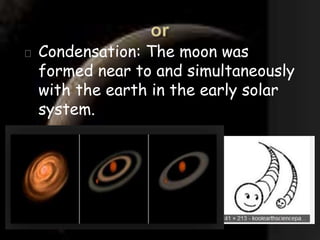
Condensation: The moon was 
formed near to and simultaneously 
with the earth in the early solar 
system.
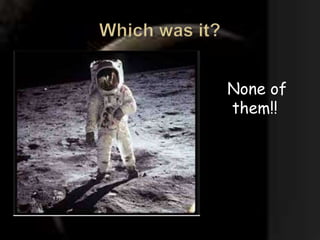
None of 
them!!
Mars size 
celestial object 
collided with the 
Earth. This is well 
tested with 
evidence. 
Rocks from the 
moon have 
been found on the 
Artic continent. They have the same 
composition as that of the earth.
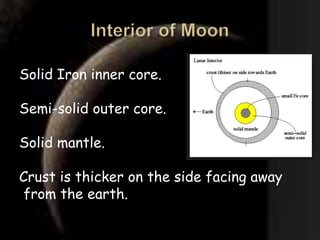
Solid Iron inner core. 
Semi-solid outer core. 
Solid mantle. 
Crust is thicker on the side facing away 
from the earth.
maria: singular is mare 
mascons: mass 
concentrations beneath the 
maria.
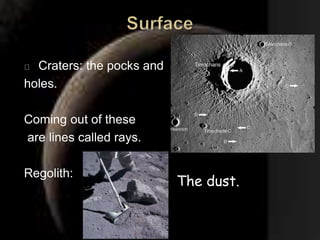
Craters: the pocks and 
holes. 
Coming out of these 
are lines called rays. 
Regolith: 
The dust.
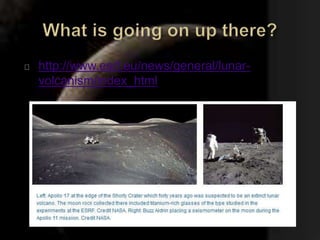
http://www.esrf.eu/news/general/lunar-volcanism/ 
index_html
..Astronomymoon facts.docx 
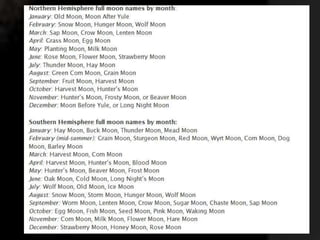
Full Moon 
Names:
https://animoto.com/play/cmNrGpZWG3Z5rlxml 
aTiYw
The Moon has quakes: 
These are caused by the gravitational pull of 
the Earth. Lunar astronauts used 
seismographs on their visits to the Moon, and 
found that small moonquakes occurred several 
kilometres beneath the surface, causing 
ruptures and cracks. Scientists think the Moon 
has a molten core, just like Earth.
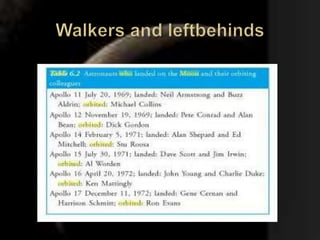
The Moon has only been walked on by 12 
people; all American males: 
The first man to set foot on the Moon in 1969 
was Neil Armstrong on the Apollo 11 mission, 
while the last man to walk on the Moon in 1972 
was Gene Cernan on the Apollo 17 mission. 
Since then the Moon has only be visited by 
unmanned vehicles.
The Moon is the fifth largest natural satellite 
in the Solar System: 
At 3,475 km in diameter, the Moon is much 
smaller than the major moons of Jupiter and 
Saturn. Earth is about 80 times the volume 
than the Moon, but both are about the same 
age. A prevailing theory is that the Moon was 
once part of the Earth, and was formed from a 
chunk that broke away due to a huge object 
colliding with Earth when it was relatively 
young.
The Moon will be visited by man in the near 
future: 
NASA plans to return astronauts to the moon to 
set up a permanent space station. Mankind 
may once again walk on the moon in 2019, if 
all goes according to plan.

Ch 7 -moon (2)

  • 1.
  • 2.
    1. Pock markedwith craters and maria (mar’-ee-a for plural,) or mare (mar’-eyh,) which are the smooth places. Gravity 1/6 that of the earth: 9.8/6 = 1.7 m/s2. That is why no water or atmosphere will stay there.
  • 3.
    We always seethe same side of the moon because it rotates on its axis at the same rate it revolves around the earth. Try the dime/quarter experiment.
  • 4.
    1. Fission: Themoon was material separated from the earth when the earth was first forming.
  • 5.
    2. Capture: Themoon was formed in another part of the solar system and captured by the earth’s gravity.
  • 6.
    Condensation: The moonwas formed near to and simultaneously with the earth in the early solar system.
  • 7.
  • 8.
    Mars size celestialobject collided with the Earth. This is well tested with evidence. Rocks from the moon have been found on the Artic continent. They have the same composition as that of the earth.
  • 9.
    Solid Iron innercore. Semi-solid outer core. Solid mantle. Crust is thicker on the side facing away from the earth.
  • 10.
    maria: singular ismare mascons: mass concentrations beneath the maria.
  • 11.
    Craters: the pocksand holes. Coming out of these are lines called rays. Regolith: The dust.
  • 12.
  • 13.
  • 16.
  • 17.
    The Moon hasquakes: These are caused by the gravitational pull of the Earth. Lunar astronauts used seismographs on their visits to the Moon, and found that small moonquakes occurred several kilometres beneath the surface, causing ruptures and cracks. Scientists think the Moon has a molten core, just like Earth.
  • 18.
    The Moon hasonly been walked on by 12 people; all American males: The first man to set foot on the Moon in 1969 was Neil Armstrong on the Apollo 11 mission, while the last man to walk on the Moon in 1972 was Gene Cernan on the Apollo 17 mission. Since then the Moon has only be visited by unmanned vehicles.
  • 19.
    The Moon isthe fifth largest natural satellite in the Solar System: At 3,475 km in diameter, the Moon is much smaller than the major moons of Jupiter and Saturn. Earth is about 80 times the volume than the Moon, but both are about the same age. A prevailing theory is that the Moon was once part of the Earth, and was formed from a chunk that broke away due to a huge object colliding with Earth when it was relatively young.
  • 20.
    The Moon willbe visited by man in the near future: NASA plans to return astronauts to the moon to set up a permanent space station. Mankind may once again walk on the moon in 2019, if all goes according to plan.