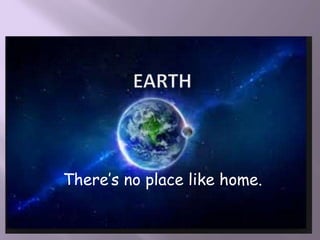
There’s no place like home.
Crust 
Core Mantle 
Lithosphere 
Lithosphere: Upper mantle and crust 
Core: Solid inner, liquid outer, hot, made of iron and nickel 
Mantle: lower is partially melted, upper is rigid 
Crust: Rigid with lots of silicates
Plate Tetonics: explains continental drift. These 
plates drift about 3 cm per year. 
Explains how mountain ranges form as one plate 
is shoved under another.
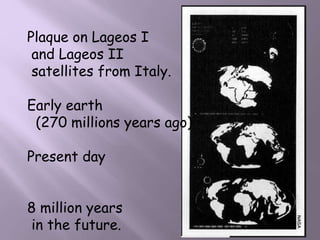
Plaque on Lageos I 
and Lageos II 
satellites from Italy. 
Early earth 
(270 millions years ago) 
Present day 
8 million years 
in the future.
Tides: Moon is mostly responsible. 
High tides and low tides depend on 
the distance away the moon is.
C B A 
Water at point A is pulled toward the moon. 
Earth at point C is pulled away from the water. 
So water collects at A and C (high tides) 
Water is depleted at B (low tides)
The envelope of gas surrounding the Earth is divided into four distinct layers 
by thermal characteristics (temperature changes), chemical composition, 
movement, and density. The troposphere starts at the Earth's surface and 
extends to about 15 kilometers (9 miles) high. The stratosphere starts just 
above the troposphere and extends to 50 kilometers (31 miles) high. The 
mesosphere starts just above the stratosphere and extends to 85 kilometers 
(53 miles) high. The thermosphere starts just above the mesosphere and 
extends to 600 kilometers (375 miles) high.
Troposphere: Closest to surface. About 
9 miles high; made mostly of Nitrogen, 
Oxygen, and Carbon Dioxide 
Stratosphere: Above Troposphere, about 
31 miles high; made of the Ozone layer 
Mesosphere: Just above stratosphere, 
about 53 miles high; Made of OH, Oxygen, 
and Nitrate. 
Thermosphere: Just above mesosphere, 
about 373 miles high. Made pretty much 
of Oxygen atoms.
A note about OZONE (O3) 
Ozone is an atomospheric filter. It 
protects us from harmful UV rays. 
Holes in the ozone are caused by 
sunlight interacting with pollutant 
gases. 
Antarctica hole has somewhat 
stabilized. But the Arctic is still a 
worry.
Arctic Circle 
Antarctica
Greenhouse effect: Not to be confused 
with the holes in the Ozone. 
The greenhouse effect is caused by 
CO2 trapping sunlight and causing a 
warming effect. 
But, global warming causes 
more storms which causes 
more water in the 
atmosphere which leads to 
more reactions 
that destroy the Ozone.
Van Allen Belts: 
Not a new 
fashion designer 
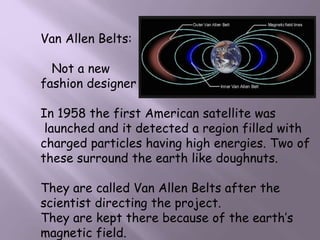
In 1958 the first American satellite was 
launched and it detected a region filled with 
charged particles having high energies. Two of 
these surround the earth like doughnuts. 
They are called Van Allen Belts after the 
scientist directing the project. 
They are kept there because of the earth’s 
magnetic field.
http://www.huffingtonpost.com/2014/04 
/15/iceland-northern-lights-w_ 
n_5146263.html 
http://vimeo.com/90707024 
Any planet with a magnetic field will have 
regions of charged particles.

Ch 7 -earth

  • 1.
  • 2.
    Crust Core Mantle Lithosphere Lithosphere: Upper mantle and crust Core: Solid inner, liquid outer, hot, made of iron and nickel Mantle: lower is partially melted, upper is rigid Crust: Rigid with lots of silicates
  • 3.
    Plate Tetonics: explainscontinental drift. These plates drift about 3 cm per year. Explains how mountain ranges form as one plate is shoved under another.
  • 4.
    Plaque on LageosI and Lageos II satellites from Italy. Early earth (270 millions years ago) Present day 8 million years in the future.
  • 5.
    Tides: Moon ismostly responsible. High tides and low tides depend on the distance away the moon is.
  • 6.
    C B A Water at point A is pulled toward the moon. Earth at point C is pulled away from the water. So water collects at A and C (high tides) Water is depleted at B (low tides)
  • 7.
    The envelope ofgas surrounding the Earth is divided into four distinct layers by thermal characteristics (temperature changes), chemical composition, movement, and density. The troposphere starts at the Earth's surface and extends to about 15 kilometers (9 miles) high. The stratosphere starts just above the troposphere and extends to 50 kilometers (31 miles) high. The mesosphere starts just above the stratosphere and extends to 85 kilometers (53 miles) high. The thermosphere starts just above the mesosphere and extends to 600 kilometers (375 miles) high.
  • 8.
    Troposphere: Closest tosurface. About 9 miles high; made mostly of Nitrogen, Oxygen, and Carbon Dioxide Stratosphere: Above Troposphere, about 31 miles high; made of the Ozone layer Mesosphere: Just above stratosphere, about 53 miles high; Made of OH, Oxygen, and Nitrate. Thermosphere: Just above mesosphere, about 373 miles high. Made pretty much of Oxygen atoms.
  • 9.
    A note aboutOZONE (O3) Ozone is an atomospheric filter. It protects us from harmful UV rays. Holes in the ozone are caused by sunlight interacting with pollutant gases. Antarctica hole has somewhat stabilized. But the Arctic is still a worry.
  • 10.
  • 11.
    Greenhouse effect: Notto be confused with the holes in the Ozone. The greenhouse effect is caused by CO2 trapping sunlight and causing a warming effect. But, global warming causes more storms which causes more water in the atmosphere which leads to more reactions that destroy the Ozone.
  • 12.
    Van Allen Belts: Not a new fashion designer In 1958 the first American satellite was launched and it detected a region filled with charged particles having high energies. Two of these surround the earth like doughnuts. They are called Van Allen Belts after the scientist directing the project. They are kept there because of the earth’s magnetic field.
  • 13.
    http://www.huffingtonpost.com/2014/04 /15/iceland-northern-lights-w_ n_5146263.html http://vimeo.com/90707024 Any planet with a magnetic field will have regions of charged particles.