The Moon, Our
Natural Satellite
By
Amita Vadlamudi
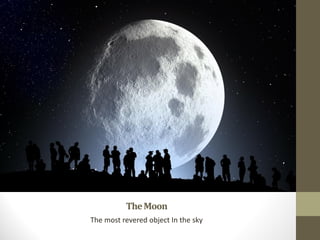
TheMoon
The most revered object In the sky
Introduction
• The Moon appears as a beautiful, ethereal object in the sky. In
reality, it is much like the earth with rocks and soil, its
brilliance caused by the reflecting sun.
• The word moon comes from the old Germanic language
meaning time and measure. In Latin, it is referred to as Luna.
Although many other moons orbiting other planets have been
discovered and given unique names, our moon remains to be
simply referred to as the Moon – with a capital letter.
Companion to the Earth
• The Moon orbits around the Earth and rotates around its axis
once in approximately 27 days. Changes in tides occur due to
its magnetic pull. It also causes the Earth’s precession,
moderating its axial tilt.
• The Moon located at a distance of 384,400 km from the Earth
is a bit more than one-fourth the size of Earth with a radius of
1,737.5 km.
Origins
• Leading giant-Impact theory suggests that the Moon’s
formation was a result of a collision between the Earth and
Theia—a planet that is roughly the size of Mars. Believed to
have formed 4.5 billion years ago, its timeline is much-
debated. Recently scientists discovered that the Moon might
be 100 million years older, formed just after 50 million years
of the Solar System.
Geology
• The Moon has a relatively smaller solid iron core, enclosed in a
partly melted iron shell. The mantle lies between the molten
layer and the crust. Its composition is similar to the Earth.
• The surface is rocky and cratered due to impacts. Its volcanoes
can be considered extinct. Another notable development has
been the discovery of traces of water on the lunar surface.
The Weather
• The atmosphere, an exosphere to be precise, is thin with no
air pressure and a weak magnetic field. Temperatures range
between -280F at nighttime and +260F at daytime.
• The Moon experiences same season all year long, having a tilt
of only 1.5 degrees.
Visitors to the Moon
• Humans had set their sights on Moon for a long time. The first
to enter the Moon space was an unmanned spacecraft
launched by the Soviet Union in 1959. The first unmanned
landing occurred in 1966. Six manned landings had occurred
between the years of 1969 and 1972 conducted by the United
States. The first person to walk on the Moon was the
American astronaut Neil Armstrong, part of a three man crew
that included Buzz Aldrin and Michael Collins.
About the Author
• After retiring from a 30 year career in Information Technology,
Amita Vadlamudi now pursues publishing interests.
Researching into and writing about various topics in
Astronomy and Geography is of particular interest to Amita
Vadlamudi.

The Moon, Our Natural Satellite

  • 1.
    The Moon, Our NaturalSatellite By Amita Vadlamudi
  • 2.
    TheMoon The most reveredobject In the sky
  • 3.
    Introduction • The Moonappears as a beautiful, ethereal object in the sky. In reality, it is much like the earth with rocks and soil, its brilliance caused by the reflecting sun. • The word moon comes from the old Germanic language meaning time and measure. In Latin, it is referred to as Luna. Although many other moons orbiting other planets have been discovered and given unique names, our moon remains to be simply referred to as the Moon – with a capital letter.
  • 4.
    Companion to theEarth • The Moon orbits around the Earth and rotates around its axis once in approximately 27 days. Changes in tides occur due to its magnetic pull. It also causes the Earth’s precession, moderating its axial tilt. • The Moon located at a distance of 384,400 km from the Earth is a bit more than one-fourth the size of Earth with a radius of 1,737.5 km.
  • 5.
    Origins • Leading giant-Impacttheory suggests that the Moon’s formation was a result of a collision between the Earth and Theia—a planet that is roughly the size of Mars. Believed to have formed 4.5 billion years ago, its timeline is much- debated. Recently scientists discovered that the Moon might be 100 million years older, formed just after 50 million years of the Solar System.
  • 6.
    Geology • The Moonhas a relatively smaller solid iron core, enclosed in a partly melted iron shell. The mantle lies between the molten layer and the crust. Its composition is similar to the Earth. • The surface is rocky and cratered due to impacts. Its volcanoes can be considered extinct. Another notable development has been the discovery of traces of water on the lunar surface.
  • 7.
    The Weather • Theatmosphere, an exosphere to be precise, is thin with no air pressure and a weak magnetic field. Temperatures range between -280F at nighttime and +260F at daytime. • The Moon experiences same season all year long, having a tilt of only 1.5 degrees.
  • 8.
    Visitors to theMoon • Humans had set their sights on Moon for a long time. The first to enter the Moon space was an unmanned spacecraft launched by the Soviet Union in 1959. The first unmanned landing occurred in 1966. Six manned landings had occurred between the years of 1969 and 1972 conducted by the United States. The first person to walk on the Moon was the American astronaut Neil Armstrong, part of a three man crew that included Buzz Aldrin and Michael Collins.
  • 9.
    About the Author •After retiring from a 30 year career in Information Technology, Amita Vadlamudi now pursues publishing interests. Researching into and writing about various topics in Astronomy and Geography is of particular interest to Amita Vadlamudi.