Putting personas to work
How to ensure they live beyond the initial
enthusiasm and interest
Bruce Darby
University Website Programme
University of Edinburgh, July 2014
Overview
1. What’s a persona?
2. Bringing personas to life: Activities, tips,
experiences
3. Why persona projects fail
Questions?
1. What’s a persona?
• Personas are essentially made-up people
– Reflecting key traits and attitudes
• They help personalise a large, diverse group
• They’re typically based on:
– Data generated by user research
– Knowledge of a customer base or user group
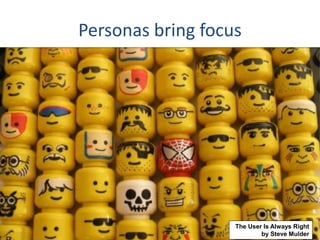
Personas bring focus
The User Is Always Right
by Steve Mulder
Personas build empathy
Personas encourage consensus
Personas bring efficiencies
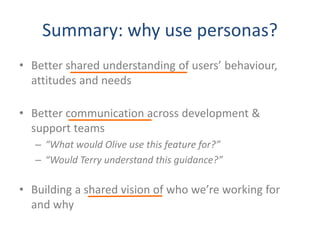
Summary: why use personas?
• Better shared understanding of users’ behaviour,
attitudes and needs
• Better communication across development &
support teams
– “What would Olive use this feature for?”
– “Would Terry understand this guidance?”
• Building a shared vision of who we’re working for
and why
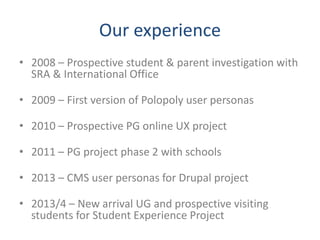
Our experience
• 2008 – Prospective student & parent investigation with
SRA & International Office
• 2009 – First version of Polopoly user personas
• 2010 – Prospective PG online UX project
• 2011 – PG project phase 2 with schools
• 2013 – CMS user personas for Drupal project
• 2013/4 – New arrival UG and prospective visiting
students for Student Experience Project
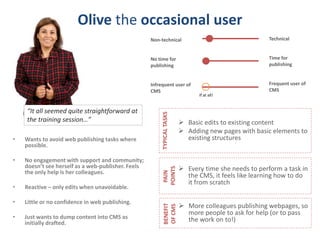
Olive the occasional user
• Wants to avoid web publishing tasks where
possible.
• No engagement with support and community;
doesn’t see herself as a web-publisher. Feels
the only help is her colleagues.
• Reactive – only edits when unavoidable.
• Little or no confidence in web publishing.
• Just wants to dump content into CMS as
initially drafted.
Technical
Time for
publishing
Frequent user of
CMS
Non-technical
No time for
publishing
Infrequent user of
CMS
“It all seemed quite straightforward at
the training session…”  Basic edits to existing content
 Adding new pages with basic elements to
existing structures
TYPICALTASKS
 Every time she needs to perform a task in
the CMS, it feels like learning how to do
it from scratch
PAIN
POINTS
 More colleagues publishing webpages, so
more people to ask for help (or to pass
the work on to!)
BENEFIT
OFCMS
If at all!
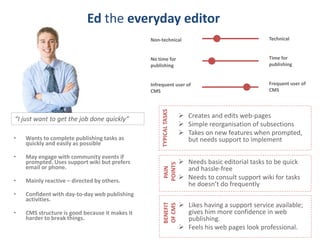
Ed the everyday editor
• Wants to complete publishing tasks as
quickly and easily as possible
• May engage with community events if
prompted. Uses support wiki but prefers
email or phone.
• Mainly reactive – directed by others.
• Confident with day-to-day web publishing
activities.
• CMS structure is good because it makes it
harder to break things.
Technical
Time for
publishing
Frequent user of
CMS
Non-technical
No time for
publishing
Infrequent user of
CMS
 Creates and edits web-pages
 Simple reorganisation of subsections
 Takes on new features when prompted,
but needs support to implement
TYPICALTASKS  Needs basic editorial tasks to be quick
and hassle-free
 Needs to consult support wiki for tasks
he doesn’t do frequently
PAIN
POINTS
 Likes having a support service available;
gives him more confidence in web
publishing.
 Feels his web pages look professional.
BENEFIT
OFCMS
“I just want to get the job done quickly”
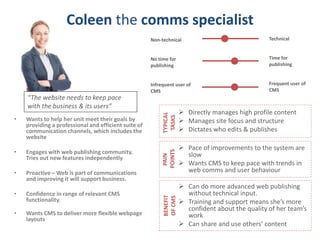
Coleen the comms specialist
• Wants to help her unit meet their goals by
providing a professional and efficient suite of
communication channels, which includes the
website
• Engages with web publishing community.
Tries out new features independently
• Proactive – Web is part of communications
and improving it will support business.
• Confidence in range of relevant CMS
functionality.
• Wants CMS to deliver more flexible webpage
layouts
Technical
Time for
publishing
Frequent user of
CMS
Non-technical
No time for
publishing
Infrequent user of
CMS
“The website needs to keep pace
with the business & its users”
 Directly manages high profile content
 Manages site focus and structure
 Dictates who edits & publishes
TYPICAL
TASKS
 Pace of improvements to the system are
slow
 Wants CMS to keep pace with trends in
web comms and user behaviour
PAIN
POINTS
 Can do more advanced web publishing
without technical input.
 Training and support means she’s more
confident about the quality of her team’s
work
 Can share and use others’ content
BENEFIT
OFCMS
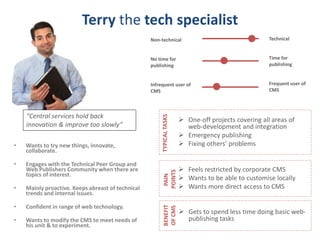
Terry the tech specialist
• Wants to try new things, innovate,
collaborate.
• Engages with the Technical Peer Group and
Web Publishers Community when there are
topics of interest.
• Mainly proactive. Keeps abreast of technical
trends and internal issues.
• Confident in range of web technology.
• Wants to modify the CMS to meet needs of
his unit & to experiment.
Technical
Time for
publishing
Frequent user of
CMS
Non-technical
No time for
publishing
Infrequent user of
CMS
“Central services hold back
innovation & improve too slowly”
 One-off projects covering all areas of
web-development and integration
 Emergency publishing
 Fixing others’ problems
TYPICALTASKS
 Feels restricted by corporate CMS
 Wants to be able to customise locally
 Wants more direct access to CMS
PAIN
POINTS
 Gets to spend less time doing basic web-
publishing tasks
BENEFIT
OFCMS
2. Bringing personas to life
Familiarisation exercises, Research,
Reporting, Planning & prioritising
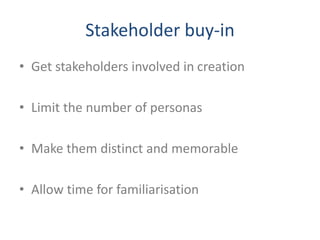
Stakeholder buy-in
• Get stakeholders involved in creation
• Limit the number of personas
• Make them distinct and memorable
• Allow time for familiarisation
Familiarisation exercises
• A way to think about and discuss the personas
How do we know we’re doing it properly?
When you find yourself saying:
– “I doubt Ed would ever want to do that”
And no one asks:
– “Who’s Ed?”
We’re probably getting there 
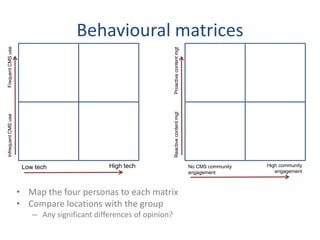
Behavioural matrices
Low tech High tech
InfrequentCMSuseFrequentCMSuse
No CMS community
engagement
High community
engagement
ReactivecontentmgtProactivecontentmgt
• Map the four personas to each matrix
• Compare locations with the group
– Any significant differences of opinion?
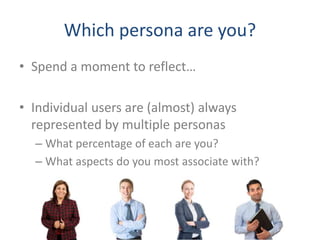
Which persona are you?
• Spend a moment to reflect…
• Individual users are (almost) always
represented by multiple personas
– What percentage of each are you?
– What aspects do you most associate with?
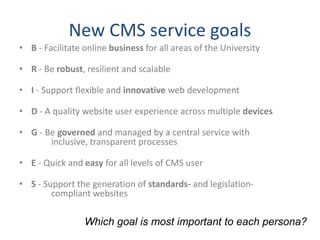
New CMS service goals
• B - Facilitate online business for all areas of the University
• R - Be robust, resilient and scalable
• I - Support flexible and innovative web development
• D - A quality website user experience across multiple devices
• G - Be governed and managed by a central service with
inclusive, transparent processes
• E - Quick and easy for all levels of CMS user
• S - Support the generation of standards- and legislation-
compliant websites
Which goal is most important to each persona?
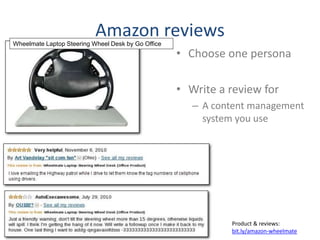
Amazon reviews
• Choose one persona
• Write a review for
– A content management
system you use
Wheelmate Laptop Steering Wheel Desk by Go Office
Product & reviews:
bit.ly/amazon-wheelmate
User testing
• Recruit participants to play role of personas
• Use persona to steer real user recruitment
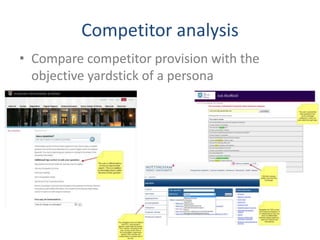
Competitor analysis
• Compare competitor provision with the
objective yardstick of a persona
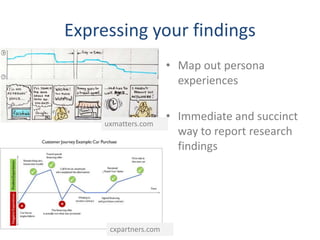
Expressing your findings
• Map out persona
experiences
• Immediate and succinct
way to report research
findings
cxpartners.com
uxmatters.com
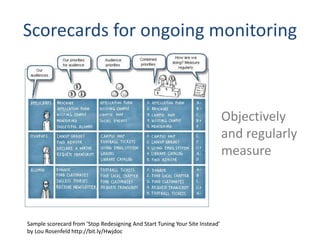
Scorecards for ongoing monitoring
Sample scorecard from ‘Stop Redesigning And Start Tuning Your Site Instead’
by Lou Rosenfeld http://bit.ly/Hwjdoc
Objectively
and regularly
measure
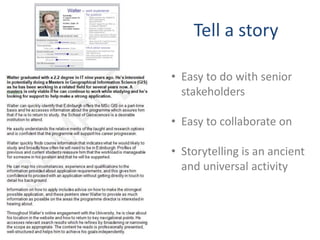
Tell a story
• Easy to do with senior
stakeholders
• Easy to collaborate on
• Storytelling is an ancient
and universal activity
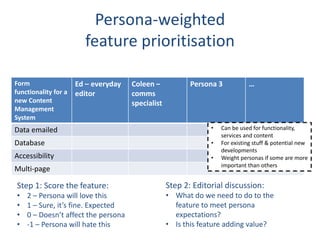
Persona-weighted
feature prioritisation
Form
functionality for a
new Content
Management
System
Ed – everyday
editor
Coleen –
comms
specialist
Persona 3 …
Data emailed
Database
Accessibility
Multi-page
Step 1: Score the feature:
• 2 – Persona will love this
• 1 – Sure, it’s fine. Expected
• 0 – Doesn’t affect the persona
• -1 – Persona will hate this
Step 2: Editorial discussion:
• What do we need to do to the
feature to meet persona
expectations?
• Is this feature adding value?
• Can be used for functionality,
services and content
• For existing stuff & potential new
developments
• Weight personas if some are more
important than others
The CMS…
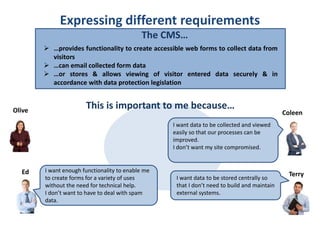
Expressing different requirements
 …provides functionality to create accessible web forms to collect data from
visitors
 …can email collected form data
 …or stores & allows viewing of visitor entered data securely & in
accordance with data protection legislation
I want data to be collected and viewed
easily so that our processes can be
improved.
I don’t want my site compromised.
I want enough functionality to enable me
to create forms for a variety of uses
without the need for technical help.
I don’t want to have to deal with spam
data.
Coleen
Ed TerryI want data to be stored centrally so
that I don’t need to build and maintain
external systems.
This is important to me because…Olive
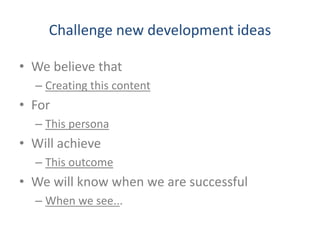
• We believe that
– Creating this content
• For
– This persona
• Will achieve
– This outcome
• We will know when we are successful
– When we see...
Challenge new development ideas
3. So why do personas fail?
• Stakeholders don’t understand
• Personas don’t feel real
• Personas get avoided or forgotten
“Essence of a Successful
Persona Project”
Jared Spool found the most important
aspects were:
– Internalizing the personas
– Creating rich scenarios
– Prioritizing the most important personas
– Involving all the stakeholders and influencers
bit.ly/uie-successful-personas
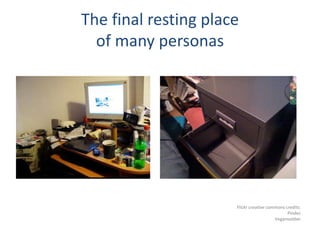
The final resting place
of many personas
Flickr creative commons credits:
Pindec
Vegansoldier
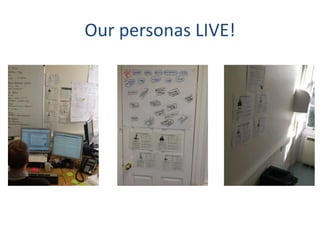
Our personas LIVE!
Want to learn more?
• Five factors for successful persona projects –
Jared Spool on UIE.com
– http://www.uie.com/articles/successful_persona_
projects
• Designing with scenarios: Putting personas to
work – Kim Goodwin
– http://www.uie.com/brainsparks/2011/06/24/kim
-goodwin-designing-with-scenarios-putting-
personas-to-work/
Thank you
Questions?

Making personas work

  • 1.
    Putting personas towork How to ensure they live beyond the initial enthusiasm and interest Bruce Darby University Website Programme University of Edinburgh, July 2014
  • 2.
    Overview 1. What’s apersona? 2. Bringing personas to life: Activities, tips, experiences 3. Why persona projects fail Questions?
  • 3.
    1. What’s apersona? • Personas are essentially made-up people – Reflecting key traits and attitudes • They help personalise a large, diverse group • They’re typically based on: – Data generated by user research – Knowledge of a customer base or user group
  • 4.
    Personas bring focus TheUser Is Always Right by Steve Mulder
  • 5.
  • 6.
  • 7.
  • 8.
    Summary: why usepersonas? • Better shared understanding of users’ behaviour, attitudes and needs • Better communication across development & support teams – “What would Olive use this feature for?” – “Would Terry understand this guidance?” • Building a shared vision of who we’re working for and why
  • 9.
    Our experience • 2008– Prospective student & parent investigation with SRA & International Office • 2009 – First version of Polopoly user personas • 2010 – Prospective PG online UX project • 2011 – PG project phase 2 with schools • 2013 – CMS user personas for Drupal project • 2013/4 – New arrival UG and prospective visiting students for Student Experience Project
  • 10.
    Olive the occasionaluser • Wants to avoid web publishing tasks where possible. • No engagement with support and community; doesn’t see herself as a web-publisher. Feels the only help is her colleagues. • Reactive – only edits when unavoidable. • Little or no confidence in web publishing. • Just wants to dump content into CMS as initially drafted. Technical Time for publishing Frequent user of CMS Non-technical No time for publishing Infrequent user of CMS “It all seemed quite straightforward at the training session…”  Basic edits to existing content  Adding new pages with basic elements to existing structures TYPICALTASKS  Every time she needs to perform a task in the CMS, it feels like learning how to do it from scratch PAIN POINTS  More colleagues publishing webpages, so more people to ask for help (or to pass the work on to!) BENEFIT OFCMS If at all!
  • 11.
    Ed the everydayeditor • Wants to complete publishing tasks as quickly and easily as possible • May engage with community events if prompted. Uses support wiki but prefers email or phone. • Mainly reactive – directed by others. • Confident with day-to-day web publishing activities. • CMS structure is good because it makes it harder to break things. Technical Time for publishing Frequent user of CMS Non-technical No time for publishing Infrequent user of CMS  Creates and edits web-pages  Simple reorganisation of subsections  Takes on new features when prompted, but needs support to implement TYPICALTASKS  Needs basic editorial tasks to be quick and hassle-free  Needs to consult support wiki for tasks he doesn’t do frequently PAIN POINTS  Likes having a support service available; gives him more confidence in web publishing.  Feels his web pages look professional. BENEFIT OFCMS “I just want to get the job done quickly”
  • 12.
    Coleen the commsspecialist • Wants to help her unit meet their goals by providing a professional and efficient suite of communication channels, which includes the website • Engages with web publishing community. Tries out new features independently • Proactive – Web is part of communications and improving it will support business. • Confidence in range of relevant CMS functionality. • Wants CMS to deliver more flexible webpage layouts Technical Time for publishing Frequent user of CMS Non-technical No time for publishing Infrequent user of CMS “The website needs to keep pace with the business & its users”  Directly manages high profile content  Manages site focus and structure  Dictates who edits & publishes TYPICAL TASKS  Pace of improvements to the system are slow  Wants CMS to keep pace with trends in web comms and user behaviour PAIN POINTS  Can do more advanced web publishing without technical input.  Training and support means she’s more confident about the quality of her team’s work  Can share and use others’ content BENEFIT OFCMS
  • 13.
    Terry the techspecialist • Wants to try new things, innovate, collaborate. • Engages with the Technical Peer Group and Web Publishers Community when there are topics of interest. • Mainly proactive. Keeps abreast of technical trends and internal issues. • Confident in range of web technology. • Wants to modify the CMS to meet needs of his unit & to experiment. Technical Time for publishing Frequent user of CMS Non-technical No time for publishing Infrequent user of CMS “Central services hold back innovation & improve too slowly”  One-off projects covering all areas of web-development and integration  Emergency publishing  Fixing others’ problems TYPICALTASKS  Feels restricted by corporate CMS  Wants to be able to customise locally  Wants more direct access to CMS PAIN POINTS  Gets to spend less time doing basic web- publishing tasks BENEFIT OFCMS
  • 14.
    2. Bringing personasto life Familiarisation exercises, Research, Reporting, Planning & prioritising
  • 15.
    Stakeholder buy-in • Getstakeholders involved in creation • Limit the number of personas • Make them distinct and memorable • Allow time for familiarisation
  • 16.
    Familiarisation exercises • Away to think about and discuss the personas
  • 17.
    How do weknow we’re doing it properly? When you find yourself saying: – “I doubt Ed would ever want to do that” And no one asks: – “Who’s Ed?” We’re probably getting there 
  • 18.
    Behavioural matrices Low techHigh tech InfrequentCMSuseFrequentCMSuse No CMS community engagement High community engagement ReactivecontentmgtProactivecontentmgt • Map the four personas to each matrix • Compare locations with the group – Any significant differences of opinion?
  • 19.
    Which persona areyou? • Spend a moment to reflect… • Individual users are (almost) always represented by multiple personas – What percentage of each are you? – What aspects do you most associate with?
  • 20.
    New CMS servicegoals • B - Facilitate online business for all areas of the University • R - Be robust, resilient and scalable • I - Support flexible and innovative web development • D - A quality website user experience across multiple devices • G - Be governed and managed by a central service with inclusive, transparent processes • E - Quick and easy for all levels of CMS user • S - Support the generation of standards- and legislation- compliant websites Which goal is most important to each persona?
  • 21.
    Amazon reviews • Chooseone persona • Write a review for – A content management system you use Wheelmate Laptop Steering Wheel Desk by Go Office Product & reviews: bit.ly/amazon-wheelmate
  • 22.
    User testing • Recruitparticipants to play role of personas • Use persona to steer real user recruitment
  • 23.
    Competitor analysis • Comparecompetitor provision with the objective yardstick of a persona
  • 24.
    Expressing your findings •Map out persona experiences • Immediate and succinct way to report research findings cxpartners.com uxmatters.com
  • 25.
    Scorecards for ongoingmonitoring Sample scorecard from ‘Stop Redesigning And Start Tuning Your Site Instead’ by Lou Rosenfeld http://bit.ly/Hwjdoc Objectively and regularly measure
  • 26.
    Tell a story •Easy to do with senior stakeholders • Easy to collaborate on • Storytelling is an ancient and universal activity
  • 27.
    Persona-weighted feature prioritisation Form functionality fora new Content Management System Ed – everyday editor Coleen – comms specialist Persona 3 … Data emailed Database Accessibility Multi-page Step 1: Score the feature: • 2 – Persona will love this • 1 – Sure, it’s fine. Expected • 0 – Doesn’t affect the persona • -1 – Persona will hate this Step 2: Editorial discussion: • What do we need to do to the feature to meet persona expectations? • Is this feature adding value? • Can be used for functionality, services and content • For existing stuff & potential new developments • Weight personas if some are more important than others
  • 28.
    The CMS… Expressing differentrequirements  …provides functionality to create accessible web forms to collect data from visitors  …can email collected form data  …or stores & allows viewing of visitor entered data securely & in accordance with data protection legislation I want data to be collected and viewed easily so that our processes can be improved. I don’t want my site compromised. I want enough functionality to enable me to create forms for a variety of uses without the need for technical help. I don’t want to have to deal with spam data. Coleen Ed TerryI want data to be stored centrally so that I don’t need to build and maintain external systems. This is important to me because…Olive
  • 29.
    • We believethat – Creating this content • For – This persona • Will achieve – This outcome • We will know when we are successful – When we see... Challenge new development ideas
  • 30.
    3. So whydo personas fail? • Stakeholders don’t understand • Personas don’t feel real • Personas get avoided or forgotten
  • 31.
    “Essence of aSuccessful Persona Project” Jared Spool found the most important aspects were: – Internalizing the personas – Creating rich scenarios – Prioritizing the most important personas – Involving all the stakeholders and influencers bit.ly/uie-successful-personas
  • 32.
    The final restingplace of many personas Flickr creative commons credits: Pindec Vegansoldier
  • 33.
  • 34.
    Want to learnmore? • Five factors for successful persona projects – Jared Spool on UIE.com – http://www.uie.com/articles/successful_persona_ projects • Designing with scenarios: Putting personas to work – Kim Goodwin – http://www.uie.com/brainsparks/2011/06/24/kim -goodwin-designing-with-scenarios-putting- personas-to-work/
  • 35.