Composition of
EARTH
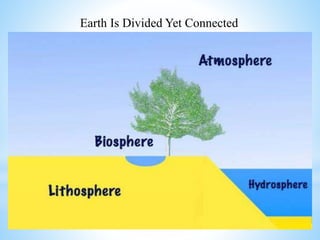
Earth Is Divided Yet Connected
*The Earth is divided into
4 “Sub-systems” or
“Spheres” namely:
 ATMOS(Gaseous)-
SPHERE.
HYDRO(Water)-
SPHERE
LITHOS(Rock)-SPHERE
BIOS(Life)-SPHERE
*They are interdependent
and function as a whole.
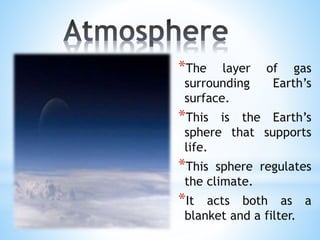
*The layer of gas
surrounding Earth’s
surface.
*This is the Earth’s
sphere that supports
life.
*This sphere regulates
the climate.
*It acts both as a
blanket and a filter.
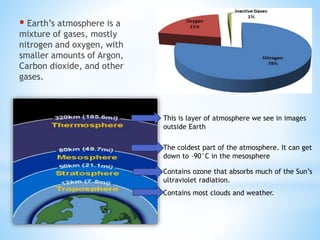
 Earth’s atmosphere is a
mixture of gases, mostly
nitrogen and oxygen, with
smaller amounts of Argon,
Carbon dioxide, and other
gases.
Contains most clouds and weather.
Contains ozone that absorbs much of the Sun’s
ultraviolet radiation.
The coldest part of the atmosphere. It can get
down to -90°C in the mesosphere
This is layer of atmosphere we see in images
outside Earth
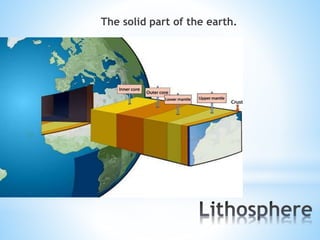
The solid part of the earth.
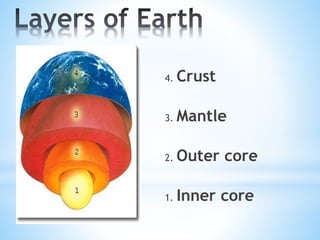
4. Crust
3. Mantle
2. Outer core
1. Inner core
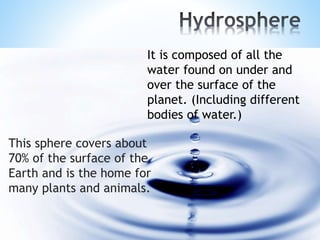
It is composed of all the
water found on under and
over the surface of the
planet. (Including different
bodies of water.)
This sphere covers about
70% of the surface of the
Earth and is the home for
many plants and animals.
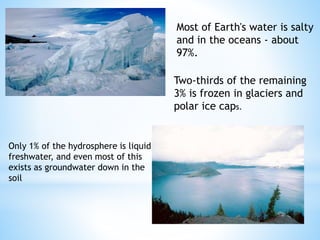
Most of Earth's water is salty
and in the oceans - about
97%.
Two-thirds of the remaining
3% is frozen in glaciers and
polar ice caps.
Only 1% of the hydrosphere is liquid
freshwater, and even most of this
exists as groundwater down in the
soil
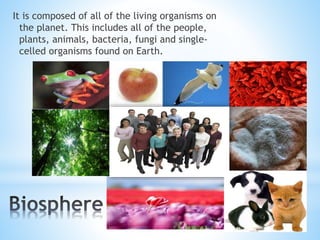
It is composed of all of the living organisms on
the planet. This includes all of the people,
plants, animals, bacteria, fungi and single-
celled organisms found on Earth.
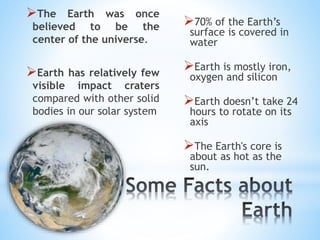
70% of the Earth’s
surface is covered in
water
Earth is mostly iron,
oxygen and silicon
Earth doesn’t take 24
hours to rotate on its
axis
The Earth's core is
about as hot as the
sun.
The Earth was once
believed to be the
center of the universe.
Earth has relatively few
visible impact craters
compared with other solid
bodies in our solar system
Earth presentation

Earth presentation

  • 1.
  • 2.
    Earth Is DividedYet Connected
  • 3.
    *The Earth isdivided into 4 “Sub-systems” or “Spheres” namely:  ATMOS(Gaseous)- SPHERE. HYDRO(Water)- SPHERE LITHOS(Rock)-SPHERE BIOS(Life)-SPHERE *They are interdependent and function as a whole.
  • 4.
    *The layer ofgas surrounding Earth’s surface. *This is the Earth’s sphere that supports life. *This sphere regulates the climate. *It acts both as a blanket and a filter.
  • 5.
     Earth’s atmosphereis a mixture of gases, mostly nitrogen and oxygen, with smaller amounts of Argon, Carbon dioxide, and other gases. Contains most clouds and weather. Contains ozone that absorbs much of the Sun’s ultraviolet radiation. The coldest part of the atmosphere. It can get down to -90°C in the mesosphere This is layer of atmosphere we see in images outside Earth
  • 6.
    The solid partof the earth.
  • 8.
    4. Crust 3. Mantle 2.Outer core 1. Inner core
  • 9.
    It is composedof all the water found on under and over the surface of the planet. (Including different bodies of water.) This sphere covers about 70% of the surface of the Earth and is the home for many plants and animals.
  • 10.
    Most of Earth'swater is salty and in the oceans - about 97%. Two-thirds of the remaining 3% is frozen in glaciers and polar ice caps. Only 1% of the hydrosphere is liquid freshwater, and even most of this exists as groundwater down in the soil
  • 11.
    It is composedof all of the living organisms on the planet. This includes all of the people, plants, animals, bacteria, fungi and single- celled organisms found on Earth.
  • 13.
    70% of theEarth’s surface is covered in water Earth is mostly iron, oxygen and silicon Earth doesn’t take 24 hours to rotate on its axis The Earth's core is about as hot as the sun. The Earth was once believed to be the center of the universe. Earth has relatively few visible impact craters compared with other solid bodies in our solar system