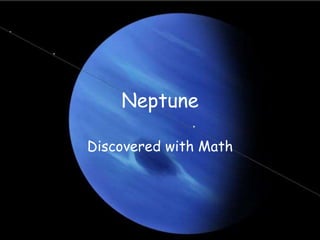
Neptune
Discovered with Math
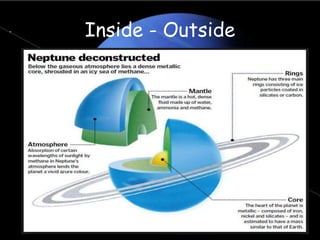
Inside - Outside
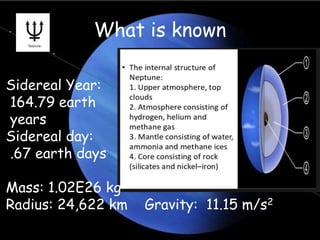
What is known
Sidereal Year:
164.79 earth
years
Sidereal day:
.67 earth days
Mass: 1.02E26 kg
Radius: 24,622 km Gravity: 11.15 m/s2
Reflectivity
• Appears blue for the same reasons
Uranus does.
• Methane atmosphere absorbs all the
red wavelengths and will reflect the
• blue – green wavelengths.
• However, it is more blue than Uranus so
• there is an unknown component.
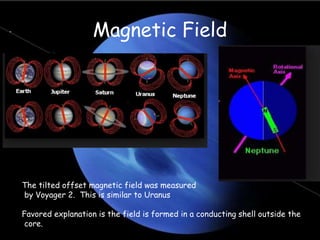
Magnetic Field
The tilted offset magnetic field was measured
by Voyager 2. This is similar to Uranus
Favored explanation is the field is formed in a conducting shell outside the
core.
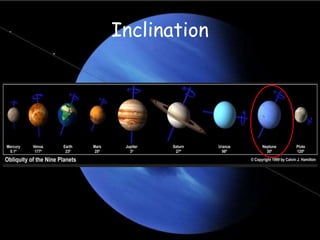
Inclination
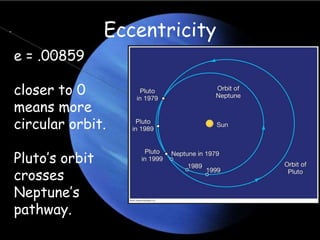
Eccentricity
e = .00859
closer to 0
means more
circular orbit.
Pluto’s orbit
crosses
Neptune’s
pathway.
Climate
• Neptune has a very active climate:
Large storms whirl through its upper
atmosphere, and high-speed winds track
around the planet at up 600 meters per
second. One of the largest storms
ever seen was recorded in 1989.
It was called the Great Dark
Spot. It lasted about five years.
Does it rain Diamonds?
• http://www.fromquarkstoquasars.com/is
-it-raining-diamonds-on-uranus-neptune/
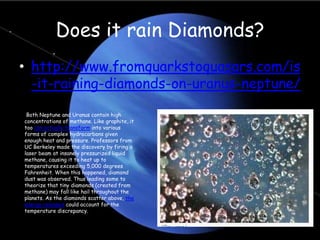
Both Neptune and Uranus contain high
concentrations of methane. Like graphite, it
too can actually transform into various
forms of complex hydrocarbons given
enough heat and pressure. Professors from
UC Berkeley made the discovery by firing a
laser beam at insanely pressurized liquid
methane, causing it to heat up to
temperatures exceeding 5,000 degrees
Fahrenheit. When this happened, diamond
dust was observed. Thus leading some to
theorize that tiny diamonds (created from
methane) may fall like hail throughout the
planets. As the diamonds scatter above, the
energy released could account for the
temperature discrepancy.
Rings
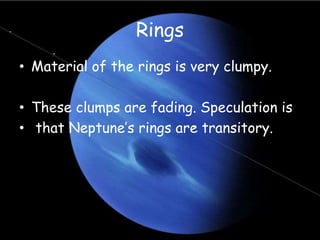
• Material of the rings is very clumpy.
• These clumps are fading. Speculation is
• that Neptune’s rings are transitory.
Rings
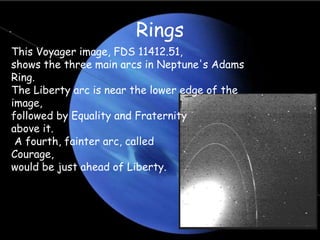
This Voyager image, FDS 11412.51,
shows the three main arcs in Neptune's Adams
Ring.
The Liberty arc is near the lower edge of the
image,
followed by Equality and Fraternity
above it.
A fourth, fainter arc, called
Courage,
would be just ahead of Liberty.
Names of
Rings
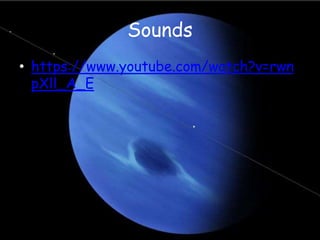
Sounds
• https://www.youtube.com/watch?v=rwn
pXll_A_E
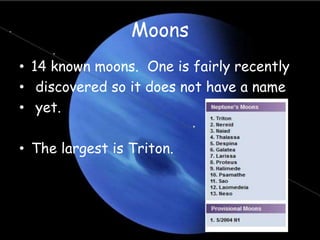
Moons
• 14 known moons. One is fairly recently
• discovered so it does not have a name
• yet.
• The largest is Triton.
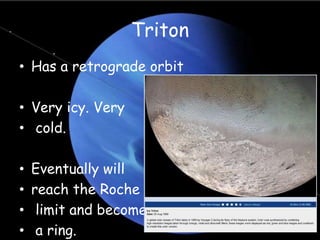
Triton
• Has a retrograde orbit
• Very icy. Very
• cold.
• Eventually will
• reach the Roche
• limit and become
• a ring.
Roche Limit
• Minimum distance an orbiting body can
• exist. Closer in and the body is ripped
to pieces by tidal forces on it.
• This is Triton’s destiny because it’s
orbit is getting smaller. It will be
billions of years before it happens.
How do they get those
pictures?
• http://solarsystem.nasa.gov/multimedia
/video-view.cfm?Vid_ID=4363
• This will be a short answer to how
• do they get a montage?

Ch 14 -neptune

  • 1.
  • 2.
  • 3.
    What is known SiderealYear: 164.79 earth years Sidereal day: .67 earth days Mass: 1.02E26 kg Radius: 24,622 km Gravity: 11.15 m/s2
  • 4.
    Reflectivity • Appears bluefor the same reasons Uranus does. • Methane atmosphere absorbs all the red wavelengths and will reflect the • blue – green wavelengths. • However, it is more blue than Uranus so • there is an unknown component.
  • 5.
    Magnetic Field The tiltedoffset magnetic field was measured by Voyager 2. This is similar to Uranus Favored explanation is the field is formed in a conducting shell outside the core.
  • 6.
  • 7.
    Eccentricity e = .00859 closerto 0 means more circular orbit. Pluto’s orbit crosses Neptune’s pathway.
  • 8.
    Climate • Neptune hasa very active climate: Large storms whirl through its upper atmosphere, and high-speed winds track around the planet at up 600 meters per second. One of the largest storms ever seen was recorded in 1989. It was called the Great Dark Spot. It lasted about five years.
  • 9.
    Does it rainDiamonds? • http://www.fromquarkstoquasars.com/is -it-raining-diamonds-on-uranus-neptune/ Both Neptune and Uranus contain high concentrations of methane. Like graphite, it too can actually transform into various forms of complex hydrocarbons given enough heat and pressure. Professors from UC Berkeley made the discovery by firing a laser beam at insanely pressurized liquid methane, causing it to heat up to temperatures exceeding 5,000 degrees Fahrenheit. When this happened, diamond dust was observed. Thus leading some to theorize that tiny diamonds (created from methane) may fall like hail throughout the planets. As the diamonds scatter above, the energy released could account for the temperature discrepancy.
  • 10.
    Rings • Material ofthe rings is very clumpy. • These clumps are fading. Speculation is • that Neptune’s rings are transitory.
  • 11.
    Rings This Voyager image,FDS 11412.51, shows the three main arcs in Neptune's Adams Ring. The Liberty arc is near the lower edge of the image, followed by Equality and Fraternity above it. A fourth, fainter arc, called Courage, would be just ahead of Liberty.
  • 12.
  • 13.
  • 14.
    Moons • 14 knownmoons. One is fairly recently • discovered so it does not have a name • yet. • The largest is Triton.
  • 15.
    Triton • Has aretrograde orbit • Very icy. Very • cold. • Eventually will • reach the Roche • limit and become • a ring.
  • 16.
    Roche Limit • Minimumdistance an orbiting body can • exist. Closer in and the body is ripped to pieces by tidal forces on it. • This is Triton’s destiny because it’s orbit is getting smaller. It will be billions of years before it happens.
  • 17.
    How do theyget those pictures? • http://solarsystem.nasa.gov/multimedia /video-view.cfm?Vid_ID=4363 • This will be a short answer to how • do they get a montage?