Matter
Matter can be invisible. Air is matter, but it cannot be seen. Matter appears to be continuous and unbroken. Matter is actually discontinuous.  It is made  up of tiny particles call  atoms.   Matter is anything that has mass and occupies space.
1.3 An apparently empty test tube is submerged, mouth downward in water.  Only a small volume of water rises into the tube, which is actually filled with invisible matter –air.
Physical States of Matter
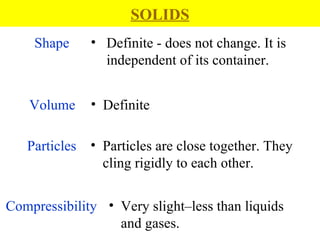
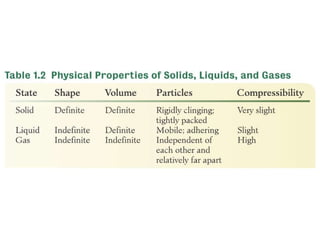
Shape Definite - does not change. It is  independent of its container. Volume Definite Particles Particles are close together. They cling rigidly to each other. SOLIDS Compressibility Very slight–less than liquids and gases.
A solid can be either  crystalline  or  amorphous . Which one it is depends on the internal arrangement of the particles that constitute the solid. Solid Amorphous Solid Crystalline Solid Particles lack a regular internal arrangement Particles exist in regular, repeating three-dimensional geometric patterns . Glass, plastics, gels Diamond, metals, salts
Shape Not definite - assumes the shape of its container. Volume Definite Particles Particles are close together. Particles are held together by strong attractive forces.  They stick firmly but not rigidly to each other. They can move freely throughout the volume of the liquid. LIQUIDS Compressibility Very slight–greater than solids, less than gases.
GASES Shape No fixed shape. Volume Indefinite. Particles Particles are far apart compared to liquids and solids. Particles move independently of each other.
GASES Compressibility The actual volume of the gas particles is small compared to the volume of space occupied by the gas. Because of this a gas can be compressed into a very small volume or expanded almost indefinitely.
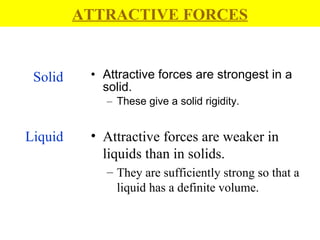
Attractive forces are strongest in a solid. These give a solid rigidity. ATTRACTIVE FORCES Solid Liquid Attractive forces are weaker in liquids than in solids. They are sufficiently strong so that a liquid has a definite volume.
ATTRACTIVE FORCES Gas Attractive forces in a gas are extremely weak. Particles in the gaseous state have enough energy to overcome the weak attractive forces that hold them together in liquids or solids. Because of this the gas particles move almost independently of each other.
 
 
Classifying Matter
Matter refers to all of the materials that make up the universe.
Substance A particular kind of matter that has a fixed composition and distinct properties.  Examples ammonia, water, and oxygen.
Homogeneous Matter Matter that is uniform in appearance and with uniform properties throughout. Examples ice, soda,  pure gold
Heterogeneous Matter Matter with two or more physically distinct phases present. Examples ice and water, wood, blood
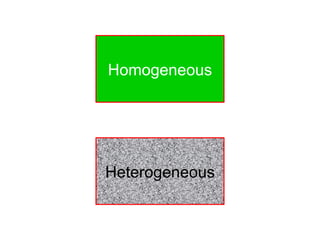
Homogeneous Heterogeneous
Phase A homogenous part of a system separated from other parts by physical boundaries. Examples In an ice water mixture, ice is the solid phase and water is the liquid phase.
Mixture Matter containing 2 or more substances that are present in variable amounts. Mixtures are variable in composition.  They can be homogeneous or heterogeneous.
Homogeneous Mixture (Solution) A homogeneous mixture of 2 or more substances. It has one phase. Example Sugar and water.  Before the sugar and water are mixed, each is a separate phase.  After mixing the sugar is evenly dispersed throughout the volume of the water.
Example Sugar and fine white sand. The amount of sugar relative to sand can be varied.  The sugar and sand each retain their own properties.  Heterogeneous Mixture A heterogeneous  mixture consists of 2 or more phases.
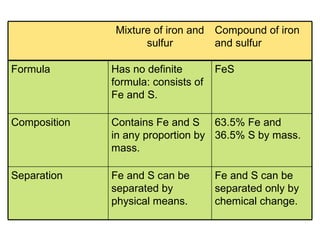
Example Iron (II) sulfide (FeS) is 63.5% Fe and 36.5% S by mass. Mixing iron and sulfur in these proportions does not form iron (II) sulfide. Two phases are present: a sulfur phase and an iron phase.  If the mixture is heated strongly a chemical reaction occurs and iron (II) sulfide is formed. FeS is a compound of iron and sulfur and has none of the properties of iron or sulfur. Heterogeneous Mixture A heterogeneous  mixture consists of 2 or more phases.
liquid phase Heterogeneous Mixture solid phase 2 solid phase 1
Mixture of iron and sulfur Compound of iron and sulfur Formula Has no definite formula: consists of Fe and S. FeS Composition Contains Fe and S in any proportion by mass. 63.5% Fe and 36.5% S by mass. Separation Fe and S can be separated by physical means. Fe and S can be separated only by chemical change.
Heterogeneous Mixture  of One Substance A pure substance can exist as different phases in a heterogeneous system.  Example Ice floating in water consists of two phases and one substance.  Ice is one phase, and water is the other phase.  The substance in both cases is the same.
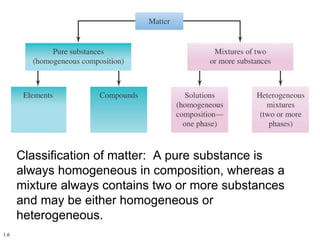
1.6 Classification of matter:  A pure substance is always homogeneous in composition, whereas a mixture always contains two or more substances and may be either homogeneous or  heterogeneous.
Elements
An element is a fundamental or elementary substance that cannot be broken down into simpler substances by chemical means.
All known substances on Earth and probably the universe are formed by combinations of more than 100 elements. Each element has a number. Beginning with hydrogen as 1, the elements are numbered in order of increasing complexity.
Most substances can be decomposed into two or more simpler substances. Water can be decomposed into hydrogen and oxygen. Table salt can be decomposed into sodium and chlorine. An element cannot be decomposed into a simpler substance.
ATOM The smallest particle of an element that can exist. The smallest unit of an element that can enter into a chemical reaction.
Compounds
A compound is a distinct substance that contains two or more elements combined in a definite proportion by weight.
Compounds can be decomposed chemically into simpler substances –that is, into simpler  compounds or elements. Elements cannot be decomposed into simpler substances. Atoms of the elements that constitute a compound are always present in simple whole number ratios.  They are never present as fractional parts.
There are two types of compounds:  molecular  and  ionic .
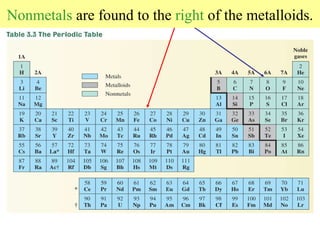
Metals, Nonmetals  and Metalloids
Metals
Most elements  are metals Metals are solid at room temperature. Mercury is an exception.  At room temperature it is a liquid. Metals have high luster (they are shiny). Metals are good conductors of heat and electricity. Metals are malleable (they can be rolled or hammered into sheets). physical properties of metals
Most elements  are metals Metals are ductile (they can be drawn into wires). Most metals have a high melting point. Metals have high densities
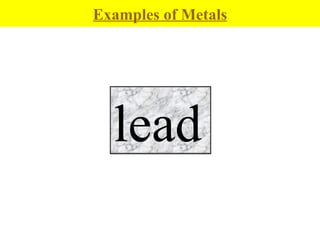
Examples of Metals gold iron lead
Many metals readily combine with nonmetals to form ionic compounds.  They can combine with  sulfur. Metals have little tendency to combine with each other to form compounds. chlorine. In nature, minerals are formed by combinations of the more reactive metals with other elements. Chemical Properties of Metals oxygen.
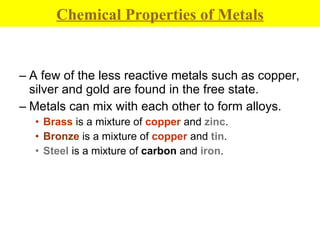
A few of the less reactive metals such as copper, silver and gold are found in the free state. Metals can mix with each other to form alloys. Brass  is a mixture of  copper  and  zinc . Bronze  is a mixture of  copper  and  tin . Steel  is a mixture of  carbon  and  iron . Chemical Properties of Metals
Nonmetals
Have relatively low melting points Have low densities.  Poor conductors of heat and electricity At room temperature, carbon, phosphorous, sulfur, selenium, and iodine are solids.  Physical Properties of Nonmetals Lack luster (they are dull)
Solid Physical State at Room Temperature sulfur selenium phosphorous carbon iodine
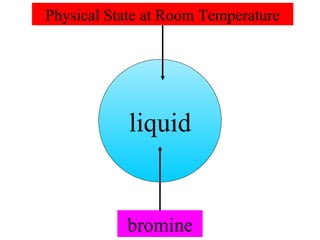
liquid Physical State at Room Temperature bromine
gas Physical State at Room Temperature helium, neon, argon, krypton, xenon, radon nitrogen, oxygen fluorine, chlorine
Metalloids
Metalloids have properties that are intermediate between metals and nonmetals
The  Metalloids boron silicon germanium arsenic antimony  tellurium polonium
Metals  are found to the  left  of the metalloids Nonmetals  are found to the  right  of the metalloids.
Properties of Substances
A property is a characteristic of a substance. Each substance has a set of properties that are characteristic of that substance and give it a unique identity. Properties of a Substance
Physical Properties
The inherent characteristics of a substance that are determined without changing its composition. Examples: taste color physical state melting point boiling point
2.4 times heavier than air color is yellowish-green odor is disagreeable melting point  –101 o C boiling point  –34.6 o C Physical Properties of Chlorine
Chemical Properties
Describe the ability of a substance to form new substances, either by reaction with other substances or by decomposition.
It will not burn in oxygen. It will support the combustion of certain other substances.  It can be used as a bleaching agent. It can be used as a water disinfectant. It can combine with sodium to form sodium chloride. Chemical Properties of Chlorine
 
Physical Changes
Changes in physical properties (such as size, shape, and density) or changes in the state of matter without an accompanying change in composition. Examples: tearing of paper change of ice into water change of water into steam heating platinum wire Physical Changes No new substances are formed.
Chemical Changes
In a chemical change new substances are formed that have different properties and composition from the original material.
Heating a copper wire in a Bunsen burner causes the copper to lose its original appearance and become a black material. Formation of Copper(II) Oxide Heating a copper wire in a Bunsen burner causes the copper to lose its original appearance and become a black material. The black material is a new substance called copper(II) oxide. Copper is 100% copper by mass. Copper (II) oxide is: 79.94% copper by mass 20.1% oxygen by mass. The formation of copper(II) oxide from copper and oxygen is a chemical change.  The copper (II) oxide is a new substance with properties that are different from copper.
Formation of Copper(II) Oxide Copper(II) oxide is made up of Cu 2+  and O 2- 4.2 Neither Cu nor O 2  contains Cu 2+  or O 2- A chemical change has occurred.
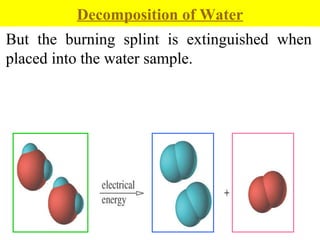
Water is decomposed into hydrogen and oxygen by passing electricity through it. Decomposition of Water The composition and physical appearance of hydrogen and oxygen are different from water. The hydrogen explodes with a pop upon the addition of a burning splint. The oxygen causes the flame of a burning splint to intensify. They are both colorless gases. But the burning splint is extinguished when placed into the water sample.
Chemical Equations
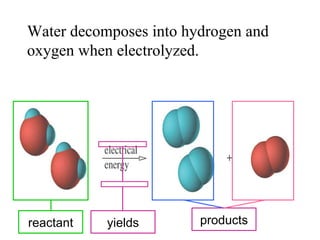
Water decomposes into hydrogen and oxygen when electrolyzed. reactant products yields
Chemical symbols can be used to express chemical reactions
Water decomposes into hydrogen and oxygen when electrolyzed. reactant yields 2H 2 O 2H 2 O 2 products
Copper plus oxygen yields copper(II) oxide. yield product reactants heat
Copper plus oxygen yields copper(II) oxide. heat yield product reactants 2Cu O 2 2Cu 2 O
 
Conservation of Mass
No change is observed in the total mass of the substances involved in a chemical change.
sodium + sulfur   sodium sulfide 78.1 g 78.1 g product mass products 78.1 g reactant -> 46.0 g 32.1 g mass reactants =
Energy
Energy is the capacity to do work
Types of Energy mechanical chemical electrical heat nuclear radiant
Potential Energy Energy that an object possesses due to its relative position.
The potential energy of the ball increases  with increasing height. increasing potential energy 50 ft 20 ft increasing potential energy
Potential Energy Stored energy
The heat released when gasoline burns is associated with a decrease in its chemical potential energy. The new substances formed by burning have less chemical potential energy than the gasoline and oxygen. Gasoline is a source of chemical potential energy.
Kinetic Energy Energy matter possesses due to its motion.
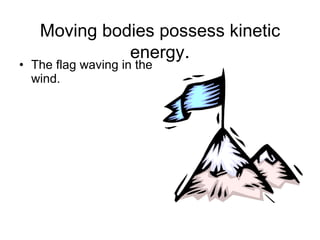
Moving bodies possess kinetic energy . The flag waving in the wind.
Moving bodies possess kinetic energy. A bouncing ball. The running man.
The runner Moving bodies possess kinetic energy.
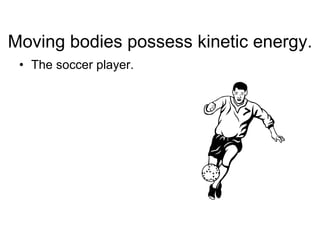
The soccer player. Moving bodies possess kinetic energy.
Heat
Heat A form of energy associated with small particles of matter. Temperature A measure of the intensity of heat, or of how hot or cold a system is.
Units of Heat Energy
The SI unit for heat energy is the joule (pronounced  “jool”). Another unit is the calorie. This amount of heat energy will raise the temperature of 1 gram of water 1 o C. 4.184 J = 1 cal (exactly)  4.184 Joules = 1 calorie
An Example of the Difference Between Heat and Temperature A form of energy associated with small particles of matter. A measure of the intensity of heat, or of how hot or cold a system is.
Twice as much heat energy is required to raise the temperature of 200 g of water 10 o C as compared to 100 g of water. 200 g water 20 o C A 100 g water 20 o C B heat beakers temperature rises 10 o C 100 g water 30 o C 200 g water 30 o C 4184 J 8368 J
Conservation of Energy
An energy transformation occurs whenever a chemical change occurs. If energy is absorbed during a chemical change, the products will have more chemical potential energy than the reactants. If energy is given off in a chemical change, the products will have less chemical potential energy than the reactants.
4.3 H 2  + O 2  have higher  potential energy than H 2 O Electrolysis of Water Burning of  Hydrogen  in Air  energy is given off energy is absorbed higher potential energy lower potential energy
Law of Conservation of Energy Energy can be neither created nor destroyed, though it can be transformed from one form of energy to another form of energy.

Matter

  • 1.
  • 2.
    Matter can beinvisible. Air is matter, but it cannot be seen. Matter appears to be continuous and unbroken. Matter is actually discontinuous. It is made up of tiny particles call atoms. Matter is anything that has mass and occupies space.
  • 3.
    1.3 An apparentlyempty test tube is submerged, mouth downward in water. Only a small volume of water rises into the tube, which is actually filled with invisible matter –air.
  • 4.
  • 5.
    Shape Definite -does not change. It is independent of its container. Volume Definite Particles Particles are close together. They cling rigidly to each other. SOLIDS Compressibility Very slight–less than liquids and gases.
  • 6.
    A solid canbe either crystalline or amorphous . Which one it is depends on the internal arrangement of the particles that constitute the solid. Solid Amorphous Solid Crystalline Solid Particles lack a regular internal arrangement Particles exist in regular, repeating three-dimensional geometric patterns . Glass, plastics, gels Diamond, metals, salts
  • 7.
    Shape Not definite- assumes the shape of its container. Volume Definite Particles Particles are close together. Particles are held together by strong attractive forces. They stick firmly but not rigidly to each other. They can move freely throughout the volume of the liquid. LIQUIDS Compressibility Very slight–greater than solids, less than gases.
  • 8.
    GASES Shape Nofixed shape. Volume Indefinite. Particles Particles are far apart compared to liquids and solids. Particles move independently of each other.
  • 9.
    GASES Compressibility Theactual volume of the gas particles is small compared to the volume of space occupied by the gas. Because of this a gas can be compressed into a very small volume or expanded almost indefinitely.
  • 10.
    Attractive forces arestrongest in a solid. These give a solid rigidity. ATTRACTIVE FORCES Solid Liquid Attractive forces are weaker in liquids than in solids. They are sufficiently strong so that a liquid has a definite volume.
  • 11.
    ATTRACTIVE FORCES GasAttractive forces in a gas are extremely weak. Particles in the gaseous state have enough energy to overcome the weak attractive forces that hold them together in liquids or solids. Because of this the gas particles move almost independently of each other.
  • 12.
  • 13.
  • 14.
  • 15.
    Matter refers toall of the materials that make up the universe.
  • 16.
    Substance A particularkind of matter that has a fixed composition and distinct properties. Examples ammonia, water, and oxygen.
  • 17.
    Homogeneous Matter Matterthat is uniform in appearance and with uniform properties throughout. Examples ice, soda, pure gold
  • 18.
    Heterogeneous Matter Matterwith two or more physically distinct phases present. Examples ice and water, wood, blood
  • 19.
  • 20.
    Phase A homogenouspart of a system separated from other parts by physical boundaries. Examples In an ice water mixture, ice is the solid phase and water is the liquid phase.
  • 21.
    Mixture Matter containing2 or more substances that are present in variable amounts. Mixtures are variable in composition. They can be homogeneous or heterogeneous.
  • 22.
    Homogeneous Mixture (Solution)A homogeneous mixture of 2 or more substances. It has one phase. Example Sugar and water. Before the sugar and water are mixed, each is a separate phase. After mixing the sugar is evenly dispersed throughout the volume of the water.
  • 23.
    Example Sugar andfine white sand. The amount of sugar relative to sand can be varied. The sugar and sand each retain their own properties. Heterogeneous Mixture A heterogeneous mixture consists of 2 or more phases.
  • 24.
    Example Iron (II)sulfide (FeS) is 63.5% Fe and 36.5% S by mass. Mixing iron and sulfur in these proportions does not form iron (II) sulfide. Two phases are present: a sulfur phase and an iron phase. If the mixture is heated strongly a chemical reaction occurs and iron (II) sulfide is formed. FeS is a compound of iron and sulfur and has none of the properties of iron or sulfur. Heterogeneous Mixture A heterogeneous mixture consists of 2 or more phases.
  • 25.
    liquid phase HeterogeneousMixture solid phase 2 solid phase 1
  • 26.
    Mixture of ironand sulfur Compound of iron and sulfur Formula Has no definite formula: consists of Fe and S. FeS Composition Contains Fe and S in any proportion by mass. 63.5% Fe and 36.5% S by mass. Separation Fe and S can be separated by physical means. Fe and S can be separated only by chemical change.
  • 27.
    Heterogeneous Mixture of One Substance A pure substance can exist as different phases in a heterogeneous system. Example Ice floating in water consists of two phases and one substance. Ice is one phase, and water is the other phase. The substance in both cases is the same.
  • 28.
    1.6 Classification ofmatter: A pure substance is always homogeneous in composition, whereas a mixture always contains two or more substances and may be either homogeneous or heterogeneous.
  • 29.
  • 30.
    An element isa fundamental or elementary substance that cannot be broken down into simpler substances by chemical means.
  • 31.
    All known substanceson Earth and probably the universe are formed by combinations of more than 100 elements. Each element has a number. Beginning with hydrogen as 1, the elements are numbered in order of increasing complexity.
  • 32.
    Most substances canbe decomposed into two or more simpler substances. Water can be decomposed into hydrogen and oxygen. Table salt can be decomposed into sodium and chlorine. An element cannot be decomposed into a simpler substance.
  • 33.
    ATOM The smallestparticle of an element that can exist. The smallest unit of an element that can enter into a chemical reaction.
  • 34.
  • 35.
    A compound isa distinct substance that contains two or more elements combined in a definite proportion by weight.
  • 36.
    Compounds can bedecomposed chemically into simpler substances –that is, into simpler compounds or elements. Elements cannot be decomposed into simpler substances. Atoms of the elements that constitute a compound are always present in simple whole number ratios. They are never present as fractional parts.
  • 37.
    There are twotypes of compounds: molecular and ionic .
  • 38.
    Metals, Nonmetals and Metalloids
  • 39.
  • 40.
    Most elements are metals Metals are solid at room temperature. Mercury is an exception. At room temperature it is a liquid. Metals have high luster (they are shiny). Metals are good conductors of heat and electricity. Metals are malleable (they can be rolled or hammered into sheets). physical properties of metals
  • 41.
    Most elements are metals Metals are ductile (they can be drawn into wires). Most metals have a high melting point. Metals have high densities
  • 42.
    Examples of Metalsgold iron lead
  • 43.
    Many metals readilycombine with nonmetals to form ionic compounds. They can combine with sulfur. Metals have little tendency to combine with each other to form compounds. chlorine. In nature, minerals are formed by combinations of the more reactive metals with other elements. Chemical Properties of Metals oxygen.
  • 44.
    A few ofthe less reactive metals such as copper, silver and gold are found in the free state. Metals can mix with each other to form alloys. Brass is a mixture of copper and zinc . Bronze is a mixture of copper and tin . Steel is a mixture of carbon and iron . Chemical Properties of Metals
  • 45.
  • 46.
    Have relatively lowmelting points Have low densities. Poor conductors of heat and electricity At room temperature, carbon, phosphorous, sulfur, selenium, and iodine are solids. Physical Properties of Nonmetals Lack luster (they are dull)
  • 47.
    Solid Physical Stateat Room Temperature sulfur selenium phosphorous carbon iodine
  • 48.
    liquid Physical Stateat Room Temperature bromine
  • 49.
    gas Physical Stateat Room Temperature helium, neon, argon, krypton, xenon, radon nitrogen, oxygen fluorine, chlorine
  • 50.
  • 51.
    Metalloids have propertiesthat are intermediate between metals and nonmetals
  • 52.
    The Metalloidsboron silicon germanium arsenic antimony tellurium polonium
  • 53.
    Metals arefound to the left of the metalloids Nonmetals are found to the right of the metalloids.
  • 54.
  • 55.
    A property isa characteristic of a substance. Each substance has a set of properties that are characteristic of that substance and give it a unique identity. Properties of a Substance
  • 56.
  • 57.
    The inherent characteristicsof a substance that are determined without changing its composition. Examples: taste color physical state melting point boiling point
  • 58.
    2.4 times heavierthan air color is yellowish-green odor is disagreeable melting point –101 o C boiling point –34.6 o C Physical Properties of Chlorine
  • 59.
  • 60.
    Describe the abilityof a substance to form new substances, either by reaction with other substances or by decomposition.
  • 61.
    It will notburn in oxygen. It will support the combustion of certain other substances. It can be used as a bleaching agent. It can be used as a water disinfectant. It can combine with sodium to form sodium chloride. Chemical Properties of Chlorine
  • 62.
  • 63.
  • 64.
    Changes in physicalproperties (such as size, shape, and density) or changes in the state of matter without an accompanying change in composition. Examples: tearing of paper change of ice into water change of water into steam heating platinum wire Physical Changes No new substances are formed.
  • 65.
  • 66.
    In a chemicalchange new substances are formed that have different properties and composition from the original material.
  • 67.
    Heating a copperwire in a Bunsen burner causes the copper to lose its original appearance and become a black material. Formation of Copper(II) Oxide Heating a copper wire in a Bunsen burner causes the copper to lose its original appearance and become a black material. The black material is a new substance called copper(II) oxide. Copper is 100% copper by mass. Copper (II) oxide is: 79.94% copper by mass 20.1% oxygen by mass. The formation of copper(II) oxide from copper and oxygen is a chemical change. The copper (II) oxide is a new substance with properties that are different from copper.
  • 68.
    Formation of Copper(II)Oxide Copper(II) oxide is made up of Cu 2+ and O 2- 4.2 Neither Cu nor O 2 contains Cu 2+ or O 2- A chemical change has occurred.
  • 69.
    Water is decomposedinto hydrogen and oxygen by passing electricity through it. Decomposition of Water The composition and physical appearance of hydrogen and oxygen are different from water. The hydrogen explodes with a pop upon the addition of a burning splint. The oxygen causes the flame of a burning splint to intensify. They are both colorless gases. But the burning splint is extinguished when placed into the water sample.
  • 70.
  • 71.
    Water decomposes intohydrogen and oxygen when electrolyzed. reactant products yields
  • 72.
    Chemical symbols canbe used to express chemical reactions
  • 73.
    Water decomposes intohydrogen and oxygen when electrolyzed. reactant yields 2H 2 O 2H 2 O 2 products
  • 74.
    Copper plus oxygenyields copper(II) oxide. yield product reactants heat
  • 75.
    Copper plus oxygenyields copper(II) oxide. heat yield product reactants 2Cu O 2 2Cu 2 O
  • 76.
  • 77.
  • 78.
    No change isobserved in the total mass of the substances involved in a chemical change.
  • 79.
    sodium + sulfur  sodium sulfide 78.1 g 78.1 g product mass products 78.1 g reactant -> 46.0 g 32.1 g mass reactants =
  • 80.
  • 81.
    Energy is thecapacity to do work
  • 82.
    Types of Energymechanical chemical electrical heat nuclear radiant
  • 83.
    Potential Energy Energythat an object possesses due to its relative position.
  • 84.
    The potential energyof the ball increases with increasing height. increasing potential energy 50 ft 20 ft increasing potential energy
  • 85.
  • 86.
    The heat releasedwhen gasoline burns is associated with a decrease in its chemical potential energy. The new substances formed by burning have less chemical potential energy than the gasoline and oxygen. Gasoline is a source of chemical potential energy.
  • 87.
    Kinetic Energy Energymatter possesses due to its motion.
  • 88.
    Moving bodies possesskinetic energy . The flag waving in the wind.
  • 89.
    Moving bodies possesskinetic energy. A bouncing ball. The running man.
  • 90.
    The runner Movingbodies possess kinetic energy.
  • 91.
    The soccer player.Moving bodies possess kinetic energy.
  • 92.
  • 93.
    Heat A formof energy associated with small particles of matter. Temperature A measure of the intensity of heat, or of how hot or cold a system is.
  • 94.
  • 95.
    The SI unitfor heat energy is the joule (pronounced “jool”). Another unit is the calorie. This amount of heat energy will raise the temperature of 1 gram of water 1 o C. 4.184 J = 1 cal (exactly) 4.184 Joules = 1 calorie
  • 96.
    An Example ofthe Difference Between Heat and Temperature A form of energy associated with small particles of matter. A measure of the intensity of heat, or of how hot or cold a system is.
  • 97.
    Twice as muchheat energy is required to raise the temperature of 200 g of water 10 o C as compared to 100 g of water. 200 g water 20 o C A 100 g water 20 o C B heat beakers temperature rises 10 o C 100 g water 30 o C 200 g water 30 o C 4184 J 8368 J
  • 98.
  • 99.
    An energy transformationoccurs whenever a chemical change occurs. If energy is absorbed during a chemical change, the products will have more chemical potential energy than the reactants. If energy is given off in a chemical change, the products will have less chemical potential energy than the reactants.
  • 100.
    4.3 H 2 + O 2 have higher potential energy than H 2 O Electrolysis of Water Burning of Hydrogen in Air energy is given off energy is absorbed higher potential energy lower potential energy
  • 101.
    Law of Conservationof Energy Energy can be neither created nor destroyed, though it can be transformed from one form of energy to another form of energy.