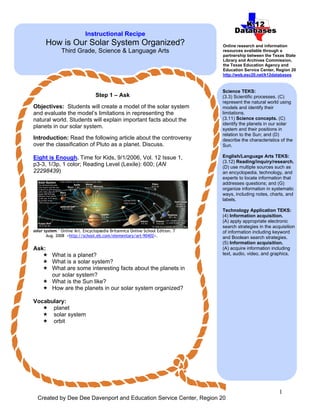
Instructional Recipe
       How is Our Solar System Organized?                                     Online research and information
              Third Grade, Science & Language Arts                            resources available through a
                                                                              partnership between the Texas State
                                                                              Library and Archives Commission,
                                                                              the Texas Education Agency and
                                                                              Education Service Center, Region 20
                                                                              http://web.esc20.net/k12databases


                                                                              Science TEKS:
                                Step 1 – Ask                                  (3.3) Scientific processes. (C)
                                                                              represent the natural world using
Objectives: Students will create a model of the solar system                  models and identify their
and evaluate the model’s limitations in representing the                      limitations.
natural world. Students will explain important facts about the                (3.11) Science concepts. (C)
                                                                              identify the planets in our solar
planets in our solar system.                                                  system and their positions in
                                                                              relation to the Sun; and (D)
Introduction: Read the following article about the controversy                describe the characteristics of the
over the classification of Pluto as a planet. Discuss.                        Sun.

Eight is Enough. Time for Kids, 9/1/2006, Vol. 12 Issue 1,                    English/Language Arts TEKS:
                                                                              (3.12) Reading/inquiry/research.
p3-3, 1/3p, 1 color; Reading Level (Lexile): 600; (AN                         (D) use multiple sources such as
22298439)                                                                     an encyclopedia, technology, and
                                                                              experts to locate information that
                                                                              addresses questions; and (G)
                                                                              organize information in systematic
                                                                              ways, including notes, charts, and
                                                                              labels.

                                                                              Technology Application TEKS:
                                                                              (4) Information acquisition.
                                                                              (A) apply appropriate electronic
                                                                              search strategies in the acquisition
solar system." Online Art. Encyclopædia Britannica Online School Edition. 7   of information including keyword
       Aug. 2008 <http://school.eb.com/elementary/art-90402>.                 and Boolean search strategies.
                                                                              (5) Information acquisition.
Ask:                                                                          (A) acquire information including
         What is a planet?                                                    text, audio, video, and graphics.
         What is a solar system?
         What are some interesting facts about the planets in
         our solar system?
         What is the Sun like?
         How are the planets in our solar system organized?

Vocabulary:
      planet
      solar system
      orbit


                                                                                                          1
  Created by Dee Dee Davenport and Education Service Center, Region 20
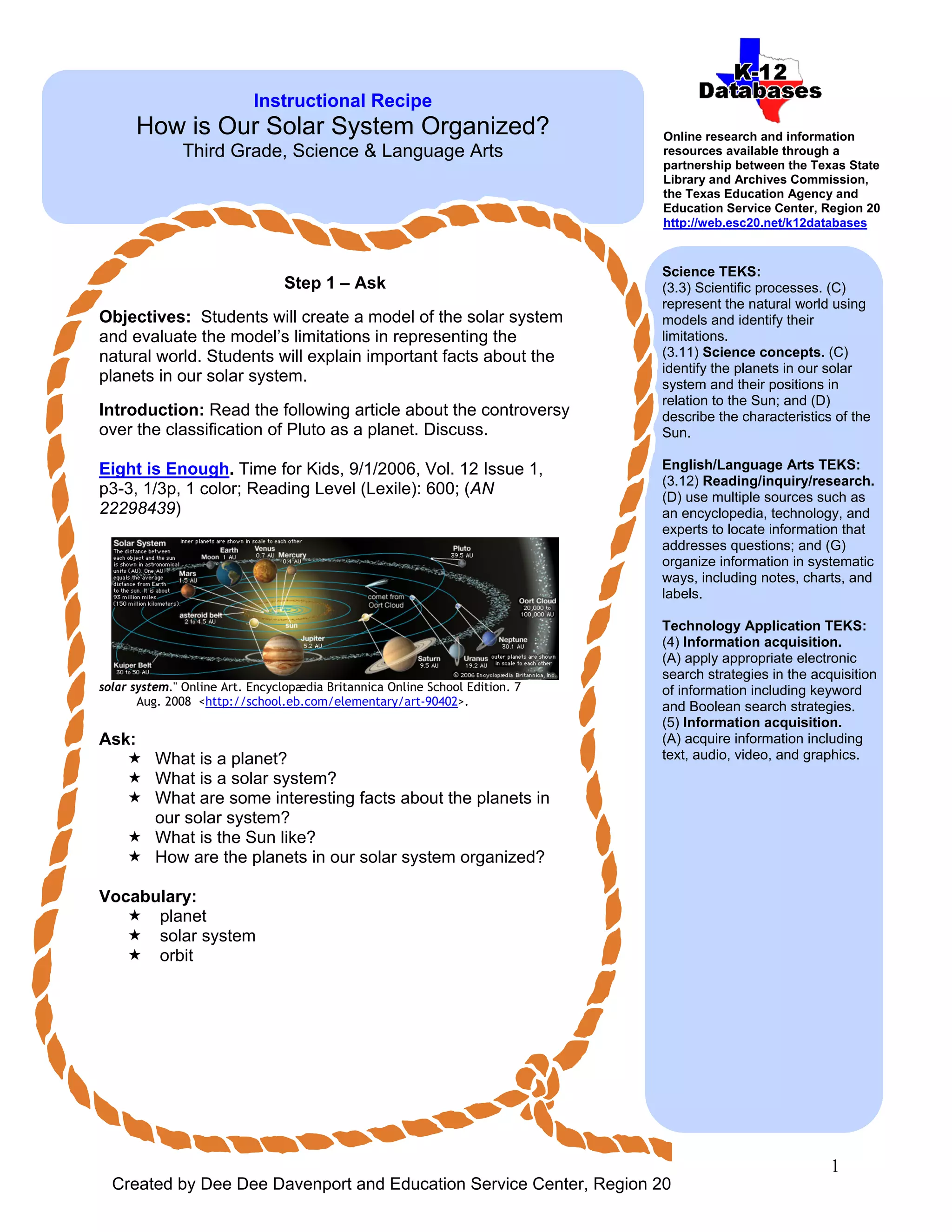
Step 2 – Investigate
   Search using Boolean logic: planets OR “solar system”.

   K-12 Databases Resources:
   • The Changing Face of Mars. By: Downey, Francis. National Geographic Explorer,
      Oct2007, Vol. 7 Issue 2, p18-23, 6p, 5 color; Reading Level (Lexile): 500; (AN
      28541087)
   • FACTS About the PLANETS. World Almanac for Kids, 2001, p210-210, 0p;
      Reading Level (Lexile): 500; (AN 15345296)
   • IS THE RED PLANET ALL WET? By: Kranking, Kathy; Thompson, Sharon.
      National Geographic World, Sep2000 Issue 301, p4, 1/5p, 1 color; Reading Level
      (Lexile): 640; (AN 3528494)
   • FACTS ABOUT THE PLANETS. World Almanac for Kids, 2002, p206, 0p; Reading
      Level (Lexile): 480; (AN 8540081)
   • "solar system." Britannica Elementary Encyclopedia. 2008. Encyclopædia
         Britannica Online School Edition. 8 Oct. 2008
         <http://school.eb.com/elementary/article?articleId=353789>.

   Additional Websites:
      • Distance Between Planets- Visualization
           http://www.classzone.com/books/earth_science/terc/content/visualizations/es27
           01/es2701page01.cfm?chapter_no=27
      • NASA- Solar System Exploration http://solarsystem.nasa.gov/kids/index.cfm

          Books: Extreme Planets by Mary Kay Carson
                 Our Solar System by Amanda Davis


                                        Step 3 – Create

         Students will take notes from online and print resources. They may use a note
         taking format such as the following.

    Planet (or Sun)                Notes                     Source of Information


      Technology Link – Students may use a word processing program, such as
    Microsoft Word, to create a table in which to type their notes.


                                                                                           2
Created by Dee Dee Davenport and Education Service Center, Region 20
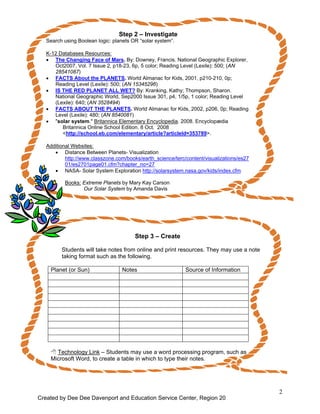
Step 4 – Discuss


              Solar System Model- Small groups of students will use their notes to
             create a model of the solar system. Students should be able to explain
             how their model is limited in representing the actual solar system (E.g.,
             planet sizes and distances between planets can not be represented
             accurately on a small-scale model).
              Poster- Students will create a poster featuring drawings of and facts
             about the Sun and planets in our solar system.

         Students will share their model/poster with the class via a Gallery Walk.

       Technology Link – Students may create the written materials for their poster
    using a word processing program such as Microsoft Word.

    Note: There is some controversy about whether or not Pluto is a planet. Use the latest available
    resources to make that determination. The rubric below includes Pluto as one of nine planets.


                                            Step 5 – Reflect

      Allow students to present their projects to the rest of the class. Use the
      following suggested rubric to assess the students’ work. Make sure that the
      students are familiar with the rubric before they begin creating their project.
      They should refer to the rubric repeatedly to monitor their progress in creating
      their project.

         Technology Link: You can also create your own rubric with your students at
      http://rubistar.4teachers.org/index.php.


                                                                                                       3
Created by Dee Dee Davenport and Education Service Center, Region 20
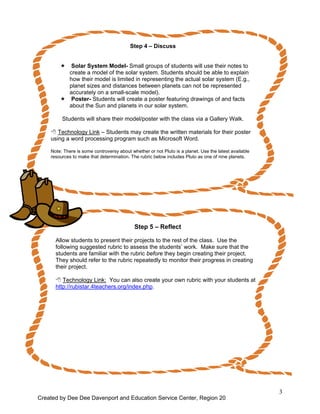
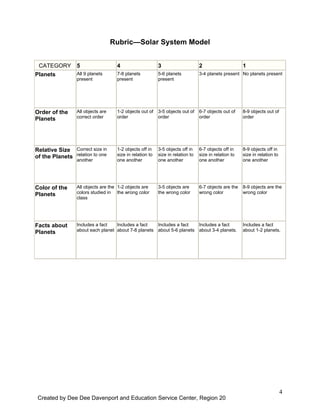
Rubric—Solar System Model


 CATEGORY 5                         4                     3                     2                     1
Planets          All 9 planets      7-8 planets           5-6 planets           3-4 planets present No planets present
                 present            present               present


Order of the     All objects are    1-2 objects out of    3-5 objects out of    6-7 objects out of    8-9 objects out of
Planets          correct order      order                 order                 order                 order


Relative Size Correct size in       1-2 objects off in    3-5 objects off in    6-7 objects off in    8-9 objects off in
of the Planets relation to one      size in relation to   size in relation to   size in relation to   size in relation to
                 another            one another           one another           one another           one another


Color of the     All objects are the 1-2 objects are      3-5 objects are       6-7 objects are the   8-9 objects are the
Planets          colors studied in the wrong color        the wrong color       wrong color           wrong color
                 class


Facts about      Includes a fact   Includes a fact   Includes a fact   Includes a fact                Includes a fact
Planets          about each planet about 7-8 planets about 5-6 planets about 3-4 planets.             about 1-2 planets.


                                                                                                                            4
 Created by Dee Dee Davenport and Education Service Center, Region 20

Solar System Model

  • 1.
    Instructional Recipe How is Our Solar System Organized? Online research and information Third Grade, Science & Language Arts resources available through a partnership between the Texas State Library and Archives Commission, the Texas Education Agency and Education Service Center, Region 20 http://web.esc20.net/k12databases Science TEKS: Step 1 – Ask (3.3) Scientific processes. (C) represent the natural world using Objectives: Students will create a model of the solar system models and identify their and evaluate the model’s limitations in representing the limitations. natural world. Students will explain important facts about the (3.11) Science concepts. (C) identify the planets in our solar planets in our solar system. system and their positions in relation to the Sun; and (D) Introduction: Read the following article about the controversy describe the characteristics of the over the classification of Pluto as a planet. Discuss. Sun. Eight is Enough. Time for Kids, 9/1/2006, Vol. 12 Issue 1, English/Language Arts TEKS: (3.12) Reading/inquiry/research. p3-3, 1/3p, 1 color; Reading Level (Lexile): 600; (AN (D) use multiple sources such as 22298439) an encyclopedia, technology, and experts to locate information that addresses questions; and (G) organize information in systematic ways, including notes, charts, and labels. Technology Application TEKS: (4) Information acquisition. (A) apply appropriate electronic search strategies in the acquisition solar system." Online Art. Encyclopædia Britannica Online School Edition. 7 of information including keyword Aug. 2008 <http://school.eb.com/elementary/art-90402>. and Boolean search strategies. (5) Information acquisition. Ask: (A) acquire information including What is a planet? text, audio, video, and graphics. What is a solar system? What are some interesting facts about the planets in our solar system? What is the Sun like? How are the planets in our solar system organized? Vocabulary: planet solar system orbit 1 Created by Dee Dee Davenport and Education Service Center, Region 20
  • 2.
    Step 2 –Investigate Search using Boolean logic: planets OR “solar system”. K-12 Databases Resources: • The Changing Face of Mars. By: Downey, Francis. National Geographic Explorer, Oct2007, Vol. 7 Issue 2, p18-23, 6p, 5 color; Reading Level (Lexile): 500; (AN 28541087) • FACTS About the PLANETS. World Almanac for Kids, 2001, p210-210, 0p; Reading Level (Lexile): 500; (AN 15345296) • IS THE RED PLANET ALL WET? By: Kranking, Kathy; Thompson, Sharon. National Geographic World, Sep2000 Issue 301, p4, 1/5p, 1 color; Reading Level (Lexile): 640; (AN 3528494) • FACTS ABOUT THE PLANETS. World Almanac for Kids, 2002, p206, 0p; Reading Level (Lexile): 480; (AN 8540081) • "solar system." Britannica Elementary Encyclopedia. 2008. Encyclopædia Britannica Online School Edition. 8 Oct. 2008 <http://school.eb.com/elementary/article?articleId=353789>. Additional Websites: • Distance Between Planets- Visualization http://www.classzone.com/books/earth_science/terc/content/visualizations/es27 01/es2701page01.cfm?chapter_no=27 • NASA- Solar System Exploration http://solarsystem.nasa.gov/kids/index.cfm Books: Extreme Planets by Mary Kay Carson Our Solar System by Amanda Davis Step 3 – Create Students will take notes from online and print resources. They may use a note taking format such as the following. Planet (or Sun) Notes Source of Information Technology Link – Students may use a word processing program, such as Microsoft Word, to create a table in which to type their notes. 2 Created by Dee Dee Davenport and Education Service Center, Region 20
  • 3.
    Step 4 –Discuss Solar System Model- Small groups of students will use their notes to create a model of the solar system. Students should be able to explain how their model is limited in representing the actual solar system (E.g., planet sizes and distances between planets can not be represented accurately on a small-scale model). Poster- Students will create a poster featuring drawings of and facts about the Sun and planets in our solar system. Students will share their model/poster with the class via a Gallery Walk. Technology Link – Students may create the written materials for their poster using a word processing program such as Microsoft Word. Note: There is some controversy about whether or not Pluto is a planet. Use the latest available resources to make that determination. The rubric below includes Pluto as one of nine planets. Step 5 – Reflect Allow students to present their projects to the rest of the class. Use the following suggested rubric to assess the students’ work. Make sure that the students are familiar with the rubric before they begin creating their project. They should refer to the rubric repeatedly to monitor their progress in creating their project. Technology Link: You can also create your own rubric with your students at http://rubistar.4teachers.org/index.php. 3 Created by Dee Dee Davenport and Education Service Center, Region 20
  • 4.
    Rubric—Solar System Model CATEGORY 5 4 3 2 1 Planets All 9 planets 7-8 planets 5-6 planets 3-4 planets present No planets present present present present Order of the All objects are 1-2 objects out of 3-5 objects out of 6-7 objects out of 8-9 objects out of Planets correct order order order order order Relative Size Correct size in 1-2 objects off in 3-5 objects off in 6-7 objects off in 8-9 objects off in of the Planets relation to one size in relation to size in relation to size in relation to size in relation to another one another one another one another one another Color of the All objects are the 1-2 objects are 3-5 objects are 6-7 objects are the 8-9 objects are the Planets colors studied in the wrong color the wrong color wrong color wrong color class Facts about Includes a fact Includes a fact Includes a fact Includes a fact Includes a fact Planets about each planet about 7-8 planets about 5-6 planets about 3-4 planets. about 1-2 planets. 4 Created by Dee Dee Davenport and Education Service Center, Region 20