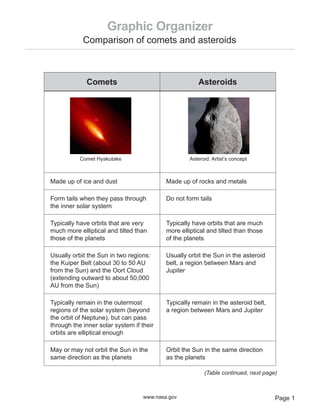
Graphic Organizer
            Comparison of comets and asteroids


             Comets                                    Asteroids


           Comet Hyakutake                         Asteroid: Artist’s concept


Made up of ice and dust                    Made up of rocks and metals

Form tails when they pass through          Do not form tails
the inner solar system

Typically have orbits that are very        Typically have orbits that are much
much more elliptical and tilted than       more elliptical and tilted than those
those of the planets                       of the planets

Usually orbit the Sun in two regions:      Usually orbit the Sun in the asteroid
the Kuiper Belt (about 30 to 50 AU         belt, a region between Mars and
from the Sun) and the Oort Cloud           Jupiter
(extending outward to about 50,000
AU from the Sun)

Typically remain in the outermost          Typically remain in the asteroid belt,
regions of the solar system (beyond        a region between Mars and Jupiter
the orbit of Neptune), but can pass
through the inner solar system if their
orbits are elliptical enough

May or may not orbit the Sun in the        Orbit the Sun in the same direction
same direction as the planets              as the planets

                                                         (Table continued, next page)


                                   www.nasa.gov                                     Page 1
Graphic Organizer
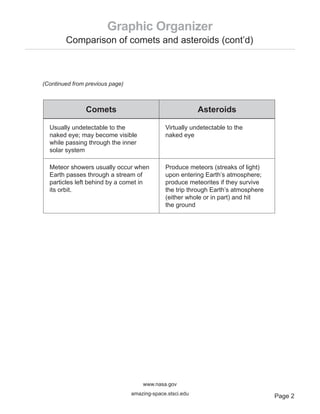
        Comparison of comets and asteroids (cont’d)


(Continued from previous page)


                Comets                                     Asteroids

  Usually undetectable to the                 Virtually undetectable to the
  naked eye; may become visible               naked eye
  while passing through the inner
  solar system

  Meteor showers usually occur when           Produce meteors (streaks of light)
  Earth passes through a stream of            upon entering Earth’s atmosphere;
  particles left behind by a comet in         produce meteorites if they survive
  its orbit.                                  the trip through Earth’s atmosphere
                                              (either whole or in part) and hit
                                              the ground


                                     www.nasa.gov
                                 amazing-space.stsci.edu
                                                                                    Page 2

Comets And Asteroids Comparison Graphic Organizer

  • 1.
    Graphic Organizer Comparison of comets and asteroids Comets Asteroids Comet Hyakutake Asteroid: Artist’s concept Made up of ice and dust Made up of rocks and metals Form tails when they pass through Do not form tails the inner solar system Typically have orbits that are very Typically have orbits that are much much more elliptical and tilted than more elliptical and tilted than those those of the planets of the planets Usually orbit the Sun in two regions: Usually orbit the Sun in the asteroid the Kuiper Belt (about 30 to 50 AU belt, a region between Mars and from the Sun) and the Oort Cloud Jupiter (extending outward to about 50,000 AU from the Sun) Typically remain in the outermost Typically remain in the asteroid belt, regions of the solar system (beyond a region between Mars and Jupiter the orbit of Neptune), but can pass through the inner solar system if their orbits are elliptical enough May or may not orbit the Sun in the Orbit the Sun in the same direction same direction as the planets as the planets (Table continued, next page) www.nasa.gov Page 1
  • 2.
    Graphic Organizer Comparison of comets and asteroids (cont’d) (Continued from previous page) Comets Asteroids Usually undetectable to the Virtually undetectable to the naked eye; may become visible naked eye while passing through the inner solar system Meteor showers usually occur when Produce meteors (streaks of light) Earth passes through a stream of upon entering Earth’s atmosphere; particles left behind by a comet in produce meteorites if they survive its orbit. the trip through Earth’s atmosphere (either whole or in part) and hit the ground www.nasa.gov amazing-space.stsci.edu Page 2