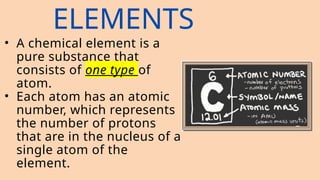
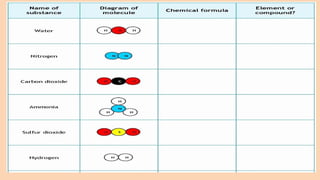
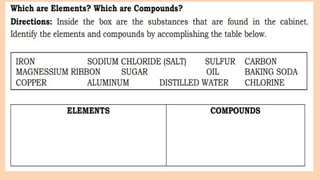
ELEMENTS
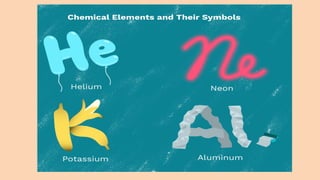
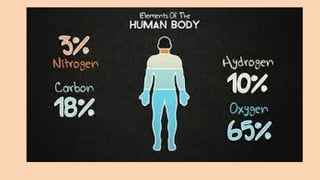
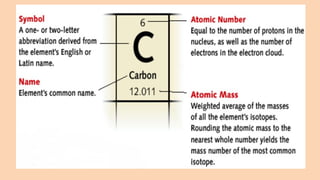
• A chemicalelement is a
pure substance that
consists of one type of
atom.
• Each atom has an atomic
number, which represents
the number of protons
that are in the nucleus of a
single atom of the
element.
8.
ELEMENTS
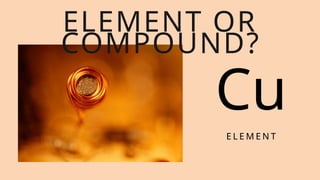
Elements are thesimplest form of substances. This means
that whatever you do with an element, it remains to be same
element. Its physical state may change but the identity of the
element will not. It may form compounds with other elements
but the element will never form anything simpler than it
already is.
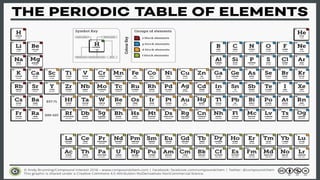
There are already more than a hundred elements and are
organized in a Periodic Table. Some of them are naturally
occurring and some were produced in a laboratory.
14.
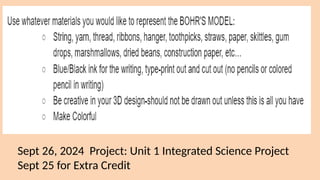
Sept 26, 2024Project: Unit 1 Integrated Science Project
Sept 25 for Extra Credit
18.
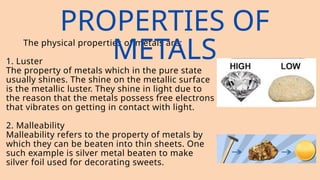
The physical propertiesof metals are:
1. Luster
The property of metals which in the pure state
usually shines. The shine on the metallic surface
is the metallic luster. They shine in light due to
the reason that the metals possess free electrons
that vibrates on getting in contact with light.
2. Malleability
Malleability refers to the property of metals by
which they can be beaten into thin sheets. One
such example is silver metal beaten to make
silver foil used for decorating sweets.
PROPERTIES OF
METALS
19.
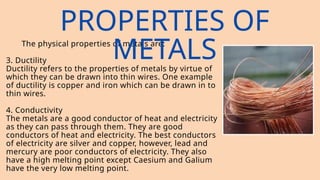
The physical propertiesof metals are:
3. Ductility
Ductility refers to the properties of metals by virtue of
which they can be drawn into thin wires. One example
of ductility is copper and iron which can be drawn in to
thin wires.
4. Conductivity
The metals are a good conductor of heat and electricity
as they can pass through them. They are good
conductors of heat and electricity. The best conductors
of electricity are silver and copper, however, lead and
mercury are poor conductors of electricity. They also
have a high melting point except Caesium and Galium
have the very low melting point.
PROPERTIES OF
METALS
20.
The physical propertiesof metals are:
5. Sonorous
On being struck hard, the metals produce a ringing
sound. Due to this property, they sonorous. For example
– the school bell produces a loud ringing sound when
stuck with the hammer hard. Some examples are – Iron,
Gold, Copper, Aluminium, Magnesium, and many more.
6. Solid
Except for Mercury, all the metals are solid. Mercury is in
the liquid state at room temperature. The exceptional
metals are Sodium ( Na), Potassium ( K ) and Mercury.
The metals like Sodium ( Na) and Potassium ( K ) are
easily cut with the help of a knife. Other examples of
metals are iron, copper, silver, aluminum, calcium, gold
etc.
PROPERTIES OF
METALS
21.
The physical propertiesof non – metals are :
1. The solid non-metals are brittle or dull and soft as they can be broken
down into a powdery substance or mass on tapping down with the hammer.
Few examples are Coal and Sulphur. However, Diamond is an exception as it
is the hardest non-metal.
2. Non – metals may be either solids, liquids, or gases.
3. Non-metals are poor conductors of heat and electricity except Graphite.
4. They do not possess metallic luster.
5. Non-metals are not sonorous, they do not produce a ringing sound.
6. Non-metals possess no malleability.
7. They are not ductile.
8. They have dull luster, however, iodine is lustrous.
9. Some example of non – metals are carbon, oxygen, Sulphur,
phosphorous, and many more.
PROPERTIES OF NON-
METALS
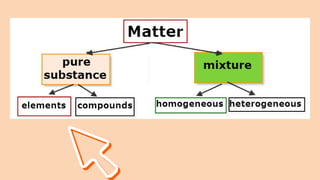
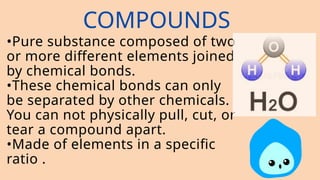
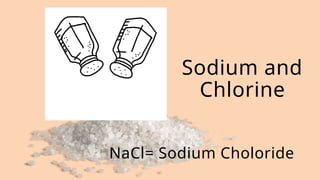
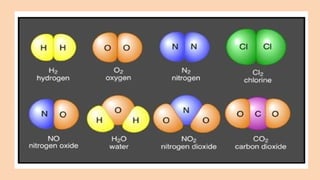
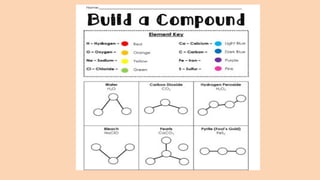
COMPOUNDS
•Pure substance composedof two
or more different elements joined
by chemical bonds.
•These chemical bonds can only
be separated by other chemicals.
You can not physically pull, cut, or
tear a compound apart.
•Made of elements in a specific
ratio .
Eating a healthybalanced diet and keeping an active
life will help us to maintain a healthy weight and
prevent illness.
Lacks some significant nutrients – like vitamin A, B, C,
and E, and zinc, iron, and selenium – may deteriorate
parts of your immune system.
56.
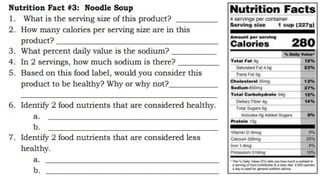
PERFORMANCE TASK
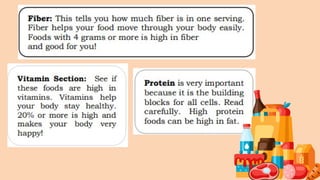
Directions: Cuta “Nutritional Facts” from a product. What does the Nutrition Facts Table tell you about these packaged foods? Examine the following nutrition labels and
answer the questions. List down in Table below the compounds in the product label and the constituent elements. There are cases that you will need to look up the constituent
elements because they may not be obvious from the compound name (e.g., citric acid, oil)
1. What food product are in your list ?
2. How many calories per serving are in this
product
3. What percent daily value is the sodium ?
4. In 2 serving how much sodium is there?
5. Based on this food label, would you
consider this product to be healthy? Why
or why not ?
6. Why is it important for you to be familiar
in classifying substance as element or
compound?





















![Human Reproduction [ Reproductive System ] Notes @irfanullah_mehar Irfanullah...](https://cdn.slidesharecdn.com/ss_thumbnails/humanreproductionreproductivesystemnotesirfanullahmeharirfanullahmeharjanantantra-260111172350-56e85778-thumbnail.jpg?width=640&height=640&fit=bounds)


