1


                                    METAL WORKING − I
                                          1. INTRODUCTION
Materials have to be processed in to a great variety of shapes in order to make component parts of every
type. The shapes required vary enormously, both in size & complexity, ranging microelectronic
components to large casing and forging having mass of 100s of tones. Engineer must be aware range of
manufacturing processes available and of advantages and limitation of the various processes. The
properties of materials in the finished component are also influenced to a considerable extend by the
type of shaping process employed, and by the condition existing during process. The whole ranging of
shaping process is classified into four categories:
   1)   Casing – pouring of liquid metal into prepared moulds.
   2)   Manipulative processes involving plastic deformation (metal forming) of materials.
   3)   Powder metallurgy - producing shapes by compacting powder and sintering.
   4)   Machining and grinding – most metals are initially produced in the liquid phase and are then cast
        in to shapes, either to give a casting or into ingots which can be further processed by
        manipulative techniques such as rolling, forging, extrusion, wire drawing, etc.

The engineering stress-strain curve does not give a true indication of the deformation characteristics of a
metal because it is based entirely on the original dimensions of the specimen, and these dimensions
change continuously during the test. Also, ductile metal which is pulled in tension becomes unstable and
necks down during the course of the test. Because the cross-sectional area of the specimen is decreasing
rapidly at this stage in the test, the load required continuing deformation falls off. The average stress
based on original area like wise decreases, and this produces the fall-off in the stress-strain curve beyond
the point of maximum load.


METAL FORMING
Metal forming is defined as solid state deforming a material by application of stress and heat beyond
yield point to obtain desired shape and size permanently without changing its mass and composition.
Forming involves deformation of body by application of force, heat or any other cause or combination
of these. Metal forming is a manufacturing through plastic modification of a shape while retaining its
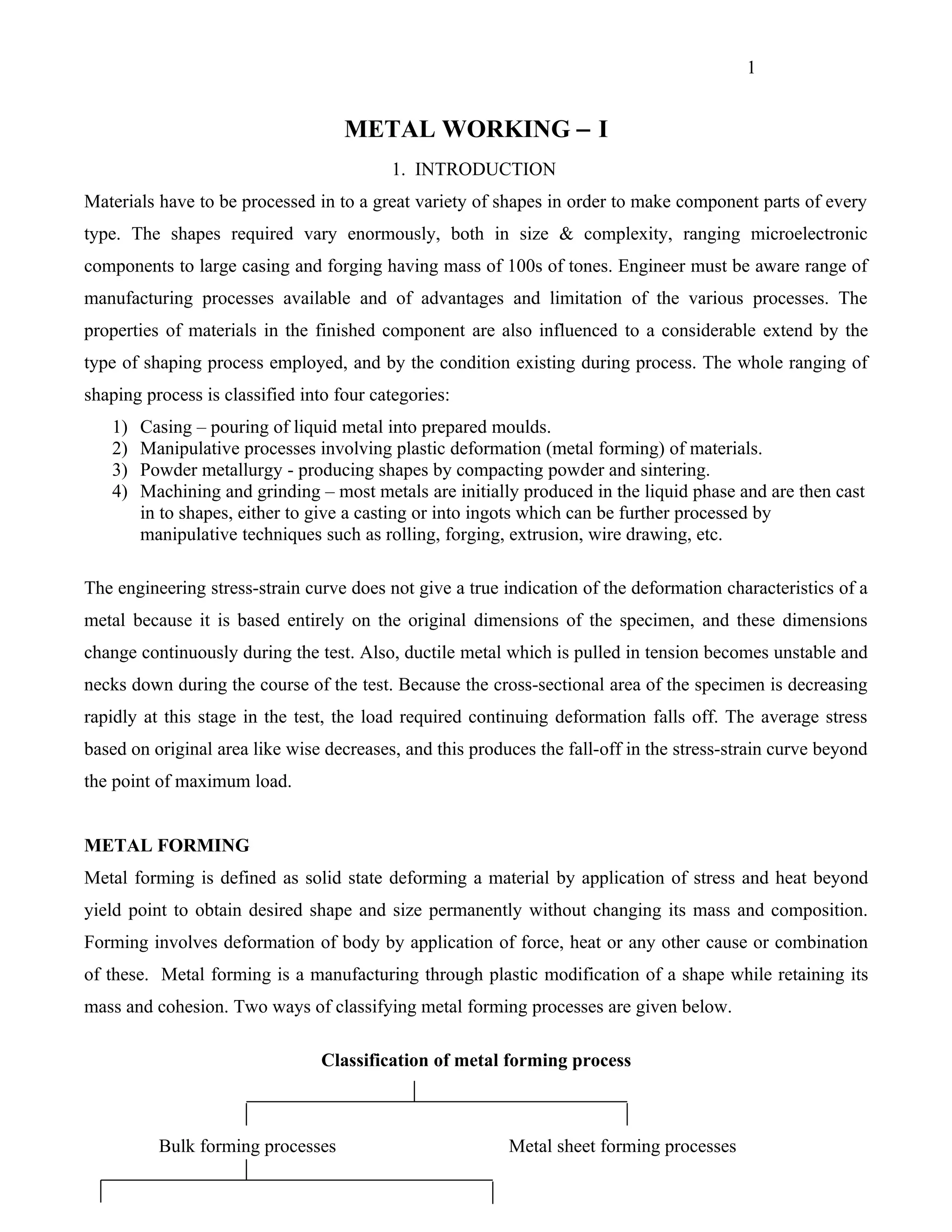
mass and cohesion. Two ways of classifying metal forming processes are given below.

                                 Classification of metal forming process


          Bulk forming processes                          Metal sheet forming processes
2


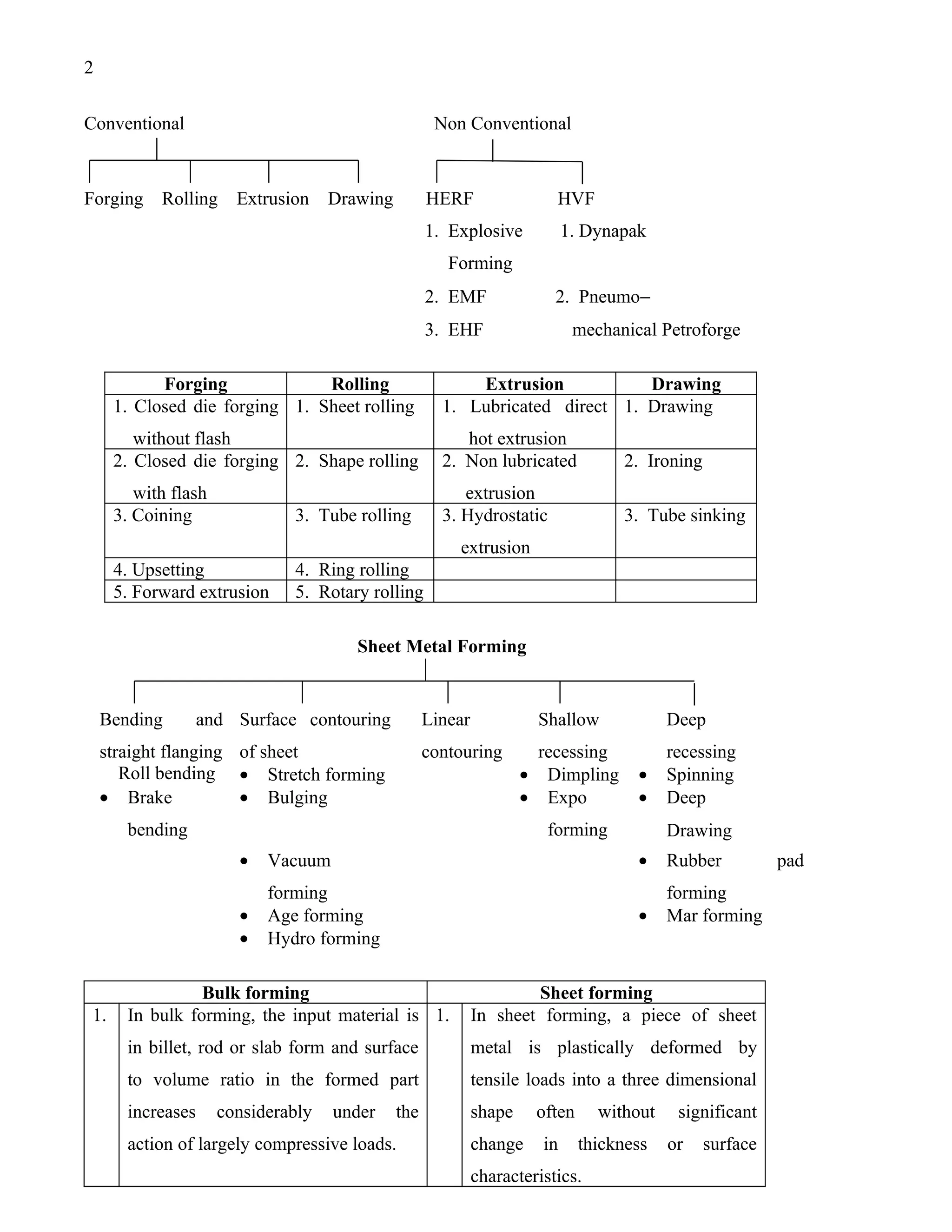
Conventional                                          Non Conventional


Forging     Rolling     Extrusion    Drawing         HERF                 HVF
                                                     1. Explosive            1. Dynapak
                                                        Forming
                                                     2. EMF               2. Pneumo−
                                                     3. EHF                   mechanical Petroforge

            Forging             Rolling                    Extrusion           Drawing
      1. Closed die forging 1. Sheet rolling           1. Lubricated direct 1. Drawing
         without flash                                    hot extrusion
      2. Closed die forging 2. Shape rolling           2. Non lubricated             2. Ironing
         with flash                                       extrusion
      3. Coining               3. Tube rolling         3. Hydrostatic                3. Tube sinking
                                                         extrusion
      4. Upsetting             4. Ring rolling
      5. Forward extrusion     5. Rotary rolling

                                        Sheet Metal Forming


    Bending        and Surface contouring            Linear             Shallow            Deep
    straight flanging of sheet                       contouring         recessing          recessing
       Roll bending • Stretch forming                                 • Dimpling      •    Spinning
    • Brake           • Bulging                                       • Expo          •    Deep
       bending                                                           forming           Drawing
                        •   Vacuum                                                    •    Rubber           pad
                            forming                                                        forming
                        •   Age forming                                               •    Mar forming
                        •   Hydro forming

                 Bulk forming                                         Sheet forming
 1.    In bulk forming, the input material is 1.              In sheet forming, a piece of sheet
       in billet, rod or slab form and surface                metal is plastically deformed by
       to volume ratio in the formed part                     tensile loads into a three dimensional
       increases      considerably   under     the            shape    often     without    significant
       action of largely compressive loads.                   change    in     thickness   or     surface
                                                              characteristics.
3


2.   Generic bulk forming processes are 2.   Sheet     forming   processes   include
     forming, rolling, extrusion, drawing    cutting      operation      (punching,
                                             blanking, notching etc.), forming,
                                             bending, drawing, etc.
4


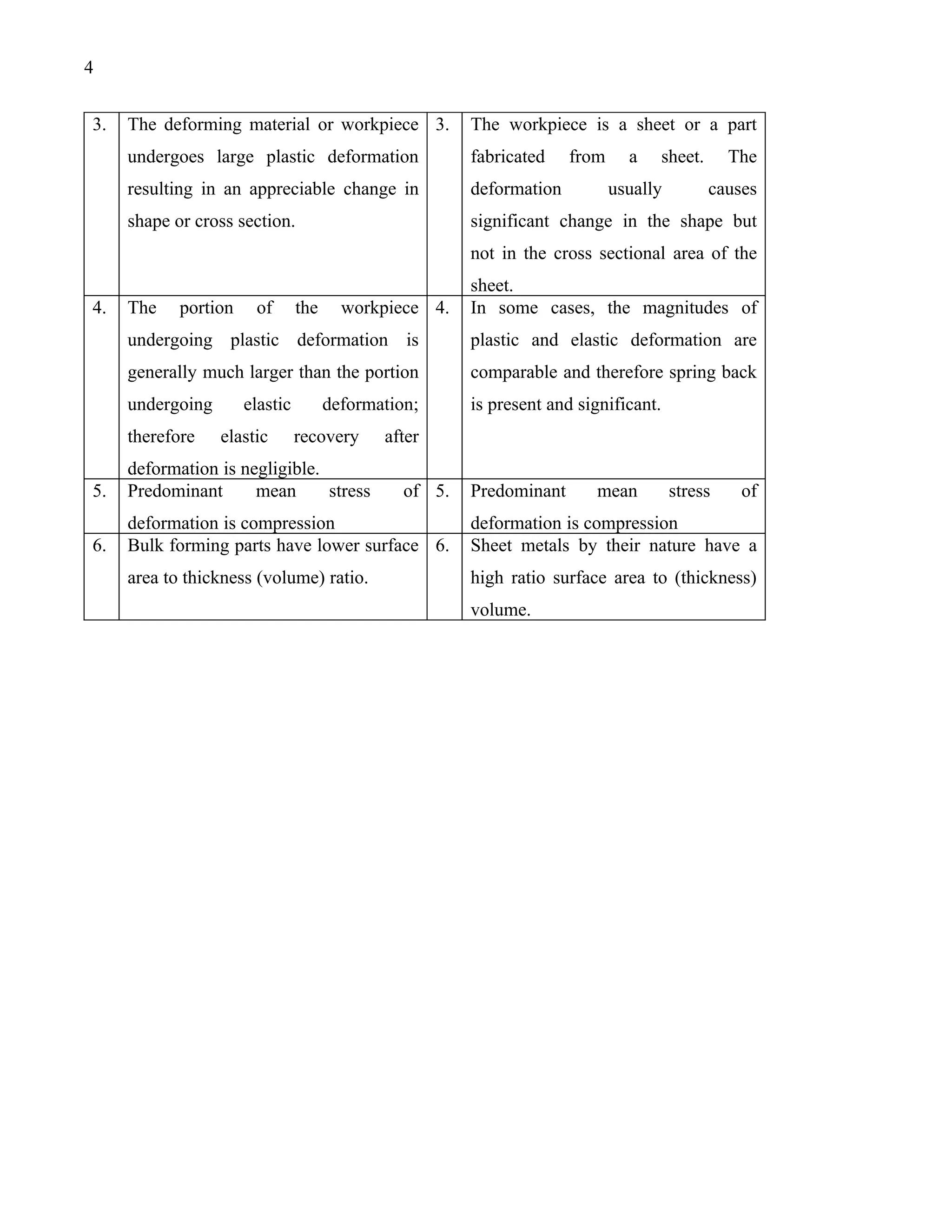
3.   The deforming material or workpiece 3.             The workpiece is a sheet or a part
     undergoes large plastic deformation                fabricated    from     a      sheet.     The
     resulting in an appreciable change in              deformation          usually           causes
     shape or cross section.                            significant change in the shape but
                                                        not in the cross sectional area of the
                                                        sheet.
4.   The    portion    of       the     workpiece 4.    In some cases, the magnitudes of
     undergoing plastic deformation is                  plastic and elastic deformation are
     generally much larger than the portion             comparable and therefore spring back
     undergoing       elastic         deformation;      is present and significant.
     therefore    elastic       recovery     after
     deformation is negligible.
5.   Predominant      mean      stress          of 5.   Predominant      mean          stress      of
     deformation is compression                         deformation is compression
6.   Bulk forming parts have lower surface 6.           Sheet metals by their nature have a
     area to thickness (volume) ratio.                  high ratio surface area to (thickness)
                                                        volume.
5


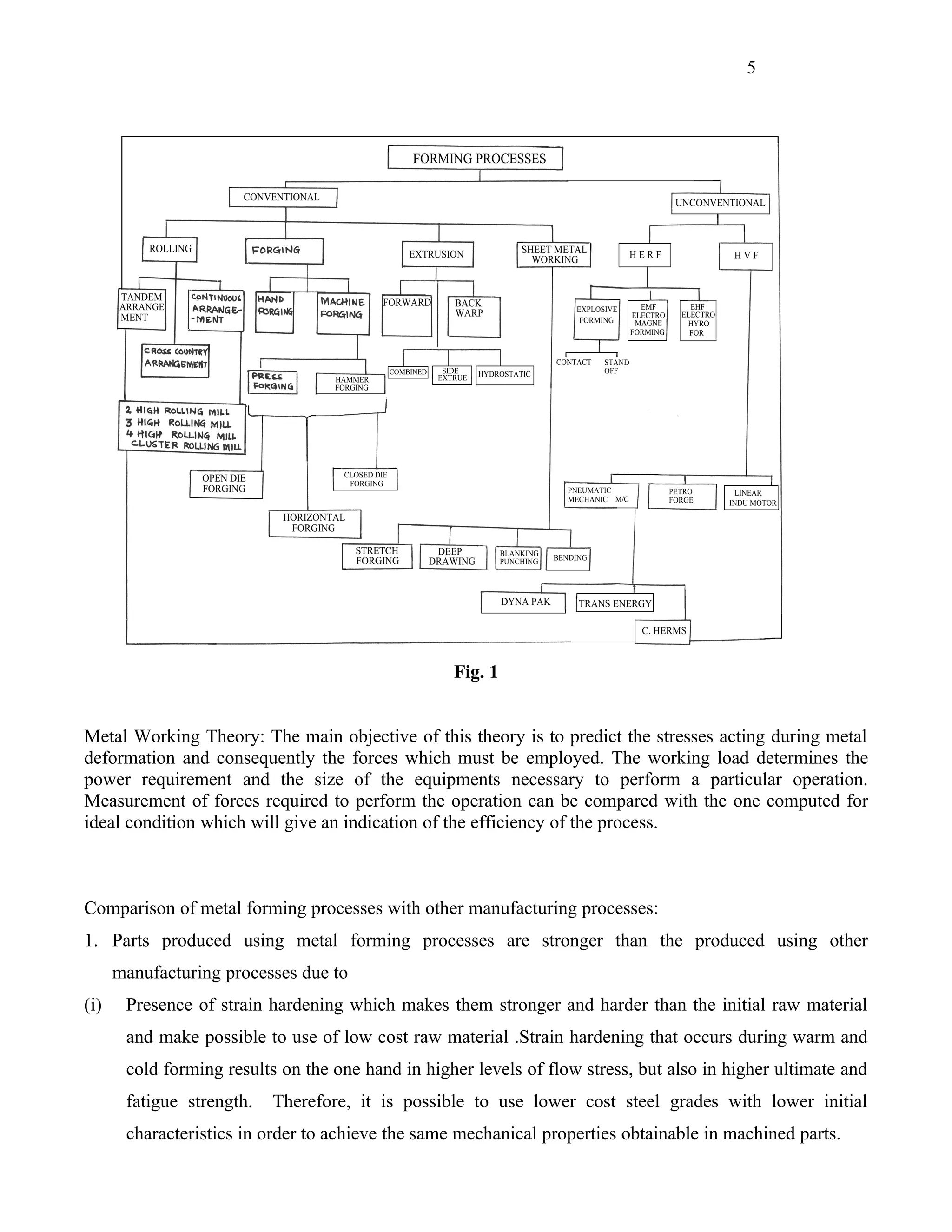
                                                   Fig. 1


Metal Working Theory: The main objective of this theory is to predict the stresses acting during metal
deformation and consequently the forces which must be employed. The working load determines the
power requirement and the size of the equipments necessary to perform a particular operation.
Measurement of forces required to perform the operation can be compared with the one computed for
ideal condition which will give an indication of the efficiency of the process.


Comparison of metal forming processes with other manufacturing processes:
1. Parts produced using metal forming processes are stronger than the produced using other
      manufacturing processes due to
(i)    Presence of strain hardening which makes them stronger and harder than the initial raw material
       and make possible to use of low cost raw material .Strain hardening that occurs during warm and
       cold forming results on the one hand in higher levels of flow stress, but also in higher ultimate and
       fatigue strength.   Therefore, it is possible to use lower cost steel grades with lower initial
       characteristics in order to achieve the same mechanical properties obtainable in machined parts.
6


       The work hardening behaviour is interesting from economic point of view, as cheaper materials
       can be extruded or drawn to obtain higher mechanical strength generally obtainable in higher grade
       costlier materials. This aspect is all the more important in case of certain materials like pure
       aluminium and pure copper which cannot be strengthened except by work hardening.
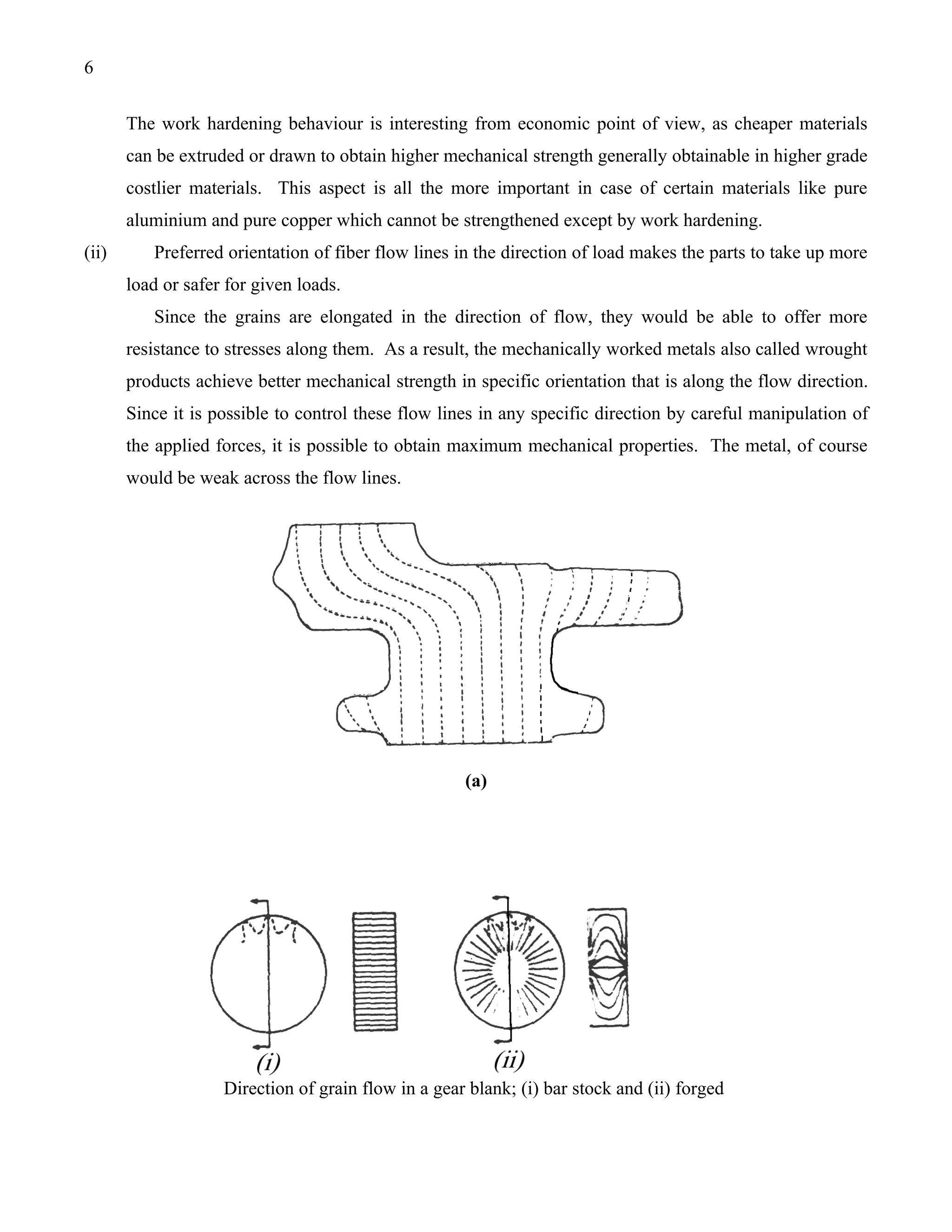
(ii)      Preferred orientation of fiber flow lines in the direction of load makes the parts to take up more
       load or safer for given loads.
          Since the grains are elongated in the direction of flow, they would be able to offer more
       resistance to stresses along them. As a result, the mechanically worked metals also called wrought
       products achieve better mechanical strength in specific orientation that is along the flow direction.
       Since it is possible to control these flow lines in any specific direction by careful manipulation of
       the applied forces, it is possible to obtain maximum mechanical properties. The metal, of course
       would be weak across the flow lines.


                                                     (a)


                    Direction of grain flow in a gear blank; (i) bar stock and (ii) forged
7


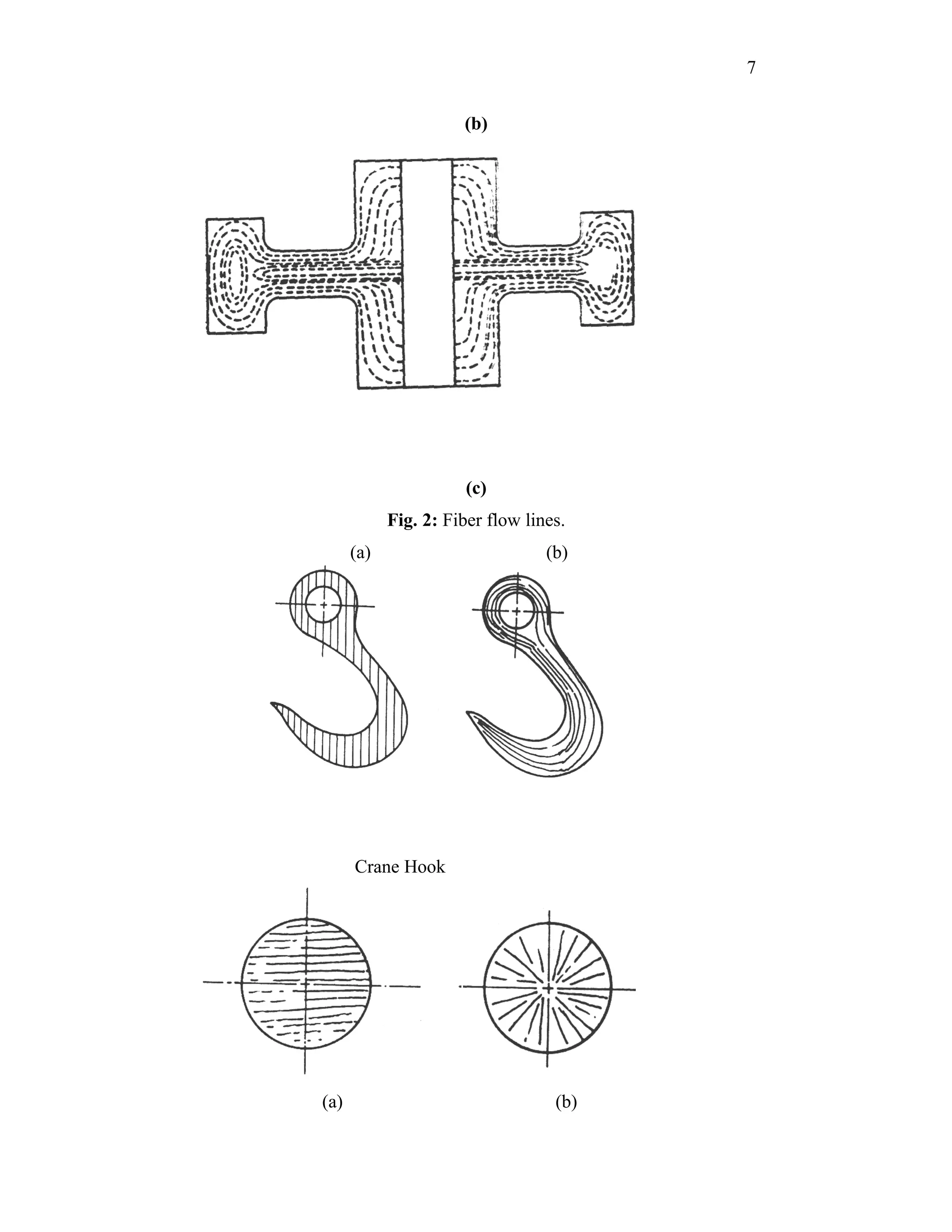
                      (b)


                       (c)
            Fig. 2: Fiber flow lines.
      (a)                         (b)


      Crane Hook


(a)                                (b)
8


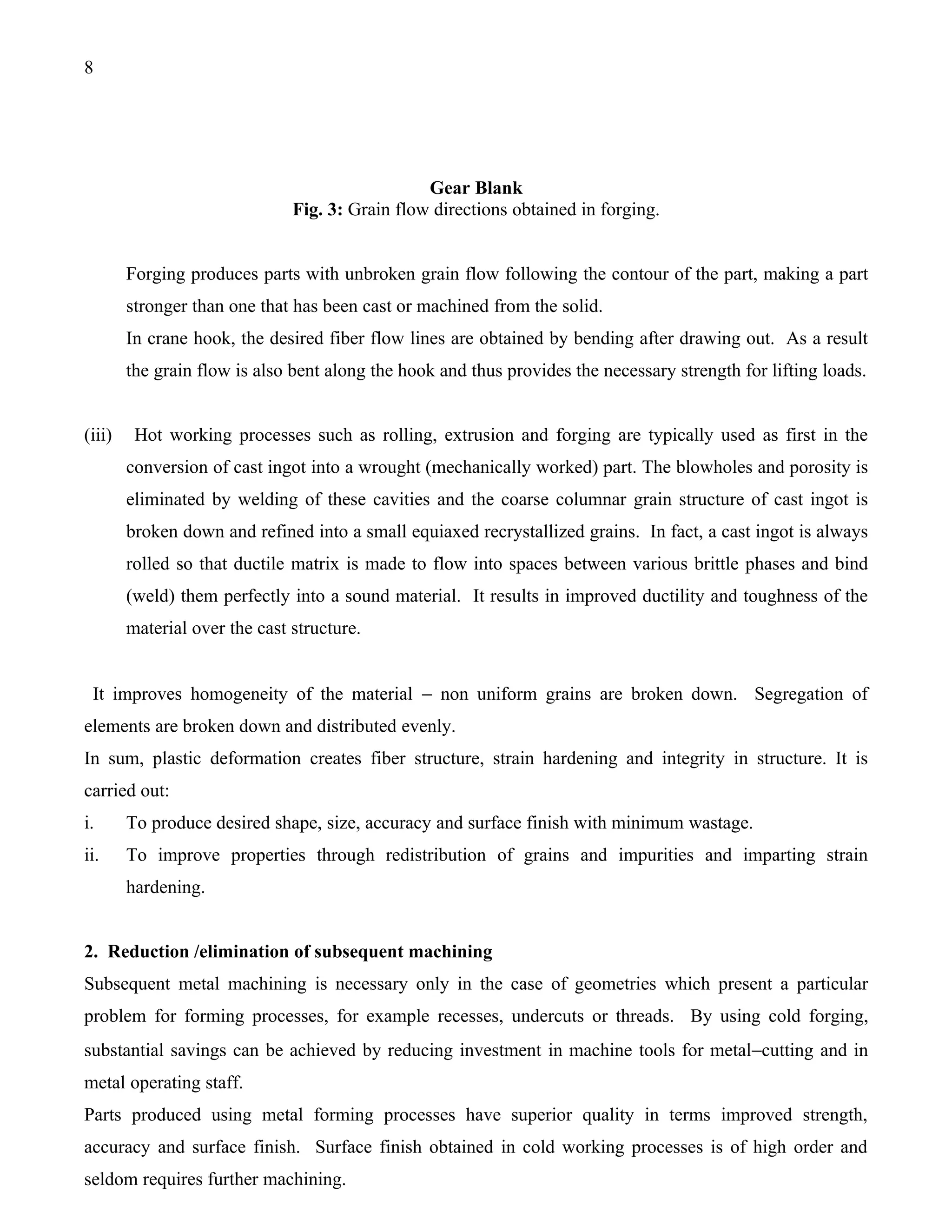
                                                 Gear Blank
                               Fig. 3: Grain flow directions obtained in forging.


        Forging produces parts with unbroken grain flow following the contour of the part, making a part
        stronger than one that has been cast or machined from the solid.
        In crane hook, the desired fiber flow lines are obtained by bending after drawing out. As a result
        the grain flow is also bent along the hook and thus provides the necessary strength for lifting loads.


(iii)    Hot working processes such as rolling, extrusion and forging are typically used as first in the
        conversion of cast ingot into a wrought (mechanically worked) part. The blowholes and porosity is
        eliminated by welding of these cavities and the coarse columnar grain structure of cast ingot is
        broken down and refined into a small equiaxed recrystallized grains. In fact, a cast ingot is always
        rolled so that ductile matrix is made to flow into spaces between various brittle phases and bind
        (weld) them perfectly into a sound material. It results in improved ductility and toughness of the
        material over the cast structure.


 It improves homogeneity of the material − non uniform grains are broken down. Segregation of
elements are broken down and distributed evenly.
In sum, plastic deformation creates fiber structure, strain hardening and integrity in structure. It is
carried out:
i.      To produce desired shape, size, accuracy and surface finish with minimum wastage.
ii.     To improve properties through redistribution of grains and impurities and imparting strain
        hardening.


2. Reduction /elimination of subsequent machining
Subsequent metal machining is necessary only in the case of geometries which present a particular
problem for forming processes, for example recesses, undercuts or threads. By using cold forging,
substantial savings can be achieved by reducing investment in machine tools for metal−cutting and in
metal operating staff.
Parts produced using metal forming processes have superior quality in terms improved strength,
accuracy and surface finish. Surface finish obtained in cold working processes is of high order and
seldom requires further machining.
9


3. Lower Material Input
Almost all initial volume of the billet is processed into the finished part. Comparing with machining,
saving up to 75 % of material is possible. When high alloyed and costly materials are used, the benefit
of low material input becomes increasingly significant in relation to overall manufacturing cost.
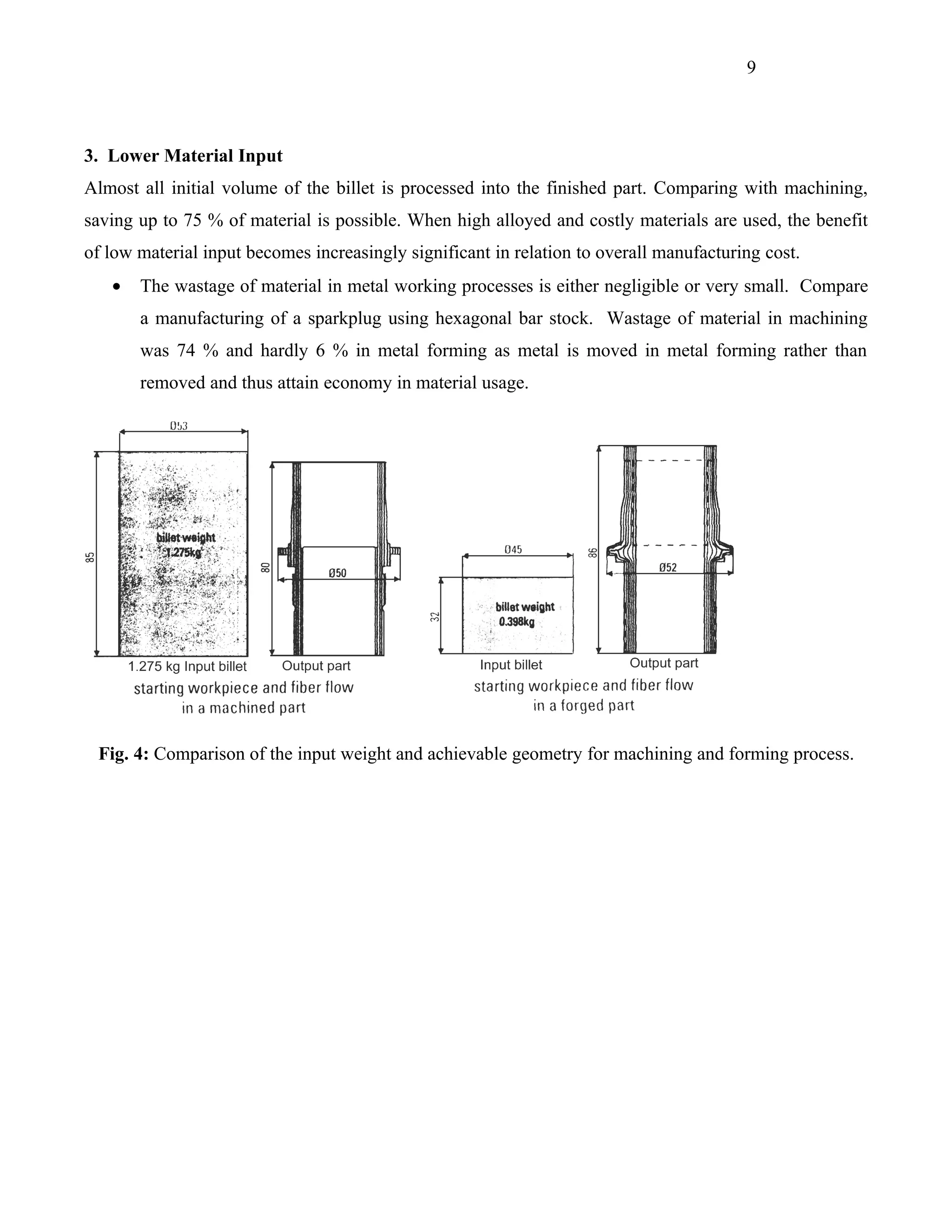
   •   The wastage of material in metal working processes is either negligible or very small. Compare
       a manufacturing of a sparkplug using hexagonal bar stock. Wastage of material in machining
       was 74 % and hardly 6 % in metal forming as metal is moved in metal forming rather than
       removed and thus attain economy in material usage.


 Fig. 4: Comparison of the input weight and achievable geometry for machining and forming process.
10


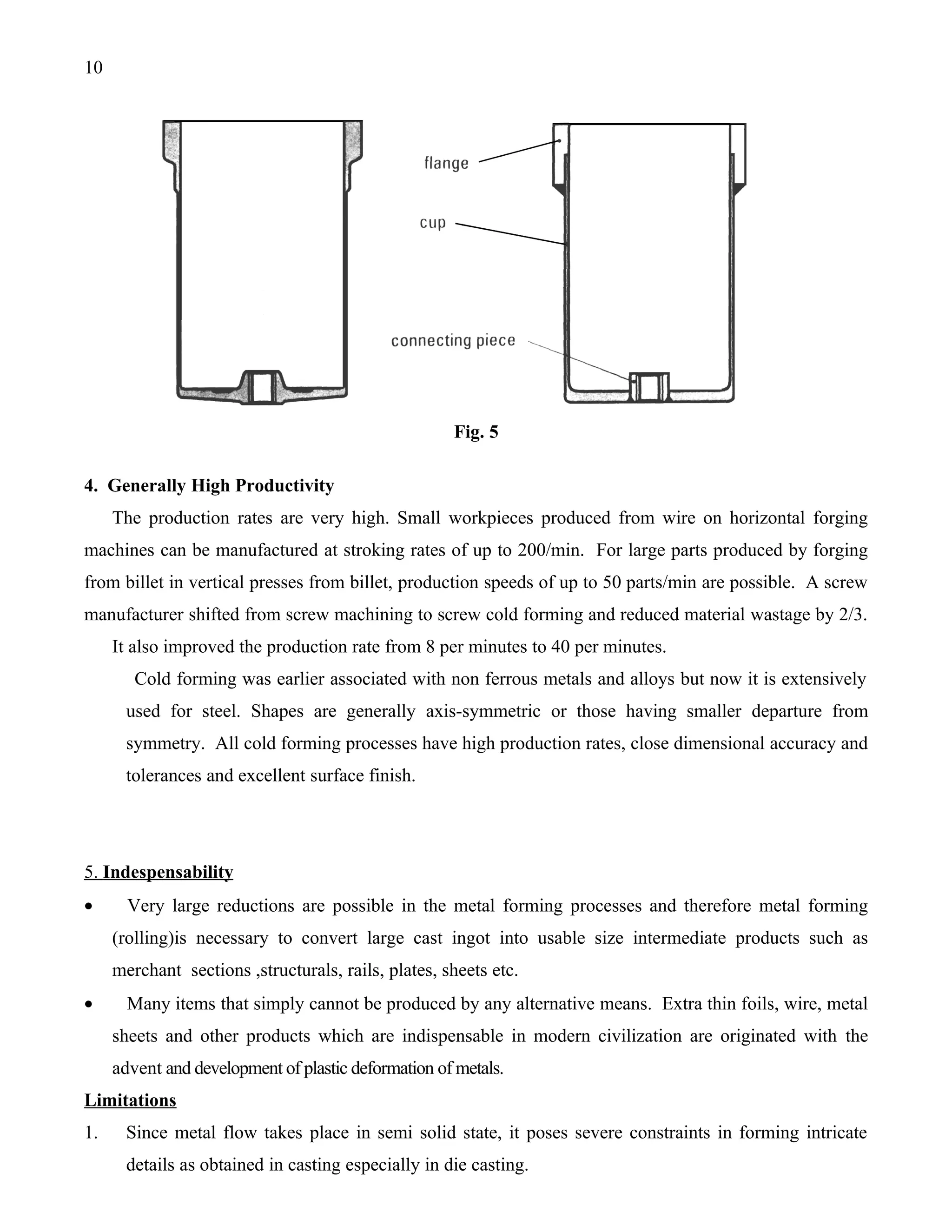
                                                     Fig. 5

4. Generally High Productivity
     The production rates are very high. Small workpieces produced from wire on horizontal forging
machines can be manufactured at stroking rates of up to 200/min. For large parts produced by forging
from billet in vertical presses from billet, production speeds of up to 50 parts/min are possible. A screw
manufacturer shifted from screw machining to screw cold forming and reduced material wastage by 2/3.
     It also improved the production rate from 8 per minutes to 40 per minutes.
        Cold forming was earlier associated with non ferrous metals and alloys but now it is extensively
       used for steel. Shapes are generally axis-symmetric or those having smaller departure from
       symmetry. All cold forming processes have high production rates, close dimensional accuracy and
       tolerances and excellent surface finish.


5. Indespensability
•      Very large reductions are possible in the metal forming processes and therefore metal forming
     (rolling)is necessary to convert large cast ingot into usable size intermediate products such as
     merchant sections ,structurals, rails, plates, sheets etc.
•      Many items that simply cannot be produced by any alternative means. Extra thin foils, wire, metal
     sheets and other products which are indispensable in modern civilization are originated with the
     advent and development of plastic deformation of metals.
Limitations
1.     Since metal flow takes place in semi solid state, it poses severe constraints in forming intricate
       details as obtained in casting especially in die casting.
11


2.      Metal forming processes required heavy and sturdy tooling, equipments and presses to withstand
        heavy forces arising due to
       i.     Flow stress of metal is high especially in cold forming ranging from 5 to 250 Kgf/mm2.
       ii. Entire or at least major part of the workpiece is deformed at one and same time. e.g. in closed
              die forging, whole part is deformed at a time.
       iii. Many a times the size of the part itself is very large especially in processes like rolling and
              extrusion.
3.            All these means heavy investment required compared to other manufacturing processes. For
              example, to set up a steel plant having capacity of 1 million ton requires investment of about
              Rs.1800 cr. To recover such a huge investment, large volume of production is a necessary
              condition. It provides (i) high productivity and production rate (ii) minimum wastage of
              material. (iii) Improved mechanical properties.
4.      Difficulties encountered in metal forming
        i.     During metal forming virgin surfaces are generated and continuously exposed to the
               atmosphere. This situation calls for continuous lubrication to protect such virgin surfaces.
               Maintaining lubrication at high temperature and pressure is very difficult.
       ii.     Manufacturing of metal forming tools calls for well equipped tool room and skilled manpower
               to accomplish close tolerances required on the tooling.
       iii.    Very high tonnage requirement.
       iv.     Certain minimum production volume requirement to make plants economically viable.
Important areas of application
i.      Components for automobiles and machine tools as well as for industrial plants and equipments.
        Here metal forming is vital link in the development of modern design in light alloys.
ii.     Hand tools, such as hammers, pliers, screw drivers and surgical instrument.
iii.    Fasteners such as screws, nuts, bolds and rivets.
iv.     Containers such as metal boxes, cans and canisters.
v.      Fitting used in the building industry such as for doors and windows.


                                               *****************

Ch 1-introduction

  • 1.
    1 METAL WORKING − I 1. INTRODUCTION Materials have to be processed in to a great variety of shapes in order to make component parts of every type. The shapes required vary enormously, both in size & complexity, ranging microelectronic components to large casing and forging having mass of 100s of tones. Engineer must be aware range of manufacturing processes available and of advantages and limitation of the various processes. The properties of materials in the finished component are also influenced to a considerable extend by the type of shaping process employed, and by the condition existing during process. The whole ranging of shaping process is classified into four categories: 1) Casing – pouring of liquid metal into prepared moulds. 2) Manipulative processes involving plastic deformation (metal forming) of materials. 3) Powder metallurgy - producing shapes by compacting powder and sintering. 4) Machining and grinding – most metals are initially produced in the liquid phase and are then cast in to shapes, either to give a casting or into ingots which can be further processed by manipulative techniques such as rolling, forging, extrusion, wire drawing, etc. The engineering stress-strain curve does not give a true indication of the deformation characteristics of a metal because it is based entirely on the original dimensions of the specimen, and these dimensions change continuously during the test. Also, ductile metal which is pulled in tension becomes unstable and necks down during the course of the test. Because the cross-sectional area of the specimen is decreasing rapidly at this stage in the test, the load required continuing deformation falls off. The average stress based on original area like wise decreases, and this produces the fall-off in the stress-strain curve beyond the point of maximum load. METAL FORMING Metal forming is defined as solid state deforming a material by application of stress and heat beyond yield point to obtain desired shape and size permanently without changing its mass and composition. Forming involves deformation of body by application of force, heat or any other cause or combination of these. Metal forming is a manufacturing through plastic modification of a shape while retaining its mass and cohesion. Two ways of classifying metal forming processes are given below. Classification of metal forming process Bulk forming processes Metal sheet forming processes
  • 2.
    2 Conventional Non Conventional Forging Rolling Extrusion Drawing HERF HVF 1. Explosive 1. Dynapak Forming 2. EMF 2. Pneumo− 3. EHF mechanical Petroforge Forging Rolling Extrusion Drawing 1. Closed die forging 1. Sheet rolling 1. Lubricated direct 1. Drawing without flash hot extrusion 2. Closed die forging 2. Shape rolling 2. Non lubricated 2. Ironing with flash extrusion 3. Coining 3. Tube rolling 3. Hydrostatic 3. Tube sinking extrusion 4. Upsetting 4. Ring rolling 5. Forward extrusion 5. Rotary rolling Sheet Metal Forming Bending and Surface contouring Linear Shallow Deep straight flanging of sheet contouring recessing recessing Roll bending • Stretch forming • Dimpling • Spinning • Brake • Bulging • Expo • Deep bending forming Drawing • Vacuum • Rubber pad forming forming • Age forming • Mar forming • Hydro forming Bulk forming Sheet forming 1. In bulk forming, the input material is 1. In sheet forming, a piece of sheet in billet, rod or slab form and surface metal is plastically deformed by to volume ratio in the formed part tensile loads into a three dimensional increases considerably under the shape often without significant action of largely compressive loads. change in thickness or surface characteristics.
  • 3.
    3 2. Generic bulk forming processes are 2. Sheet forming processes include forming, rolling, extrusion, drawing cutting operation (punching, blanking, notching etc.), forming, bending, drawing, etc.
  • 4.
    4 3. The deforming material or workpiece 3. The workpiece is a sheet or a part undergoes large plastic deformation fabricated from a sheet. The resulting in an appreciable change in deformation usually causes shape or cross section. significant change in the shape but not in the cross sectional area of the sheet. 4. The portion of the workpiece 4. In some cases, the magnitudes of undergoing plastic deformation is plastic and elastic deformation are generally much larger than the portion comparable and therefore spring back undergoing elastic deformation; is present and significant. therefore elastic recovery after deformation is negligible. 5. Predominant mean stress of 5. Predominant mean stress of deformation is compression deformation is compression 6. Bulk forming parts have lower surface 6. Sheet metals by their nature have a area to thickness (volume) ratio. high ratio surface area to (thickness) volume.
  • 5.
    5 Fig. 1 Metal Working Theory: The main objective of this theory is to predict the stresses acting during metal deformation and consequently the forces which must be employed. The working load determines the power requirement and the size of the equipments necessary to perform a particular operation. Measurement of forces required to perform the operation can be compared with the one computed for ideal condition which will give an indication of the efficiency of the process. Comparison of metal forming processes with other manufacturing processes: 1. Parts produced using metal forming processes are stronger than the produced using other manufacturing processes due to (i) Presence of strain hardening which makes them stronger and harder than the initial raw material and make possible to use of low cost raw material .Strain hardening that occurs during warm and cold forming results on the one hand in higher levels of flow stress, but also in higher ultimate and fatigue strength. Therefore, it is possible to use lower cost steel grades with lower initial characteristics in order to achieve the same mechanical properties obtainable in machined parts.
  • 6.
    6 The work hardening behaviour is interesting from economic point of view, as cheaper materials can be extruded or drawn to obtain higher mechanical strength generally obtainable in higher grade costlier materials. This aspect is all the more important in case of certain materials like pure aluminium and pure copper which cannot be strengthened except by work hardening. (ii) Preferred orientation of fiber flow lines in the direction of load makes the parts to take up more load or safer for given loads. Since the grains are elongated in the direction of flow, they would be able to offer more resistance to stresses along them. As a result, the mechanically worked metals also called wrought products achieve better mechanical strength in specific orientation that is along the flow direction. Since it is possible to control these flow lines in any specific direction by careful manipulation of the applied forces, it is possible to obtain maximum mechanical properties. The metal, of course would be weak across the flow lines. (a) Direction of grain flow in a gear blank; (i) bar stock and (ii) forged
  • 7.
    7 (b) (c) Fig. 2: Fiber flow lines. (a) (b) Crane Hook (a) (b)
  • 8.
    8 Gear Blank Fig. 3: Grain flow directions obtained in forging. Forging produces parts with unbroken grain flow following the contour of the part, making a part stronger than one that has been cast or machined from the solid. In crane hook, the desired fiber flow lines are obtained by bending after drawing out. As a result the grain flow is also bent along the hook and thus provides the necessary strength for lifting loads. (iii) Hot working processes such as rolling, extrusion and forging are typically used as first in the conversion of cast ingot into a wrought (mechanically worked) part. The blowholes and porosity is eliminated by welding of these cavities and the coarse columnar grain structure of cast ingot is broken down and refined into a small equiaxed recrystallized grains. In fact, a cast ingot is always rolled so that ductile matrix is made to flow into spaces between various brittle phases and bind (weld) them perfectly into a sound material. It results in improved ductility and toughness of the material over the cast structure. It improves homogeneity of the material − non uniform grains are broken down. Segregation of elements are broken down and distributed evenly. In sum, plastic deformation creates fiber structure, strain hardening and integrity in structure. It is carried out: i. To produce desired shape, size, accuracy and surface finish with minimum wastage. ii. To improve properties through redistribution of grains and impurities and imparting strain hardening. 2. Reduction /elimination of subsequent machining Subsequent metal machining is necessary only in the case of geometries which present a particular problem for forming processes, for example recesses, undercuts or threads. By using cold forging, substantial savings can be achieved by reducing investment in machine tools for metal−cutting and in metal operating staff. Parts produced using metal forming processes have superior quality in terms improved strength, accuracy and surface finish. Surface finish obtained in cold working processes is of high order and seldom requires further machining.
  • 9.
    9 3. Lower MaterialInput Almost all initial volume of the billet is processed into the finished part. Comparing with machining, saving up to 75 % of material is possible. When high alloyed and costly materials are used, the benefit of low material input becomes increasingly significant in relation to overall manufacturing cost. • The wastage of material in metal working processes is either negligible or very small. Compare a manufacturing of a sparkplug using hexagonal bar stock. Wastage of material in machining was 74 % and hardly 6 % in metal forming as metal is moved in metal forming rather than removed and thus attain economy in material usage. Fig. 4: Comparison of the input weight and achievable geometry for machining and forming process.
  • 10.
    10 Fig. 5 4. Generally High Productivity The production rates are very high. Small workpieces produced from wire on horizontal forging machines can be manufactured at stroking rates of up to 200/min. For large parts produced by forging from billet in vertical presses from billet, production speeds of up to 50 parts/min are possible. A screw manufacturer shifted from screw machining to screw cold forming and reduced material wastage by 2/3. It also improved the production rate from 8 per minutes to 40 per minutes. Cold forming was earlier associated with non ferrous metals and alloys but now it is extensively used for steel. Shapes are generally axis-symmetric or those having smaller departure from symmetry. All cold forming processes have high production rates, close dimensional accuracy and tolerances and excellent surface finish. 5. Indespensability • Very large reductions are possible in the metal forming processes and therefore metal forming (rolling)is necessary to convert large cast ingot into usable size intermediate products such as merchant sections ,structurals, rails, plates, sheets etc. • Many items that simply cannot be produced by any alternative means. Extra thin foils, wire, metal sheets and other products which are indispensable in modern civilization are originated with the advent and development of plastic deformation of metals. Limitations 1. Since metal flow takes place in semi solid state, it poses severe constraints in forming intricate details as obtained in casting especially in die casting.
  • 11.
    11 2. Metal forming processes required heavy and sturdy tooling, equipments and presses to withstand heavy forces arising due to i. Flow stress of metal is high especially in cold forming ranging from 5 to 250 Kgf/mm2. ii. Entire or at least major part of the workpiece is deformed at one and same time. e.g. in closed die forging, whole part is deformed at a time. iii. Many a times the size of the part itself is very large especially in processes like rolling and extrusion. 3. All these means heavy investment required compared to other manufacturing processes. For example, to set up a steel plant having capacity of 1 million ton requires investment of about Rs.1800 cr. To recover such a huge investment, large volume of production is a necessary condition. It provides (i) high productivity and production rate (ii) minimum wastage of material. (iii) Improved mechanical properties. 4. Difficulties encountered in metal forming i. During metal forming virgin surfaces are generated and continuously exposed to the atmosphere. This situation calls for continuous lubrication to protect such virgin surfaces. Maintaining lubrication at high temperature and pressure is very difficult. ii. Manufacturing of metal forming tools calls for well equipped tool room and skilled manpower to accomplish close tolerances required on the tooling. iii. Very high tonnage requirement. iv. Certain minimum production volume requirement to make plants economically viable. Important areas of application i. Components for automobiles and machine tools as well as for industrial plants and equipments. Here metal forming is vital link in the development of modern design in light alloys. ii. Hand tools, such as hammers, pliers, screw drivers and surgical instrument. iii. Fasteners such as screws, nuts, bolds and rivets. iv. Containers such as metal boxes, cans and canisters. v. Fitting used in the building industry such as for doors and windows. *****************