Metal Forming
Faculty: Aneesh T
MODULE – VI - MANUFACTURING SCIENCE AND PROCESSES
Classification of materials, Structure and properties of common engineering materials, Crystalline materials, crystal
structure, defects in crystals, phase diagrams, iron carbon equilibrium diagram, Phase transformation, T-T-T
diagram, heat treatment, fracture – brittle and ductile materials, powder metallurgy. Metal casting – stand casting,
die casting, investment casting, centrifugal casting, gating and riser design, melting furnaces, forming – hot and
cold processes, forging, drawing, extrusion, shearing, bending, high energy forming, joining processes – welding,
weldability, metallurgy of welding, machining processes – single and multi point cutting tools, tool geometry and
materials, mechanics of machining, tool life and wear, jigs and fixtures, unconventional methods, EBM, ECM, LBM,
ultrasonic machining, computer integrated manufacturing, CNC machining, metrology and instrumentation – limits,
fits and tolerances, accuracy, precision, repeatability, comparators, gauges, interferometry, surface structure,
measurement of displacement, velocity, acceleration, temperature, Transducers
In a Glance
Extrusion
Drawing
Bending
Metal Forming
• Metal forming is a process where
materials are subjected to plastic
deformation to obtain the required
size, shape
• The stress applying on material should
be greater than yield stress of the
material
• Common metal forming process are
rolling, forging, drawing, extrusion etc.
• Mechanism of metal forming- Flow of
material in a direction of force applied
Extrusion
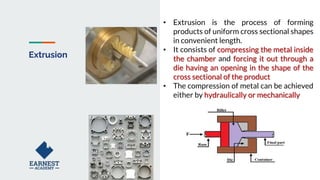
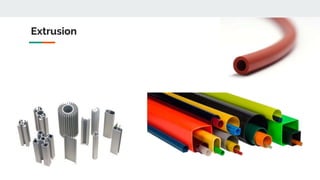
• Extrusion is the process of forming
products of uniform cross sectional shapes
in convenient length.
• It consists of compressing the metal inside
the chamber and forcing it out through a
die having an opening in the shape of the
cross sectional of the product
• The compression of metal can be achieved
either by hydraulically or mechanically
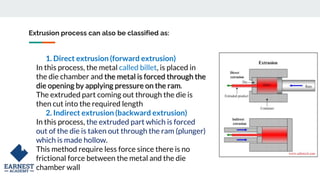
Extrusion process can also be classified as:
1. Direct extrusion (forward extrusion)
In this process, the metal called billet, is placed in
the die chamber and the metal is forced through the
die opening by applying pressure on the ram.
The extruded part coming out through the die is
then cut into the required length
2. Indirect extrusion (backward extrusion)
In this process, the extruded part which is forced
out of the die is taken out through the ram (plunger)
which is made hollow.
This method require less force since there is no
frictional force between the metal and the die
chamber wall
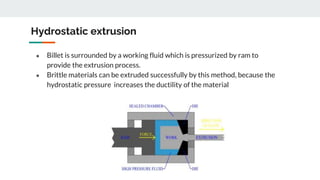
Hydrostatic extrusion
● Billet is surrounded by a working fluid which is pressurized by ram to
provide the extrusion process.
● Brittle materials can be extruded successfully by this method, because the
hydrostatic pressure increases the ductility of the material
Impact Extrusion
● Here cold billet is used and the process is carried out at a higher velocity
● The punch descends rapidly on the blank (slug), which is extruded backwards
Applications
● Collapsible medical tubes and Toothpaste tubes are made in this way
Extrusion force
Extrusion
Extrusion defects
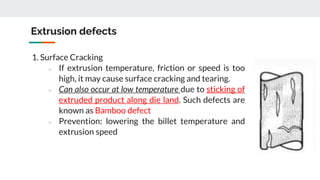
1. Surface Cracking
○ If extrusion temperature, friction or speed is too
high, it may cause surface cracking and tearing.
○ Can also occur at low temperature due to sticking of
extruded product along die land. Such defects are
known as Bamboo defect
○ Prevention: lowering the billet temperature and
extrusion speed
Extrusion defects
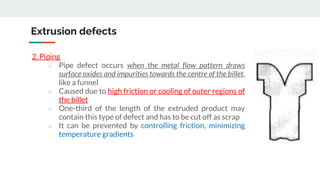
2. Piping
○ Pipe defect occurs when the metal flow pattern draws
surface oxides and impurities towards the centre of the billet,
like a funnel
○ Caused due to high friction or cooling of outer regions of
the billet
○ One-third of the length of the extruded product may
contain this type of defect and has to be cut off as scrap
○ It can be prevented by controlling friction, minimizing
temperature gradients
Extrusion defects
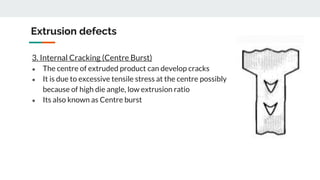
3. Internal Cracking (Centre Burst)
● The centre of extruded product can develop cracks
● It is due to excessive tensile stress at the centre possibly
because of high die angle, low extrusion ratio
● Its also known as Centre burst
DRAWING
• In drawing, the cross section of a long rod or wire is reduced or changed by pulling
(hence the term drawing) it through a die called a draw die
• Thus, the difference between drawing and extrusion is that in extrusion the material is
pushed through a die, whereas in drawing it is pulled through it.
14
Types
• Wire,
• Rod,
• and tube drawing The die angle, the reductionin cross-sectional
area per pass,the speed of drawing,thetemperature,and the lubricationall affect the drawing
force, F.
Drawing Force
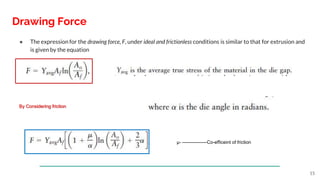
● The expression for the drawing force, F, under ideal and frictionless conditions is similar to that for extrusion and
is given by the equation
15
By Considering friction
μ- ----------------Co-efficeint of friction
Deep Drawing
● Deep drawing is a sheet metal forming process.
● Deep drawing is a process of converting metal sheet into cylindrical or box shaped
structure with or without changing its length and thickness.
● Many cylindrical parts like metal can, pots, container for food and beverages, kitchen sinks,
automobile fuel tank etc. are deep drawing product.
16
● The blank is placed over an open circular die
with the help of blank holder.
● The blank holder provides a necessary force to
hold the blank.
● The punch which is attached with a mechanical
or hydraulic press moves downward and
provide a necessary drawing force at blank.
● This force tends to deform metal sheet and
forces it into the die cavity and convert it into a
cup shape structure.
● If this force is high it causes elongation of cup
wall to thin and if excessive, it causes tearing of
sheet.
● So the punch force should remain a certain limit
to avoid tearing during operation.
17
Shearing Operation
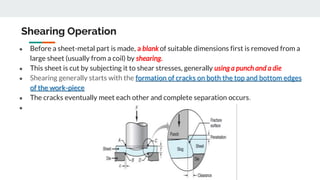
● Before a sheet-metal part is made, a blank of suitable dimensions first is removed from a
large sheet (usually from a coil) by shearing.
● This sheet is cut by subjecting it to shear stresses, generally using a punch and a die
● Shearing generally starts with the formation of cracks on both the top and bottom edges
of the work-piece
● The cracks eventually meet each other and complete separation occurs.
●
Punch force
● The maximum punch force, F, can be estimated from the equation
Where T is the sheet thickness, L is the total length sheared [L= ∏ x D]
(such as the perimeter of a hole), and UTS is the ultimate tensile strength of the
material.
Shearing operations
● Blanking is the process of cutting sheet
metal along a close outline in a single step
● Here the part cut out from the sheet is
called blank and it is the desired product and
the remaining portion is discarded
● Piercing or Punching is similar to
blanking except that the part cut and
separated is (slug) discarded
Bending
● Bending: forming process causes the sheet metal to undergo the desired
shape change by bending without failure
Bending Terminology
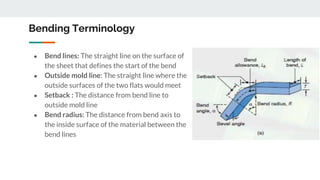
● Bend lines: The straight line on the surface of
the sheet that defines the start of the bend
● Outside mold line: The straight line where the
outside surfaces of the two flats would meet
● Setback : The distance from bend line to
outside mold line
● Bend radius: The distance from bend axis to
the inside surface of the material between the
bend lines
01. Which of the following statement is not true
about hot working
A No strain hardening B Better dimension control
C Less force required
D Even brittle material can be
forged
02. Bamboo defect is related to
A Casting B Bending
C Welding D Extrusion
03. The semi finishing operation in forging is known
as
A Fullering B Edging
C Blocking D Trimming
04. A 4mm thick metal sheet is to be bend at an
angle of 4 radian with bend radius 100mm if stretch
factor is 0.4, the bend allowance is
A 406.4 mm B 176.2 mm
C 72.04 mm D 101.6 mm
Thankyou……

AP- Class _ Extrusion.pptx

  • 1.
  • 2.
    MODULE – VI- MANUFACTURING SCIENCE AND PROCESSES Classification of materials, Structure and properties of common engineering materials, Crystalline materials, crystal structure, defects in crystals, phase diagrams, iron carbon equilibrium diagram, Phase transformation, T-T-T diagram, heat treatment, fracture – brittle and ductile materials, powder metallurgy. Metal casting – stand casting, die casting, investment casting, centrifugal casting, gating and riser design, melting furnaces, forming – hot and cold processes, forging, drawing, extrusion, shearing, bending, high energy forming, joining processes – welding, weldability, metallurgy of welding, machining processes – single and multi point cutting tools, tool geometry and materials, mechanics of machining, tool life and wear, jigs and fixtures, unconventional methods, EBM, ECM, LBM, ultrasonic machining, computer integrated manufacturing, CNC machining, metrology and instrumentation – limits, fits and tolerances, accuracy, precision, repeatability, comparators, gauges, interferometry, surface structure, measurement of displacement, velocity, acceleration, temperature, Transducers
  • 3.
  • 4.
    Metal Forming • Metalforming is a process where materials are subjected to plastic deformation to obtain the required size, shape • The stress applying on material should be greater than yield stress of the material • Common metal forming process are rolling, forging, drawing, extrusion etc. • Mechanism of metal forming- Flow of material in a direction of force applied
  • 5.
    Extrusion • Extrusion isthe process of forming products of uniform cross sectional shapes in convenient length. • It consists of compressing the metal inside the chamber and forcing it out through a die having an opening in the shape of the cross sectional of the product • The compression of metal can be achieved either by hydraulically or mechanically
  • 6.
    Extrusion process canalso be classified as: 1. Direct extrusion (forward extrusion) In this process, the metal called billet, is placed in the die chamber and the metal is forced through the die opening by applying pressure on the ram. The extruded part coming out through the die is then cut into the required length 2. Indirect extrusion (backward extrusion) In this process, the extruded part which is forced out of the die is taken out through the ram (plunger) which is made hollow. This method require less force since there is no frictional force between the metal and the die chamber wall
  • 7.
    Hydrostatic extrusion ● Billetis surrounded by a working fluid which is pressurized by ram to provide the extrusion process. ● Brittle materials can be extruded successfully by this method, because the hydrostatic pressure increases the ductility of the material
  • 8.
    Impact Extrusion ● Herecold billet is used and the process is carried out at a higher velocity ● The punch descends rapidly on the blank (slug), which is extruded backwards Applications ● Collapsible medical tubes and Toothpaste tubes are made in this way
  • 9.
  • 10.
  • 11.
    Extrusion defects 1. SurfaceCracking ○ If extrusion temperature, friction or speed is too high, it may cause surface cracking and tearing. ○ Can also occur at low temperature due to sticking of extruded product along die land. Such defects are known as Bamboo defect ○ Prevention: lowering the billet temperature and extrusion speed
  • 12.
    Extrusion defects 2. Piping ○Pipe defect occurs when the metal flow pattern draws surface oxides and impurities towards the centre of the billet, like a funnel ○ Caused due to high friction or cooling of outer regions of the billet ○ One-third of the length of the extruded product may contain this type of defect and has to be cut off as scrap ○ It can be prevented by controlling friction, minimizing temperature gradients
  • 13.
    Extrusion defects 3. InternalCracking (Centre Burst) ● The centre of extruded product can develop cracks ● It is due to excessive tensile stress at the centre possibly because of high die angle, low extrusion ratio ● Its also known as Centre burst
  • 14.
    DRAWING • In drawing,the cross section of a long rod or wire is reduced or changed by pulling (hence the term drawing) it through a die called a draw die • Thus, the difference between drawing and extrusion is that in extrusion the material is pushed through a die, whereas in drawing it is pulled through it. 14 Types • Wire, • Rod, • and tube drawing The die angle, the reductionin cross-sectional area per pass,the speed of drawing,thetemperature,and the lubricationall affect the drawing force, F.
  • 15.
    Drawing Force ● Theexpression for the drawing force, F, under ideal and frictionless conditions is similar to that for extrusion and is given by the equation 15 By Considering friction μ- ----------------Co-efficeint of friction
  • 16.
    Deep Drawing ● Deepdrawing is a sheet metal forming process. ● Deep drawing is a process of converting metal sheet into cylindrical or box shaped structure with or without changing its length and thickness. ● Many cylindrical parts like metal can, pots, container for food and beverages, kitchen sinks, automobile fuel tank etc. are deep drawing product. 16
  • 17.
    ● The blankis placed over an open circular die with the help of blank holder. ● The blank holder provides a necessary force to hold the blank. ● The punch which is attached with a mechanical or hydraulic press moves downward and provide a necessary drawing force at blank. ● This force tends to deform metal sheet and forces it into the die cavity and convert it into a cup shape structure. ● If this force is high it causes elongation of cup wall to thin and if excessive, it causes tearing of sheet. ● So the punch force should remain a certain limit to avoid tearing during operation. 17
  • 18.
    Shearing Operation ● Beforea sheet-metal part is made, a blank of suitable dimensions first is removed from a large sheet (usually from a coil) by shearing. ● This sheet is cut by subjecting it to shear stresses, generally using a punch and a die ● Shearing generally starts with the formation of cracks on both the top and bottom edges of the work-piece ● The cracks eventually meet each other and complete separation occurs. ●
  • 19.
    Punch force ● Themaximum punch force, F, can be estimated from the equation Where T is the sheet thickness, L is the total length sheared [L= ∏ x D] (such as the perimeter of a hole), and UTS is the ultimate tensile strength of the material.
  • 20.
    Shearing operations ● Blankingis the process of cutting sheet metal along a close outline in a single step ● Here the part cut out from the sheet is called blank and it is the desired product and the remaining portion is discarded ● Piercing or Punching is similar to blanking except that the part cut and separated is (slug) discarded
  • 21.
    Bending ● Bending: formingprocess causes the sheet metal to undergo the desired shape change by bending without failure
  • 22.
    Bending Terminology ● Bendlines: The straight line on the surface of the sheet that defines the start of the bend ● Outside mold line: The straight line where the outside surfaces of the two flats would meet ● Setback : The distance from bend line to outside mold line ● Bend radius: The distance from bend axis to the inside surface of the material between the bend lines
  • 23.
    01. Which ofthe following statement is not true about hot working A No strain hardening B Better dimension control C Less force required D Even brittle material can be forged
  • 24.
    02. Bamboo defectis related to A Casting B Bending C Welding D Extrusion
  • 25.
    03. The semifinishing operation in forging is known as A Fullering B Edging C Blocking D Trimming
  • 26.
    04. A 4mmthick metal sheet is to be bend at an angle of 4 radian with bend radius 100mm if stretch factor is 0.4, the bend allowance is A 406.4 mm B 176.2 mm C 72.04 mm D 101.6 mm
  • 27.