Assignment – I &  Class Test – I  Examples ME0223 SEM-IV Applied Thermodynamics & Heat Engines Applied Thermodynamics & Heat Engines S.Y. B. Tech. ME0223 SEM - IV Production Engineering
ME0223 SEM-IV Applied Thermodynamics & Heat Engines Example 1 A turbine is supplied with steam at a gauge pressure of 1.4 MPa. After expansion in the turbine, the steam flows into a condenser which is maintained at a vacuum of 710 mm of Hg. The barometric pressure is 772 mm Hg. Express the inlet and exhaust steam pressures in Pascal (absolute).Take the density of mercury as 13.6 X 10 3 kg/m 3 . The Atmospheric Pressure, P 0  =  ρ .g.z 0  =  (13.6 X 10 3 ).(9.81).(0.772)   kg/m 3   m/sec 2   mtr   = 1.03 X 10 5  Pa Inlet Steam Pressure, P i  =  [(1.4 X 10 6 ) +  (1.03 X 10 5 )] Pa   =  15.05 X 10 5  Pa = 1.503 MPa ….. Ans Outlet Steam Pressure, (i.e. Condenser Pressure) P 0 =  (0.772 – 0.710).(9.81).(13.6 X 10³)   mtr  m/sec 2   kg/m 3 = 8.27 kPa ….. Ans
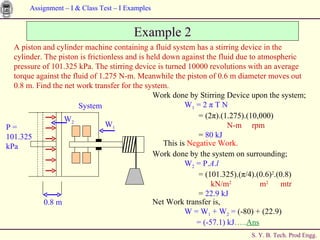
Example 2 Work done by Stirring Device upon the system; W 1  = 2  π  T N   = (2 π ).(1.275).(10,000)   N-m  rpm   =  80 kJ A piston and cylinder machine containing a fluid system has a stirring device in the cylinder. The piston is frictionless and is held down against the fluid due to atmospheric pressure of 101.325 kPa. The stirring device is turned 10000 revolutions with an average torque against the fluid of 1.275 N-m. Meanwhile the piston of 0.6 m diameter moves out 0.8 m. Find the net work transfer for the system. This is  Negative Work.   Work done by the system on surrounding; W 2  = P. A . l   = (101.325).( π /4).(0.6) 2 .(0.8)   kN/m 2   m 2   mtr   =  22.9 kJ Net Work transfer is, W = W 1  + W 2  =  (-80) + (22.9)   = (-57.1) kJ ….. Ans W 1 0.8 m W 2 P =  101.325  kPa System
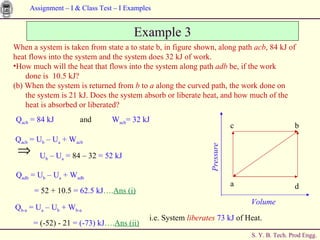
Example 3 When a system is taken from state a to state b, in figure shown, along path  acb , 84 kJ of heat flows into the system and the system does 32 kJ of work.  How much will the heat that flows into the system along path  adb  be, if the work  done is  10.5 kJ? (b) When the system is returned from  b  to  a  along the curved path, the work done on  the system is 21 kJ. Does the system absorb or liberate heat, and how much of the  heat is absorbed or liberated? Q acb  = 84 kJ and  W acb = 32 kJ Volume Pressure Q adb  = U b  – U a  + W adb =  52 + 10.5  = 62.5 kJ …. Ans (i) a d b c Q acb  = U b  – U a  + W acb U b  – U a  =  84 – 32  = 52 kJ Q b-a  = U a  – U b  + W b-a =  (-52) - 21  = (-73) kJ …. Ans (ii) i.e. System   liberates  73 kJ  of Heat.
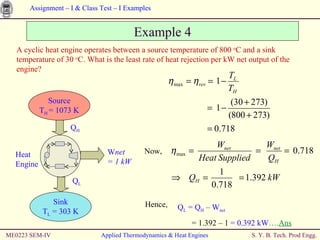
ME0223 SEM-IV Applied Thermodynamics & Heat Engines Example 4 A cyclic heat engine operates between a source temperature of 800  o C and a sink temperature of 30  o C. What is the least rate of heat rejection per kW net output of the engine? Source T H  = 1073 K W net = 1 kW   Q H   Q L   Heat  Engine Sink T L  = 303 K Now, Hence, Q L  = Q H  – W net   = 1.392 – 1  = 0.392 kW …. Ans
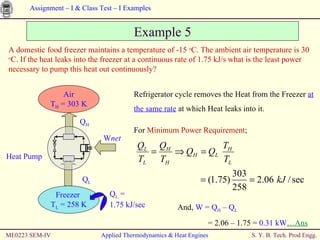
ME0223 SEM-IV Applied Thermodynamics & Heat Engines Example 5 A domestic food freezer maintains a temperature of -15  o C. The ambient air temperature is 30  o C. If the heat leaks into the freezer at a continuous rate of 1.75 kJ/s what is the least power necessary to pump this heat out continuously? And,  W = Q H  – Q L   = 2.06 – 1.75 =  0.31 kW …Ans Refrigerator cycle removes the Heat from the Freezer  at the same rate  at which Heat leaks into it. For  Minimum Power Requirement ; Air T H  = 303 K W net   Q H   Q L   Heat Pump Freezer  T L  = 258 K Q L  =  1.75 kJ/sec
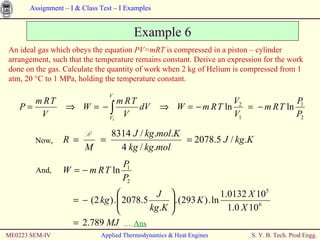
ME0223 SEM-IV Applied Thermodynamics & Heat Engines Example 6 An ideal gas which obeys the equation  PV=mRT  is compressed in a piston – cylinder arrangement, such that the temperature remains constant. Derive an expression for the work done on the gas. Calculate the quantity of work when 2 kg of Helium is compressed from 1 atm, 20 °C to 1 MPa, holding the temperature constant. Now, .… Ans And,
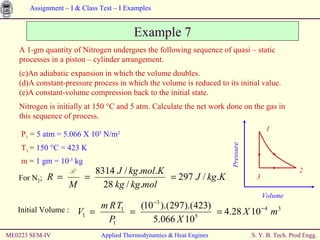
ME0223 SEM-IV Applied Thermodynamics & Heat Engines Example 7 A 1-gm quantity of Nitrogen undergoes the following sequence of quasi – static processes in a piston – cylinder arrangement. An adiabatic expansion in which the volume doubles. A constant-pressure process in which the volume is reduced to its initial value. A constant-volume compression back to the initial state. Nitrogen is initially at 150 °C and 5 atm. Calculate the net work done on the gas in  this sequence of process. P 1   =  5 atm = 5.066 X 10 5  N/m 2 T 1   =  150 °C = 423 K m  =  1 gm = 10 -3  kg Initial Volume : For N 2 ; Pressure Volume 1 2 3
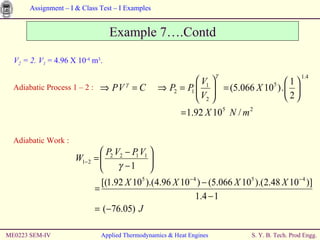
ME0223 SEM-IV Applied Thermodynamics & Heat Engines Example 7….Contd V 2  = 2. V 1   = 4.96 X 10 -4  m 3 . Adiabatic Process 1 – 2 : Adiabatic Work :
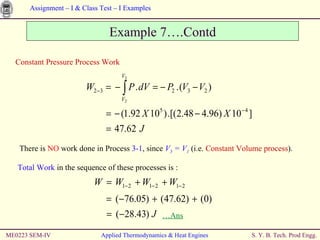
ME0223 SEM-IV Applied Thermodynamics & Heat Engines Example 7….Contd There is  NO  work done in Process  3-1 , since  V 3  = V 1  (i.e.  Constant Volume process ). Total Work  in the sequence of these processes is : Constant Pressure Process Work … Ans

Thermodynamics Examples and Class test

  • 1.
    Assignment – I& Class Test – I Examples ME0223 SEM-IV Applied Thermodynamics & Heat Engines Applied Thermodynamics & Heat Engines S.Y. B. Tech. ME0223 SEM - IV Production Engineering
  • 2.
    ME0223 SEM-IV AppliedThermodynamics & Heat Engines Example 1 A turbine is supplied with steam at a gauge pressure of 1.4 MPa. After expansion in the turbine, the steam flows into a condenser which is maintained at a vacuum of 710 mm of Hg. The barometric pressure is 772 mm Hg. Express the inlet and exhaust steam pressures in Pascal (absolute).Take the density of mercury as 13.6 X 10 3 kg/m 3 . The Atmospheric Pressure, P 0 = ρ .g.z 0 = (13.6 X 10 3 ).(9.81).(0.772) kg/m 3 m/sec 2 mtr = 1.03 X 10 5 Pa Inlet Steam Pressure, P i = [(1.4 X 10 6 ) + (1.03 X 10 5 )] Pa = 15.05 X 10 5 Pa = 1.503 MPa ….. Ans Outlet Steam Pressure, (i.e. Condenser Pressure) P 0 = (0.772 – 0.710).(9.81).(13.6 X 10³) mtr m/sec 2 kg/m 3 = 8.27 kPa ….. Ans
  • 3.
    Example 2 Workdone by Stirring Device upon the system; W 1 = 2 π T N = (2 π ).(1.275).(10,000) N-m rpm = 80 kJ A piston and cylinder machine containing a fluid system has a stirring device in the cylinder. The piston is frictionless and is held down against the fluid due to atmospheric pressure of 101.325 kPa. The stirring device is turned 10000 revolutions with an average torque against the fluid of 1.275 N-m. Meanwhile the piston of 0.6 m diameter moves out 0.8 m. Find the net work transfer for the system. This is Negative Work. Work done by the system on surrounding; W 2 = P. A . l = (101.325).( π /4).(0.6) 2 .(0.8) kN/m 2 m 2 mtr = 22.9 kJ Net Work transfer is, W = W 1 + W 2 = (-80) + (22.9) = (-57.1) kJ ….. Ans W 1 0.8 m W 2 P = 101.325 kPa System
  • 4.
    Example 3 Whena system is taken from state a to state b, in figure shown, along path acb , 84 kJ of heat flows into the system and the system does 32 kJ of work. How much will the heat that flows into the system along path adb be, if the work done is 10.5 kJ? (b) When the system is returned from b to a along the curved path, the work done on the system is 21 kJ. Does the system absorb or liberate heat, and how much of the heat is absorbed or liberated? Q acb = 84 kJ and W acb = 32 kJ Volume Pressure Q adb = U b – U a + W adb = 52 + 10.5 = 62.5 kJ …. Ans (i) a d b c Q acb = U b – U a + W acb U b – U a = 84 – 32 = 52 kJ Q b-a = U a – U b + W b-a = (-52) - 21 = (-73) kJ …. Ans (ii) i.e. System liberates 73 kJ of Heat.
  • 5.
    ME0223 SEM-IV AppliedThermodynamics & Heat Engines Example 4 A cyclic heat engine operates between a source temperature of 800 o C and a sink temperature of 30 o C. What is the least rate of heat rejection per kW net output of the engine? Source T H = 1073 K W net = 1 kW Q H Q L Heat Engine Sink T L = 303 K Now, Hence, Q L = Q H – W net = 1.392 – 1 = 0.392 kW …. Ans
  • 6.
    ME0223 SEM-IV AppliedThermodynamics & Heat Engines Example 5 A domestic food freezer maintains a temperature of -15 o C. The ambient air temperature is 30 o C. If the heat leaks into the freezer at a continuous rate of 1.75 kJ/s what is the least power necessary to pump this heat out continuously? And, W = Q H – Q L = 2.06 – 1.75 = 0.31 kW …Ans Refrigerator cycle removes the Heat from the Freezer at the same rate at which Heat leaks into it. For Minimum Power Requirement ; Air T H = 303 K W net Q H Q L Heat Pump Freezer T L = 258 K Q L = 1.75 kJ/sec
  • 7.
    ME0223 SEM-IV AppliedThermodynamics & Heat Engines Example 6 An ideal gas which obeys the equation PV=mRT is compressed in a piston – cylinder arrangement, such that the temperature remains constant. Derive an expression for the work done on the gas. Calculate the quantity of work when 2 kg of Helium is compressed from 1 atm, 20 °C to 1 MPa, holding the temperature constant. Now, .… Ans And,
  • 8.
    ME0223 SEM-IV AppliedThermodynamics & Heat Engines Example 7 A 1-gm quantity of Nitrogen undergoes the following sequence of quasi – static processes in a piston – cylinder arrangement. An adiabatic expansion in which the volume doubles. A constant-pressure process in which the volume is reduced to its initial value. A constant-volume compression back to the initial state. Nitrogen is initially at 150 °C and 5 atm. Calculate the net work done on the gas in this sequence of process. P 1 = 5 atm = 5.066 X 10 5 N/m 2 T 1 = 150 °C = 423 K m = 1 gm = 10 -3 kg Initial Volume : For N 2 ; Pressure Volume 1 2 3
  • 9.
    ME0223 SEM-IV AppliedThermodynamics & Heat Engines Example 7….Contd V 2 = 2. V 1 = 4.96 X 10 -4 m 3 . Adiabatic Process 1 – 2 : Adiabatic Work :
  • 10.
    ME0223 SEM-IV AppliedThermodynamics & Heat Engines Example 7….Contd There is NO work done in Process 3-1 , since V 3 = V 1 (i.e. Constant Volume process ). Total Work in the sequence of these processes is : Constant Pressure Process Work … Ans