Thread milling
NOMENCLATURE


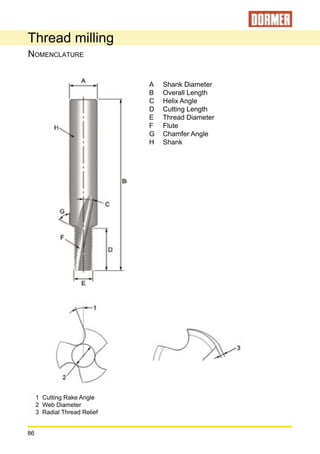
                              A   Shank Diameter
                              B   Overall Length
                              C   Helix Angle
                              D   Cutting Length
                              E   Thread Diameter
                              F   Flute
                              G   Chamfer Angle
                              H   Shank


     1 Cutting Rake Angle
     2 Web Diameter
     3 Radial Thread Relief


86
Thread milling
GENERAL HINTS ON THREAD MILLING
Thread milling is a method of producing a thread with a milling operation.
To make this possible, you need a CNC-machine which can make helical paths, (run in
3 directions). Consult your manual or contact your machine supplier for information. You
can also write your own sub-program for the thread milling operation.

1.   Run the application in the Product Selector and you will get a suggestion of
     the thread milling cutter best suited for the application, with cutting data and a
     CNC program optimised for the application. The CNC program can be produced
     according to the most common systems, including DIN66025(ISO), Heidenhain,
     Fanuc and Siemens.

2.   Use recommended drill sizes for the thread diameter, as for conventional taps.

3.   For easy adjustments of the thread tolerance, always program with radius
     correction. Start value Rprg is printed on the cutter. If a tolerance is selected in the
     Product Selector you will also get a recommendation of how much to adjust the Rprg
     value.

4.   Use a gauge to check the tolerance on the first thread and then regularly to get an
     indication if the radius needs to be corrected. The radius can normally be corrected
     2-3 times before the thread milling cutter is worn out.

5.   When dry machining is used, it is recommended to blow away the chips with
     compressed air.

6.   When working with more difficult materials, it is recommended that the thread milling
     operation be done in 2 or 3 passes. The Product Selector gives you the choice of
     generating a CNC-program dividing the cut by a half or 1/3 (2 or 3 passes).

ADVANTAGES OF THREAD MILLING COMPARED TO CONVENTIONAL THREADING

-    Thread milling gives increased reliability, namely:
     •   Smaller chips.
     •   Tolerance adjustments can be made using exact calculations.
     •   Full thread to the bottom of the hole.
-    Longer tool life.
-    Suitable for most materials.
-    The same cutter can be used for many diameters, as long as the pitch is the same.
-    The same tool can be used both for left and right hand internal threads, and G can
     be used for both internal and external threads.
-    Enables dry machining.
-    The countersink on the metric tool makes it possible to chamfer.
-    Conical threads with the possibility to chamfer with a superior quality and accuracy
     compared to conventional taps.

                                                                                          87
Thread milling
OTHER FACTS ABOUT THREAD MILLING

-    Thread milling is a slow process and time savings are apparent on larger
     dimensions. However, the quality of finish and accuracy achieved can greatly
     compensate for the speed of the production process.
-    Thread depth is limited to 2 x Diameter for metric and 1.5 x Diameter on Metric
     Fine and G.
-    It is possible to regrind the cutter on the rake side (see regrinding section).

CHOOSING YOUR TOOL

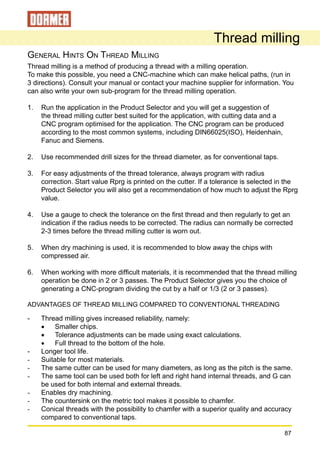
All thread milling cutters have an Item Code based on the type, diameter (d1) and the
pitch (P). The item code is the number to use when ordering your tool. Always consult
the Catalogue/Product Selector for correct thread dimension of tool.


This thread milling cutter can be used for threads ≥ M12x1.5 (M14x1.5, M16x1.5 etc)


88
Thread milling
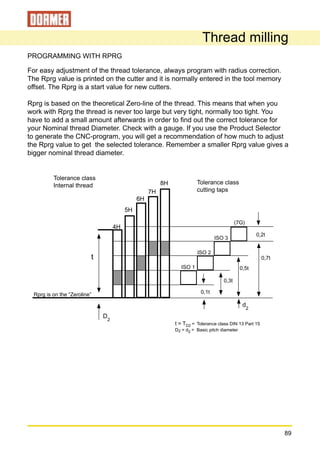
PROGRAMMING WITH RPRG

For easy adjustment of the thread tolerance, always program with radius correction.
The Rprg value is printed on the cutter and it is normally entered in the tool memory
offset. The Rprg is a start value for new cutters.

Rprg is based on the theoretical Zero-line of the thread. This means that when you
work with Rprg the thread is never too large but very tight, normally too tight. You
have to add a small amount afterwards in order to find out the correct tolerance for
your Nominal thread Diameter. Check with a gauge. If you use the Product Selector
to generate the CNC-program, you will get a recommendation of how much to adjust
the Rprg value to get the selected tolerance. Remember a smaller Rprg value gives a
bigger nominal thread diameter.


          Tolerance class
          Internal thread                              8H              Tolerance class
                                                  7H                   cutting taps
                                             6H
                                        5H

                                                                                          (7G)
                                   4H
                                                                                                    0,2t
                                                                               ISO 3

                                                                       ISO 2
                          t                                                                            0,7t
                                                               ISO 1                         0,5t

                                                                                   0,3t

  Rprg is on the “Zeroline”                                             0,1t

                                                                                              d2
                              D2
                                                            t = TD2 = Tolerance class DIN 13 Part 15
                                                            D2 = d2 = Basic pitch diameter


                                                                                                              89
Thread milling
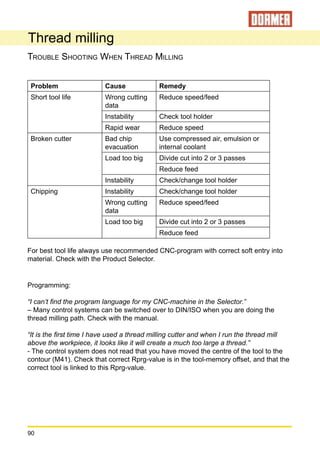
TROUBLE SHOOTING WHEN THREAD MILLING


 Problem                  Cause             Remedy
 Short tool life          Wrong cutting     Reduce speed/feed
                          data
                          Instability       Check tool holder
                          Rapid wear        Reduce speed
 Broken cutter            Bad chip          Use compressed air, emulsion or
                          evacuation        internal coolant
                          Load too big      Divide cut into 2 or 3 passes
                                            Reduce feed
                          Instability       Check/change tool holder
 Chipping                 Instability       Check/change tool holder
                          Wrong cutting     Reduce speed/feed
                          data
                          Load too big      Divide cut into 2 or 3 passes
                                            Reduce feed

For best tool life always use recommended CNC-program with correct soft entry into
material. Check with the Product Selector.


Programming:

“I can’t find the program language for my CNC-machine in the Selector.”
– Many control systems can be switched over to DIN/ISO when you are doing the
thread milling path. Check with the manual.

“It is the first time I have used a thread milling cutter and when I run the thread mill
above the workpiece, it looks like it will create a much too large a thread.”
- The control system does not read that you have moved the centre of the tool to the
contour (M41). Check that correct Rprg-value is in the tool-memory offset, and that the
correct tool is linked to this Rprg-value.


90
91

6 threadmilling

  • 1.
    Thread milling NOMENCLATURE A Shank Diameter B Overall Length C Helix Angle D Cutting Length E Thread Diameter F Flute G Chamfer Angle H Shank 1 Cutting Rake Angle 2 Web Diameter 3 Radial Thread Relief 86
  • 2.
    Thread milling GENERAL HINTSON THREAD MILLING Thread milling is a method of producing a thread with a milling operation. To make this possible, you need a CNC-machine which can make helical paths, (run in 3 directions). Consult your manual or contact your machine supplier for information. You can also write your own sub-program for the thread milling operation. 1. Run the application in the Product Selector and you will get a suggestion of the thread milling cutter best suited for the application, with cutting data and a CNC program optimised for the application. The CNC program can be produced according to the most common systems, including DIN66025(ISO), Heidenhain, Fanuc and Siemens. 2. Use recommended drill sizes for the thread diameter, as for conventional taps. 3. For easy adjustments of the thread tolerance, always program with radius correction. Start value Rprg is printed on the cutter. If a tolerance is selected in the Product Selector you will also get a recommendation of how much to adjust the Rprg value. 4. Use a gauge to check the tolerance on the first thread and then regularly to get an indication if the radius needs to be corrected. The radius can normally be corrected 2-3 times before the thread milling cutter is worn out. 5. When dry machining is used, it is recommended to blow away the chips with compressed air. 6. When working with more difficult materials, it is recommended that the thread milling operation be done in 2 or 3 passes. The Product Selector gives you the choice of generating a CNC-program dividing the cut by a half or 1/3 (2 or 3 passes). ADVANTAGES OF THREAD MILLING COMPARED TO CONVENTIONAL THREADING - Thread milling gives increased reliability, namely: • Smaller chips. • Tolerance adjustments can be made using exact calculations. • Full thread to the bottom of the hole. - Longer tool life. - Suitable for most materials. - The same cutter can be used for many diameters, as long as the pitch is the same. - The same tool can be used both for left and right hand internal threads, and G can be used for both internal and external threads. - Enables dry machining. - The countersink on the metric tool makes it possible to chamfer. - Conical threads with the possibility to chamfer with a superior quality and accuracy compared to conventional taps. 87
  • 3.
    Thread milling OTHER FACTSABOUT THREAD MILLING - Thread milling is a slow process and time savings are apparent on larger dimensions. However, the quality of finish and accuracy achieved can greatly compensate for the speed of the production process. - Thread depth is limited to 2 x Diameter for metric and 1.5 x Diameter on Metric Fine and G. - It is possible to regrind the cutter on the rake side (see regrinding section). CHOOSING YOUR TOOL All thread milling cutters have an Item Code based on the type, diameter (d1) and the pitch (P). The item code is the number to use when ordering your tool. Always consult the Catalogue/Product Selector for correct thread dimension of tool. This thread milling cutter can be used for threads ≥ M12x1.5 (M14x1.5, M16x1.5 etc) 88
  • 4.
    Thread milling PROGRAMMING WITHRPRG For easy adjustment of the thread tolerance, always program with radius correction. The Rprg value is printed on the cutter and it is normally entered in the tool memory offset. The Rprg is a start value for new cutters. Rprg is based on the theoretical Zero-line of the thread. This means that when you work with Rprg the thread is never too large but very tight, normally too tight. You have to add a small amount afterwards in order to find out the correct tolerance for your Nominal thread Diameter. Check with a gauge. If you use the Product Selector to generate the CNC-program, you will get a recommendation of how much to adjust the Rprg value to get the selected tolerance. Remember a smaller Rprg value gives a bigger nominal thread diameter. Tolerance class Internal thread 8H Tolerance class 7H cutting taps 6H 5H (7G) 4H 0,2t ISO 3 ISO 2 t 0,7t ISO 1 0,5t 0,3t Rprg is on the “Zeroline” 0,1t d2 D2 t = TD2 = Tolerance class DIN 13 Part 15 D2 = d2 = Basic pitch diameter 89
  • 5.
    Thread milling TROUBLE SHOOTINGWHEN THREAD MILLING Problem Cause Remedy Short tool life Wrong cutting Reduce speed/feed data Instability Check tool holder Rapid wear Reduce speed Broken cutter Bad chip Use compressed air, emulsion or evacuation internal coolant Load too big Divide cut into 2 or 3 passes Reduce feed Instability Check/change tool holder Chipping Instability Check/change tool holder Wrong cutting Reduce speed/feed data Load too big Divide cut into 2 or 3 passes Reduce feed For best tool life always use recommended CNC-program with correct soft entry into material. Check with the Product Selector. Programming: “I can’t find the program language for my CNC-machine in the Selector.” – Many control systems can be switched over to DIN/ISO when you are doing the thread milling path. Check with the manual. “It is the first time I have used a thread milling cutter and when I run the thread mill above the workpiece, it looks like it will create a much too large a thread.” - The control system does not read that you have moved the centre of the tool to the contour (M41). Check that correct Rprg-value is in the tool-memory offset, and that the correct tool is linked to this Rprg-value. 90
  • 6.