1
M EC H A N I C A L WO R K I N G
P RO C E S S E S E - N OT E S
M U KU L D E V K H U N T E
M E TA L L U R G Y 5 T H S E M
R O L L N O - 0 1 U G 1 5 0 5 0 0 2 3
O P J I N D A L U N I V E R S I T Y R A I G A R H
C H H A T T I S G A R H
UNIT-1
IN THIS SECTION:
• Fundamental concept of metal forming
• flow stress
• yield criteria
• Von-mises theory
• Tresca Criterion
• classification of metal forming operations on the basis
of cold, hot &warm working
• effect of variables
• friction
• lubricants
• strain rate and strain rate sensitivity
Fundamental Concept Of Metal Forming
Metal forming: Large set of manufacturing processes in which the material is deformed plastically to
take the shape of the die geometry. The tools used for such deformation are called die, punch etc.
depending on the type of process.
Materials are converted into finished products though different manufacturing processes.
Manufacturing processes are classified into shaping [casting], forming, joining, and coating, dividing,
machining and modifying material property.
Classification Of Forming
metal forming processes can be classified into two broad groups. One is bulk forming and the other is
sheet metal forming. Bulk deformation refers to the use of raw materials for forming which have low
surface area to volume ratio. Rolling, forging, extrusion and drawing are bulk forming processes. In
bulk deformation processing methods, the nature of force applied may be compressive, compressive
and tensile, shear or a combination of these forces.
Bulk forming is accomplished in forming presses with the help of a set of tool and die. Examples for
products produced by bulk forming are: gears, bushed, valves, engine parts such as valves, connecting
rods, hydraulic valves, etc.
Sheet metal forming involves application of tensile or shear forces predominantly. Working upon
sheets, plates and strips mainly constitutes sheet forming. Sheet metal operations are mostly carried
out in presses – hydraulic or pneumatic. A set of tools called die and punch are used for the sheet
working operations. Bending, drawing, shearing, blanking, punching are some of the sheet metal
operations.
Forming processes
Forming processes tend to be categorised by differences in effective stresses. These categories and
descriptions are highly simplified, since the stresses operating at a local level in any given process are
very complex and may involve many varieties of stresses operating simultaneously, or it may involve
stresses which change over the course of the operation.
Compressive forming involves those processes where the primary means of plastic deformation is
uni- or multiaxial compressive loading.
• Rolling, where the material is passed through a pair of rollers
• Extrusion, where the material is pushed through an orifice
• Die forming, where the material is stamped by a press around or onto a die
• Forging, where the material is shaped by localized compressive forces
• Indenting, where a tool is pressed into the workpiece
Tensile forming
Tensile forming involves those processes where the primary means of plastic deformation is uni- or
multiaxial tensile stress.
• Stretching, where a tensile load is applied along the longitudinal axis of the workpiece
• Expanding, where the circumference of a hollow body is increased by tangential loading
• Recessing, where depressions and holes are formed through tensile loading
Combined tensile and compressive forming
This category of forming processes involves those operations where the primary means of plastic
deformation involves both tensile stresses and compressive loads.
• Pulling through a die
• Deep drawing
• Spinning
• Flange forming
• Upset bulging
Bending
This category of forming processes involves those operations where the primary means of plastic
deformation is a bending load.
Shearing
This category of forming processes involves those operations where the primary means of plastic
deformation is a shearing load.
Material considerations
Material Behavior
In the plastic region, the metal behavior is expressed by the flow curve:
σ = Κεn
where K is the strength coefficient and n is the strain-hardening (or work-hardening) exponent. K and
n are given in the tables of material properties or are calculated from the material testing curves.
Flow stress
For some metalworking calculations, the flow stress Yf of the work material (the instantaneous value
of stress required to continue deforming the metal) must be known:
Yf = Κεn
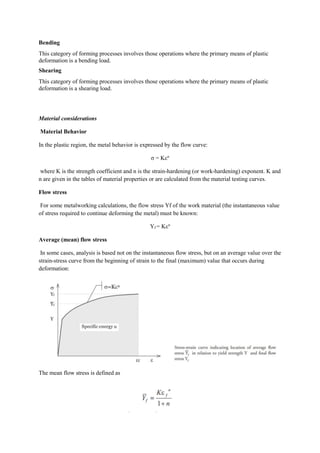
Average (mean) flow stress
In some cases, analysis is based not on the instantaneous flow stress, but on an average value over the
strain-stress curve from the beginning of strain to the final (maximum) value that occurs during
deformation:
The mean flow stress is defined as
here εf is the maximum strain value during deformation
Work-hardening
It is an important material characteristic since it determines both the properties of the workpiece and
process power. It could be removed by annealing
in metallurgy, increase in hardness of a metal induced, deliberately or accidentally, by
hammering, rolling, drawing, or other physical processes. Although the first few deformations
imposed on metal by such treatment weaken it, its strength is increased by continued deformations.
The reason for this seeming paradox lies in the crystalline structure of metal. As stresses are exerted,
the crystals slip against each other; but, because of the complexity of the crystal structure, the more
such slips are multiplied, the more they tend to place obstacles in the way of further slippage, because
the various dislocation lines crisscross each other.
Von Mises Yield Criterion
The elastic limits discussed before are based on simple tension or uniaxial stress experiments. The
maximum distortion energy theory originated from the observation that materials, especially ductile
materials, behaved differently when a non-simple tension or non-uniaxial stress experiment was
conducted, exhibiting resistance values that are much larger than the ones observed during simple
tension experiments. A theory involving the full stress tensor was therefore developed.
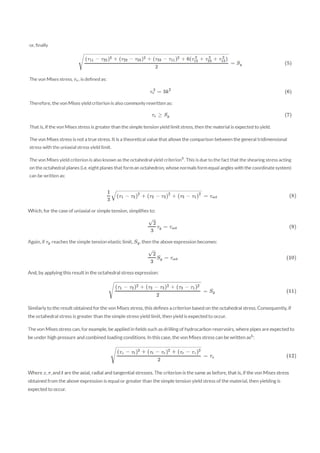
The von Mises stress is a criterion for yielding, widely used for metals and other ductile materials. It
states that yielding will occur in a body if the components of stress acting on it are greater than the
criterion
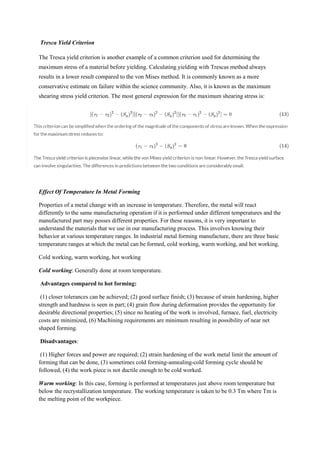
Tresca Yield Criterion
The Tresca yield criterion is another example of a common criterion used for determining the
maximum stress of a material before yielding. Calculating yielding with Trescas method always
results in a lower result compared to the von Mises method. It is commonly known as a more
conservative estimate on failure within the science community. Also, it is known as the maximum
shearing stress yield criterion. The most general expression for the maximum shearing stress is:
Effect Of Temperature In Metal Forming
Properties of a metal change with an increase in temperature. Therefore, the metal will react
differently to the same manufacturing operation if it is performed under different temperatures and the
manufactured part may posses different properties. For these reasons, it is very important to
understand the materials that we use in our manufacturing process. This involves knowing their
behavior at various temperature ranges. In industrial metal forming manufacture, there are three basic
temperature ranges at which the metal can be formed, cold working, warm working, and hot working.
Cold working, warm working, hot working
Cold working: Generally done at room temperature.
Advantages compared to hot forming:
(1) closer tolerances can be achieved; (2) good surface finish; (3) because of strain hardening, higher
strength and hardness is seen in part; (4) grain flow during deformation provides the opportunity for
desirable directional properties; (5) since no heating of the work is involved, furnace, fuel, electricity
costs are minimized, (6) Machining requirements are minimum resulting in possibility of near net
shaped forming.
Disadvantages:
(1) Higher forces and power are required; (2) strain hardening of the work metal limit the amount of
forming that can be done, (3) sometimes cold forming-annealing-cold forming cycle should be
followed, (4) the work piece is not ductile enough to be cold worked.
Warm working: In this case, forming is performed at temperatures just above room temperature but
below the recrystallization temperature. The working temperature is taken to be 0.3 Tm where Tm is
the melting point of the workpiece.
Advantages: (1) enhanced plastic deformation properties, (2) lower forces required, (3) intricate
work geometries possible, (4) annealing stages can be reduced.
Hot working: Involves deformation above recrystallization temperature, between 0.5Tm to 0.75Tm.
Advantages: (1) significant plastic deformation can be given to the sample,(2) significant change in
work piece shape, (3) lower forces are required, (4) materials with premature failure can be hot
formed, (5) absence of strengthening due to work hardening.
Disadvantages: (1) shorter tool life, (2) poor surface finish, (3) lower dimensional accuracy, (4)
sample surface oxidation.
Factors affecting the plastic deformation are:
(a) Applied stress: The plastic deformation depends upon the applied stress. The applied stress has
to be higher than the yield strength and lower than the fracture strength. The plastic deformation
increases with the applied stresses when these stresses are in between the yield strength and the
fracture strength.
(b) Deformation temperature: The metal strength decreases as the temperature is increased. Metal
plasticity is greatest when deformation temperature is above the recrystallisation temperature but
below the melting point of the metal. Recrystallisation temperature is the temperature at which the
material becomes sufficient plastic for deformation due to the formation of new grains which can flow
in the direction of elongation.
(c) Strain rate: The change of deformation in a unit time is called strain rate. The plastic deformation
is more at higher strain rate. However, higher strain rate is possible at elevated temperature when
metal becomes more plastic.
The strain rate for any particular manufacturing metal forming process is directly related to the speed
at which deformation is occurring. A greater rate of deformation of the work piece will mean a higher
strain rate. The specific process and the physical action of the equipment being used has a lot to do
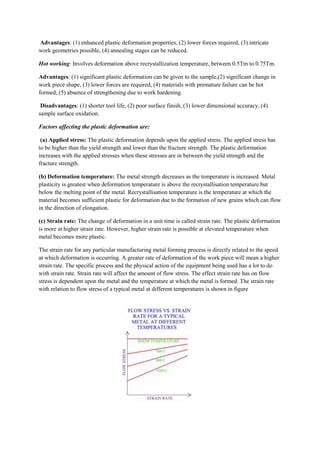
with strain rate. Strain rate will affect the amount of flow stress. The effect strain rate has on flow
stress is dependent upon the metal and the temperature at which the metal is formed. The strain rate
with relation to flow stress of a typical metal at different temperatures is shown in figure
(d)Friction And Lubrication In Metal Forming : Metal forming processes are characteristic of
high pressures between two contacting surfaces. In hot forming operations, these high
pressures are accompanied by extreme temperatures. Friction and die wear are a serious
consideration in metal forming manufacturing. A certain amount of friction will be necessary for
some metal forming processes, but excessive friction is always undesirable. Friction increases
the amount of force required to perform an operation, causes wear on tooling, and can affect
metal flow, creating defects in the work.
Where friction is involved, lubricants can usually help. For some metal forming processes and
materials no lubrication is used, but for many lubrication is applied to contacting surfaces to reduce
friction forces. Lubricants used in industry are different depending upon the type of metal forming
process, the temperature at which the operation occurs, and the type of material formed. Lubricants
should be effective and not produce any toxic fumes. Lubricants used in manufacturing industry for
metal forming processes include, vegetable and mineral oils, soaps, graphite dispensed in grease,
water based solutions, solid polymers, wax, and molten glass.
(e) Strain Rate Sensitivity : The most important mechanical characteristic of a superplastic material
is its high strain rate sensitivity of flow stress. The characteristic equation which describes the
superplastic behaviour is usually written as
i
1. http://nptel.ac.in/courses/112106153/
2. http://shodhganga.inflibnet.ac.in/bitstream/10603/17564/9/09_chapter%204.pdf
3. Fundamentals of Modern Manufacturing: Materials, Processes, and Systems
By Mikell P. Groover
4. http://thelibraryofmanufacturing.com/forming_basics.html
5. http://me.emu.edu.tr/hacisevki/Metal%20forming.pdf
6. Metal Forming (Production Engineering Series) Macmillan Engineering Evaluation
7. Mechanical Metallurgy GEORGE E. DIETER
8. Manufacturing Processes for Engineering Materials Serope Kalpakjian

BASIC MECHANICAL WORKING PROCESSES /METAL FORMING

  • 1.
    1 M EC HA N I C A L WO R K I N G P RO C E S S E S E - N OT E S M U KU L D E V K H U N T E M E TA L L U R G Y 5 T H S E M R O L L N O - 0 1 U G 1 5 0 5 0 0 2 3 O P J I N D A L U N I V E R S I T Y R A I G A R H C H H A T T I S G A R H
  • 3.
    UNIT-1 IN THIS SECTION: •Fundamental concept of metal forming • flow stress • yield criteria • Von-mises theory • Tresca Criterion • classification of metal forming operations on the basis of cold, hot &warm working • effect of variables • friction • lubricants • strain rate and strain rate sensitivity
  • 4.
    Fundamental Concept OfMetal Forming Metal forming: Large set of manufacturing processes in which the material is deformed plastically to take the shape of the die geometry. The tools used for such deformation are called die, punch etc. depending on the type of process. Materials are converted into finished products though different manufacturing processes. Manufacturing processes are classified into shaping [casting], forming, joining, and coating, dividing, machining and modifying material property. Classification Of Forming metal forming processes can be classified into two broad groups. One is bulk forming and the other is sheet metal forming. Bulk deformation refers to the use of raw materials for forming which have low surface area to volume ratio. Rolling, forging, extrusion and drawing are bulk forming processes. In
  • 5.
    bulk deformation processingmethods, the nature of force applied may be compressive, compressive and tensile, shear or a combination of these forces. Bulk forming is accomplished in forming presses with the help of a set of tool and die. Examples for products produced by bulk forming are: gears, bushed, valves, engine parts such as valves, connecting rods, hydraulic valves, etc. Sheet metal forming involves application of tensile or shear forces predominantly. Working upon sheets, plates and strips mainly constitutes sheet forming. Sheet metal operations are mostly carried out in presses – hydraulic or pneumatic. A set of tools called die and punch are used for the sheet working operations. Bending, drawing, shearing, blanking, punching are some of the sheet metal operations. Forming processes Forming processes tend to be categorised by differences in effective stresses. These categories and descriptions are highly simplified, since the stresses operating at a local level in any given process are very complex and may involve many varieties of stresses operating simultaneously, or it may involve stresses which change over the course of the operation. Compressive forming involves those processes where the primary means of plastic deformation is uni- or multiaxial compressive loading. • Rolling, where the material is passed through a pair of rollers • Extrusion, where the material is pushed through an orifice • Die forming, where the material is stamped by a press around or onto a die • Forging, where the material is shaped by localized compressive forces • Indenting, where a tool is pressed into the workpiece Tensile forming Tensile forming involves those processes where the primary means of plastic deformation is uni- or multiaxial tensile stress. • Stretching, where a tensile load is applied along the longitudinal axis of the workpiece • Expanding, where the circumference of a hollow body is increased by tangential loading • Recessing, where depressions and holes are formed through tensile loading Combined tensile and compressive forming This category of forming processes involves those operations where the primary means of plastic deformation involves both tensile stresses and compressive loads. • Pulling through a die • Deep drawing • Spinning • Flange forming • Upset bulging
  • 6.
    Bending This category offorming processes involves those operations where the primary means of plastic deformation is a bending load. Shearing This category of forming processes involves those operations where the primary means of plastic deformation is a shearing load. Material considerations Material Behavior In the plastic region, the metal behavior is expressed by the flow curve: σ = Κεn where K is the strength coefficient and n is the strain-hardening (or work-hardening) exponent. K and n are given in the tables of material properties or are calculated from the material testing curves. Flow stress For some metalworking calculations, the flow stress Yf of the work material (the instantaneous value of stress required to continue deforming the metal) must be known: Yf = Κεn Average (mean) flow stress In some cases, analysis is based not on the instantaneous flow stress, but on an average value over the strain-stress curve from the beginning of strain to the final (maximum) value that occurs during deformation: The mean flow stress is defined as
  • 7.
    here εf isthe maximum strain value during deformation Work-hardening It is an important material characteristic since it determines both the properties of the workpiece and process power. It could be removed by annealing in metallurgy, increase in hardness of a metal induced, deliberately or accidentally, by hammering, rolling, drawing, or other physical processes. Although the first few deformations imposed on metal by such treatment weaken it, its strength is increased by continued deformations. The reason for this seeming paradox lies in the crystalline structure of metal. As stresses are exerted, the crystals slip against each other; but, because of the complexity of the crystal structure, the more such slips are multiplied, the more they tend to place obstacles in the way of further slippage, because the various dislocation lines crisscross each other. Von Mises Yield Criterion The elastic limits discussed before are based on simple tension or uniaxial stress experiments. The maximum distortion energy theory originated from the observation that materials, especially ductile materials, behaved differently when a non-simple tension or non-uniaxial stress experiment was conducted, exhibiting resistance values that are much larger than the ones observed during simple tension experiments. A theory involving the full stress tensor was therefore developed. The von Mises stress is a criterion for yielding, widely used for metals and other ductile materials. It states that yielding will occur in a body if the components of stress acting on it are greater than the criterion
  • 9.
    Tresca Yield Criterion TheTresca yield criterion is another example of a common criterion used for determining the maximum stress of a material before yielding. Calculating yielding with Trescas method always results in a lower result compared to the von Mises method. It is commonly known as a more conservative estimate on failure within the science community. Also, it is known as the maximum shearing stress yield criterion. The most general expression for the maximum shearing stress is: Effect Of Temperature In Metal Forming Properties of a metal change with an increase in temperature. Therefore, the metal will react differently to the same manufacturing operation if it is performed under different temperatures and the manufactured part may posses different properties. For these reasons, it is very important to understand the materials that we use in our manufacturing process. This involves knowing their behavior at various temperature ranges. In industrial metal forming manufacture, there are three basic temperature ranges at which the metal can be formed, cold working, warm working, and hot working. Cold working, warm working, hot working Cold working: Generally done at room temperature. Advantages compared to hot forming: (1) closer tolerances can be achieved; (2) good surface finish; (3) because of strain hardening, higher strength and hardness is seen in part; (4) grain flow during deformation provides the opportunity for desirable directional properties; (5) since no heating of the work is involved, furnace, fuel, electricity costs are minimized, (6) Machining requirements are minimum resulting in possibility of near net shaped forming. Disadvantages: (1) Higher forces and power are required; (2) strain hardening of the work metal limit the amount of forming that can be done, (3) sometimes cold forming-annealing-cold forming cycle should be followed, (4) the work piece is not ductile enough to be cold worked. Warm working: In this case, forming is performed at temperatures just above room temperature but below the recrystallization temperature. The working temperature is taken to be 0.3 Tm where Tm is the melting point of the workpiece.
  • 10.
    Advantages: (1) enhancedplastic deformation properties, (2) lower forces required, (3) intricate work geometries possible, (4) annealing stages can be reduced. Hot working: Involves deformation above recrystallization temperature, between 0.5Tm to 0.75Tm. Advantages: (1) significant plastic deformation can be given to the sample,(2) significant change in work piece shape, (3) lower forces are required, (4) materials with premature failure can be hot formed, (5) absence of strengthening due to work hardening. Disadvantages: (1) shorter tool life, (2) poor surface finish, (3) lower dimensional accuracy, (4) sample surface oxidation. Factors affecting the plastic deformation are: (a) Applied stress: The plastic deformation depends upon the applied stress. The applied stress has to be higher than the yield strength and lower than the fracture strength. The plastic deformation increases with the applied stresses when these stresses are in between the yield strength and the fracture strength. (b) Deformation temperature: The metal strength decreases as the temperature is increased. Metal plasticity is greatest when deformation temperature is above the recrystallisation temperature but below the melting point of the metal. Recrystallisation temperature is the temperature at which the material becomes sufficient plastic for deformation due to the formation of new grains which can flow in the direction of elongation. (c) Strain rate: The change of deformation in a unit time is called strain rate. The plastic deformation is more at higher strain rate. However, higher strain rate is possible at elevated temperature when metal becomes more plastic. The strain rate for any particular manufacturing metal forming process is directly related to the speed at which deformation is occurring. A greater rate of deformation of the work piece will mean a higher strain rate. The specific process and the physical action of the equipment being used has a lot to do with strain rate. Strain rate will affect the amount of flow stress. The effect strain rate has on flow stress is dependent upon the metal and the temperature at which the metal is formed. The strain rate with relation to flow stress of a typical metal at different temperatures is shown in figure
  • 11.
    (d)Friction And LubricationIn Metal Forming : Metal forming processes are characteristic of high pressures between two contacting surfaces. In hot forming operations, these high pressures are accompanied by extreme temperatures. Friction and die wear are a serious consideration in metal forming manufacturing. A certain amount of friction will be necessary for some metal forming processes, but excessive friction is always undesirable. Friction increases the amount of force required to perform an operation, causes wear on tooling, and can affect metal flow, creating defects in the work. Where friction is involved, lubricants can usually help. For some metal forming processes and materials no lubrication is used, but for many lubrication is applied to contacting surfaces to reduce friction forces. Lubricants used in industry are different depending upon the type of metal forming process, the temperature at which the operation occurs, and the type of material formed. Lubricants should be effective and not produce any toxic fumes. Lubricants used in manufacturing industry for metal forming processes include, vegetable and mineral oils, soaps, graphite dispensed in grease, water based solutions, solid polymers, wax, and molten glass. (e) Strain Rate Sensitivity : The most important mechanical characteristic of a superplastic material is its high strain rate sensitivity of flow stress. The characteristic equation which describes the superplastic behaviour is usually written as i 1. http://nptel.ac.in/courses/112106153/ 2. http://shodhganga.inflibnet.ac.in/bitstream/10603/17564/9/09_chapter%204.pdf 3. Fundamentals of Modern Manufacturing: Materials, Processes, and Systems By Mikell P. Groover 4. http://thelibraryofmanufacturing.com/forming_basics.html 5. http://me.emu.edu.tr/hacisevki/Metal%20forming.pdf 6. Metal Forming (Production Engineering Series) Macmillan Engineering Evaluation 7. Mechanical Metallurgy GEORGE E. DIETER 8. Manufacturing Processes for Engineering Materials Serope Kalpakjian