Planning


        Defination
Characteristics of good plan
    Steps in planning
    Strategic planning
Defination plan
• In simple words, planning is deciding in advance what is to be done,
  when where, how and by whom it is to be done.
• Planning bridges the gap from where we are to where we want to go.
• It includes the selection of objectives, policies, procedures and
  programmes from among alternatives.
• A plan is a predetermined course of action to achieve a specified goal.
  It is an intellectual process characterized by thinking before doing.
• It is an attempt on the part of manager to anticipate the future in order
  to achieve better performance.

• Planning is the primary function of management    .
• According to Alford and Beatt, "Planning is the thinking
  process, the organized foresight, the vision based on fact
  and experience that is required for intelligent action."
• According to Theo Haimann, "Planning is deciding in
  advance what is to be done. When a manager plans, he
  projects a course of action for further attempting to achieve
  a consistent co-ordinate structure of operations aimed at the
  desired results.
• According to Billy E. Goetz, "Planning is fundamentally
  choosing and a planning problem arises when an alternative
  course of action is discovered."
• According to Koontz and O' Donnell, "Planning is an
  intellectual process, conscious determination of course of
  action, the basing of decision on purpose, facts and
  considered estimates."
• According to Allen, "A plan is a trap laid to capture the
  future."
Characteristics of good plan
•   Planning is an Intellectual Process
•   Planning Contributes to the Objectives
•   Planning is a Primary Function of Management
•   A continuous Process
•   Reduction of Uncertainty
•   Better Utilization of Resources
•   Increases Organizational Effectiveness
•   Reduces the Cost of Performance
•   Concentration on Objectives
•   Helps in Co-ordination
Characteristics of good plan(cont)

•   Makes Control Effective
•   Encouragement to Innovation
•   Increase in Competitive Strength
•   Delegation is Facilitated
Steps involved in Planning
• Establishing objectives
• Definite objectives, in fact, speak categorically
  about what is to be done, where to place the initial
  emphasis and the things to be accomplished by the
  network of policies, procedures, budgets and
  programmes, the lack of which would invariably
  result in either faulty or ineffective planning.
Steps involved in Planning
• Establishment of Planning Premises
• Planning premises are assumptions about the future
  understanding of the expected situations. These are the
  conditions under which planning activities are to be
  undertaken.
• These premises may be internal or external. Internal
  premises are internal variables that affect the planning.
  These include organizational polices, various resources and
  the ability of the organisation to withstand the
  environmental pressure.
• External premises include all factors in task environment
  like political, social technological, competitors' plans and
  actions, government policies, market conditions. Both
  internal factors should be considered in formulating plans.
  At the top level mainly external premises are considered.
  As one moves downward, internal premises gain
  importance.
Steps involved in Planning
• Determining Alternative Courses
• The next logical step in planning is to determine and
  evaluate alternative courses of action.
• It may be mentioned that there can hardly be any occasion
  when there are no alternatives.
• And it is most likely that alternatives properly assessed
  may prove worthy and meaningful.
• alternative courses of action must be developed before
  deciding upon the exact plan.
Steps involved in Planning
• Evaluation of Alternatives
•  Having sought out the available alternatives along with
  their strong and weak points, planners are required to
  evaluate the alternatives giving due weight-age to various
  factors involved, for one alternative may appear to be most
  profitable involving heavy cash outlay whereas the other
  less profitable but involve least risk.
• another course of action may be found contributing
  significantly to the company's long-range objectives
  although immediate expectations are likely to go
  unfulfilled.
Steps involved in Planning
• Selecting a Course of Action
• The fifth step in planning is selecting a course of action
  from among alternatives. In fact, it is the point of decision-
  making-deciding upon the plan to be adopted for
  accomplishing the enterprise objectives.
Steps involved in Planning
• Formulating Derivative Plans
• To make any planning process complete the final step is to
  formulate derivative plans to give effect to and support the
  basic plan.
• In other words, plans do not accomplish themselves. They
  require to be broken down into supporting plans.
• Each manager and department of the organisation is to
  contribute to the accomplishment of the master plan on the
  basis of the derivative plans.
Steps involved in Planning
• Establishing Sequence of Activities
• Timing an sequence of activities are determined after
  formulating basic and derivative plans, so that plans may
  be put into action.
• Timing is an essential consideration in planning. It gives
  practical shape and concrete form to the programmes.
• The starting and finishing times are fixed for each piece of
  work, so as to indicate when the within what time that
  work is to be commenced and completed. Bad timing of
  programmes results in their failure.
• To maintain a symmetry of performance and a smooth
  flow of work, the sequence of operation shaped be
  arranged carefully by giving priorities to some work in
  preference to others. Under sequence it should be decided
  as to who will don what and at what time.
Steps involved in Planning
• Feedback or Follow-up Action
• Formulating plans and chalking out of programmes are not
  sufficient, unless follow-up action is provided to see that
  plans so prepared and programmes chalked out are being
  carried out in accordance with the plan and to see whether
  these are not kept in cold storage.
• It is also required to see whether the plan is working well
  in the present situation. If conditions have changed, the
  plan current plan has become outdated or inoperative it
  should be replaced by another plan.
• A regular follow-up is necessary and desirable from
  effective implementation and accomplishment of tasks
  assigned.
Strategic Planning

• Strategic planning is the managerial decision
  process that matches the organization’s
  resources and capabilities to its market
  opportunities for long-term growth
• Firms may become multi-product companies
  with self-contained divisions
  – Strategic Business Units (SBUs)
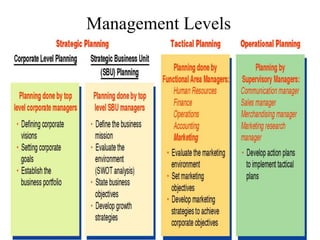
Management Levels
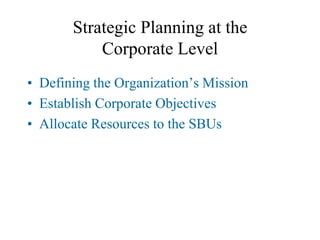
Strategic Planning at the
           Corporate Level
• Defining the Organization’s Mission
• Establish Corporate Objectives
• Allocate Resources to the SBUs
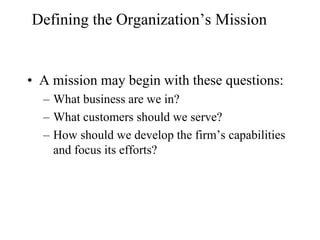
Defining the Organization’s Mission


• A mission may begin with these questions:
  – What business are we in?
  – What customers should we serve?
  – How should we develop the firm’s capabilities
    and focus its efforts?
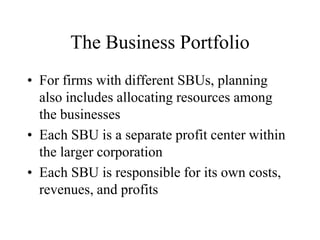
The Business Portfolio
• For firms with different SBUs, planning
  also includes allocating resources among
  the businesses
• Each SBU is a separate profit center within
  the larger corporation
• Each SBU is responsible for its own costs,
  revenues, and profits
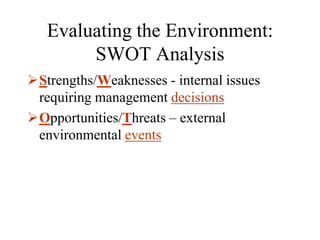
Evaluating the Environment:
        SWOT Analysis
Strengths/Weaknesses - internal issues
 requiring management decisions
Opportunities/Threats – external
 environmental events
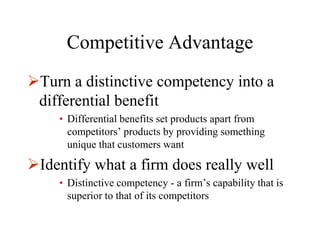
Competitive Advantage
Turn a distinctive competency into a
 differential benefit
    • Differential benefits set products apart from
      competitors’ products by providing something
      unique that customers want

Identify what a firm does really well
    • Distinctive competency - a firm’s capability that is
      superior to that of its competitors
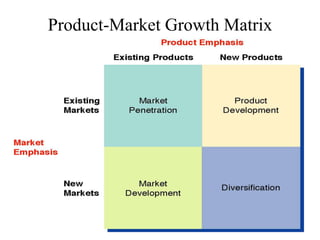
Product-Market Growth Matrix
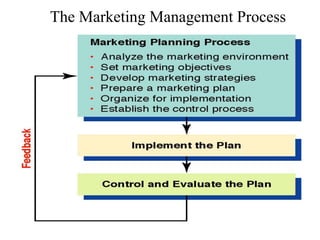
The Marketing Management Process
Marketing Planning
Analyzing the Marketing Environment
Setting Marketing Objectives
Developing Marketing Strategies
Developing Marketing Strategies

Selecting a Target Market
Developing Marketing Mix Programs
  –   Product Strategies
  –   Pricing Strategies
  –   Promotion Strategies
  –   Distribution Strategies
Executing the Marketing Plan
Implementing the Marketing Plan
  The Marketing Budget
  Organizing the Marketing Function
Controlling the Marketing Plan
  Trend Analysis
  Marketing Research

6. planning

  • 1.
    Planning Defination Characteristics of good plan Steps in planning Strategic planning
  • 2.
    Defination plan • Insimple words, planning is deciding in advance what is to be done, when where, how and by whom it is to be done. • Planning bridges the gap from where we are to where we want to go. • It includes the selection of objectives, policies, procedures and programmes from among alternatives. • A plan is a predetermined course of action to achieve a specified goal. It is an intellectual process characterized by thinking before doing. • It is an attempt on the part of manager to anticipate the future in order to achieve better performance. • Planning is the primary function of management .
  • 3.
    • According toAlford and Beatt, "Planning is the thinking process, the organized foresight, the vision based on fact and experience that is required for intelligent action." • According to Theo Haimann, "Planning is deciding in advance what is to be done. When a manager plans, he projects a course of action for further attempting to achieve a consistent co-ordinate structure of operations aimed at the desired results. • According to Billy E. Goetz, "Planning is fundamentally choosing and a planning problem arises when an alternative course of action is discovered." • According to Koontz and O' Donnell, "Planning is an intellectual process, conscious determination of course of action, the basing of decision on purpose, facts and considered estimates." • According to Allen, "A plan is a trap laid to capture the future."
  • 4.
    Characteristics of goodplan • Planning is an Intellectual Process • Planning Contributes to the Objectives • Planning is a Primary Function of Management • A continuous Process • Reduction of Uncertainty • Better Utilization of Resources • Increases Organizational Effectiveness • Reduces the Cost of Performance • Concentration on Objectives • Helps in Co-ordination
  • 5.
    Characteristics of goodplan(cont) • Makes Control Effective • Encouragement to Innovation • Increase in Competitive Strength • Delegation is Facilitated
  • 6.
    Steps involved inPlanning • Establishing objectives • Definite objectives, in fact, speak categorically about what is to be done, where to place the initial emphasis and the things to be accomplished by the network of policies, procedures, budgets and programmes, the lack of which would invariably result in either faulty or ineffective planning.
  • 7.
    Steps involved inPlanning • Establishment of Planning Premises • Planning premises are assumptions about the future understanding of the expected situations. These are the conditions under which planning activities are to be undertaken. • These premises may be internal or external. Internal premises are internal variables that affect the planning. These include organizational polices, various resources and the ability of the organisation to withstand the environmental pressure.
  • 8.
    • External premisesinclude all factors in task environment like political, social technological, competitors' plans and actions, government policies, market conditions. Both internal factors should be considered in formulating plans. At the top level mainly external premises are considered. As one moves downward, internal premises gain importance.
  • 9.
    Steps involved inPlanning • Determining Alternative Courses • The next logical step in planning is to determine and evaluate alternative courses of action. • It may be mentioned that there can hardly be any occasion when there are no alternatives. • And it is most likely that alternatives properly assessed may prove worthy and meaningful. • alternative courses of action must be developed before deciding upon the exact plan.
  • 10.
    Steps involved inPlanning • Evaluation of Alternatives • Having sought out the available alternatives along with their strong and weak points, planners are required to evaluate the alternatives giving due weight-age to various factors involved, for one alternative may appear to be most profitable involving heavy cash outlay whereas the other less profitable but involve least risk. • another course of action may be found contributing significantly to the company's long-range objectives although immediate expectations are likely to go unfulfilled.
  • 11.
    Steps involved inPlanning • Selecting a Course of Action • The fifth step in planning is selecting a course of action from among alternatives. In fact, it is the point of decision- making-deciding upon the plan to be adopted for accomplishing the enterprise objectives.
  • 12.
    Steps involved inPlanning • Formulating Derivative Plans • To make any planning process complete the final step is to formulate derivative plans to give effect to and support the basic plan. • In other words, plans do not accomplish themselves. They require to be broken down into supporting plans. • Each manager and department of the organisation is to contribute to the accomplishment of the master plan on the basis of the derivative plans.
  • 13.
    Steps involved inPlanning • Establishing Sequence of Activities • Timing an sequence of activities are determined after formulating basic and derivative plans, so that plans may be put into action. • Timing is an essential consideration in planning. It gives practical shape and concrete form to the programmes. • The starting and finishing times are fixed for each piece of work, so as to indicate when the within what time that work is to be commenced and completed. Bad timing of programmes results in their failure.
  • 14.
    • To maintaina symmetry of performance and a smooth flow of work, the sequence of operation shaped be arranged carefully by giving priorities to some work in preference to others. Under sequence it should be decided as to who will don what and at what time.
  • 15.
    Steps involved inPlanning • Feedback or Follow-up Action • Formulating plans and chalking out of programmes are not sufficient, unless follow-up action is provided to see that plans so prepared and programmes chalked out are being carried out in accordance with the plan and to see whether these are not kept in cold storage. • It is also required to see whether the plan is working well in the present situation. If conditions have changed, the plan current plan has become outdated or inoperative it should be replaced by another plan. • A regular follow-up is necessary and desirable from effective implementation and accomplishment of tasks assigned.
  • 16.
    Strategic Planning • Strategicplanning is the managerial decision process that matches the organization’s resources and capabilities to its market opportunities for long-term growth • Firms may become multi-product companies with self-contained divisions – Strategic Business Units (SBUs)
  • 17.
  • 18.
    Strategic Planning atthe Corporate Level • Defining the Organization’s Mission • Establish Corporate Objectives • Allocate Resources to the SBUs
  • 19.
    Defining the Organization’sMission • A mission may begin with these questions: – What business are we in? – What customers should we serve? – How should we develop the firm’s capabilities and focus its efforts?
  • 20.
    The Business Portfolio •For firms with different SBUs, planning also includes allocating resources among the businesses • Each SBU is a separate profit center within the larger corporation • Each SBU is responsible for its own costs, revenues, and profits
  • 21.
    Evaluating the Environment: SWOT Analysis Strengths/Weaknesses - internal issues requiring management decisions Opportunities/Threats – external environmental events
  • 22.
    Competitive Advantage Turn adistinctive competency into a differential benefit • Differential benefits set products apart from competitors’ products by providing something unique that customers want Identify what a firm does really well • Distinctive competency - a firm’s capability that is superior to that of its competitors
  • 23.
  • 24.
  • 25.
    Marketing Planning Analyzing theMarketing Environment Setting Marketing Objectives Developing Marketing Strategies
  • 26.
    Developing Marketing Strategies Selectinga Target Market Developing Marketing Mix Programs – Product Strategies – Pricing Strategies – Promotion Strategies – Distribution Strategies
  • 27.
    Executing the MarketingPlan Implementing the Marketing Plan The Marketing Budget Organizing the Marketing Function Controlling the Marketing Plan Trend Analysis Marketing Research