Advance Material and Manufacturing Technologies
By
Shobin John
1/10/2017
halmstad university, masters in mechanical
engineering 2015.
shojoh15@student.hh.se
1
CASE1:Material Selection
MATERIAL WORLD
 The material world serves a
huge list of functions.
 The evolution was faster and
the range of properties more
varied.
 The birth of materials is
dated back to the birth of the
first invention , though it
existed even before
 New materials were invented
with time and its applications
varied
 From wheel to the ultra
modern Nano-technology
instruments – material is vital
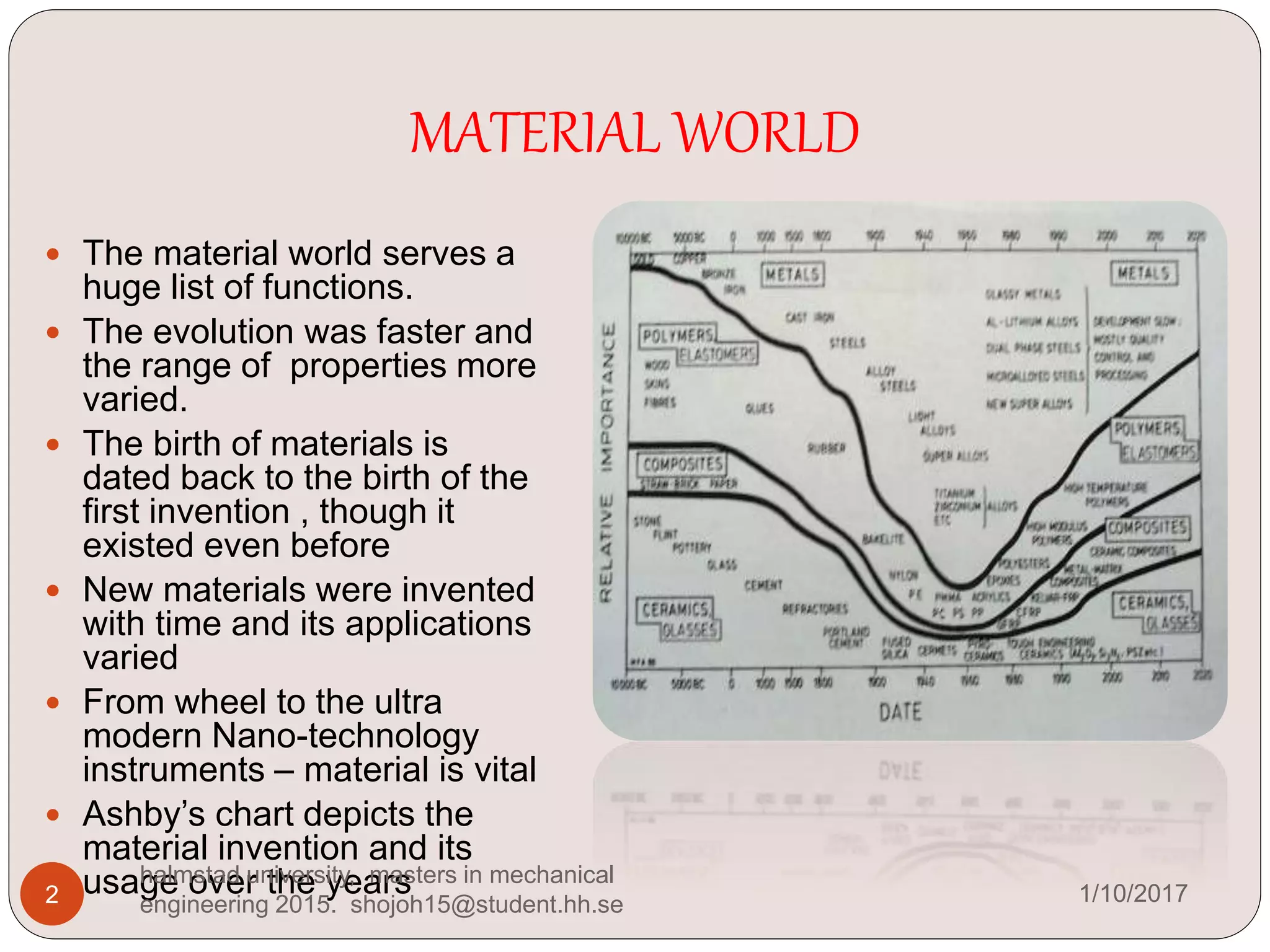
 Ashby’s chart depicts the
material invention and its
usage over the years 1/10/2017
halmstad university, masters in mechanical
engineering 2015. shojoh15@student.hh.se2
• Classifying materials is vital for
the ease of identification in
practical applications
• Periodic table was one great
invention but not good enough
as it does not include the whole
list of engineering materials
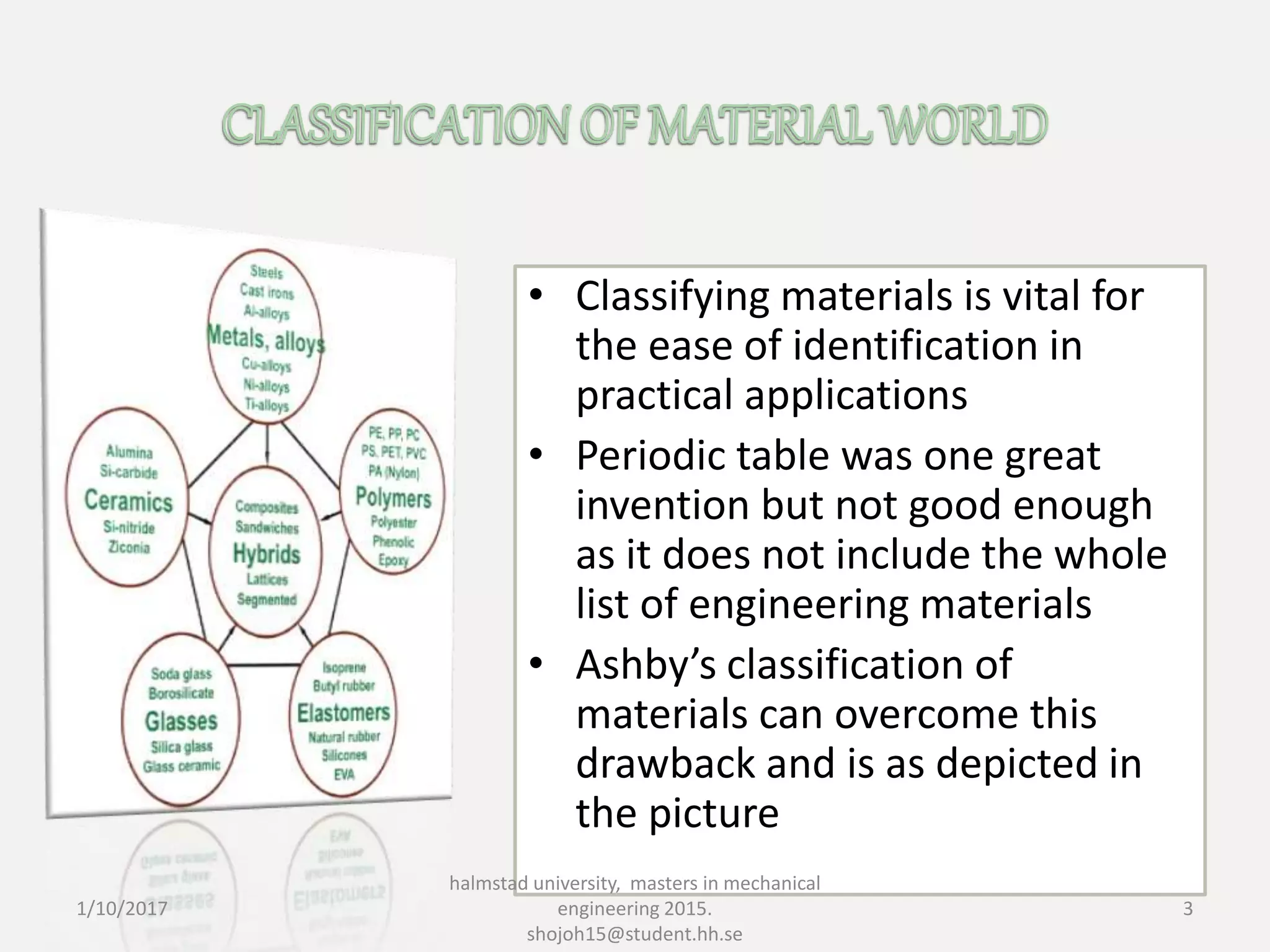
• Ashby’s classification of
materials can overcome this
drawback and is as depicted in
the picture
1/10/2017
halmstad university, masters in mechanical
engineering 2015.
shojoh15@student.hh.se
3
SELECTION OF MATERIALS
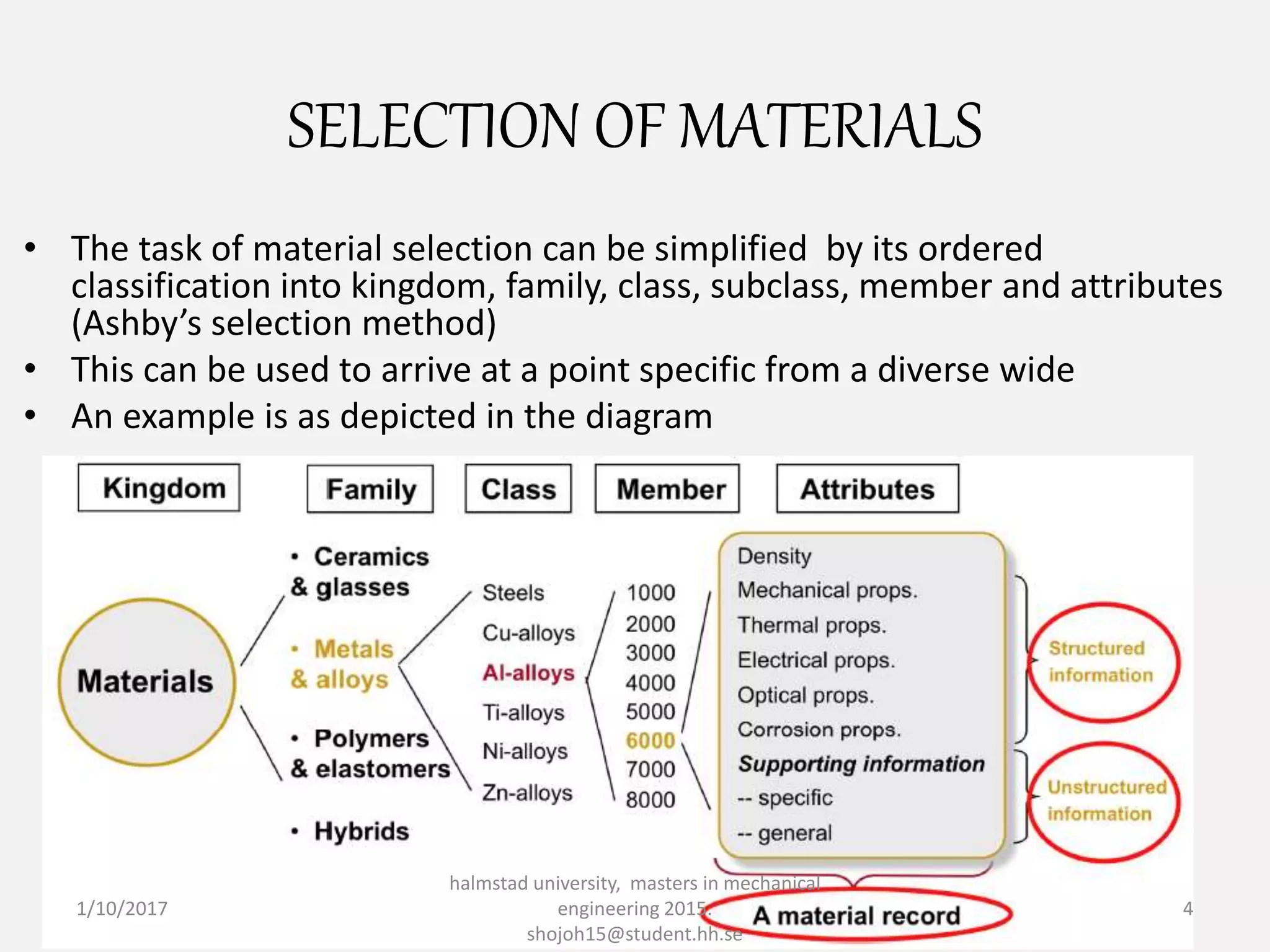
• The task of material selection can be simplified by its ordered
classification into kingdom, family, class, subclass, member and attributes
(Ashby’s selection method)
• This can be used to arrive at a point specific from a diverse wide
• An example is as depicted in the diagram
1/10/2017
halmstad university, masters in mechanical
engineering 2015.
shojoh15@student.hh.se
4
SELECTION TECHNIQUE and its structure
• The myriad number of materials and its diverse properties, makes
material selection process peccable
• CES EduPack is a software to overcome this dilemma
• It helps to identify the apt material from the material classification
world. The structure of the software is as shown in the second figure
1/10/2017
halmstad university, masters in mechanical
engineering 2015.
shojoh15@student.hh.se
5
CES SOFTWARE AND TYPES OF CHARTS
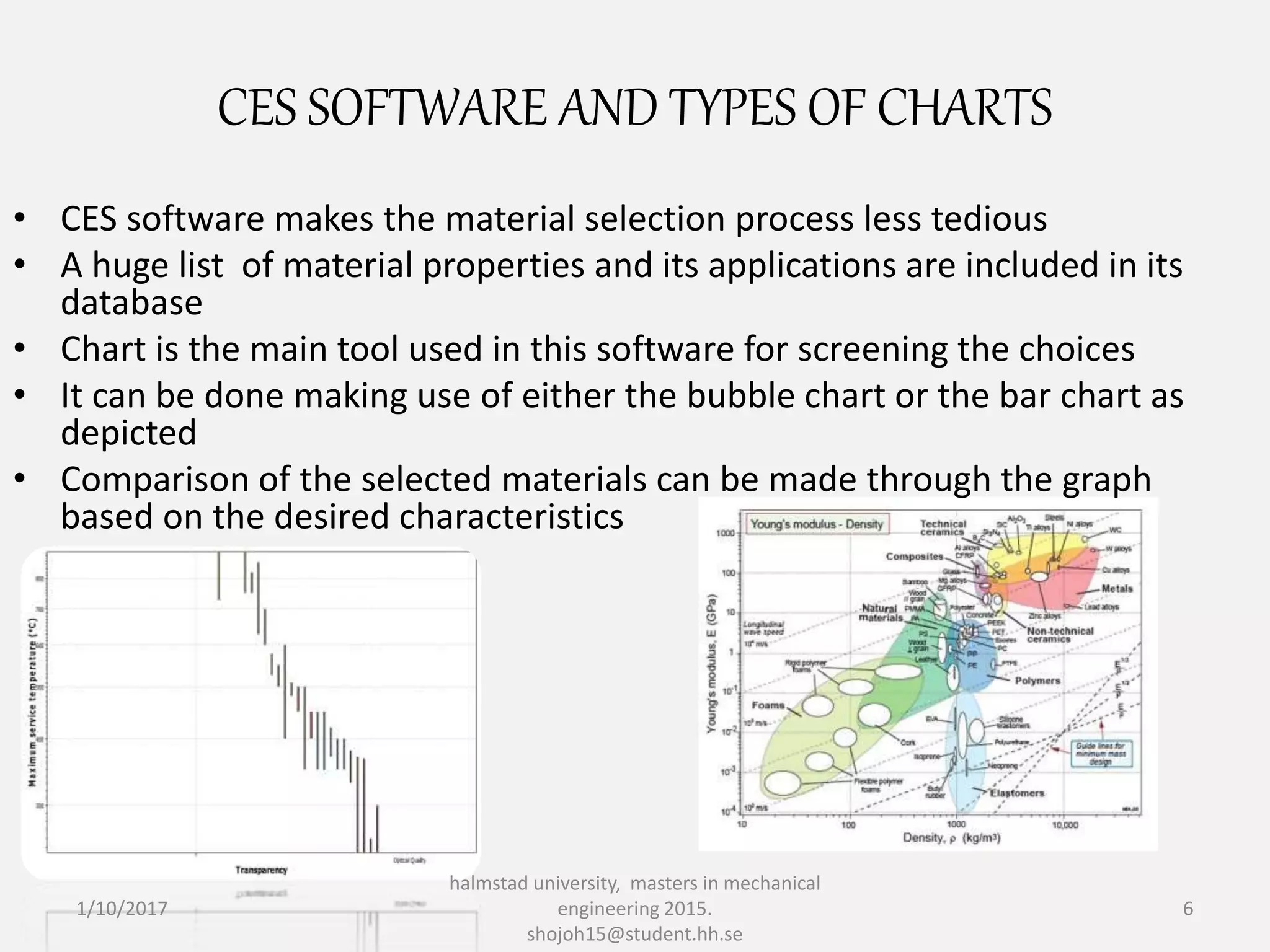
• CES software makes the material selection process less tedious
• A huge list of material properties and its applications are included in its
database
• Chart is the main tool used in this software for screening the choices
• It can be done making use of either the bubble chart or the bar chart as
depicted
• Comparison of the selected materials can be made through the graph
based on the desired characteristics
1/10/2017
halmstad university, masters in mechanical
engineering 2015.
shojoh15@student.hh.se
6
MATERIAL SELECTION FOR PRODUCT DEVELOPMENT PROCESS
DISC CLUTCH
 Project involves flywheel installed
on bicycle and is named as
Flywheel on bicycle.
 System requires a component
clutch which is used to adjust the
gear and flywheel.
 The engagement and
disengagement for changing gear
and flywheel is the function of
clutch
 Importance was low to moderate
as identified in the QFD
1/10/2017
halmstad university, masters in mechanical
engineering 2015. shojoh15@student.hh.se7
IDENTIFYING ATTRIBUTES
 Primary feature being machinability and
possessing high hardness.
 Price factor has to be low due to the relatively low
importance shown from the QFD analysis
 Aesthetically high will add value
 Heat carrying capacity has to be moderately high
to overcome friction and heat generation.
 Chemical inertness and recyclability can help in
improving environmental aspects
1/10/2017
halmstad university, masters in mechanical
engineering 2015. shojoh15@student.hh.se8
RANKING ATTRIBUTES AND GRAPH SELECTION
SL NO ATTRIBUTES
1 MACHINABILITY
2 PRICE
3 SPECIFIC HEAT
CAPACITY
4 RECYCLABILITY
5 ELECTRICAL PROP
6 TENSILE STRENGTH
7 HARDNESS
RANK ATTRIBUTES
1 MACHINABILITY
2 SPECIFIC HEAT CAPACITY
3 PRICE
4 HARDNESS
5 RECYCLABILITY
6 TENSILE STRNGTH
7 ELECTRICAL PROP
 Attribute ranking shows that the material has to be identified on the
properties of hardness, specific heat capacity, machinability and price
 Following graphs are selected for material selection
• Hardness vs. Specific heat
• Price vs. Specific heat
• Machinability vs Price 1/10/2017
halmstad university, masters in mechanical
engineering 2015. shojoh15@student.hh.se9
Hardness vs. specific heat capacity
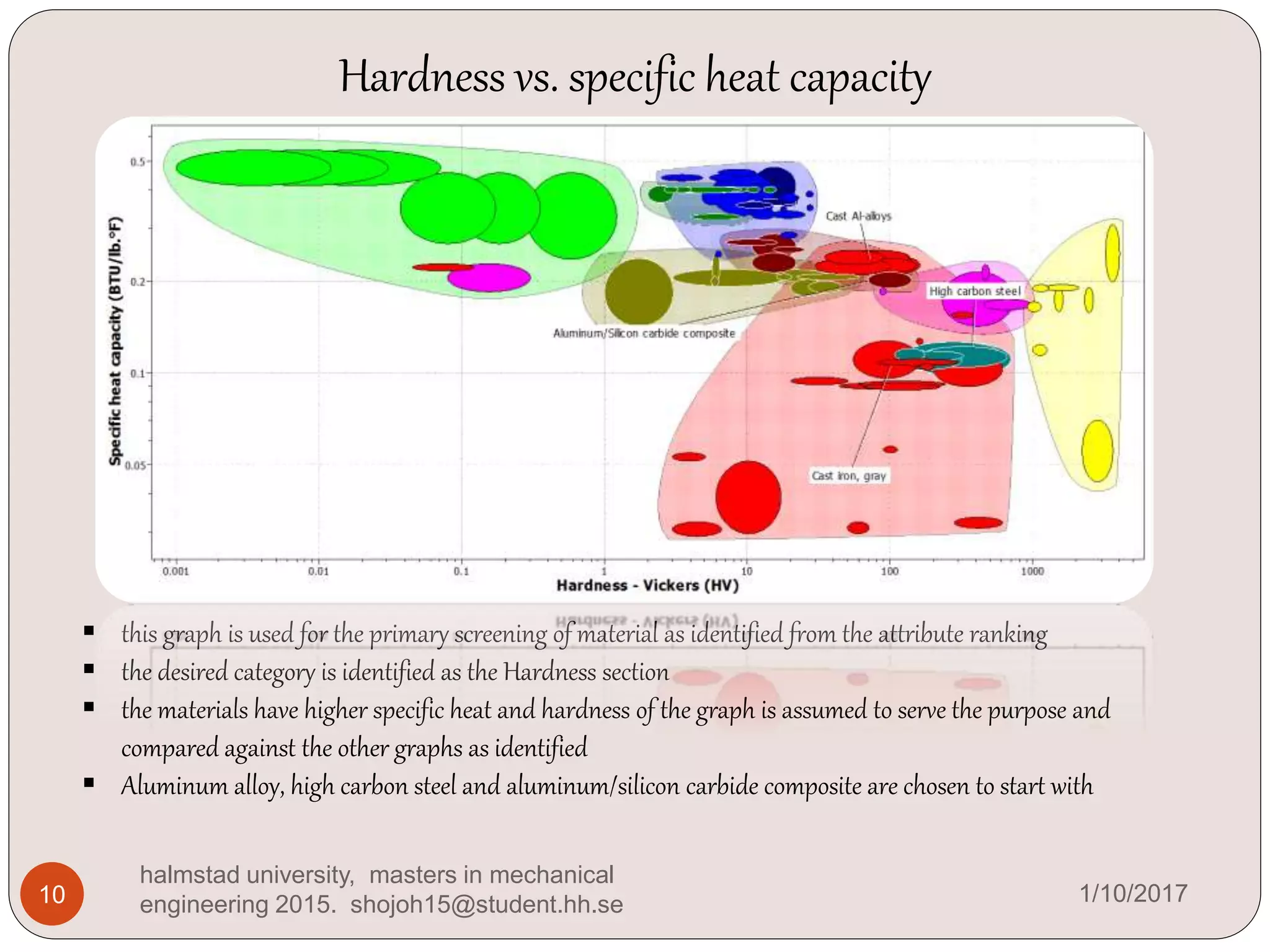
 this graph is used for the primary screening of material as identified from the attribute ranking
 the desired category is identified as the Hardness section
 the materials have higher specific heat and hardness of the graph is assumed to serve the purpose and
compared against the other graphs as identified
 Aluminum alloy, high carbon steel and aluminum/silicon carbide composite are chosen to start with
1/10/2017
halmstad university, masters in mechanical
engineering 2015. shojoh15@student.hh.se10
PRICE vs. SPECIFIC HEAT CAPACITY
 Trivial importance of the component realizes the vital importance of the
material cost
 The price range is chosen as shown as the desired category
 This eliminates ALUMINUM/SILICON CARBIDE COMPOSITE which
was chosen in the first graph as it costs around 5 USD/lb.
 ALUMINUM ALLOY and HIGH CARBON STEEL exist
Specific heat capacity (BTU/lb.°F)
0.05 0.1 0.2 0.5
Price(USD/lb)
0.01
0.1
1
10
100
1000
10000
Price vs Specific heat capacity
Cast iron, gray
High carbon steel
Cast Al-alloys
Aluminum/Silicon carbide composite
1/10/2017
halmstad university, masters in mechanical
engineering 2015. shojoh15@student.hh.se11
MACHINABILITY VS PRICE
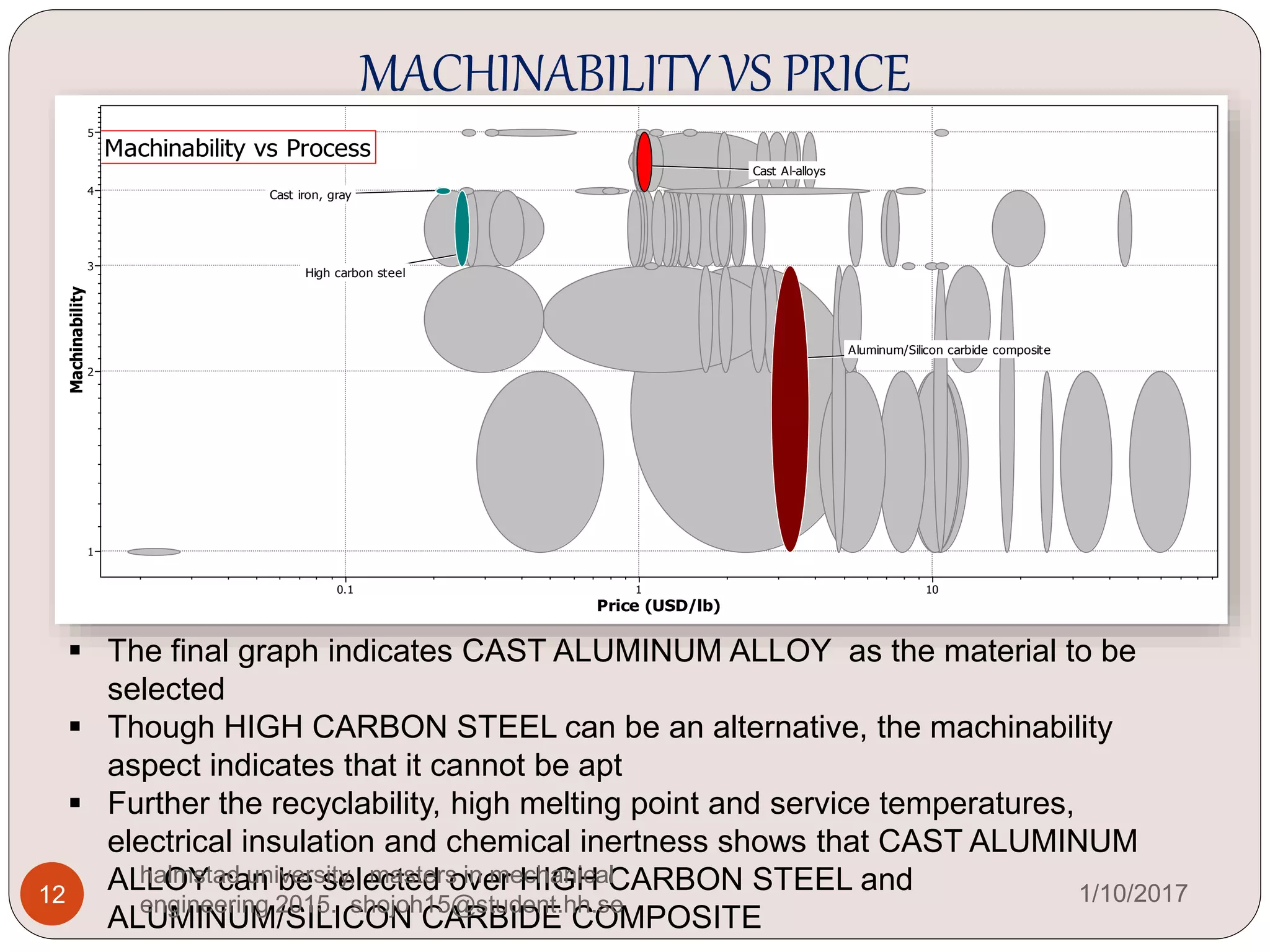
 The final graph indicates CAST ALUMINUM ALLOY as the material to be
selected
 Though HIGH CARBON STEEL can be an alternative, the machinability
aspect indicates that it cannot be apt
 Further the recyclability, high melting point and service temperatures,
electrical insulation and chemical inertness shows that CAST ALUMINUM
ALLOY can be selected over HIGH CARBON STEEL and
ALUMINUM/SILICON CARBIDE COMPOSITE
Price (USD/lb)
0.1 1 10
Machinability
1
2
3
4
5
Machinability vs Process
Cast iron, gray
High carbon steel
Aluminum/Silicon carbide composite
Cast Al-alloys
1/10/2017
halmstad university, masters in mechanical
engineering 2015. shojoh15@student.hh.se12
Final selection and alternatives
MATERI
AL
HARDNE
SS
PRICE HEAT
CAPACIT
Y
MACHIN
ABILITY
RECYCLE CHEMIC
AL
RESISTA
NCE
ELECTRI
CAL
RESISTIV
ITY
CAST
ALUMIN
UM
ALLOY
60-
150HV
0.989-
1.09USD
/lb
0.215-
0.238BT
U/lb.°F
4.5 YES YES 2.5-
8µohm.c
m
HIGH
CARBON
STEEL
400HV 0.2USD/
LB
0.18BTU
/LB,F
3.5 YES YES 200MIC
ROOHM.
CM
ALUMIN
UM/SILI
CON
CARBIDE
COMPOS
ITE
70-
140HV
2.82-
3.76USD
/lb
0.191-
0.215BT
U/lb.°F
1.7 YES YES 5-
12µohm.
cm
1/10/2017
halmstad university, masters in mechanical
engineering 2015.
shojoh15@student.hh.se
13
CONCLUSION:
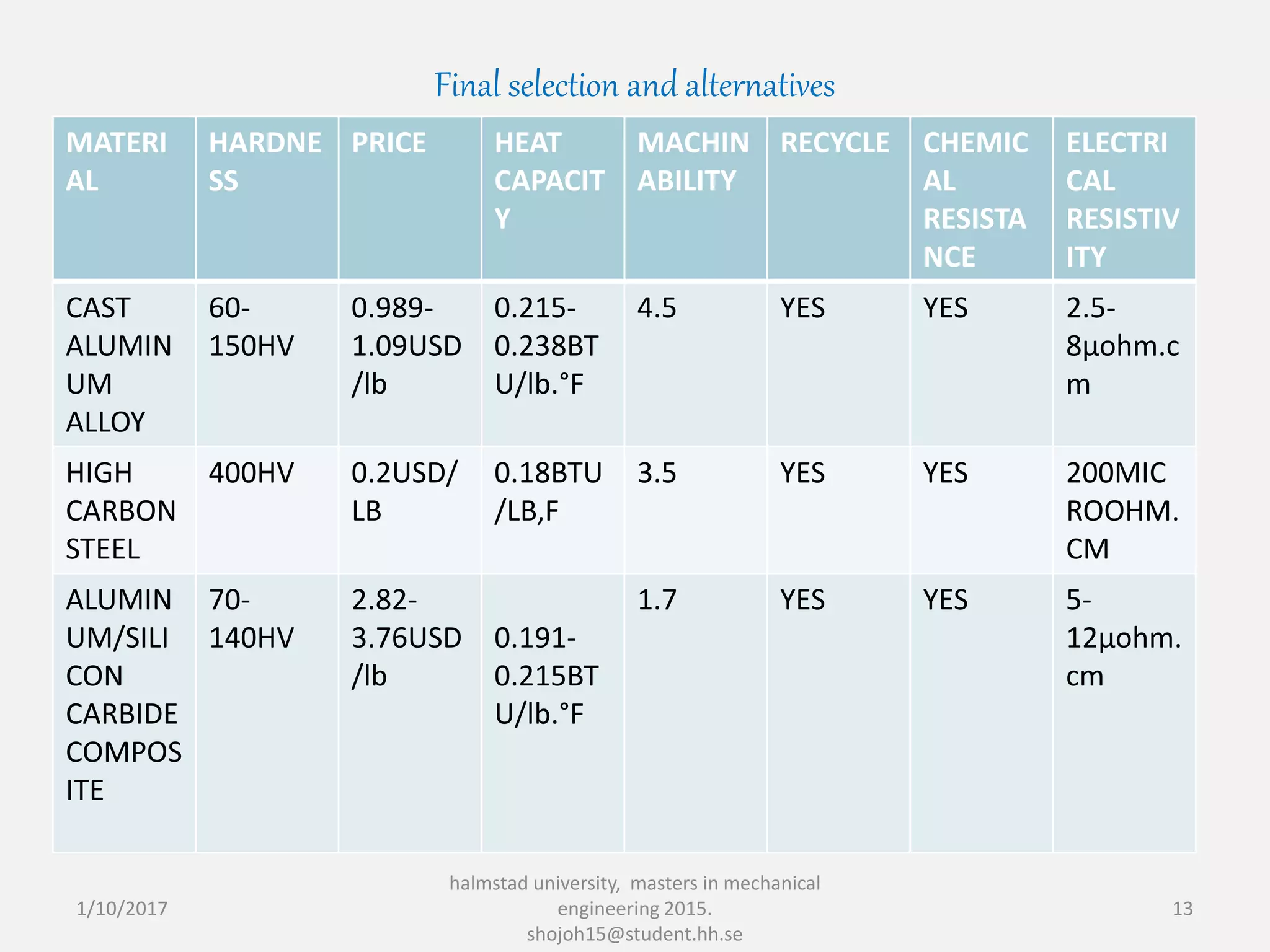
CAST ALUMINUM ALLOY WAS THE APT MATERIAL AS IT COVERED A WIDE RANGE OF DESIRED
CHARACTERISTICS.
Mechanical properties
Young's modulus 10.4 - 12.9 10^6 psi
Shear modulus 3.63 - 4.93 10^6 psi
Bulk modulus 9.57 - 10.4 10^6 psi
Poisson's ratio 0.32 - 0.36
Yield strength (elastic limit) 7.25 - 47.9 ksi
Tensile strength 9.43 - 56 ksi
Compressive strength 7.25 - 47.9 ksi
Elongation 0.4 - 10 % strain
Fatigue strength at 10^7 cycles 4.64 - 22.8 ksi
Mechanical loss coefficient (tan delta) 1e-4 -0.002
ALTERNATIVES:
Suggestion 1: HIGH CARBON STEEL
Reason: The table indicates HIGH CARBON STEEL to have a desired characteristics except
machinability. aspect in context of the product.
Suggestion 2: ALUMINUM/SILICON CARBIDE COMPOSITE
Reason: The table indicates ALUMINUM/SILICON CARBIDE COMPOSITE to possess the highest
electrical resistance and the moderate hardness. The price being on the higher end is a
concern but can still be used where reliable is valued over price.
1/10/2017
halmstad university, masters in mechanical
engineering 2015.
shojoh15@student.hh.se
14

ces edupack material selection

  • 1.
    Advance Material andManufacturing Technologies By Shobin John 1/10/2017 halmstad university, masters in mechanical engineering 2015. shojoh15@student.hh.se 1 CASE1:Material Selection
  • 2.
    MATERIAL WORLD  Thematerial world serves a huge list of functions.  The evolution was faster and the range of properties more varied.  The birth of materials is dated back to the birth of the first invention , though it existed even before  New materials were invented with time and its applications varied  From wheel to the ultra modern Nano-technology instruments – material is vital  Ashby’s chart depicts the material invention and its usage over the years 1/10/2017 halmstad university, masters in mechanical engineering 2015. shojoh15@student.hh.se2
  • 3.
    • Classifying materialsis vital for the ease of identification in practical applications • Periodic table was one great invention but not good enough as it does not include the whole list of engineering materials • Ashby’s classification of materials can overcome this drawback and is as depicted in the picture 1/10/2017 halmstad university, masters in mechanical engineering 2015. shojoh15@student.hh.se 3
  • 4.
    SELECTION OF MATERIALS •The task of material selection can be simplified by its ordered classification into kingdom, family, class, subclass, member and attributes (Ashby’s selection method) • This can be used to arrive at a point specific from a diverse wide • An example is as depicted in the diagram 1/10/2017 halmstad university, masters in mechanical engineering 2015. shojoh15@student.hh.se 4
  • 5.
    SELECTION TECHNIQUE andits structure • The myriad number of materials and its diverse properties, makes material selection process peccable • CES EduPack is a software to overcome this dilemma • It helps to identify the apt material from the material classification world. The structure of the software is as shown in the second figure 1/10/2017 halmstad university, masters in mechanical engineering 2015. shojoh15@student.hh.se 5
  • 6.
    CES SOFTWARE ANDTYPES OF CHARTS • CES software makes the material selection process less tedious • A huge list of material properties and its applications are included in its database • Chart is the main tool used in this software for screening the choices • It can be done making use of either the bubble chart or the bar chart as depicted • Comparison of the selected materials can be made through the graph based on the desired characteristics 1/10/2017 halmstad university, masters in mechanical engineering 2015. shojoh15@student.hh.se 6
  • 7.
    MATERIAL SELECTION FORPRODUCT DEVELOPMENT PROCESS DISC CLUTCH  Project involves flywheel installed on bicycle and is named as Flywheel on bicycle.  System requires a component clutch which is used to adjust the gear and flywheel.  The engagement and disengagement for changing gear and flywheel is the function of clutch  Importance was low to moderate as identified in the QFD 1/10/2017 halmstad university, masters in mechanical engineering 2015. shojoh15@student.hh.se7
  • 8.
    IDENTIFYING ATTRIBUTES  Primaryfeature being machinability and possessing high hardness.  Price factor has to be low due to the relatively low importance shown from the QFD analysis  Aesthetically high will add value  Heat carrying capacity has to be moderately high to overcome friction and heat generation.  Chemical inertness and recyclability can help in improving environmental aspects 1/10/2017 halmstad university, masters in mechanical engineering 2015. shojoh15@student.hh.se8
  • 9.
    RANKING ATTRIBUTES ANDGRAPH SELECTION SL NO ATTRIBUTES 1 MACHINABILITY 2 PRICE 3 SPECIFIC HEAT CAPACITY 4 RECYCLABILITY 5 ELECTRICAL PROP 6 TENSILE STRENGTH 7 HARDNESS RANK ATTRIBUTES 1 MACHINABILITY 2 SPECIFIC HEAT CAPACITY 3 PRICE 4 HARDNESS 5 RECYCLABILITY 6 TENSILE STRNGTH 7 ELECTRICAL PROP  Attribute ranking shows that the material has to be identified on the properties of hardness, specific heat capacity, machinability and price  Following graphs are selected for material selection • Hardness vs. Specific heat • Price vs. Specific heat • Machinability vs Price 1/10/2017 halmstad university, masters in mechanical engineering 2015. shojoh15@student.hh.se9
  • 10.
    Hardness vs. specificheat capacity  this graph is used for the primary screening of material as identified from the attribute ranking  the desired category is identified as the Hardness section  the materials have higher specific heat and hardness of the graph is assumed to serve the purpose and compared against the other graphs as identified  Aluminum alloy, high carbon steel and aluminum/silicon carbide composite are chosen to start with 1/10/2017 halmstad university, masters in mechanical engineering 2015. shojoh15@student.hh.se10
  • 11.
    PRICE vs. SPECIFICHEAT CAPACITY  Trivial importance of the component realizes the vital importance of the material cost  The price range is chosen as shown as the desired category  This eliminates ALUMINUM/SILICON CARBIDE COMPOSITE which was chosen in the first graph as it costs around 5 USD/lb.  ALUMINUM ALLOY and HIGH CARBON STEEL exist Specific heat capacity (BTU/lb.°F) 0.05 0.1 0.2 0.5 Price(USD/lb) 0.01 0.1 1 10 100 1000 10000 Price vs Specific heat capacity Cast iron, gray High carbon steel Cast Al-alloys Aluminum/Silicon carbide composite 1/10/2017 halmstad university, masters in mechanical engineering 2015. shojoh15@student.hh.se11
  • 12.
    MACHINABILITY VS PRICE The final graph indicates CAST ALUMINUM ALLOY as the material to be selected  Though HIGH CARBON STEEL can be an alternative, the machinability aspect indicates that it cannot be apt  Further the recyclability, high melting point and service temperatures, electrical insulation and chemical inertness shows that CAST ALUMINUM ALLOY can be selected over HIGH CARBON STEEL and ALUMINUM/SILICON CARBIDE COMPOSITE Price (USD/lb) 0.1 1 10 Machinability 1 2 3 4 5 Machinability vs Process Cast iron, gray High carbon steel Aluminum/Silicon carbide composite Cast Al-alloys 1/10/2017 halmstad university, masters in mechanical engineering 2015. shojoh15@student.hh.se12
  • 13.
    Final selection andalternatives MATERI AL HARDNE SS PRICE HEAT CAPACIT Y MACHIN ABILITY RECYCLE CHEMIC AL RESISTA NCE ELECTRI CAL RESISTIV ITY CAST ALUMIN UM ALLOY 60- 150HV 0.989- 1.09USD /lb 0.215- 0.238BT U/lb.°F 4.5 YES YES 2.5- 8µohm.c m HIGH CARBON STEEL 400HV 0.2USD/ LB 0.18BTU /LB,F 3.5 YES YES 200MIC ROOHM. CM ALUMIN UM/SILI CON CARBIDE COMPOS ITE 70- 140HV 2.82- 3.76USD /lb 0.191- 0.215BT U/lb.°F 1.7 YES YES 5- 12µohm. cm 1/10/2017 halmstad university, masters in mechanical engineering 2015. shojoh15@student.hh.se 13
  • 14.
    CONCLUSION: CAST ALUMINUM ALLOYWAS THE APT MATERIAL AS IT COVERED A WIDE RANGE OF DESIRED CHARACTERISTICS. Mechanical properties Young's modulus 10.4 - 12.9 10^6 psi Shear modulus 3.63 - 4.93 10^6 psi Bulk modulus 9.57 - 10.4 10^6 psi Poisson's ratio 0.32 - 0.36 Yield strength (elastic limit) 7.25 - 47.9 ksi Tensile strength 9.43 - 56 ksi Compressive strength 7.25 - 47.9 ksi Elongation 0.4 - 10 % strain Fatigue strength at 10^7 cycles 4.64 - 22.8 ksi Mechanical loss coefficient (tan delta) 1e-4 -0.002 ALTERNATIVES: Suggestion 1: HIGH CARBON STEEL Reason: The table indicates HIGH CARBON STEEL to have a desired characteristics except machinability. aspect in context of the product. Suggestion 2: ALUMINUM/SILICON CARBIDE COMPOSITE Reason: The table indicates ALUMINUM/SILICON CARBIDE COMPOSITE to possess the highest electrical resistance and the moderate hardness. The price being on the higher end is a concern but can still be used where reliable is valued over price. 1/10/2017 halmstad university, masters in mechanical engineering 2015. shojoh15@student.hh.se 14