LASER CLADDING
M L N Bhargav
2016UGPI026
NIT JAMSHEDPUR
LASER
• A laser is a device that emits light through a
process of optical amplification based on
the stimulated emission of electromagnetic
radiation.
• The term "laser" originated as an acronym for
"light amplification by stimulated
emission of radiation".
Stimulated Emission
LASER Cladding
• LASER claddingis a method of depositing material
by which a powdered or wire feedstock material is
melted and consolidated by use of a LASER in order
to coat part of a substrate or fabricate a near-net
shape part.
• It is often used to improve
mechanical properties or
increase corrosion resistance,
repair worn out parts, and
fabricate metal matrix composites.
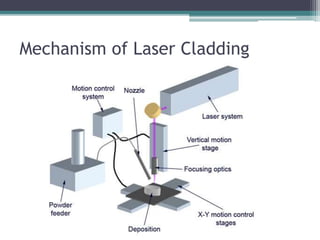
Mechanism of Laser Cladding
• The powder used in laser cladding is normally of a
metallic nature, and is injected into the system by
either coaxial or lateral nozzles.
• The interaction of the metallic powder stream and
the laser causes melting to occur, and is known as
the melt pool.
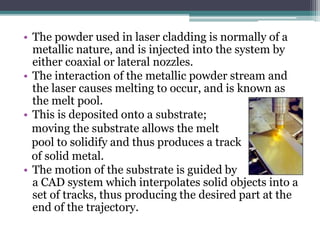
• This is deposited onto a substrate;
moving the substrate allows the melt
pool to solidify and thus produces a track
of solid metal.
• The motion of the substrate is guided by
a CAD system which interpolates solid objects into a
set of tracks, thus producing the desired part at the
end of the trajectory.
Materials
We use different welding consumables, depending on
coating requirements, which are applied in powder form.
Corrosion protection
• Nickel-based alloys
• Chrome-nickel steels
High-temperature
applications
• Cobalt-based alloys
Wear protection
• Materials containing carbide
ex: (NiBSi + WSC)
• Iron-based alloys with different carbides
Process Parameters
Some of the important process parameters of
Laser Cladding are :
• laser power
• laser focal point
• substrate velocity
• powder injection
• Material of substrate
and powder
Applications of laser cladding:
• Repair of worn components
• Coating of components with materials to
improve corrosion and/or wear resistance
properties.
Advantages and Disadvantages
Advantages:
• Best technique for coating any shape
• Particular dispositions for repairing parts
• Most suited technique for graded material application.
• Well adapted for near-net
-shape manufacturing.
• Low dilution between track
and substrate (unlike other
welding processes and
strong metallurgical bond).
• High cooling rate
• Low deformation of the substrate and small heat
affected zone.
• A lot of material flexibility (metal, ceramic, even
polymer).
• Built part is free of crack and porosity.
• Compact technology.
Disadvantages:
• Relatively high equipment and
maintenance cost.
• Large equipment size limits portability.
• Being a new technology, availability and capability
are still very limited.
THANK YOU

Laser cladding

  • 1.
    LASER CLADDING M LN Bhargav 2016UGPI026 NIT JAMSHEDPUR
  • 2.
    LASER • A laseris a device that emits light through a process of optical amplification based on the stimulated emission of electromagnetic radiation. • The term "laser" originated as an acronym for "light amplification by stimulated emission of radiation".
  • 3.
  • 4.
    LASER Cladding • LASERcladdingis a method of depositing material by which a powdered or wire feedstock material is melted and consolidated by use of a LASER in order to coat part of a substrate or fabricate a near-net shape part. • It is often used to improve mechanical properties or increase corrosion resistance, repair worn out parts, and fabricate metal matrix composites.
  • 5.
  • 6.
    • The powderused in laser cladding is normally of a metallic nature, and is injected into the system by either coaxial or lateral nozzles. • The interaction of the metallic powder stream and the laser causes melting to occur, and is known as the melt pool. • This is deposited onto a substrate; moving the substrate allows the melt pool to solidify and thus produces a track of solid metal. • The motion of the substrate is guided by a CAD system which interpolates solid objects into a set of tracks, thus producing the desired part at the end of the trajectory.
  • 7.
    Materials We use differentwelding consumables, depending on coating requirements, which are applied in powder form. Corrosion protection • Nickel-based alloys • Chrome-nickel steels High-temperature applications • Cobalt-based alloys Wear protection • Materials containing carbide ex: (NiBSi + WSC) • Iron-based alloys with different carbides
  • 8.
    Process Parameters Some ofthe important process parameters of Laser Cladding are : • laser power • laser focal point • substrate velocity • powder injection • Material of substrate and powder
  • 9.
    Applications of lasercladding: • Repair of worn components • Coating of components with materials to improve corrosion and/or wear resistance properties.
  • 10.
    Advantages and Disadvantages Advantages: •Best technique for coating any shape • Particular dispositions for repairing parts • Most suited technique for graded material application. • Well adapted for near-net -shape manufacturing. • Low dilution between track and substrate (unlike other welding processes and strong metallurgical bond). • High cooling rate
  • 11.
    • Low deformationof the substrate and small heat affected zone. • A lot of material flexibility (metal, ceramic, even polymer). • Built part is free of crack and porosity. • Compact technology. Disadvantages: • Relatively high equipment and maintenance cost. • Large equipment size limits portability. • Being a new technology, availability and capability are still very limited.
  • 12.