Pratik Chaudhari
MIS- 111210015
TY Mechanical div-1
Subject – Advanced manufacturing techniques
Conventional materials
 Conventional materials are shows more crystallinity.
Shows deflection under service load
 More crystallinity , harder, stiffer and less ductile
 Structure sensitive
 Problems with sophastication,
machinability,tolerance, etc.
 Changed by small changes in chemical composition
Plastics
 Material of “New age”
 Its basic constituent is prepared synthetically or semi-
synthetically from monomer.
 Easily machined , cast and joined
 Ease of manufacturing and versatility
 hardness, elasticity, breaking strength, temperature
resistance, thermal dimensional stability, chemical
resistance
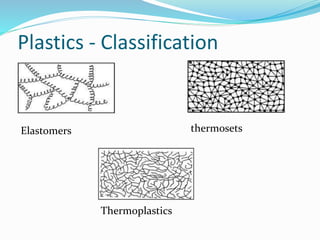
Plastics - Classification
Elastomers thermosets
Thermoplastics
Thermoplastics
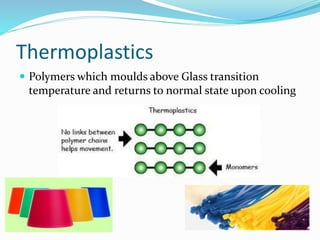
 Polymers which moulds above Glass transition
temperature and returns to normal state upon cooling
Thermoplastics
 Most commonly used engineering thermoplastics as
matrices
 Nylon
 Polycarbonate (PC)
 Polyethylene terephthalate (PET)
 Polypropylene (PP)
 Stronger and stiffer but lower toughness
 Have engineering as well as advanced applications
Glass transition temperature
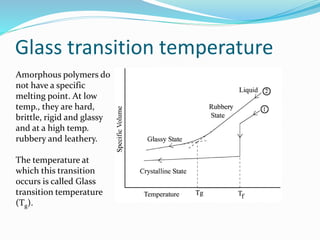
Amorphous polymers do
not have a specific
melting point. At low
temp., they are hard,
brittle, rigid and glassy
and at a high temp.
rubbery and leathery.
The temperature at
which this transition
occurs is called Glass
transition temperature
(Tg).
Effect of temperature
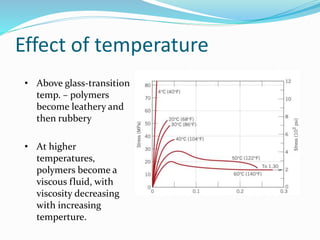
• Above glass-transition
temp. – polymers
become leathery and
then rubbery
• At higher
temperatures,
polymers become a
viscous fluid, with
viscosity decreasing
with increasing
temperture.
Behaviour under temperature
conditions
• Below temperature Tg, plastic polymers are glassy ,rigid,
hard or brittle and behave as a elastic body.
• If the load exceeds the certain critical value, it fractures as
a piece of glass
• 1. Elastic deformation
2. Viscous deformation
3. Maxwell Model of Viscoelastic deformation
4. Voigt or Kelvin Model of Viscoelastic deformation
Viscoelastic behavior
 When heated above Tg , It becomes leathery first and
then rubbery with increasing temperature
 If we increase above Tm (melting point ), it becomes

viscous and viscosity goes on decreasing with increase
in temperature and strain rate
 As viscosity is not constant, thermoplastic shows
visco-elastic behavior
Draw diagrams on page 569
Orientation
 When thermoplastics are permanently deformed by
stretching, long chain molecules align in general
direction of elongation. This is known as orientation.
 The polymer becomes stiffer and stronger in the
elongation direction as compared to transverse
direction
 This technique is used to enhance the strength and
toughness of polymers
Crazing & stress whitening
 Some thermoplastics such as polystyrene develop
localized,wedge shaped narrow regions of highly
deformed material when subjected to high tensile
stresses or bending
 Presence of various additives, solvents, water vapour
favours crazing
 Stress whitening - When polymer subjected to tensile
stresses such as by folding or bending, the plastic
becomes lighter in color due to formation of micro-voids
in the material.
Water absorption
 This is limitation of thermoplastics
 Water acts as plasticizing agent. Thus, it makes
polymer more plastic
 It lowers the glass transition temperature, yield stress
and elastic modulus of polymer
 Sometimes,Undesired dimensional changes occur
Classification…
Amorphous thermoplastic polymers
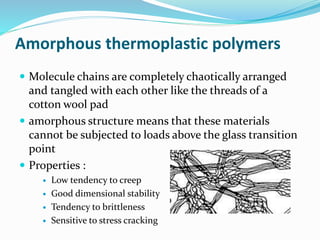
 Molecule chains are completely chaotically arranged
and tangled with each other like the threads of a
cotton wool pad
 amorphous structure means that these materials
cannot be subjected to loads above the glass transition
point
 Properties :
 Low tendency to creep
 Good dimensional stability
 Tendency to brittleness
 Sensitive to stress cracking
Semi-crystalline thermoplastics
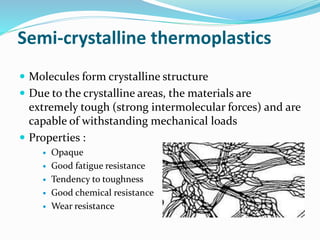
 Molecules form crystalline structure
 Due to the crystalline areas, the materials are
extremely tough (strong intermolecular forces) and are
capable of withstanding mechanical loads
 Properties :
 Opaque
 Good fatigue resistance
 Tendency to toughness
 Good chemical resistance
 Wear resistance
Some examples…
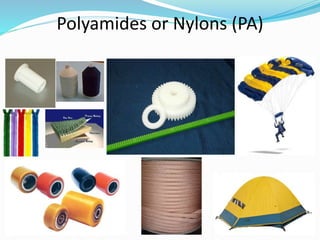
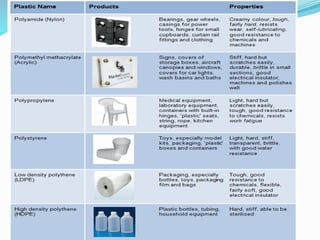
Polyamides or Nylons (PA)
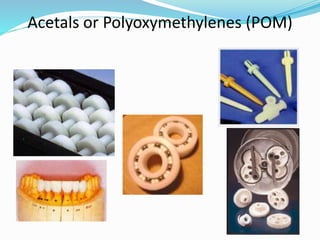
Acetals or Polyoxymethylenes (POM)
•Mechanical—do not embrittle, good impact
strength
•Moisture—very little (shower heads)
•Chemical resistance—very high, resists
stains, sensitive to strong acids and
bases
•Electrical resistance - good
•Machining—like cutting brass
•Adhesion—epoxy glues
Acetals or Polyoxymethylenes (POM)
and Polyamides characteristics
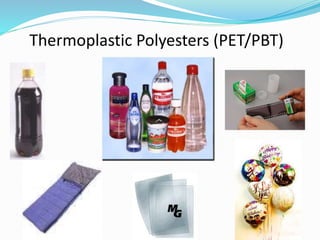
Thermoplastic Polyesters (PET/PBT)
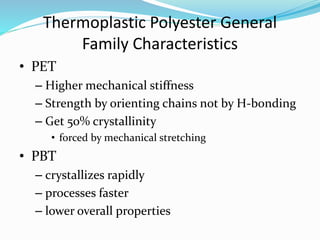
Thermoplastic Polyester General
Family Characteristics
• PET
– Higher mechanical stiffness
– Strength by orienting chains not by H-bonding
– Get 50% crystallinity
• forced by mechanical stretching
• PBT
– crystallizes rapidly
– processes faster
– lower overall properties
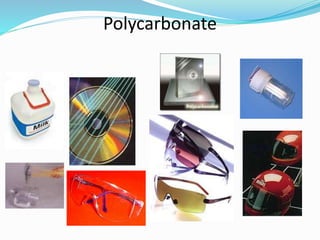
Polycarbonate
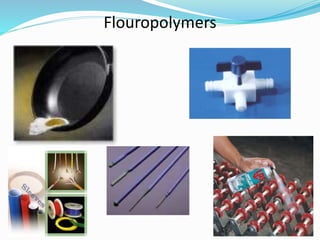
Flouropolymers
Other aspects …
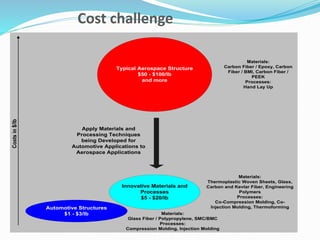
Costsin$/lb
Automotive Structures
$1 - $3/lb
Innovative Materials and
Processes
$5 - $20/lb
Typical Aerospace Structure
$50 - $100/lb
and more
Materials:
Glass Fiber / Polypropylene, SMC/BMC
Processes:
Compression Molding, Injection Molding
Materials:
Thermoplastic Woven Sheets, Glass,
Carbon and Kevlar Fiber, Engineering
Polymers
Processes:
Co-Compression Molding, Co-
Injection Molding, Thermoforming
Materials:
Carbon Fiber / Epoxy, Carbon
Fiber / BMI, Carbon Fiber /
PEEK
Processes:
Hand Lay Up
Apply Materials and
Processing Techniques
being Developed for
Automotive Applications to
Aerospace Applications
Cost challenge
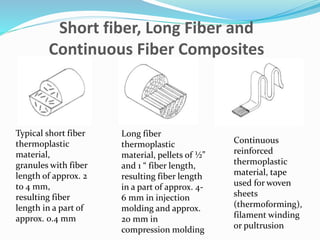
Short fiber, Long Fiber and
Continuous Fiber Composites
Typical short fiber
thermoplastic
material,
granules with fiber
length of approx. 2
to 4 mm,
resulting fiber
length in a part of
approx. 0.4 mm
Long fiber
thermoplastic
material, pellets of ½”
and 1 “ fiber length,
resulting fiber length
in a part of approx. 4-
6 mm in injection
molding and approx.
20 mm in
compression molding
Continuous
reinforced
thermoplastic
material, tape
used for woven
sheets
(thermoforming),
filament winding
or pultrusion
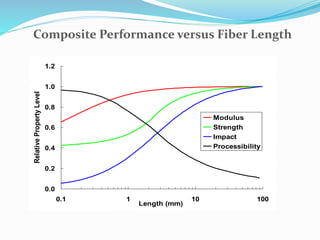
Composite Performance versus Fiber Length
0.0
0.2
0.4
0.6
0.8
1.0
1.2
0.1 1 10 100
Length (mm)
RelativePropertyLevel
Modulus
Strength
Impact
Processibility
Processing…
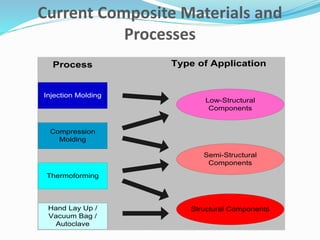
Current Composite Materials and
Processes
Process Type of Application
Injection Molding
Compression
Molding
Thermoforming
Hand Lay Up /
Vacuum Bag /
Autoclave
Low-Structural
Components
Semi-Structural
Components
Structural Components
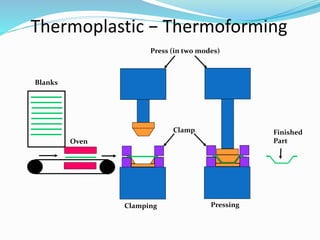
Thermoplastic − Thermoforming
Blanks
Oven
Clamp
Clamping Pressing
Press (in two modes)
Finished
Part
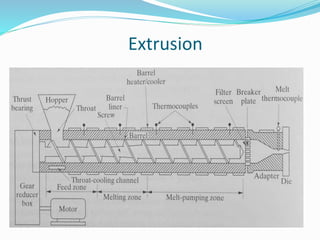
Extrusion
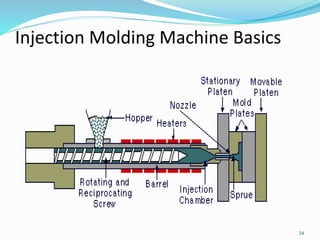
Injection Molding Machine Basics
34
35
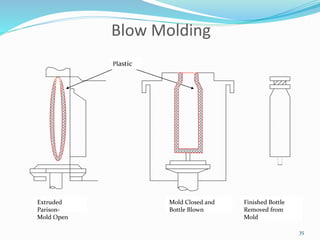
Blow Molding
Extruded
Parison-
Mold Open
Mold Closed and
Bottle Blown
Finished Bottle
Removed from
Mold
Plastic
Plastic Materials and Pocesses 36
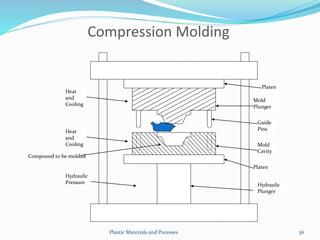
Compression Molding
Platen
Mold
Plunger
Guide
Pins
Mold
Cavity
Platen
Hydraulic
Plunger
Heat
and
Cooling
Heat
and
Cooling
Hydraulic
Pressure
Compound to be molded
Applications…
Applications For High-Performance
Thermoplastics
•Aerospace and defense:
•Radomes, wing and fuselage sextions, anti-ballistics
•Infrastructure and Construction
•Window profiles, rebar, beams, structures, composite bolts
•Consumer / recreational
•Orthotics, safety shoes, sporting goods, helmets, personal
injury protextion, speaker cones, enclosures, bed suspension
slats
•Auto and truck
•Bumper beams, skid plates, load floor, seat structures
•Transportation
•Railcar structure, body structure and closures
•Energy production and storage
•Oil and gas structura tube, wind turbines
Future ?
• Thermoplastics polymers go to more structural
applications using different technical
thermoplastics in combination with glass, carbon
and synthetic fibers.
• Thermoplastics will replace metal applications and
reduce weight.
• Improved processing methods will be developed
and applied.
Thank you…

Thermoplastics : Introduction,classification,Processing & applications

  • 1.
    Pratik Chaudhari MIS- 111210015 TYMechanical div-1 Subject – Advanced manufacturing techniques
  • 2.
    Conventional materials  Conventionalmaterials are shows more crystallinity. Shows deflection under service load  More crystallinity , harder, stiffer and less ductile  Structure sensitive  Problems with sophastication, machinability,tolerance, etc.  Changed by small changes in chemical composition
  • 3.
    Plastics  Material of“New age”  Its basic constituent is prepared synthetically or semi- synthetically from monomer.  Easily machined , cast and joined  Ease of manufacturing and versatility  hardness, elasticity, breaking strength, temperature resistance, thermal dimensional stability, chemical resistance
  • 4.
    Plastics - Classification Elastomersthermosets Thermoplastics
  • 5.
    Thermoplastics  Polymers whichmoulds above Glass transition temperature and returns to normal state upon cooling
  • 6.
    Thermoplastics  Most commonlyused engineering thermoplastics as matrices  Nylon  Polycarbonate (PC)  Polyethylene terephthalate (PET)  Polypropylene (PP)  Stronger and stiffer but lower toughness  Have engineering as well as advanced applications
  • 7.
    Glass transition temperature Amorphouspolymers do not have a specific melting point. At low temp., they are hard, brittle, rigid and glassy and at a high temp. rubbery and leathery. The temperature at which this transition occurs is called Glass transition temperature (Tg).
  • 8.
    Effect of temperature •Above glass-transition temp. – polymers become leathery and then rubbery • At higher temperatures, polymers become a viscous fluid, with viscosity decreasing with increasing temperture.
  • 9.
    Behaviour under temperature conditions •Below temperature Tg, plastic polymers are glassy ,rigid, hard or brittle and behave as a elastic body. • If the load exceeds the certain critical value, it fractures as a piece of glass • 1. Elastic deformation 2. Viscous deformation 3. Maxwell Model of Viscoelastic deformation 4. Voigt or Kelvin Model of Viscoelastic deformation
  • 10.
    Viscoelastic behavior  Whenheated above Tg , It becomes leathery first and then rubbery with increasing temperature  If we increase above Tm (melting point ), it becomes viscous and viscosity goes on decreasing with increase in temperature and strain rate  As viscosity is not constant, thermoplastic shows visco-elastic behavior
  • 11.
  • 12.
    Orientation  When thermoplasticsare permanently deformed by stretching, long chain molecules align in general direction of elongation. This is known as orientation.  The polymer becomes stiffer and stronger in the elongation direction as compared to transverse direction  This technique is used to enhance the strength and toughness of polymers
  • 13.
    Crazing & stresswhitening  Some thermoplastics such as polystyrene develop localized,wedge shaped narrow regions of highly deformed material when subjected to high tensile stresses or bending  Presence of various additives, solvents, water vapour favours crazing  Stress whitening - When polymer subjected to tensile stresses such as by folding or bending, the plastic becomes lighter in color due to formation of micro-voids in the material.
  • 14.
    Water absorption  Thisis limitation of thermoplastics  Water acts as plasticizing agent. Thus, it makes polymer more plastic  It lowers the glass transition temperature, yield stress and elastic modulus of polymer  Sometimes,Undesired dimensional changes occur
  • 15.
  • 16.
    Amorphous thermoplastic polymers Molecule chains are completely chaotically arranged and tangled with each other like the threads of a cotton wool pad  amorphous structure means that these materials cannot be subjected to loads above the glass transition point  Properties :  Low tendency to creep  Good dimensional stability  Tendency to brittleness  Sensitive to stress cracking
  • 17.
    Semi-crystalline thermoplastics  Moleculesform crystalline structure  Due to the crystalline areas, the materials are extremely tough (strong intermolecular forces) and are capable of withstanding mechanical loads  Properties :  Opaque  Good fatigue resistance  Tendency to toughness  Good chemical resistance  Wear resistance
  • 18.
  • 19.
  • 20.
  • 21.
    •Mechanical—do not embrittle,good impact strength •Moisture—very little (shower heads) •Chemical resistance—very high, resists stains, sensitive to strong acids and bases •Electrical resistance - good •Machining—like cutting brass •Adhesion—epoxy glues Acetals or Polyoxymethylenes (POM) and Polyamides characteristics
  • 22.
  • 23.
    Thermoplastic Polyester General FamilyCharacteristics • PET – Higher mechanical stiffness – Strength by orienting chains not by H-bonding – Get 50% crystallinity • forced by mechanical stretching • PBT – crystallizes rapidly – processes faster – lower overall properties
  • 24.
  • 25.
  • 26.
  • 27.
    Costsin$/lb Automotive Structures $1 -$3/lb Innovative Materials and Processes $5 - $20/lb Typical Aerospace Structure $50 - $100/lb and more Materials: Glass Fiber / Polypropylene, SMC/BMC Processes: Compression Molding, Injection Molding Materials: Thermoplastic Woven Sheets, Glass, Carbon and Kevlar Fiber, Engineering Polymers Processes: Co-Compression Molding, Co- Injection Molding, Thermoforming Materials: Carbon Fiber / Epoxy, Carbon Fiber / BMI, Carbon Fiber / PEEK Processes: Hand Lay Up Apply Materials and Processing Techniques being Developed for Automotive Applications to Aerospace Applications Cost challenge
  • 28.
    Short fiber, LongFiber and Continuous Fiber Composites Typical short fiber thermoplastic material, granules with fiber length of approx. 2 to 4 mm, resulting fiber length in a part of approx. 0.4 mm Long fiber thermoplastic material, pellets of ½” and 1 “ fiber length, resulting fiber length in a part of approx. 4- 6 mm in injection molding and approx. 20 mm in compression molding Continuous reinforced thermoplastic material, tape used for woven sheets (thermoforming), filament winding or pultrusion
  • 29.
    Composite Performance versusFiber Length 0.0 0.2 0.4 0.6 0.8 1.0 1.2 0.1 1 10 100 Length (mm) RelativePropertyLevel Modulus Strength Impact Processibility
  • 30.
  • 31.
    Current Composite Materialsand Processes Process Type of Application Injection Molding Compression Molding Thermoforming Hand Lay Up / Vacuum Bag / Autoclave Low-Structural Components Semi-Structural Components Structural Components
  • 32.
    Thermoplastic − Thermoforming Blanks Oven Clamp ClampingPressing Press (in two modes) Finished Part
  • 33.
  • 34.
  • 35.
    35 Blow Molding Extruded Parison- Mold Open MoldClosed and Bottle Blown Finished Bottle Removed from Mold Plastic
  • 36.
    Plastic Materials andPocesses 36 Compression Molding Platen Mold Plunger Guide Pins Mold Cavity Platen Hydraulic Plunger Heat and Cooling Heat and Cooling Hydraulic Pressure Compound to be molded
  • 37.
  • 39.
    Applications For High-Performance Thermoplastics •Aerospaceand defense: •Radomes, wing and fuselage sextions, anti-ballistics •Infrastructure and Construction •Window profiles, rebar, beams, structures, composite bolts •Consumer / recreational •Orthotics, safety shoes, sporting goods, helmets, personal injury protextion, speaker cones, enclosures, bed suspension slats •Auto and truck •Bumper beams, skid plates, load floor, seat structures •Transportation •Railcar structure, body structure and closures •Energy production and storage •Oil and gas structura tube, wind turbines
  • 40.
    Future ? • Thermoplasticspolymers go to more structural applications using different technical thermoplastics in combination with glass, carbon and synthetic fibers. • Thermoplastics will replace metal applications and reduce weight. • Improved processing methods will be developed and applied.
  • 41.

Editor's Notes

  • #4 Plastics can comprise both linear chains and also branched and crosslinked chains. The chain length and the branches define not only the composition but also the main characteristics of the individual materials.