CEREBRAL CORTEX AND
ITS FUNCTION AND
APPLIED - I
DR.PRIYANKA VERMA
MBBS, MD PHYSIOLOGY
DEPARTMENT OF PHYSIOLOGY
LNCT MEDICAL COLLEGE INDORE
1
2
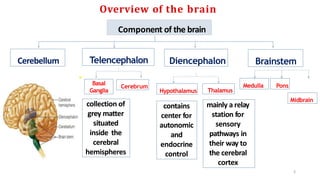
Overview of the brain
Component of the brain
Cerebellum Telencephalon Diencephalon Brainstem
Midbrain
Pons
Medulla
Thalamus
Hypothalamus
mainly a relay
station for
sensory
pathways in
their way to
the cerebral
cortex
contains
center for
autonomic
and
endocrine
control
Cerebrum
Basal
Ganglia
collection of
grey matter
situated
inside the
cerebral
hemispheres
3
4
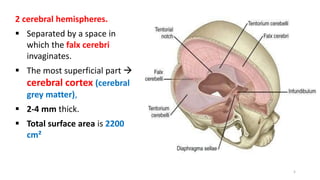
2 cerebral hemispheres.
 Separated by a space in
which the falx cerebri
invaginates.
 The most superficial part 
cerebral cortex (cerebral
grey matter),
 2-4 mm thick.
 Total surface area is 2200
cm²
5
6
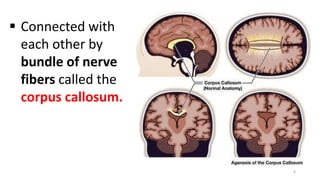
 Connected with
each other by
bundle of nerve
fibers called the
corpus callosum.
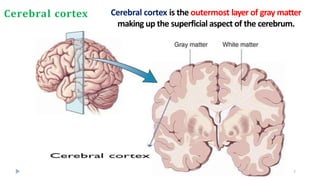
Cerebral cortex Cerebral cortex is the outermost layer of gray matter
making up the superficial aspect of the cerebrum.
7
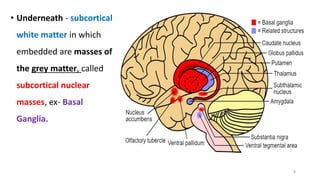
• Underneath - subcortical
white matter in which
embedded are masses of
the grey matter, called
subcortical nuclear
masses, ex- Basal
Ganglia.
8
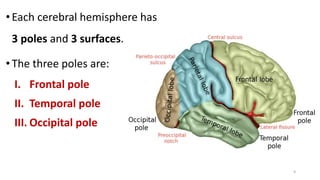
•Each cerebral hemisphere has
3 poles and 3 surfaces.
•The three poles are:
I. Frontal pole
II. Temporal pole
III. Occipital pole
9
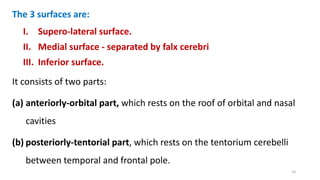
The 3 surfaces are:
I. Supero-lateral surface.
II. Medial surface - separated by falx cerebri
III. Inferior surface.
It consists of two parts:
(a) anteriorly-orbital part, which rests on the roof of orbital and nasal
cavities
(b) posteriorly-tentorial part, which rests on the tentorium cerebelli
between temporal and frontal pole.
10
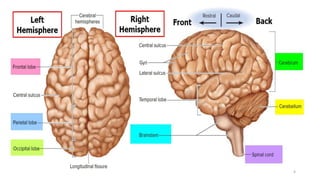
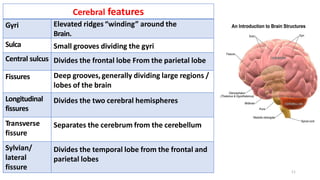
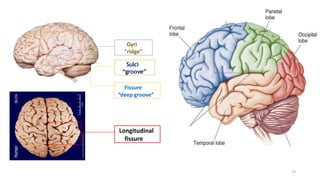
Cerebral features
Gyri Elevated ridges “winding” around the
Brain.
Sulca Small grooves dividing the gyri
Central sulcus Divides the frontal lobe From the parietal lobe
Fissures Deep grooves,generally dividing large regions /
lobes of the brain
Longitudinal
fissures
Divides the two cerebral hemispheres
Transverse
fissure
Separates the cerebrum from the cerebellum
Sylvian/
lateral
fissure
Divides the temporal lobe from the frontal and
parietal lobes
11
12
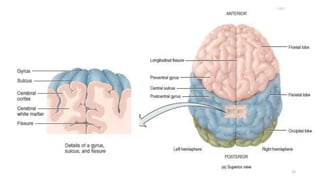
Gyri
"ridge"
Sulci
“groove”
Fissure
“deep groove”
Longitudinal
fissure
13
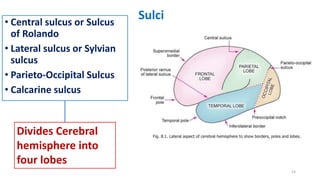
Sulci
• Central sulcus or Sulcus
of Rolando
• Lateral sulcus or Sylvian
sulcus
• Parieto-Occipital Sulcus
• Calcarine sulcus
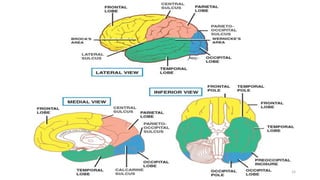
Divides Cerebral
hemisphere into
four lobes
14
15
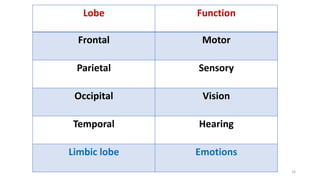
Lobe Function
Frontal Motor
Parietal Sensory
Occipital Vision
Temporal Hearing
Limbic lobe Emotions
16
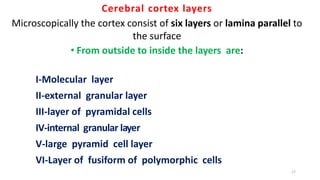
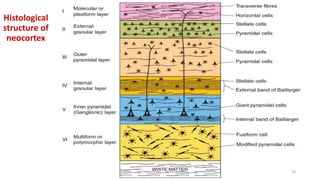
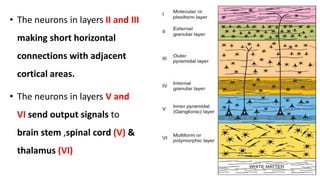
Cerebral cortex layers
Microscopically the cortex consist of six layers or lamina parallel to
the surface
• From outside to inside the layers are:
I-Molecular layer
II-external granular layer
III-layer of pyramidal cells
IV-internal granular layer
V-large pyramid cell layer
VI-Layer of fusiform of polymorphic cells
17
Histological structure.
Cells
 Pyramidal cells. (2/3)
 Stellate cells or Granule cells.(1/3)
 Fusiform cells.
18
Histological
structure of
neocortex
19
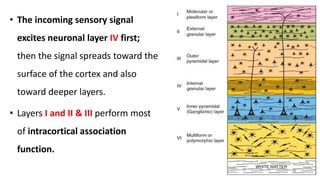
• The incoming sensory signal
excites neuronal layer IV first;
then the signal spreads toward the
surface of the cortex and also
toward deeper layers.
• Layers I and II & III perform most
of intracortical association
function.
20
• The neurons in layers II and III
making short horizontal
connections with adjacent
cortical areas.
• The neurons in layers V and
VI send output signals to
brain stem ,spinal cord (V) &
thalamus (VI)
21
IMPORTANT NOTE
• Most of the afferent fibres from the specific nuclei of thalamus
make synapses in the laminae I–IV.
• Laminae II and IV are concerned with sensorial modalities.
• Laminae III–V are meant for somatomotor or visceromotor
activities.
• Laminae I and VI are engaged for integration of association of
sensorimotor behaviour.
22
CLASSIFICATION OF CORTICAL FIBRES
Afferent And Efferent Fibers.
• Afferent Fibres include:
1. Specific thalamocortical fibres: These fibres terminate in layers IV
(mainly) and III. They may give collaterals to cells of layer V.
2. Non-specific thalamocortical fibres: These fibres terminate in
layer I but also give collaterals to cells of remaining layers II to VI.
23
CLASSIFICATION OF CORTICAL FIBRES
3. Association fibres: They connect different areas of the cerebral
cortex within a hemisphere.
4. Commissural fibres: These fibres cross the midline and connect
different parts of the two hemispheres with one another. The
association and commissural fibres terminate in layers I to IV.
5. Projection fibres: They connect the cerebral cortex with other
regions of the CNS.
24
Cortical Efferent Fibres include:
1. The pyramidal cell axons of layers V and VI which give rise to
the projection, commissural and association fibres.
2. The pyramidal and granule cell axons of layers II and IV which
are mainly distributed within these same cortical layers.
3. The axons of Martinotti (pyramidal) cells, horizontal cells of
layer I and granule cells which are distributed within the cortex
itself.
25
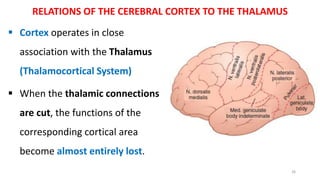
RELATIONS OF THE CEREBRAL CORTEX TO THE THALAMUS
 Cortex operates in close
association with the Thalamus
(Thalamocortical System)
 When the thalamic connections
are cut, the functions of the
corresponding cortical area
become almost entirely lost.
26
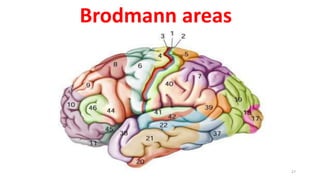
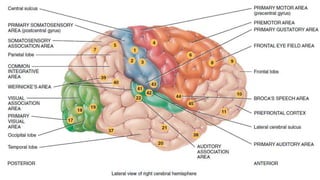
Brodmann areas
27
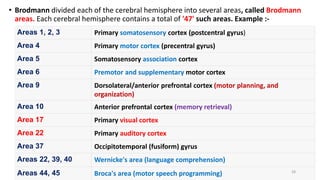
• Brodmann divided each of the cerebral hemisphere into several areas, called Brodmann
areas. Each cerebral hemisphere contains a total of '47' such areas. Example :-
Areas 1, 2, 3 Primary somatosensory cortex (postcentral gyrus)
Area 4 Primary motor cortex (precentral gyrus)
Area 5 Somatosensory association cortex
Area 6 Premotor and supplementary motor cortex
Area 9 Dorsolateral/anterior prefrontal cortex (motor planning, and
organization)
Area 10 Anterior prefrontal cortex (memory retrieval)
Area 17 Primary visual cortex
Area 22 Primary auditory cortex
Area 37 Occipitotemporal (fusiform) gyrus
Areas 22, 39, 40 Wernicke's area (language comprehension)
Areas 44, 45 Broca's area (motor speech programming) 28
29
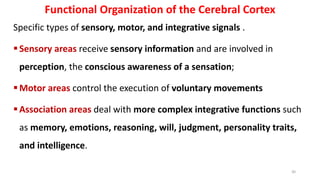
Functional Organization of the Cerebral Cortex
Specific types of sensory, motor, and integrative signals .
Sensory areas receive sensory information and are involved in
perception, the conscious awareness of a sensation;
Motor areas control the execution of voluntary movements
Association areas deal with more complex integrative functions such
as memory, emotions, reasoning, will, judgment, personality traits,
and intelligence.
30
CEREBRAL CORTEX AND
ITS FUNCTION AND
APPLIED - II
DR.PRIYANKA VERMA
MBBS, MD PHYSIOLOGY
DEPARTMENT OF PHYSIOLOGY
LNCT MEDICAL COLLEGE INDORE
31
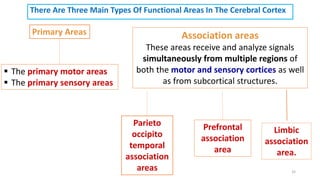
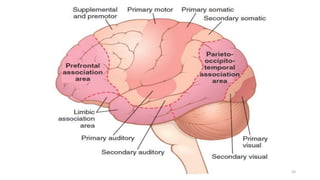
There Are Three Main Types Of Functional Areas In The Cerebral Cortex
Primary Areas Association areas
These areas receive and analyze signals
simultaneously from multiple regions of
both the motor and sensory cortices as well
as from subcortical structures.
 The primary motor areas
 The primary sensory areas
Parieto
occipito
temporal
association
areas
Prefrontal
association
area
Limbic
association
area.
32
33
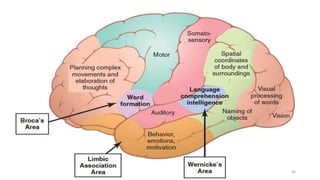
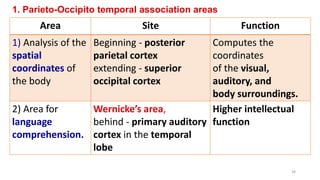
1. Parieto-Occipito temporal association areas
Area Site Function
1) Analysis of the
spatial
coordinates of
the body
Beginning - posterior
parietal cortex
extending - superior
occipital cortex
Computes the
coordinates
of the visual,
auditory, and
body surroundings.
2) Area for
language
comprehension.
Wernicke’s area,
behind - primary auditory
cortex in the temporal
lobe
Higher intellectual
function
34
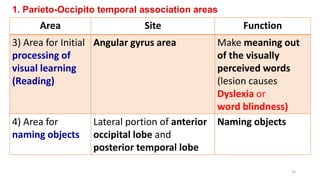
1. Parieto-Occipito temporal association areas
Area Site Function
3) Area for Initial
processing of
visual learning
(Reading)
Angular gyrus area Make meaning out
of the visually
perceived words
(lesion causes
Dyslexia or
word blindness)
4) Area for
naming objects
Lateral portion of anterior
occipital lobe and
posterior temporal lobe
Naming objects
35
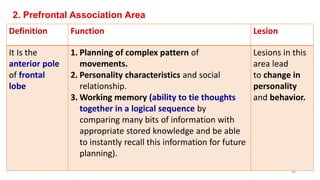
2. Prefrontal Association Area
Definition Function Lesion
It Is the
anterior pole
of frontal
lobe
1. Planning of complex pattern of
movements.
2. Personality characteristics and social
relationship.
3. Working memory (ability to tie thoughts
together in a logical sequence by
comparing many bits of information with
appropriate stored knowledge and be able
to instantly recall this information for future
planning).
Lesions in this
area lead
to change in
personality
and behavior.
36
2. Prefrontal Association Area -Broca’s Area
Definition Function Lesion
Broca’s Area [44,45]
located partly in the
posterior lateral
prefrontal cortex
and partly in the
premotor area
Provides the Neural
Circuitry for Word
Formation.
Broca's aphasia or
expressive aphasia.
--difficulty in forming
words and producing
speech but do not
struggle with
comprehension
37
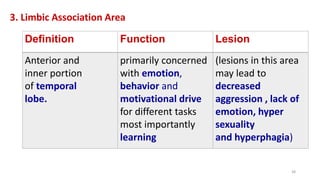
3. Limbic Association Area
Definition Function Lesion
Anterior and
inner portion
of temporal
lobe.
primarily concerned
with emotion,
behavior and
motivational drive
for different tasks
most importantly
learning
(lesions in this area
may lead to
decreased
aggression , lack of
emotion, hyper
sexuality
and hyperphagia)
38
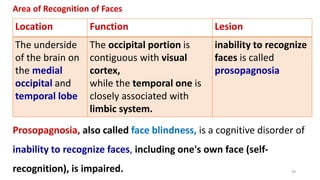
Area of Recognition of Faces
Location Function Lesion
The underside
of the brain on
the medial
occipital and
temporal lobe
The occipital portion is
contiguous with visual
cortex,
while the temporal one is
closely associated with
limbic system.
inability to recognize
faces is called
prosopagnosia
Prosopagnosia, also called face blindness, is a cognitive disorder of
inability to recognize faces, including one's own face (self-
recognition), is impaired. 39
40
[A] FRONTAL LOBE
• Lies in front of the central sulcus and above the posterior ramus of the
lateral sulcus .
• frontal lobe is subdivided into two main areas:
1. Precentral cortex and
2. Prefrontal cortex.
I. Precentral cortex
• Posterior part of the frontal lobe .
• Excitomotor area of cortex.
41
[A] FRONTAL LOBE
42
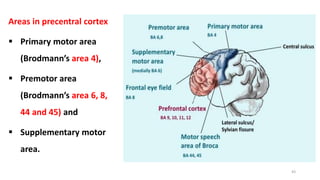
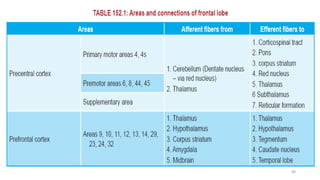
Areas in precentral cortex
 Primary motor area
(Brodmann’s area 4),
 Premotor area
(Brodmann’s area 6, 8,
44 and 45) and
 Supplementary motor
area.
43
Area 4 Functions.
 initiation of voluntary movements of the contralateral half of the
body and initiation of speech.
Area 6 Functions. –
 co-ordinates the voluntary action of area 4 ,integration of
voluntary movements.
 skilled movements are accurate and smooth.
Area 8.
• = frontal eye field - lies anterior to area 6.
• Functions. control of eye movements.
44
Area 44 and 45 or Broca’s motor speech area.
• Situated in the inferior frontal gyrus.
• Functions. This area, specially in dominated hemisphere (left
hemisphere in right handed person), it causes activation of vocal
cords, simultaneously with movements of mouth and tongue
during speech.
• Lesions of this area cause motor aphasia, i.e. inability to speak
the word though vocalization is possible
45
3. Supplementary motor area
Location. – Medial surface of frontal lobe rostral to primary motor
area
Functions. This area in association with the premotor area provides,
fixation movement of different segments of the body and
positional movements of head and eyes.
46
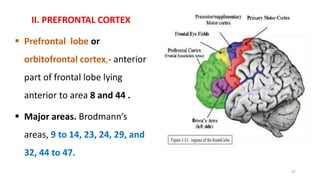
II. PREFRONTAL CORTEX
 Prefrontal lobe or
orbitofrontal cortex,- anterior
part of frontal lobe lying
anterior to area 8 and 44 .
 Major areas. Brodmann’s
areas, 9 to 14, 23, 24, 29, and
32, 44 to 47.
47
48
49
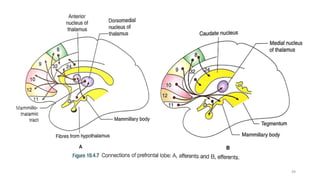
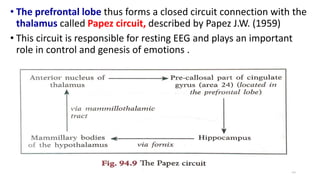
• The prefrontal lobe thus forms a closed circuit connection with the
thalamus called Papez circuit, described by Papez J.W. (1959)
• This circuit is responsible for resting EEG and plays an important
role in control and genesis of emotions .
50
Functions of prefrontal cortex
1. Centre for planned actions.
2. Centre for higher functions - like emotions, learning, memory and social
behaviour.
3. Seat of intelligence. Short-term memories are registered . It can keep track
of many bits of information and has ability to recall this information
therefore called seat of intelligence or an organ of mind.
4. Control of intellectual activities. plan the future , depth and abstractness
of thought , solution of complicated mathematical, legal and philosophical
problems.
51
APPLIED ASPECTS
Frontal lobe syndrome
• Due to injury or ablation of prefrontal cortex.
• Prefrontal leucotomy, i.e. cutting the connection between the
thalamus and prefrontal lobe
• Prefrontal lobectomy (extirpation- to destroy completely )
• In the past, these operations were performed in patients with
severe mental illness.[not now]
52
Frontal lobe syndrome
• Cause - Ablation of prefrontal
cortex.
• Features. (FEEL - FILL)
• Flight of ideas.
• Emotional instability.
• Euphoria.
• Loss of moral & social sense.
• Functional abnormal-
Hyperphagia."Sphincters control
loss.
• Disorientation & tremors.
• Impairment of Memory.
• Lack of Attention &
Concentration.
• Lack of Initiative & decreased
Intellectual Activity
53
B. PARIETAL LOBE
Parietal lobe lies between the central sulcus and parieto-occipital
sulcus.
Areas of parietal lobe
 Primary sensory area (which corresponds to Brodmann’s areas
3, 1 and 2),
 Secondary sensory area and
 Sensory association areas (Brodmann’s area 5 and 7).
 Area 40
54
PRIMARY SENSORY AREA. (3,1,& 2)
• Location - Post
central Gyrus & Post
wall of Central sulcus.
• Histo - Dense stellate
cells, few pyramidal
cells.
• Site involved with processing of tactile
and proprioceptive information.
• Lesion - without Thalamus only
Discriminative functions lost“
• With Thalamus - All sensation from
Opp. half of body lost.
55
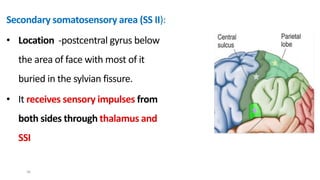
Secondary somatosensory area (SS II):
• Location -postcentral gyrus below
the area of face with most of it
buried in the sylvian fissure.
• It receives sensory impulses from
both sides through thalamus and
SSI
56
 Somatosensory association cortex
• Assists with the integration and interpretation of sensations relative
to body position and orientation in space.
• May assist with visuomotor coordination.
 Area 40
• It is concerned with recognition of common objects placed in the
hand without looking at them. Therefore, also called as
stereognosis area
57
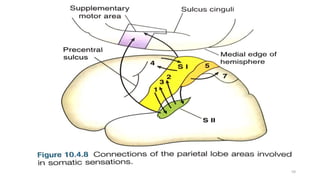
Connections- It is well connected with:
1. Thalamus (VPLN)
2. Hypothalamus
3. Reticular formation
4. The motor areas 4, 6 and 8
5. Basal ganglia
6. Cerebellum, tectum, pons
7. Sensory tracts
8. Dorsal grey horn of spinal cord
9. Cingulate gyrus
10. Vestibular apparatus
58
59
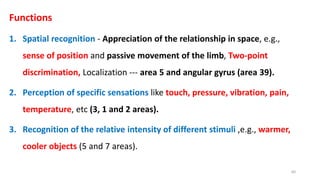
Functions
1. Spatial recognition - Appreciation of the relationship in space, e.g.,
sense of position and passive movement of the limb, Two-point
discrimination, Localization --- area 5 and angular gyrus (area 39).
2. Perception of specific sensations like touch, pressure, vibration, pain,
temperature, etc (3, 1 and 2 areas).
3. Recognition of the relative intensity of different stimuli ,e.g., warmer,
cooler objects (5 and 7 areas).
60
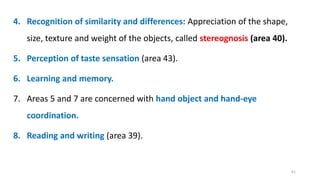
4. Recognition of similarity and differences: Appreciation of the shape,
size, texture and weight of the objects, called stereognosis (area 40).
5. Perception of taste sensation (area 43).
6. Learning and memory.
7. Areas 5 and 7 are concerned with hand object and hand-eye
coordination.
8. Reading and writing (area 39).
61
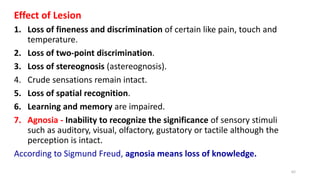
Effect of Lesion
1. Loss of fineness and discrimination of certain like pain, touch and
temperature.
2. Loss of two-point discrimination.
3. Loss of stereognosis (astereognosis).
4. Crude sensations remain intact.
5. Loss of spatial recognition.
6. Learning and memory are impaired.
7. Agnosia - Inability to recognize the significance of sensory stimuli
such as auditory, visual, olfactory, gustatory or tactile although the
perception is intact.
According to Sigmund Freud, agnosia means loss of knowledge.
62
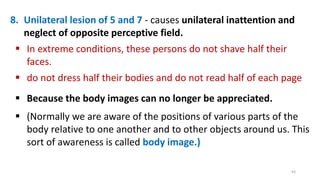
8. Unilateral lesion of 5 and 7 - causes unilateral inattention and
neglect of opposite perceptive field.
 In extreme conditions, these persons do not shave half their
faces.
 do not dress half their bodies and do not read half of each page
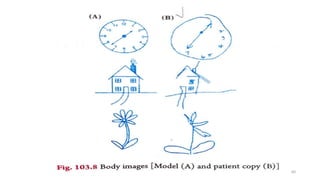
 Because the body images can no longer be appreciated.
 (Normally we are aware of the positions of various parts of the
body relative to one another and to other objects around us. This
sort of awareness is called body image.)
63
64
Bilateral lesion.
In bilateral lesion, visual placing is also lost but coarse
tactile placing is retained.
Individual is unable to make use of visual information that
is inability to copy designs etc. (called constructional
apraxia) and there is spatial disorientation.
65
C. OCCIPITAL LOBE
• Behind the parieto-occipital sulcus
• It is concerned with vision.
AREAS OF OCCIPITAL LOBE
It contains visual cortex having three areas :
• Primary visual cortex (area 17),
• Visual association area (area 18) and
• Visual association area or occipital eye field (area 19).
66
FUNCTIONS
1. Primary visual area (area 17) - perception of visual impulses.
2. Visual association areas (area 18 and area 19) - interpretation of
visual impulses.
• Recognition and identification of objects in the light of past
experience.
3. Occipital eye field area (area 19) - movements of eyeball.
Therefore, like other sensory areas, the visual area is also to be
regarded as partly motor in function.
67
Connections -It is well connected with:
1. Thalamus (LGN)
2. Frontal eye field (area 8)
3. Pineal body
4. Tectum-Superior colliculus [midbrain]
5. Hypothalamus
6. Limbic lobe
7. Posterior parietal cortex area 78.
8. Temporal lobe-Superior and inferior temporal gyri areas 22, 21, 20
and 37
68
Functions
1. Perception of light and its gradation.
2. Perception of shape, size and position of objects.
3. Perception of color and its gradation.
4. Visual acuity (depth of vision).
5. It has a role in posture and equilibrium.
6. It has a role in memory, language function and other higher functions.
69
Effect of Bilateral Removal of Occipital Lobe
1. Blindness
2. Loss of all forms of vision
3. Loss of language function and memory associated with
vision
4. Posture and equilibrium are not affected
5. Unilateral removal of occipital lobe leads to hemianopia
70
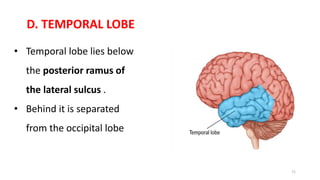
• Temporal lobe lies below
the posterior ramus of
the lateral sulcus .
• Behind it is separated
from the occipital lobe
D. TEMPORAL LOBE
71
AREAS OF TEMPORAL LOBE
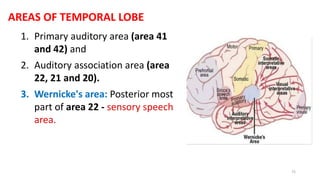
1. Primary auditory area (area 41
and 42) and
2. Auditory association area (area
22, 21 and 20).
3. Wernicke's area: Posterior most
part of area 22 - sensory speech
area.
72
AREAS OF TEMPORAL LOBE
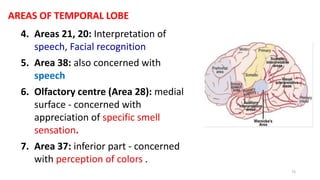
4. Areas 21, 20: Interpretation of
speech, Facial recognition
5. Area 38: also concerned with
speech
6. Olfactory centre (Area 28): medial
surface - concerned with
appreciation of specific smell
sensation.
7. Area 37: inferior part - concerned
with perception of colors .
73
Connections
Temporal lobe is well connected with:
1. Thalamus
2. Hypothalamus
3. Amygdaloid nucleus
4. Pyriform cortex
5. Hippocampus
6. Cranial nuclei III, IV and VI
7. Frontal lobe
8. Occipital lobe
74
Functions
1. It has the centre for hearing [Area 41]
2. Interpretation of various sounds.
3. Language comprehension and other higher intellectual functions
[Areas 42 and 22 ].
4. Recent memory.
5. Facial recognition (areas 21 and 20).
6. Color vision (area 37).
7. Participates in olfaction (area 28).
75
Lesions of these areas impair auditory, short-term memory
without impairing visual memory.
1.Wernicke’sAphasia :
 Language comprehension is inhibited.
 Words and sentences are not clearly understood,and sentence
formation may be inhibited or non-sensical.
76
Applied Aspects
UNILATERAL REMOVAL OF
TEMPORAL LOBE
• Causes no deafness
• As ear bilaterally represented in
auditory pathway & project equally
to 2 cerebral hemispheres
• Thus the removal of one auditory
cortex has only a slight effect on
auditory acuity (sharpness of
hearing).
TEMPORAL LOBE SYNDROME.
(KLUVER-BUCY SYNDROME)
• Bilateral removal of temporal
lobe with amygdala & Uncus
77
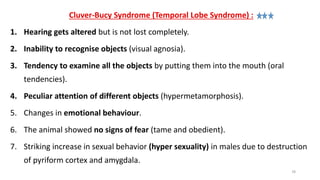
Cluver-Bucy Syndrome (Temporal Lobe Syndrome) :
1. Hearing gets altered but is not lost completely.
2. Inability to recognise objects (visual agnosia).
3. Tendency to examine all the objects by putting them into the mouth (oral
tendencies).
4. Peculiar attention of different objects (hypermetamorphosis).
5. Changes in emotional behaviour.
6. The animal showed no signs of fear (tame and obedient).
7. Striking increase in sexual behavior (hyper sexuality) in males due to destruction
of pyriform cortex and amygdala.
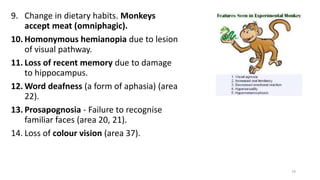
78
9. Change in dietary habits. Monkeys
accept meat (omniphagic).
10. Homonymous hemianopia due to lesion
of visual pathway.
11. Loss of recent memory due to damage
to hippocampus.
12. Word deafness (a form of aphasia) (area
22).
13. Prosapognosia - Failure to recognise
familiar faces (area 20, 21).
14. Loss of colour vision (area 37).
79
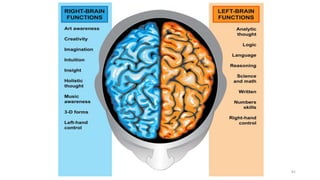
Hemispheric Lateralization
• Although the brain is almost symmetrical on its right and left
sides, subtle anatomical differences between the two hemispheres
exist.
• For example, in about 2/3rd of the population, temporal lobe that
includes Wernicke’s area, is 50% larger on the left side.
• Each hemisphere also specializes in performing certain unique
functions.
• This functional asymmetry is termed hemispheric lateralization.
80
81
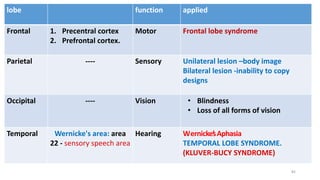
lobe function applied
Frontal 1. Precentral cortex
2. Prefrontal cortex.
Motor Frontal lobe syndrome
Parietal ---- Sensory Unilateral lesion –body image
Bilateral lesion -inability to copy
designs
Occipital ---- Vision • Blindness
• Loss of all forms of vision
Temporal Wernicke's area: area
22 - sensory speech area
Hearing Wernicke’
sAphasia
TEMPORAL LOBE SYNDROME.
(KLUVER-BUCY SYNDROME)
82
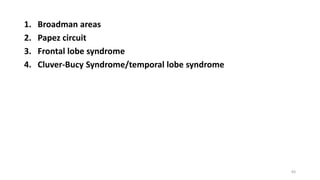
1. Broadman areas
2. Papez circuit
3. Frontal lobe syndrome
4. Cluver-Bucy Syndrome/temporal lobe syndrome
83
84

CEREBRAL CORTEX PHYSIOLOGY FUNCTIONS AND LESIONS-29 DEC.pptx

  • 1.
    CEREBRAL CORTEX AND ITSFUNCTION AND APPLIED - I DR.PRIYANKA VERMA MBBS, MD PHYSIOLOGY DEPARTMENT OF PHYSIOLOGY LNCT MEDICAL COLLEGE INDORE 1
  • 2.
  • 3.
    Overview of thebrain Component of the brain Cerebellum Telencephalon Diencephalon Brainstem Midbrain Pons Medulla Thalamus Hypothalamus mainly a relay station for sensory pathways in their way to the cerebral cortex contains center for autonomic and endocrine control Cerebrum Basal Ganglia collection of grey matter situated inside the cerebral hemispheres 3
  • 4.
  • 5.
    2 cerebral hemispheres. Separated by a space in which the falx cerebri invaginates.  The most superficial part  cerebral cortex (cerebral grey matter),  2-4 mm thick.  Total surface area is 2200 cm² 5
  • 6.
    6  Connected with eachother by bundle of nerve fibers called the corpus callosum.
  • 7.
    Cerebral cortex Cerebralcortex is the outermost layer of gray matter making up the superficial aspect of the cerebrum. 7
  • 8.
    • Underneath -subcortical white matter in which embedded are masses of the grey matter, called subcortical nuclear masses, ex- Basal Ganglia. 8
  • 9.
    •Each cerebral hemispherehas 3 poles and 3 surfaces. •The three poles are: I. Frontal pole II. Temporal pole III. Occipital pole 9
  • 10.
    The 3 surfacesare: I. Supero-lateral surface. II. Medial surface - separated by falx cerebri III. Inferior surface. It consists of two parts: (a) anteriorly-orbital part, which rests on the roof of orbital and nasal cavities (b) posteriorly-tentorial part, which rests on the tentorium cerebelli between temporal and frontal pole. 10
  • 11.
    Cerebral features Gyri Elevatedridges “winding” around the Brain. Sulca Small grooves dividing the gyri Central sulcus Divides the frontal lobe From the parietal lobe Fissures Deep grooves,generally dividing large regions / lobes of the brain Longitudinal fissures Divides the two cerebral hemispheres Transverse fissure Separates the cerebrum from the cerebellum Sylvian/ lateral fissure Divides the temporal lobe from the frontal and parietal lobes 11
  • 12.
  • 13.
  • 14.
    Sulci • Central sulcusor Sulcus of Rolando • Lateral sulcus or Sylvian sulcus • Parieto-Occipital Sulcus • Calcarine sulcus Divides Cerebral hemisphere into four lobes 14
  • 15.
  • 16.
    Lobe Function Frontal Motor ParietalSensory Occipital Vision Temporal Hearing Limbic lobe Emotions 16
  • 17.
    Cerebral cortex layers Microscopicallythe cortex consist of six layers or lamina parallel to the surface • From outside to inside the layers are: I-Molecular layer II-external granular layer III-layer of pyramidal cells IV-internal granular layer V-large pyramid cell layer VI-Layer of fusiform of polymorphic cells 17
  • 18.
    Histological structure. Cells  Pyramidalcells. (2/3)  Stellate cells or Granule cells.(1/3)  Fusiform cells. 18
  • 19.
  • 20.
    • The incomingsensory signal excites neuronal layer IV first; then the signal spreads toward the surface of the cortex and also toward deeper layers. • Layers I and II & III perform most of intracortical association function. 20
  • 21.
    • The neuronsin layers II and III making short horizontal connections with adjacent cortical areas. • The neurons in layers V and VI send output signals to brain stem ,spinal cord (V) & thalamus (VI) 21
  • 22.
    IMPORTANT NOTE • Mostof the afferent fibres from the specific nuclei of thalamus make synapses in the laminae I–IV. • Laminae II and IV are concerned with sensorial modalities. • Laminae III–V are meant for somatomotor or visceromotor activities. • Laminae I and VI are engaged for integration of association of sensorimotor behaviour. 22
  • 23.
    CLASSIFICATION OF CORTICALFIBRES Afferent And Efferent Fibers. • Afferent Fibres include: 1. Specific thalamocortical fibres: These fibres terminate in layers IV (mainly) and III. They may give collaterals to cells of layer V. 2. Non-specific thalamocortical fibres: These fibres terminate in layer I but also give collaterals to cells of remaining layers II to VI. 23
  • 24.
    CLASSIFICATION OF CORTICALFIBRES 3. Association fibres: They connect different areas of the cerebral cortex within a hemisphere. 4. Commissural fibres: These fibres cross the midline and connect different parts of the two hemispheres with one another. The association and commissural fibres terminate in layers I to IV. 5. Projection fibres: They connect the cerebral cortex with other regions of the CNS. 24
  • 25.
    Cortical Efferent Fibresinclude: 1. The pyramidal cell axons of layers V and VI which give rise to the projection, commissural and association fibres. 2. The pyramidal and granule cell axons of layers II and IV which are mainly distributed within these same cortical layers. 3. The axons of Martinotti (pyramidal) cells, horizontal cells of layer I and granule cells which are distributed within the cortex itself. 25
  • 26.
    RELATIONS OF THECEREBRAL CORTEX TO THE THALAMUS  Cortex operates in close association with the Thalamus (Thalamocortical System)  When the thalamic connections are cut, the functions of the corresponding cortical area become almost entirely lost. 26
  • 27.
  • 28.
    • Brodmann dividedeach of the cerebral hemisphere into several areas, called Brodmann areas. Each cerebral hemisphere contains a total of '47' such areas. Example :- Areas 1, 2, 3 Primary somatosensory cortex (postcentral gyrus) Area 4 Primary motor cortex (precentral gyrus) Area 5 Somatosensory association cortex Area 6 Premotor and supplementary motor cortex Area 9 Dorsolateral/anterior prefrontal cortex (motor planning, and organization) Area 10 Anterior prefrontal cortex (memory retrieval) Area 17 Primary visual cortex Area 22 Primary auditory cortex Area 37 Occipitotemporal (fusiform) gyrus Areas 22, 39, 40 Wernicke's area (language comprehension) Areas 44, 45 Broca's area (motor speech programming) 28
  • 29.
  • 30.
    Functional Organization ofthe Cerebral Cortex Specific types of sensory, motor, and integrative signals . Sensory areas receive sensory information and are involved in perception, the conscious awareness of a sensation; Motor areas control the execution of voluntary movements Association areas deal with more complex integrative functions such as memory, emotions, reasoning, will, judgment, personality traits, and intelligence. 30
  • 31.
    CEREBRAL CORTEX AND ITSFUNCTION AND APPLIED - II DR.PRIYANKA VERMA MBBS, MD PHYSIOLOGY DEPARTMENT OF PHYSIOLOGY LNCT MEDICAL COLLEGE INDORE 31
  • 32.
    There Are ThreeMain Types Of Functional Areas In The Cerebral Cortex Primary Areas Association areas These areas receive and analyze signals simultaneously from multiple regions of both the motor and sensory cortices as well as from subcortical structures.  The primary motor areas  The primary sensory areas Parieto occipito temporal association areas Prefrontal association area Limbic association area. 32
  • 33.
  • 34.
    1. Parieto-Occipito temporalassociation areas Area Site Function 1) Analysis of the spatial coordinates of the body Beginning - posterior parietal cortex extending - superior occipital cortex Computes the coordinates of the visual, auditory, and body surroundings. 2) Area for language comprehension. Wernicke’s area, behind - primary auditory cortex in the temporal lobe Higher intellectual function 34
  • 35.
    1. Parieto-Occipito temporalassociation areas Area Site Function 3) Area for Initial processing of visual learning (Reading) Angular gyrus area Make meaning out of the visually perceived words (lesion causes Dyslexia or word blindness) 4) Area for naming objects Lateral portion of anterior occipital lobe and posterior temporal lobe Naming objects 35
  • 36.
    2. Prefrontal AssociationArea Definition Function Lesion It Is the anterior pole of frontal lobe 1. Planning of complex pattern of movements. 2. Personality characteristics and social relationship. 3. Working memory (ability to tie thoughts together in a logical sequence by comparing many bits of information with appropriate stored knowledge and be able to instantly recall this information for future planning). Lesions in this area lead to change in personality and behavior. 36
  • 37.
    2. Prefrontal AssociationArea -Broca’s Area Definition Function Lesion Broca’s Area [44,45] located partly in the posterior lateral prefrontal cortex and partly in the premotor area Provides the Neural Circuitry for Word Formation. Broca's aphasia or expressive aphasia. --difficulty in forming words and producing speech but do not struggle with comprehension 37
  • 38.
    3. Limbic AssociationArea Definition Function Lesion Anterior and inner portion of temporal lobe. primarily concerned with emotion, behavior and motivational drive for different tasks most importantly learning (lesions in this area may lead to decreased aggression , lack of emotion, hyper sexuality and hyperphagia) 38
  • 39.
    Area of Recognitionof Faces Location Function Lesion The underside of the brain on the medial occipital and temporal lobe The occipital portion is contiguous with visual cortex, while the temporal one is closely associated with limbic system. inability to recognize faces is called prosopagnosia Prosopagnosia, also called face blindness, is a cognitive disorder of inability to recognize faces, including one's own face (self- recognition), is impaired. 39
  • 40.
  • 41.
    [A] FRONTAL LOBE •Lies in front of the central sulcus and above the posterior ramus of the lateral sulcus . • frontal lobe is subdivided into two main areas: 1. Precentral cortex and 2. Prefrontal cortex. I. Precentral cortex • Posterior part of the frontal lobe . • Excitomotor area of cortex. 41
  • 42.
  • 43.
    Areas in precentralcortex  Primary motor area (Brodmann’s area 4),  Premotor area (Brodmann’s area 6, 8, 44 and 45) and  Supplementary motor area. 43
  • 44.
    Area 4 Functions. initiation of voluntary movements of the contralateral half of the body and initiation of speech. Area 6 Functions. –  co-ordinates the voluntary action of area 4 ,integration of voluntary movements.  skilled movements are accurate and smooth. Area 8. • = frontal eye field - lies anterior to area 6. • Functions. control of eye movements. 44
  • 45.
    Area 44 and45 or Broca’s motor speech area. • Situated in the inferior frontal gyrus. • Functions. This area, specially in dominated hemisphere (left hemisphere in right handed person), it causes activation of vocal cords, simultaneously with movements of mouth and tongue during speech. • Lesions of this area cause motor aphasia, i.e. inability to speak the word though vocalization is possible 45
  • 46.
    3. Supplementary motorarea Location. – Medial surface of frontal lobe rostral to primary motor area Functions. This area in association with the premotor area provides, fixation movement of different segments of the body and positional movements of head and eyes. 46
  • 47.
    II. PREFRONTAL CORTEX Prefrontal lobe or orbitofrontal cortex,- anterior part of frontal lobe lying anterior to area 8 and 44 .  Major areas. Brodmann’s areas, 9 to 14, 23, 24, 29, and 32, 44 to 47. 47
  • 48.
  • 49.
  • 50.
    • The prefrontallobe thus forms a closed circuit connection with the thalamus called Papez circuit, described by Papez J.W. (1959) • This circuit is responsible for resting EEG and plays an important role in control and genesis of emotions . 50
  • 51.
    Functions of prefrontalcortex 1. Centre for planned actions. 2. Centre for higher functions - like emotions, learning, memory and social behaviour. 3. Seat of intelligence. Short-term memories are registered . It can keep track of many bits of information and has ability to recall this information therefore called seat of intelligence or an organ of mind. 4. Control of intellectual activities. plan the future , depth and abstractness of thought , solution of complicated mathematical, legal and philosophical problems. 51
  • 52.
    APPLIED ASPECTS Frontal lobesyndrome • Due to injury or ablation of prefrontal cortex. • Prefrontal leucotomy, i.e. cutting the connection between the thalamus and prefrontal lobe • Prefrontal lobectomy (extirpation- to destroy completely ) • In the past, these operations were performed in patients with severe mental illness.[not now] 52
  • 53.
    Frontal lobe syndrome •Cause - Ablation of prefrontal cortex. • Features. (FEEL - FILL) • Flight of ideas. • Emotional instability. • Euphoria. • Loss of moral & social sense. • Functional abnormal- Hyperphagia."Sphincters control loss. • Disorientation & tremors. • Impairment of Memory. • Lack of Attention & Concentration. • Lack of Initiative & decreased Intellectual Activity 53
  • 54.
    B. PARIETAL LOBE Parietallobe lies between the central sulcus and parieto-occipital sulcus. Areas of parietal lobe  Primary sensory area (which corresponds to Brodmann’s areas 3, 1 and 2),  Secondary sensory area and  Sensory association areas (Brodmann’s area 5 and 7).  Area 40 54
  • 55.
    PRIMARY SENSORY AREA.(3,1,& 2) • Location - Post central Gyrus & Post wall of Central sulcus. • Histo - Dense stellate cells, few pyramidal cells. • Site involved with processing of tactile and proprioceptive information. • Lesion - without Thalamus only Discriminative functions lost“ • With Thalamus - All sensation from Opp. half of body lost. 55
  • 56.
    Secondary somatosensory area(SS II): • Location -postcentral gyrus below the area of face with most of it buried in the sylvian fissure. • It receives sensory impulses from both sides through thalamus and SSI 56
  • 57.
     Somatosensory associationcortex • Assists with the integration and interpretation of sensations relative to body position and orientation in space. • May assist with visuomotor coordination.  Area 40 • It is concerned with recognition of common objects placed in the hand without looking at them. Therefore, also called as stereognosis area 57
  • 58.
    Connections- It iswell connected with: 1. Thalamus (VPLN) 2. Hypothalamus 3. Reticular formation 4. The motor areas 4, 6 and 8 5. Basal ganglia 6. Cerebellum, tectum, pons 7. Sensory tracts 8. Dorsal grey horn of spinal cord 9. Cingulate gyrus 10. Vestibular apparatus 58
  • 59.
  • 60.
    Functions 1. Spatial recognition- Appreciation of the relationship in space, e.g., sense of position and passive movement of the limb, Two-point discrimination, Localization --- area 5 and angular gyrus (area 39). 2. Perception of specific sensations like touch, pressure, vibration, pain, temperature, etc (3, 1 and 2 areas). 3. Recognition of the relative intensity of different stimuli ,e.g., warmer, cooler objects (5 and 7 areas). 60
  • 61.
    4. Recognition ofsimilarity and differences: Appreciation of the shape, size, texture and weight of the objects, called stereognosis (area 40). 5. Perception of taste sensation (area 43). 6. Learning and memory. 7. Areas 5 and 7 are concerned with hand object and hand-eye coordination. 8. Reading and writing (area 39). 61
  • 62.
    Effect of Lesion 1.Loss of fineness and discrimination of certain like pain, touch and temperature. 2. Loss of two-point discrimination. 3. Loss of stereognosis (astereognosis). 4. Crude sensations remain intact. 5. Loss of spatial recognition. 6. Learning and memory are impaired. 7. Agnosia - Inability to recognize the significance of sensory stimuli such as auditory, visual, olfactory, gustatory or tactile although the perception is intact. According to Sigmund Freud, agnosia means loss of knowledge. 62
  • 63.
    8. Unilateral lesionof 5 and 7 - causes unilateral inattention and neglect of opposite perceptive field.  In extreme conditions, these persons do not shave half their faces.  do not dress half their bodies and do not read half of each page  Because the body images can no longer be appreciated.  (Normally we are aware of the positions of various parts of the body relative to one another and to other objects around us. This sort of awareness is called body image.) 63
  • 64.
  • 65.
    Bilateral lesion. In bilaterallesion, visual placing is also lost but coarse tactile placing is retained. Individual is unable to make use of visual information that is inability to copy designs etc. (called constructional apraxia) and there is spatial disorientation. 65
  • 66.
    C. OCCIPITAL LOBE •Behind the parieto-occipital sulcus • It is concerned with vision. AREAS OF OCCIPITAL LOBE It contains visual cortex having three areas : • Primary visual cortex (area 17), • Visual association area (area 18) and • Visual association area or occipital eye field (area 19). 66
  • 67.
    FUNCTIONS 1. Primary visualarea (area 17) - perception of visual impulses. 2. Visual association areas (area 18 and area 19) - interpretation of visual impulses. • Recognition and identification of objects in the light of past experience. 3. Occipital eye field area (area 19) - movements of eyeball. Therefore, like other sensory areas, the visual area is also to be regarded as partly motor in function. 67
  • 68.
    Connections -It iswell connected with: 1. Thalamus (LGN) 2. Frontal eye field (area 8) 3. Pineal body 4. Tectum-Superior colliculus [midbrain] 5. Hypothalamus 6. Limbic lobe 7. Posterior parietal cortex area 78. 8. Temporal lobe-Superior and inferior temporal gyri areas 22, 21, 20 and 37 68
  • 69.
    Functions 1. Perception oflight and its gradation. 2. Perception of shape, size and position of objects. 3. Perception of color and its gradation. 4. Visual acuity (depth of vision). 5. It has a role in posture and equilibrium. 6. It has a role in memory, language function and other higher functions. 69
  • 70.
    Effect of BilateralRemoval of Occipital Lobe 1. Blindness 2. Loss of all forms of vision 3. Loss of language function and memory associated with vision 4. Posture and equilibrium are not affected 5. Unilateral removal of occipital lobe leads to hemianopia 70
  • 71.
    • Temporal lobelies below the posterior ramus of the lateral sulcus . • Behind it is separated from the occipital lobe D. TEMPORAL LOBE 71
  • 72.
    AREAS OF TEMPORALLOBE 1. Primary auditory area (area 41 and 42) and 2. Auditory association area (area 22, 21 and 20). 3. Wernicke's area: Posterior most part of area 22 - sensory speech area. 72
  • 73.
    AREAS OF TEMPORALLOBE 4. Areas 21, 20: Interpretation of speech, Facial recognition 5. Area 38: also concerned with speech 6. Olfactory centre (Area 28): medial surface - concerned with appreciation of specific smell sensation. 7. Area 37: inferior part - concerned with perception of colors . 73
  • 74.
    Connections Temporal lobe iswell connected with: 1. Thalamus 2. Hypothalamus 3. Amygdaloid nucleus 4. Pyriform cortex 5. Hippocampus 6. Cranial nuclei III, IV and VI 7. Frontal lobe 8. Occipital lobe 74
  • 75.
    Functions 1. It hasthe centre for hearing [Area 41] 2. Interpretation of various sounds. 3. Language comprehension and other higher intellectual functions [Areas 42 and 22 ]. 4. Recent memory. 5. Facial recognition (areas 21 and 20). 6. Color vision (area 37). 7. Participates in olfaction (area 28). 75
  • 76.
    Lesions of theseareas impair auditory, short-term memory without impairing visual memory. 1.Wernicke’sAphasia :  Language comprehension is inhibited.  Words and sentences are not clearly understood,and sentence formation may be inhibited or non-sensical. 76
  • 77.
    Applied Aspects UNILATERAL REMOVALOF TEMPORAL LOBE • Causes no deafness • As ear bilaterally represented in auditory pathway & project equally to 2 cerebral hemispheres • Thus the removal of one auditory cortex has only a slight effect on auditory acuity (sharpness of hearing). TEMPORAL LOBE SYNDROME. (KLUVER-BUCY SYNDROME) • Bilateral removal of temporal lobe with amygdala & Uncus 77
  • 78.
    Cluver-Bucy Syndrome (TemporalLobe Syndrome) : 1. Hearing gets altered but is not lost completely. 2. Inability to recognise objects (visual agnosia). 3. Tendency to examine all the objects by putting them into the mouth (oral tendencies). 4. Peculiar attention of different objects (hypermetamorphosis). 5. Changes in emotional behaviour. 6. The animal showed no signs of fear (tame and obedient). 7. Striking increase in sexual behavior (hyper sexuality) in males due to destruction of pyriform cortex and amygdala. 78
  • 79.
    9. Change indietary habits. Monkeys accept meat (omniphagic). 10. Homonymous hemianopia due to lesion of visual pathway. 11. Loss of recent memory due to damage to hippocampus. 12. Word deafness (a form of aphasia) (area 22). 13. Prosapognosia - Failure to recognise familiar faces (area 20, 21). 14. Loss of colour vision (area 37). 79
  • 80.
    Hemispheric Lateralization • Althoughthe brain is almost symmetrical on its right and left sides, subtle anatomical differences between the two hemispheres exist. • For example, in about 2/3rd of the population, temporal lobe that includes Wernicke’s area, is 50% larger on the left side. • Each hemisphere also specializes in performing certain unique functions. • This functional asymmetry is termed hemispheric lateralization. 80
  • 81.
  • 82.
    lobe function applied Frontal1. Precentral cortex 2. Prefrontal cortex. Motor Frontal lobe syndrome Parietal ---- Sensory Unilateral lesion –body image Bilateral lesion -inability to copy designs Occipital ---- Vision • Blindness • Loss of all forms of vision Temporal Wernicke's area: area 22 - sensory speech area Hearing Wernicke’ sAphasia TEMPORAL LOBE SYNDROME. (KLUVER-BUCY SYNDROME) 82
  • 83.
    1. Broadman areas 2.Papez circuit 3. Frontal lobe syndrome 4. Cluver-Bucy Syndrome/temporal lobe syndrome 83
  • 84.