PRESENTATION
CHEMISTRY
CERAMICS: CLAY
VASU GOEL
ABHINAV SAINI
RAGHAV AGGARWAL
CERAMICS: INTRO
 The word “ceramic comes from the Greek word
“keramikos” which means “of pottery” or “for pottery”.
 Ceramics may be defined as heat-resistant, inorganic,
non-metallic solid material primarily held in ionic and
covalent bonds.
 Traditional ceramics include objects made of clay and
cements that have been hardened by heating at high
temperatures.
CERAMICS
CERAMICS: CLAY
Clay is a fine-grained, sticky stone earth material that
occurs naturally.
 Clay is created as a result of decomposition of igneous
rock, which makes up the entire earth’s crust.
Rock + Water → Clay
 Clay forms mostly in areas which contain large amounts
of granite (a kind of igneous rock).
WHAT IS CLAY?
CERAMICS: CLAY
Clay minerals are hydrous aluminium
phyllosilicates.
Following are the main components of clay -
 Alumina (Al2O3)
 Silica (SiO2)
 Feldspar (found in Granite)
as well as other smaller amounts
of minerals/impurities
COMPOSITION OF CLAY
CERAMICS: CLAY
 Plasticity
 Shrinkage
 Texture
 Porosity
PROPERTIES OF CLAY
CERAMICS: CLAY
 It is the property of clay that allows it to change
shape without tearing or breaking.
 Clay can be made more plastic though following
methods…
- Spray it with water
- Store it with water, etc.
 Due to this property, clay can be easily moulded.
PROPERTIES OF CLAY: PLASTICITY
CERAMICS: CLAY
 Clay is supposed to reduce in size/volume as
they dry (removal of moisture).
 Clay shrinks at rate in between 5% to 15%.
Shrinkage can also vary from batch to batch.
 Clay should be dried slowly as it can crack
during the drying/shrinking process.
 Compressive strength of clay increases after
shrinking.
PROPERTIES OF CLAY: SHRINKAGE
CERAMICS: CLAY
 The texture of a clay body can range from
coarse to smooth.
 Clay, in general, has a fine texture.
 Sand or grog (material containing high amount
of silica and alumina) maybe added to clay to
change its texture.
PROPERTIES OF CLAY: TEXTURE
CERAMICS: CLAY
 Clay particles have tiny pores in them which can
retain water/moisture to some extent.
 Clay loses moisture (dehydrates) when it is
exposed to air and heat.
 Once the clay is fired, it become permanently
harder and stronger. After that, it can never
become plastic again.
PROPERTIES OF CLAY: POROSITY
CERAMICS: CLAY
 Porcelain
 Stoneware
 Earthenware
TYPES OF CLAY BODIES
CERAMICS: CLAY
 A high-firing fine-grained white clay body that fires
to a durable, strong, vitreous ceramic.
 It is usually pure white because of its high kaolin
(purest form of clay) content and absence of other
particles (like iron) that can change the color and
properties.
 Since kaolin is the purest form of clay, porcelain
lacks some of the additives that make clay more
plastic making it not the most plastic of clay.
TYPES OF CLAY BODIES: PORCELAIN
CERAMICS: CLAY
 A mid or high-firing coarse-grained clay body
that fires to an incredibly durable ceramic.
 Its color can be anywhere between buff (yellow-
brown) color to gray to dark brown, because of
varying levels of iron and other impurities.
 After firing, it gets properties similar to that of
glass. For example, it may not absorb after firing.
TYPES OF CLAY BODIES: STONEWARE
CERAMICS: CLAY
 A low-firing fine-grained clay body that is typically
found in creek beds and other deposits that have
been transported by wind or water from their location
of origin.
 This transportation aids in the weathering and
breaking down of the source rock into clay, and also
adds impurities like iron, etc. which makes
earthenware brown, orange or red, both in the raw
state and after firing.
TYPES OF CLAY BODIES: EARTHENWARE
CERAMICS: CLAY
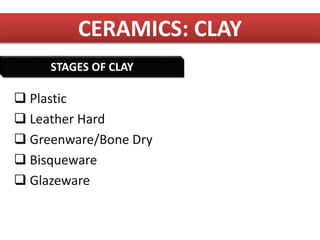
 Plastic
 Leather Hard
 Greenware/Bone Dry
 Bisqueware
 Glazeware
STAGES OF CLAY
CERAMICS: CLAY
 In this stage, clay is at a workable consistency
for slabs, coils and throwing.
 Ware can be reclaimed at this stage.
STAGES OF CLAY: PLASTIC
CERAMICS: CLAY
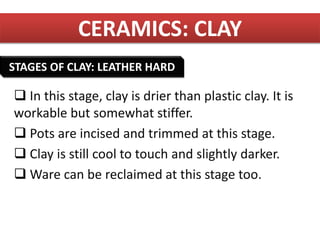
 In this stage, clay is drier than plastic clay. It is
workable but somewhat stiffer.
 Pots are incised and trimmed at this stage.
 Clay is still cool to touch and slightly darker.
 Ware can be reclaimed at this stage too.
STAGES OF CLAY: LEATHER HARD
CERAMICS: CLAY
 In this stage, clay is chalky looking and is not
nearly as cool to the touch.
 It is very fragile at this stage.
 Ware can still be reclaimed at this stage but clay
no longer remains workable.
STAGES OF CLAY: GREENWARE
CERAMICS: CLAY
 At this stage, the clay piece is to undergo its first
firing.
 After firing, the piece becomes much more
brittle and whiter.
 Ware can not be reclaimed after getting bisque
fired.
STAGES OF CLAY: BISQUEWARE
CERAMICS: CLAY
 In this stage, the clay piece is to be glazed (put
on a smooth coating) and then fired again.
 The piece will obtain the properties of the fired
glaze.
 This is a more glassy finish of our piece, but not
always.
 Ware can not be reclaimed at this stage.
STAGES OF CLAY: GLAZEWARE
CERAMICS: CLAY
 Moulding in ceramic industry (moulding plates
and stuff).
 In pottery (flower vases, cups, etc.).
 Construction products such as bricks, wall and
floor tiles.
 Protection for some plants that are used to
rapid dehydration.
USES OF CLAY
CERAMICS: CLAY
 Some types of clay are used as a lubricant.
 They are also used for making soaps.
 Refractory (high temperature) clays are used
with other clays to improve their plasticity and
strength.
 It is also used in metal casting industry.
and many more…
USES OF CLAY
FINISH

Ceramics :- Clay

  • 1.
  • 2.
    CERAMICS: INTRO  Theword “ceramic comes from the Greek word “keramikos” which means “of pottery” or “for pottery”.  Ceramics may be defined as heat-resistant, inorganic, non-metallic solid material primarily held in ionic and covalent bonds.  Traditional ceramics include objects made of clay and cements that have been hardened by heating at high temperatures. CERAMICS
  • 3.
    CERAMICS: CLAY Clay isa fine-grained, sticky stone earth material that occurs naturally.  Clay is created as a result of decomposition of igneous rock, which makes up the entire earth’s crust. Rock + Water → Clay  Clay forms mostly in areas which contain large amounts of granite (a kind of igneous rock). WHAT IS CLAY?
  • 4.
    CERAMICS: CLAY Clay mineralsare hydrous aluminium phyllosilicates. Following are the main components of clay -  Alumina (Al2O3)  Silica (SiO2)  Feldspar (found in Granite) as well as other smaller amounts of minerals/impurities COMPOSITION OF CLAY
  • 5.
    CERAMICS: CLAY  Plasticity Shrinkage  Texture  Porosity PROPERTIES OF CLAY
  • 6.
    CERAMICS: CLAY  Itis the property of clay that allows it to change shape without tearing or breaking.  Clay can be made more plastic though following methods… - Spray it with water - Store it with water, etc.  Due to this property, clay can be easily moulded. PROPERTIES OF CLAY: PLASTICITY
  • 7.
    CERAMICS: CLAY  Clayis supposed to reduce in size/volume as they dry (removal of moisture).  Clay shrinks at rate in between 5% to 15%. Shrinkage can also vary from batch to batch.  Clay should be dried slowly as it can crack during the drying/shrinking process.  Compressive strength of clay increases after shrinking. PROPERTIES OF CLAY: SHRINKAGE
  • 8.
    CERAMICS: CLAY  Thetexture of a clay body can range from coarse to smooth.  Clay, in general, has a fine texture.  Sand or grog (material containing high amount of silica and alumina) maybe added to clay to change its texture. PROPERTIES OF CLAY: TEXTURE
  • 9.
    CERAMICS: CLAY  Clayparticles have tiny pores in them which can retain water/moisture to some extent.  Clay loses moisture (dehydrates) when it is exposed to air and heat.  Once the clay is fired, it become permanently harder and stronger. After that, it can never become plastic again. PROPERTIES OF CLAY: POROSITY
  • 10.
    CERAMICS: CLAY  Porcelain Stoneware  Earthenware TYPES OF CLAY BODIES
  • 11.
    CERAMICS: CLAY  Ahigh-firing fine-grained white clay body that fires to a durable, strong, vitreous ceramic.  It is usually pure white because of its high kaolin (purest form of clay) content and absence of other particles (like iron) that can change the color and properties.  Since kaolin is the purest form of clay, porcelain lacks some of the additives that make clay more plastic making it not the most plastic of clay. TYPES OF CLAY BODIES: PORCELAIN
  • 12.
    CERAMICS: CLAY  Amid or high-firing coarse-grained clay body that fires to an incredibly durable ceramic.  Its color can be anywhere between buff (yellow- brown) color to gray to dark brown, because of varying levels of iron and other impurities.  After firing, it gets properties similar to that of glass. For example, it may not absorb after firing. TYPES OF CLAY BODIES: STONEWARE
  • 13.
    CERAMICS: CLAY  Alow-firing fine-grained clay body that is typically found in creek beds and other deposits that have been transported by wind or water from their location of origin.  This transportation aids in the weathering and breaking down of the source rock into clay, and also adds impurities like iron, etc. which makes earthenware brown, orange or red, both in the raw state and after firing. TYPES OF CLAY BODIES: EARTHENWARE
  • 14.
    CERAMICS: CLAY  Plastic Leather Hard  Greenware/Bone Dry  Bisqueware  Glazeware STAGES OF CLAY
  • 15.
    CERAMICS: CLAY  Inthis stage, clay is at a workable consistency for slabs, coils and throwing.  Ware can be reclaimed at this stage. STAGES OF CLAY: PLASTIC
  • 16.
    CERAMICS: CLAY  Inthis stage, clay is drier than plastic clay. It is workable but somewhat stiffer.  Pots are incised and trimmed at this stage.  Clay is still cool to touch and slightly darker.  Ware can be reclaimed at this stage too. STAGES OF CLAY: LEATHER HARD
  • 17.
    CERAMICS: CLAY  Inthis stage, clay is chalky looking and is not nearly as cool to the touch.  It is very fragile at this stage.  Ware can still be reclaimed at this stage but clay no longer remains workable. STAGES OF CLAY: GREENWARE
  • 18.
    CERAMICS: CLAY  Atthis stage, the clay piece is to undergo its first firing.  After firing, the piece becomes much more brittle and whiter.  Ware can not be reclaimed after getting bisque fired. STAGES OF CLAY: BISQUEWARE
  • 19.
    CERAMICS: CLAY  Inthis stage, the clay piece is to be glazed (put on a smooth coating) and then fired again.  The piece will obtain the properties of the fired glaze.  This is a more glassy finish of our piece, but not always.  Ware can not be reclaimed at this stage. STAGES OF CLAY: GLAZEWARE
  • 20.
    CERAMICS: CLAY  Mouldingin ceramic industry (moulding plates and stuff).  In pottery (flower vases, cups, etc.).  Construction products such as bricks, wall and floor tiles.  Protection for some plants that are used to rapid dehydration. USES OF CLAY
  • 21.
    CERAMICS: CLAY  Sometypes of clay are used as a lubricant.  They are also used for making soaps.  Refractory (high temperature) clays are used with other clays to improve their plasticity and strength.  It is also used in metal casting industry. and many more… USES OF CLAY
  • 22.