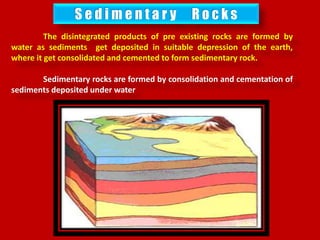
The disintegrated products of pre existing rocks are formed by
water as sediments get deposited in suitable depression of the earth,
where it get consolidated and cemented to form sedimentary rock.
Sedimentary rocks are formed by consolidation and cementation of
sediments deposited under water
S e d i m e n t a r y R o c k s
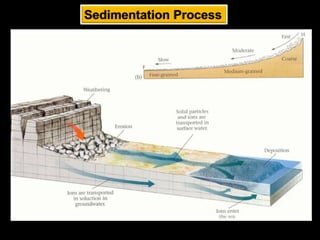
Sedimentation Process
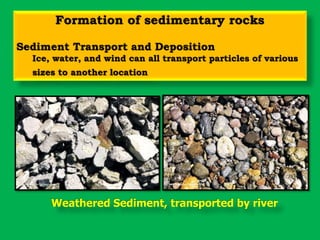
Formation of sedimentary rocks
Sediment Transport and Deposition
Ice, water, and wind can all transport particles of various
sizes to another location
Weathered Sediment, transported by river
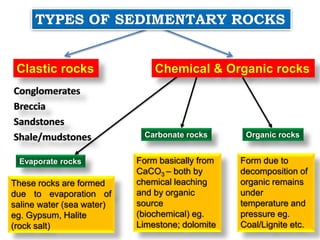
Conglomerates
Breccia
Sandstones
Shale/mudstones
TYPES OF SEDIMENTARY ROCKS
Clastic rocks
Evaporate rocks
These rocks are formed
due to evaporation of
saline water (sea water)
eg. Gypsum, Halite
(rock salt)
Carbonate rocks
Form basically from
CaCO3 – both by
chemical leaching
and by organic
source
(biochemical) eg.
Limestone; dolomite
Organic rocks
Form due to
decomposition of
organic remains
under
temperature and
pressure eg.
Coal/Lignite etc.
Chemical & Organic rocks
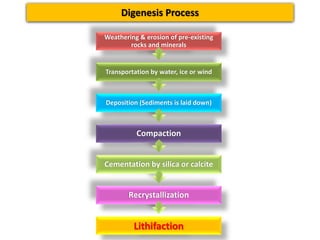
Weathering & erosion of pre-existing
rocks and minerals
Transportation by water, ice or wind
Deposition (Sediments is laid down)
Compaction
Cementation by silica or calcite
Recrystallization
Lithifaction
Digenesis Process
Classification of Sedimentary Rocks
Lava
Clastic Sediments
Rudaceous Rocks
Arenaceous Rocks
Argillaceous Rocks
Conglomerate Breccia
Sandstone
Shale
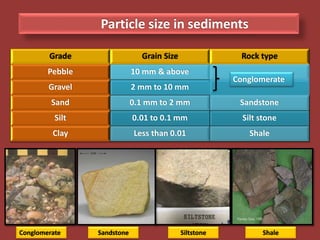
Particle size in sediments
Grade Grain Size Rock type
Pebble 10 mm & above
Gravel 2 mm to 10 mm
Sand 0.1 mm to 2 mm Sandstone
Silt 0.01 to 0.1 mm Silt stone
Clay Less than 0.01 Shale
Conglomerate
Conglomerate Sandstone Siltstone Shale
Non Clastic Sediments
1) Chemically formed Rocks 2) Organically formed Rocks
• Carbonate Rocks
• Salt Rocks
• Ferruginous Rocks
• Siliceous Rocks
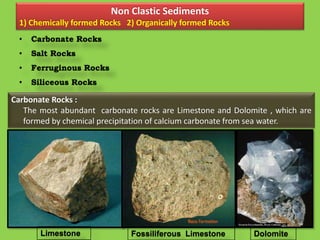
Carbonate Rocks :
The most abundant carbonate rocks are Limestone and Dolomite , which are
formed by chemical precipitation of calcium carbonate from sea water.
Fossiliferous LimestoneLimestone Dolomite
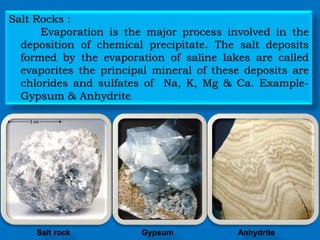
Salt Rocks :
Evaporation is the major process involved in the
deposition of chemical precipitate. The salt deposits
formed by the evaporation of saline lakes are called
evaporites the principal mineral of these deposits are
chlorides and sulfates of Na, K, Mg & Ca. Example-
Gypsum & Anhydrite
Salt rock AnhydriteGypsum
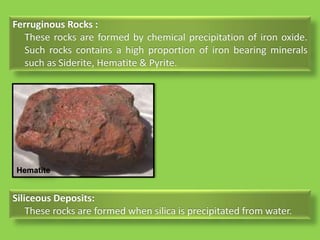
Ferruginous Rocks :
These rocks are formed by chemical precipitation of iron oxide.
Such rocks contains a high proportion of iron bearing minerals
such as Siderite, Hematite & Pyrite.
Hematite
Siliceous Deposits:
These rocks are formed when silica is precipitated from water.
Organically formed Rocks
These rocks are composed mainly of remains of animals or plants.
1) Biochemical Rocks 2)Organic Rocks
Biochemical Rocks:
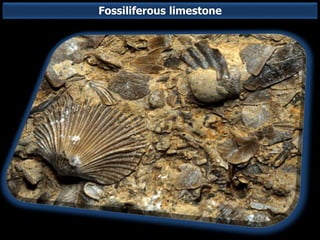
The biochemical sediments are produced when plants and animals living
under water, extract from it dissolved mineral matter usually calcite to
form Shell or other hard parts. Example – Limestone
Shale with Plant fossil
Fossiliferous limestone
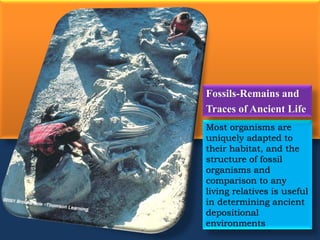
Most organisms are
uniquely adapted to
their habitat, and the
structure of fossil
organisms and
comparison to any
living relatives is useful
in determining ancient
depositional
environments
Fossils-Remains and
Traces of Ancient Life
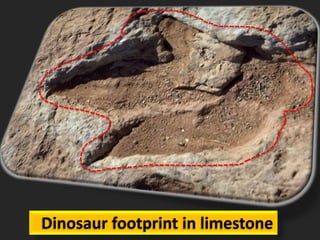
Dinosaur footprint in limestone
Organically formed Rocks
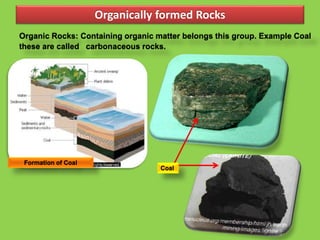
Organic Rocks: Containing organic matter belongs this group. Example Coal
these are called carbonaceous rocks.
Formation of Coal
Coal
TEXTURES OF SEDIMENTARY ROCKS
• Origin of Grains
• Size of Grains
• Shape of Grains
• Packing of Grains
• Fabric of Grains
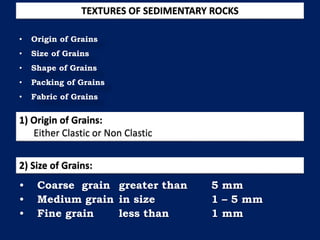
1) Origin of Grains:
Either Clastic or Non Clastic
2) Size of Grains:
• Coarse grain greater than 5 mm
• Medium grain in size 1 – 5 mm
• Fine grain less than 1 mm
TEXTURES OF SEDIMENTARY ROCKS
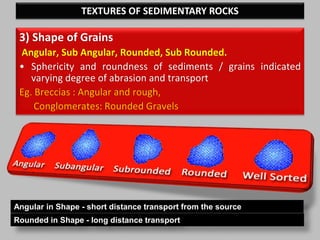
3) Shape of Grains
Angular, Sub Angular, Rounded, Sub Rounded.
• Sphericity and roundness of sediments / grains indicated
varying degree of abrasion and transport
Eg. Breccias : Angular and rough,
Conglomerates: Rounded Gravels
Angular in Shape - short distance transport from the source
Rounded in Shape - long distance transport
4) PACKING OF SEDIMENTS / GRAINS:
Opened packed / densely packed.
Related to litho stratigraphic pressure.
5) FABRIC OF GRAINS:
Sedimentary rocks containing elongated particles and
their orientation demarks the flows of sediments.
• Example. Rhyolites: High degree of crystallization / parallel
axis of grains.
STRUCTURES OF SEDIMENTARY ROCKS
► Stratification
► Lamination
► Cross bedding or current bedding
► Graded bedding
► Ripple marks
► Concretionary Structure
► Minor Structure
STRUCTURES OF SEDIMENTARY ROCKS
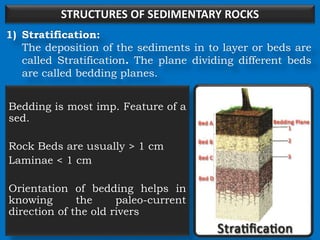
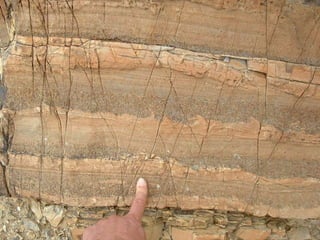
1) Stratification:
The deposition of the sediments in to layer or beds are
called Stratification. The plane dividing different beds
are called bedding planes.
Bedding is most imp. Feature of a
sed.
Rock Beds are usually > 1 cm
Laminae < 1 cm
Orientation of bedding helps in
knowing the paleo-current
direction of the old rivers
STRUCTURES OF SEDIMENTARY ROCKS
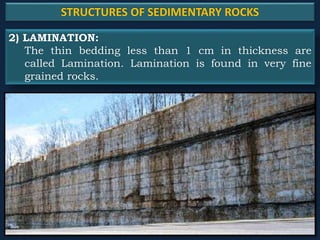
2) LAMINATION:
The thin bedding less than 1 cm in thickness are
called Lamination. Lamination is found in very fine
grained rocks.
STRUCTURES OF SEDIMENTARY ROCKS
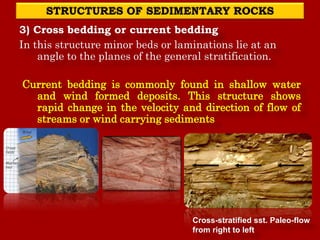
3) Cross bedding or current bedding
In this structure minor beds or laminations lie at an
angle to the planes of the general stratification.
Current bedding is commonly found in shallow water
and wind formed deposits. This structure shows
rapid change in the velocity and direction of flow of
streams or wind carrying sediments
Cross-stratified sst. Paleo-flow
from right to left
STRUCTURES OF SEDIMENTARY ROCKS
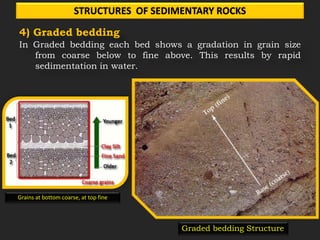
4) Graded bedding
In Graded bedding each bed shows a gradation in grain size
from coarse below to fine above. This results by rapid
sedimentation in water.
Grains at bottom coarse, at top fine
Graded bedding Structure
STRUCTURES OF SEDIMENTARY ROCKS
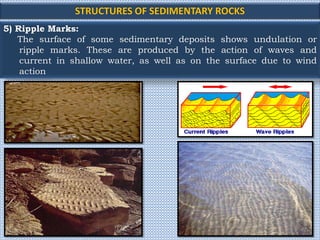
5) Ripple Marks:
The surface of some sedimentary deposits shows undulation or
ripple marks. These are produced by the action of waves and
current in shallow water, as well as on the surface due to wind
action
STRUCTURES OF SEDIMENTARY ROCKS
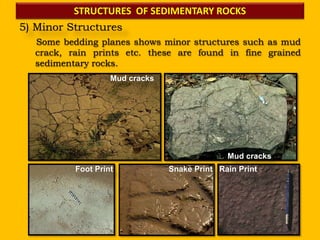
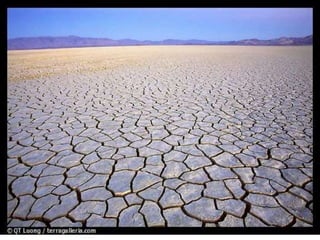
5) Minor Structures
Some bedding planes shows minor structures such as mud
crack, rain prints etc. these are found in fine grained
sedimentary rocks.
Mud cracks
Mud cracks
Foot Print Snake Print Rain Print
Sedimentary rocks
Sedimentary rocks
Sedimentary rocks
Sedimentary rocks
Sedimentary rocks

Sedimentary rocks

  • 2.
    The disintegrated productsof pre existing rocks are formed by water as sediments get deposited in suitable depression of the earth, where it get consolidated and cemented to form sedimentary rock. Sedimentary rocks are formed by consolidation and cementation of sediments deposited under water S e d i m e n t a r y R o c k s
  • 3.
  • 4.
    Formation of sedimentaryrocks Sediment Transport and Deposition Ice, water, and wind can all transport particles of various sizes to another location Weathered Sediment, transported by river
  • 5.
    Conglomerates Breccia Sandstones Shale/mudstones TYPES OF SEDIMENTARYROCKS Clastic rocks Evaporate rocks These rocks are formed due to evaporation of saline water (sea water) eg. Gypsum, Halite (rock salt) Carbonate rocks Form basically from CaCO3 – both by chemical leaching and by organic source (biochemical) eg. Limestone; dolomite Organic rocks Form due to decomposition of organic remains under temperature and pressure eg. Coal/Lignite etc. Chemical & Organic rocks
  • 6.
    Weathering & erosionof pre-existing rocks and minerals Transportation by water, ice or wind Deposition (Sediments is laid down) Compaction Cementation by silica or calcite Recrystallization Lithifaction Digenesis Process
  • 7.
    Classification of SedimentaryRocks Lava Clastic Sediments Rudaceous Rocks Arenaceous Rocks Argillaceous Rocks Conglomerate Breccia Sandstone Shale
  • 8.
    Particle size insediments Grade Grain Size Rock type Pebble 10 mm & above Gravel 2 mm to 10 mm Sand 0.1 mm to 2 mm Sandstone Silt 0.01 to 0.1 mm Silt stone Clay Less than 0.01 Shale Conglomerate Conglomerate Sandstone Siltstone Shale
  • 9.
    Non Clastic Sediments 1)Chemically formed Rocks 2) Organically formed Rocks • Carbonate Rocks • Salt Rocks • Ferruginous Rocks • Siliceous Rocks Carbonate Rocks : The most abundant carbonate rocks are Limestone and Dolomite , which are formed by chemical precipitation of calcium carbonate from sea water. Fossiliferous LimestoneLimestone Dolomite
  • 10.
    Salt Rocks : Evaporationis the major process involved in the deposition of chemical precipitate. The salt deposits formed by the evaporation of saline lakes are called evaporites the principal mineral of these deposits are chlorides and sulfates of Na, K, Mg & Ca. Example- Gypsum & Anhydrite Salt rock AnhydriteGypsum
  • 11.
    Ferruginous Rocks : Theserocks are formed by chemical precipitation of iron oxide. Such rocks contains a high proportion of iron bearing minerals such as Siderite, Hematite & Pyrite. Hematite Siliceous Deposits: These rocks are formed when silica is precipitated from water.
  • 12.
    Organically formed Rocks Theserocks are composed mainly of remains of animals or plants. 1) Biochemical Rocks 2)Organic Rocks Biochemical Rocks: The biochemical sediments are produced when plants and animals living under water, extract from it dissolved mineral matter usually calcite to form Shell or other hard parts. Example – Limestone Shale with Plant fossil
  • 13.
  • 14.
    Most organisms are uniquelyadapted to their habitat, and the structure of fossil organisms and comparison to any living relatives is useful in determining ancient depositional environments Fossils-Remains and Traces of Ancient Life
  • 15.
  • 16.
    Organically formed Rocks OrganicRocks: Containing organic matter belongs this group. Example Coal these are called carbonaceous rocks. Formation of Coal Coal
  • 17.
    TEXTURES OF SEDIMENTARYROCKS • Origin of Grains • Size of Grains • Shape of Grains • Packing of Grains • Fabric of Grains 1) Origin of Grains: Either Clastic or Non Clastic 2) Size of Grains: • Coarse grain greater than 5 mm • Medium grain in size 1 – 5 mm • Fine grain less than 1 mm
  • 18.
    TEXTURES OF SEDIMENTARYROCKS 3) Shape of Grains Angular, Sub Angular, Rounded, Sub Rounded. • Sphericity and roundness of sediments / grains indicated varying degree of abrasion and transport Eg. Breccias : Angular and rough, Conglomerates: Rounded Gravels Angular in Shape - short distance transport from the source Rounded in Shape - long distance transport
  • 19.
    4) PACKING OFSEDIMENTS / GRAINS: Opened packed / densely packed. Related to litho stratigraphic pressure. 5) FABRIC OF GRAINS: Sedimentary rocks containing elongated particles and their orientation demarks the flows of sediments. • Example. Rhyolites: High degree of crystallization / parallel axis of grains.
  • 20.
    STRUCTURES OF SEDIMENTARYROCKS ► Stratification ► Lamination ► Cross bedding or current bedding ► Graded bedding ► Ripple marks ► Concretionary Structure ► Minor Structure
  • 21.
    STRUCTURES OF SEDIMENTARYROCKS 1) Stratification: The deposition of the sediments in to layer or beds are called Stratification. The plane dividing different beds are called bedding planes. Bedding is most imp. Feature of a sed. Rock Beds are usually > 1 cm Laminae < 1 cm Orientation of bedding helps in knowing the paleo-current direction of the old rivers
  • 22.
    STRUCTURES OF SEDIMENTARYROCKS 2) LAMINATION: The thin bedding less than 1 cm in thickness are called Lamination. Lamination is found in very fine grained rocks.
  • 23.
    STRUCTURES OF SEDIMENTARYROCKS 3) Cross bedding or current bedding In this structure minor beds or laminations lie at an angle to the planes of the general stratification. Current bedding is commonly found in shallow water and wind formed deposits. This structure shows rapid change in the velocity and direction of flow of streams or wind carrying sediments Cross-stratified sst. Paleo-flow from right to left
  • 24.
    STRUCTURES OF SEDIMENTARYROCKS 4) Graded bedding In Graded bedding each bed shows a gradation in grain size from coarse below to fine above. This results by rapid sedimentation in water. Grains at bottom coarse, at top fine Graded bedding Structure
  • 25.
    STRUCTURES OF SEDIMENTARYROCKS 5) Ripple Marks: The surface of some sedimentary deposits shows undulation or ripple marks. These are produced by the action of waves and current in shallow water, as well as on the surface due to wind action
  • 26.
    STRUCTURES OF SEDIMENTARYROCKS 5) Minor Structures Some bedding planes shows minor structures such as mud crack, rain prints etc. these are found in fine grained sedimentary rocks. Mud cracks Mud cracks Foot Print Snake Print Rain Print