CLA 
Y!
What is it? 
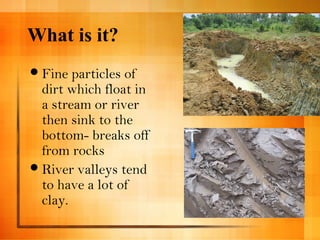
Fine particles of 
dirt which float in 
a stream or river 
then sink to the 
bottom- breaks off 
from rocks 
River valleys tend 
to have a lot of 
clay.
Ancient Cultures 
Ancient man discovered that 
clay could be shaped and 
modeled into forms both 
 decorative and functional. 
Some of the earliest pottery 
has been found in the Middle 
East and dates to 
 between 8,000-7,000 BCE. 
Japanese ceramics have 
flourished since over 4,000 
years ago 
Native American pottery 
shards have been found dating 
back over 3,000 years.
Types of Clay 
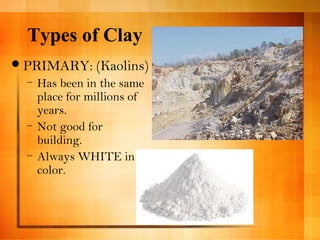
PRIMARY: (Kaolins) 
– Has been in the same 
place for millions of 
years. 
– Not good for 
building. 
– Always WHITE in 
color.
Kaolin (primary) clay 
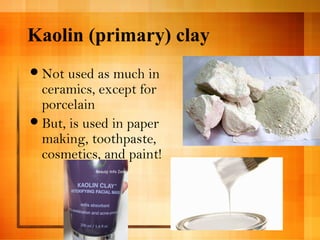
Not used as much in 
ceramics, except for 
porcelain 
But, is used in paper 
making, toothpaste, 
cosmetics, and paint!
Types of Clay 
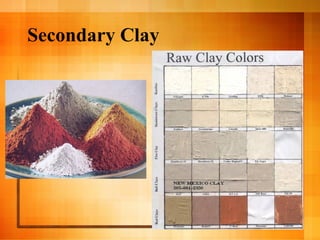
SECONDARY: 
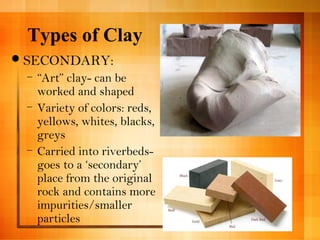
– “Art” clay- can be 
worked and shaped 
– Variety of colors: reds, 
yellows, whites, blacks, 
greys 
– Carried into riverbeds-goes 
to a ‘secondary’ 
place from the original 
rock and contains more 
impurities/smaller 
particles
Secondary Clay
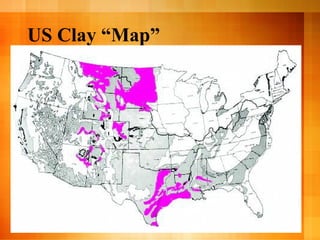
US Clay “Map”
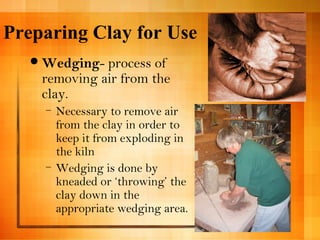
Preparing Clay for Use 
Wedging- process of 
removing air from the 
clay. 
– Necessary to remove air 
from the clay in order to 
keep it from exploding in 
the kiln 
– Wedging is done by 
kneaded or ‘throwing’ the 
clay down in the 
appropriate wedging area.
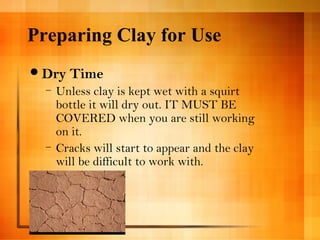
Preparing Clay for Use 
Dry Time 
– Unless clay is kept wet with a squirt 
bottle it will dry out. IT MUST BE 
COVERED when you are still working 
on it. 
– Cracks will start to appear and the clay 
will be difficult to work with.
Preparing Clay for Use 
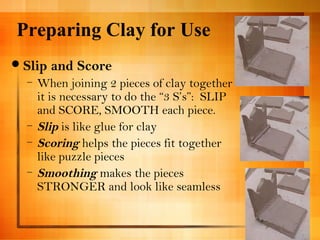
Slip and Score 
– When joining 2 pieces of clay together 
it is necessary to do the “3 S’s”: SLIP 
and SCORE, SMOOTH each piece. 
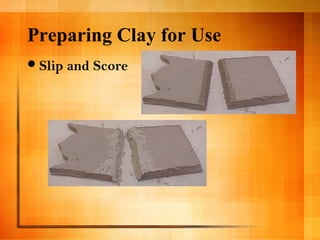
– Slip is like glue for clay 
– Scoring helps the pieces fit together 
like puzzle pieces 
– Smoothing makes the pieces 
STRONGER and look like seamless
Preparing Clay for Use 
Slip and Score
Preparing Clay for Use 
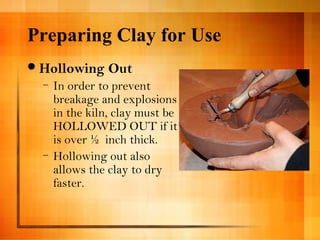
Hollowing Out 
– In order to prevent 
breakage and explosions 
in the kiln, clay must be 
HOLLOWED OUT if it 
is over ½ inch thick. 
– Hollowing out also 
allows the clay to dry 
faster.
Preparing Clay for Use 
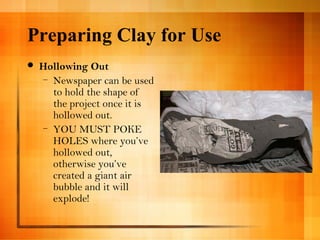
 Hollowing Out 
– Newspaper can be used 
to hold the shape of 
the project once it is 
hollowed out. 
– YOU MUST POKE 
HOLES where you’ve 
hollowed out, 
otherwise you’ve 
created a giant air 
bubble and it will 
explode!
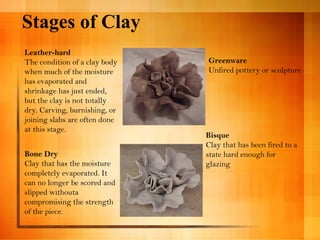
Stages of Clay 
Leather-hard 
The condition of a clay body 
when much of the moisture 
has evaporated and 
shrinkage has just ended, 
but the clay is not totally 
dry. Carving, burnishing, or 
joining slabs are often done 
at this stage. 
Bone Dry 
Clay that has the moisture 
completely evaporated. It 
can no longer be scored and 
slipped withouta 
compromising the strength 
of the piece. 
Greenware 
Unfired pottery or sculpture. 
Bisque 
Clay that has been fired to a 
state hard enough for 
glazing
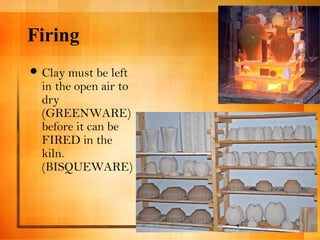
Firing 
Clay must be left 
in the open air to 
dry 
(GREENWARE) 
before it can be 
FIRED in the 
kiln. 
(BISQUEWARE)
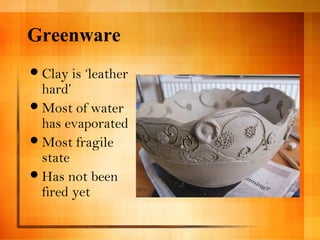
Greenware 
Clay is ‘leather 
hard’ 
Most of water 
has evaporated 
Most fragile 
state 
Has not been 
fired yet
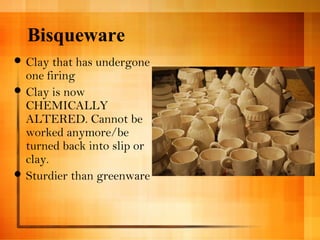
Bisqueware 
Clay that has undergone 
one firing 
Clay is now 
CHEMICALLY 
ALTERED. Cannot be 
worked anymore/be 
turned back into slip or 
clay. 
Sturdier than greenware
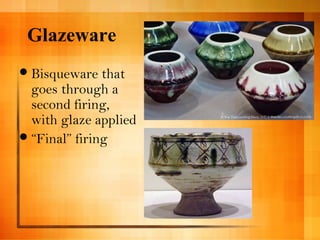
Glazeware 
Bisqueware that 
goes through a 
second firing, 
with glaze applied 
“Final” firing
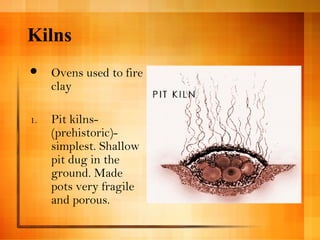
Kilns 
 Ovens used to fire 
clay 
1. Pit kilns- 
(prehistoric)- 
simplest. Shallow 
pit dug in the 
ground. Made 
pots very fragile 
and porous.
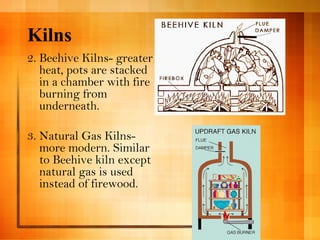
Kilns 
2. Beehive Kilns- greater 
heat, pots are stacked 
in a chamber with fire 
burning from 
underneath. 
3. Natural Gas Kilns-more 
modern. Similar 
to Beehive kiln except 
natural gas is used 
instead of firewood.
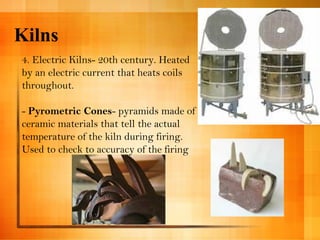
Kilns 
4. Electric Kilns- 20th century. Heated 
by an electric current that heats coils 
throughout. 
- Pyrometric Cones- pyramids made of 
ceramic materials that tell the actual 
temperature of the kiln during firing. 
Used to check to accuracy of the firing
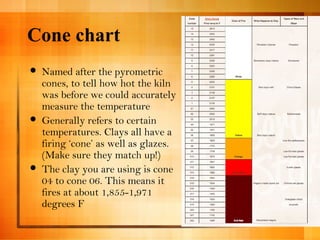
Cone chart 
 Named after the pyrometric 
cones, to tell how hot the kiln 
was before we could accurately 
measure the temperature 
 Generally refers to certain 
temperatures. Clays all have a 
firing ‘cone’ as well as glazes. 
(Make sure they match up!) 
 The clay you are using is cone 
04 to cone 06. This means it 
fires at about 1,855-1,971 
degrees F
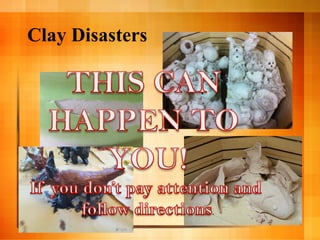
Clay Disasters
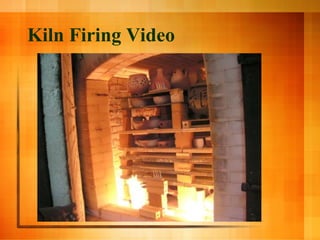
Kiln Firing Video

Clay

  • 1.
  • 2.
    What is it? Fine particles of dirt which float in a stream or river then sink to the bottom- breaks off from rocks River valleys tend to have a lot of clay.
  • 3.
    Ancient Cultures Ancientman discovered that clay could be shaped and modeled into forms both  decorative and functional. Some of the earliest pottery has been found in the Middle East and dates to  between 8,000-7,000 BCE. Japanese ceramics have flourished since over 4,000 years ago Native American pottery shards have been found dating back over 3,000 years.
  • 4.
    Types of Clay PRIMARY: (Kaolins) – Has been in the same place for millions of years. – Not good for building. – Always WHITE in color.
  • 5.
    Kaolin (primary) clay Not used as much in ceramics, except for porcelain But, is used in paper making, toothpaste, cosmetics, and paint!
  • 6.
    Types of Clay SECONDARY: – “Art” clay- can be worked and shaped – Variety of colors: reds, yellows, whites, blacks, greys – Carried into riverbeds-goes to a ‘secondary’ place from the original rock and contains more impurities/smaller particles
  • 7.
  • 8.
  • 9.
    Preparing Clay forUse Wedging- process of removing air from the clay. – Necessary to remove air from the clay in order to keep it from exploding in the kiln – Wedging is done by kneaded or ‘throwing’ the clay down in the appropriate wedging area.
  • 10.
    Preparing Clay forUse Dry Time – Unless clay is kept wet with a squirt bottle it will dry out. IT MUST BE COVERED when you are still working on it. – Cracks will start to appear and the clay will be difficult to work with.
  • 11.
    Preparing Clay forUse Slip and Score – When joining 2 pieces of clay together it is necessary to do the “3 S’s”: SLIP and SCORE, SMOOTH each piece. – Slip is like glue for clay – Scoring helps the pieces fit together like puzzle pieces – Smoothing makes the pieces STRONGER and look like seamless
  • 12.
    Preparing Clay forUse Slip and Score
  • 13.
    Preparing Clay forUse Hollowing Out – In order to prevent breakage and explosions in the kiln, clay must be HOLLOWED OUT if it is over ½ inch thick. – Hollowing out also allows the clay to dry faster.
  • 14.
    Preparing Clay forUse  Hollowing Out – Newspaper can be used to hold the shape of the project once it is hollowed out. – YOU MUST POKE HOLES where you’ve hollowed out, otherwise you’ve created a giant air bubble and it will explode!
  • 15.
    Stages of Clay Leather-hard The condition of a clay body when much of the moisture has evaporated and shrinkage has just ended, but the clay is not totally dry. Carving, burnishing, or joining slabs are often done at this stage. Bone Dry Clay that has the moisture completely evaporated. It can no longer be scored and slipped withouta compromising the strength of the piece. Greenware Unfired pottery or sculpture. Bisque Clay that has been fired to a state hard enough for glazing
  • 16.
    Firing Clay mustbe left in the open air to dry (GREENWARE) before it can be FIRED in the kiln. (BISQUEWARE)
  • 17.
    Greenware Clay is‘leather hard’ Most of water has evaporated Most fragile state Has not been fired yet
  • 18.
    Bisqueware Clay thathas undergone one firing Clay is now CHEMICALLY ALTERED. Cannot be worked anymore/be turned back into slip or clay. Sturdier than greenware
  • 19.
    Glazeware Bisqueware that goes through a second firing, with glaze applied “Final” firing
  • 20.
    Kilns  Ovensused to fire clay 1. Pit kilns- (prehistoric)- simplest. Shallow pit dug in the ground. Made pots very fragile and porous.
  • 21.
    Kilns 2. BeehiveKilns- greater heat, pots are stacked in a chamber with fire burning from underneath. 3. Natural Gas Kilns-more modern. Similar to Beehive kiln except natural gas is used instead of firewood.
  • 22.
    Kilns 4. ElectricKilns- 20th century. Heated by an electric current that heats coils throughout. - Pyrometric Cones- pyramids made of ceramic materials that tell the actual temperature of the kiln during firing. Used to check to accuracy of the firing
  • 23.
    Cone chart Named after the pyrometric cones, to tell how hot the kiln was before we could accurately measure the temperature  Generally refers to certain temperatures. Clays all have a firing ‘cone’ as well as glazes. (Make sure they match up!)  The clay you are using is cone 04 to cone 06. This means it fires at about 1,855-1,971 degrees F
  • 24.
  • 25.

Editor's Notes

  • #3 Result of weathering and erosion of rocks containing feldspar, a mineral, over time.
  • #7 Clays that have been transported away from their point of geologic origins by wind or water. Finer particle-size gives greater plasticity—ball clays, stoneware clays, fireclays, e