
Refractory Bricks
Presentation by
Mr.P.Selvakumar.,B.E.,M.E.
Assistant Professor,
Department Of Civil Engineering
Knowledge Institute Of Technology, Salem.
1CE8391 CONSTRUCTION MATERIALS
UNIT I STONES – BRICKS – CONCRETE BLOCKS
Topic : Bricks
Sub Topic:
Refractory Bricks
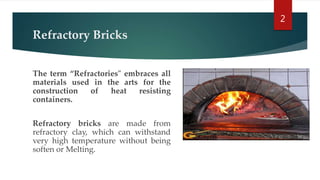
The term “Refractories" embraces all
materials used in the arts for the
construction of heat resisting
containers.
Refractory bricks are made from
refractory clay, which can withstand
very high temperature without being
soften or Melting.
2
Composition
 Silica
 Alumina
 Bauxite
 Magnesite
 Chromite
 Oxide of Iron
 Lime
 Alkalies
3
Principles
 The two principal functions involved in the use of refactory
materials are those of thermal insulation and conduction.
4
A good refractory material should have
the following properties:
1. It should be able to withstand high temperatures generated in the furnace.
2. It should be able to withstand sudden alternating, heating and cooling, i.e.
thermal shocks.
3. It should be able to withstand abrasion and rough usage.
4. Its contraction and expansion due to the inevitable temperature variation
should be minimum possible.
5. It should be able to withstand fluxing action of the slags and the corrosive
action of gases.
5
A good refractory material should have
the following properties:
6. It should have good heat insulating properties.
7. It should be chemically inactive at elevated temperatures.
8. It should be impermeable to gases and liquids as far as possible.
9. If used in electric furnaces, it must have low electrical conductivity.
6
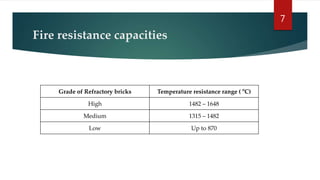
Fire resistance capacities
Grade of Refractory bricks Temperature resistance range ( o
C)
High 1482 – 1648
Medium 1315 – 1482
Low Up to 870
7
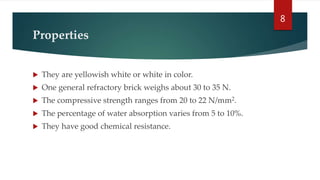
Properties
 They are yellowish white or white in color.
 One general refractory brick weighs about 30 to 35 N.
 The compressive strength ranges from 20 to 22 N/mm2.
 The percentage of water absorption varies from 5 to 10%.
 They have good chemical resistance.
8
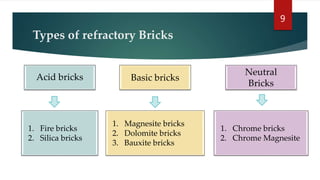
Types of refractory Bricks
9
Acid bricks Basic bricks
Neutral
Bricks
1. Fire bricks
2. Silica bricks
1. Magnesite bricks
2. Dolomite bricks
3. Bauxite bricks
1. Chrome bricks
2. Chrome Magnesite
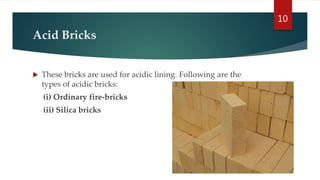
Acid Bricks
 These bricks are used for acidic lining. Following are the
types of acidic bricks:
(i) Ordinary fire-bricks
(ii) Silica bricks
10
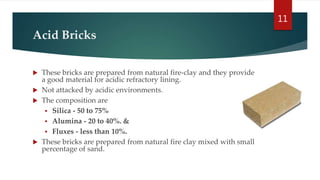
Acid Bricks
 These bricks are prepared from natural fire-clay and they provide
a good material for acidic refractory lining.
 Not attacked by acidic environments.
 The composition are
 Silica - 50 to 75%
 Alumina - 20 to 40%. &
 Fluxes - less than 10%.
 These bricks are prepared from natural fire clay mixed with small
percentage of sand.
11
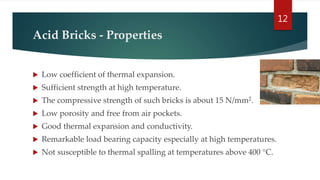
Acid Bricks - Properties
 Low coefficient of thermal expansion.
 Sufficient strength at high temperature.
 The compressive strength of such bricks is about 15 N/mm2.
 Low porosity and free from air pockets.
 Good thermal expansion and conductivity.
 Remarkable load bearing capacity especially at high temperatures.
 Not susceptible to thermal spalling at temperatures above 400 °C.
12
Acid Bricks - Uses
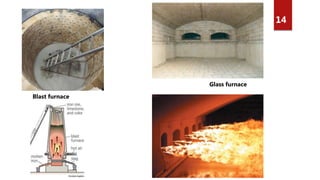
 Lining of blast furnace for melting of iron, copper, lead, ect.
 Lining of fuels and stocks.
 Heat treatment furnaces.
 Glass furnaces.
 Electrical furnace.
 Copper smelting.
 Lining for acid storage containers.
13
14
Blast furnace
Glass furnace
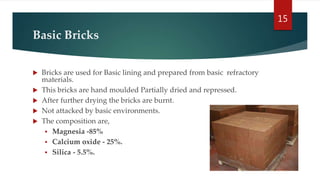
Basic Bricks
 Bricks are used for Basic lining and prepared from basic refractory
materials.
 This bricks are hand moulded Partially dried and repressed.
 After further drying the bricks are burnt.
 Not attacked by basic environments.
 The composition are,
 Magnesia -85%
 Calcium oxide - 25%.
 Silica - 5.5%.
15
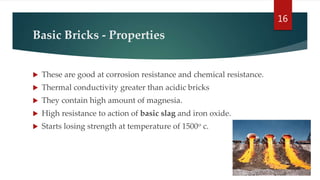
Basic Bricks - Properties
 These are good at corrosion resistance and chemical resistance.
 Thermal conductivity greater than acidic bricks
 They contain high amount of magnesia.
 High resistance to action of basic slag and iron oxide.
 Starts losing strength at temperature of 1500o c.
16
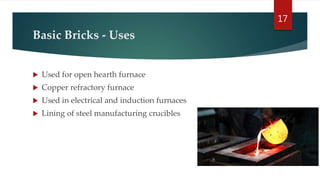
Basic Bricks - Uses
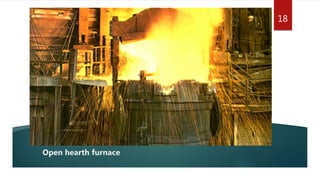
 Used for open hearth furnace
 Copper refractory furnace
 Used in electrical and induction furnaces
 Lining of steel manufacturing crucibles
17
Open hearth furnace
18
Neutral Bricks
 Neutral brick is otherwise known as inert bricks.
 This bricks are used for neutral lining are more inert to slag.
 They are used to separate the acid and basic linings of a furnace so
that they cannot react with each other.
 Two types – Chrome bricks and chrome magnesite bricks
 Composition: Chrome oxide, Oxides of magnesia, aluminum and
little amount of silica
19
Neutral Bricks - Properties
 Low porosity
 High resistance to acid and basic slag
 High thermal conductivity
 Low resistance to spalling
 Less shrinkage
 Good mechanical properties
20
Neutral Bricks - Uses
 Used in steel industry for lining of open hearth and bottom
of soaking pits
 Used in electrical furnaces
21
Thank You
ANY QUERIES?
22

Refractory bricks

  • 1.
    Refractory Bricks Presentation by Mr.P.Selvakumar.,B.E.,M.E. AssistantProfessor, Department Of Civil Engineering Knowledge Institute Of Technology, Salem. 1CE8391 CONSTRUCTION MATERIALS UNIT I STONES – BRICKS – CONCRETE BLOCKS Topic : Bricks Sub Topic:
  • 2.
    Refractory Bricks The term“Refractories" embraces all materials used in the arts for the construction of heat resisting containers. Refractory bricks are made from refractory clay, which can withstand very high temperature without being soften or Melting. 2
  • 3.
    Composition  Silica  Alumina Bauxite  Magnesite  Chromite  Oxide of Iron  Lime  Alkalies 3
  • 4.
    Principles  The twoprincipal functions involved in the use of refactory materials are those of thermal insulation and conduction. 4
  • 5.
    A good refractorymaterial should have the following properties: 1. It should be able to withstand high temperatures generated in the furnace. 2. It should be able to withstand sudden alternating, heating and cooling, i.e. thermal shocks. 3. It should be able to withstand abrasion and rough usage. 4. Its contraction and expansion due to the inevitable temperature variation should be minimum possible. 5. It should be able to withstand fluxing action of the slags and the corrosive action of gases. 5
  • 6.
    A good refractorymaterial should have the following properties: 6. It should have good heat insulating properties. 7. It should be chemically inactive at elevated temperatures. 8. It should be impermeable to gases and liquids as far as possible. 9. If used in electric furnaces, it must have low electrical conductivity. 6
  • 7.
    Fire resistance capacities Gradeof Refractory bricks Temperature resistance range ( o C) High 1482 – 1648 Medium 1315 – 1482 Low Up to 870 7
  • 8.
    Properties  They areyellowish white or white in color.  One general refractory brick weighs about 30 to 35 N.  The compressive strength ranges from 20 to 22 N/mm2.  The percentage of water absorption varies from 5 to 10%.  They have good chemical resistance. 8
  • 9.
    Types of refractoryBricks 9 Acid bricks Basic bricks Neutral Bricks 1. Fire bricks 2. Silica bricks 1. Magnesite bricks 2. Dolomite bricks 3. Bauxite bricks 1. Chrome bricks 2. Chrome Magnesite
  • 10.
    Acid Bricks  Thesebricks are used for acidic lining. Following are the types of acidic bricks: (i) Ordinary fire-bricks (ii) Silica bricks 10
  • 11.
    Acid Bricks  Thesebricks are prepared from natural fire-clay and they provide a good material for acidic refractory lining.  Not attacked by acidic environments.  The composition are  Silica - 50 to 75%  Alumina - 20 to 40%. &  Fluxes - less than 10%.  These bricks are prepared from natural fire clay mixed with small percentage of sand. 11
  • 12.
    Acid Bricks -Properties  Low coefficient of thermal expansion.  Sufficient strength at high temperature.  The compressive strength of such bricks is about 15 N/mm2.  Low porosity and free from air pockets.  Good thermal expansion and conductivity.  Remarkable load bearing capacity especially at high temperatures.  Not susceptible to thermal spalling at temperatures above 400 °C. 12
  • 13.
    Acid Bricks -Uses  Lining of blast furnace for melting of iron, copper, lead, ect.  Lining of fuels and stocks.  Heat treatment furnaces.  Glass furnaces.  Electrical furnace.  Copper smelting.  Lining for acid storage containers. 13
  • 14.
  • 15.
    Basic Bricks  Bricksare used for Basic lining and prepared from basic refractory materials.  This bricks are hand moulded Partially dried and repressed.  After further drying the bricks are burnt.  Not attacked by basic environments.  The composition are,  Magnesia -85%  Calcium oxide - 25%.  Silica - 5.5%. 15
  • 16.
    Basic Bricks -Properties  These are good at corrosion resistance and chemical resistance.  Thermal conductivity greater than acidic bricks  They contain high amount of magnesia.  High resistance to action of basic slag and iron oxide.  Starts losing strength at temperature of 1500o c. 16
  • 17.
    Basic Bricks -Uses  Used for open hearth furnace  Copper refractory furnace  Used in electrical and induction furnaces  Lining of steel manufacturing crucibles 17
  • 18.
  • 19.
    Neutral Bricks  Neutralbrick is otherwise known as inert bricks.  This bricks are used for neutral lining are more inert to slag.  They are used to separate the acid and basic linings of a furnace so that they cannot react with each other.  Two types – Chrome bricks and chrome magnesite bricks  Composition: Chrome oxide, Oxides of magnesia, aluminum and little amount of silica 19
  • 20.
    Neutral Bricks -Properties  Low porosity  High resistance to acid and basic slag  High thermal conductivity  Low resistance to spalling  Less shrinkage  Good mechanical properties 20
  • 21.
    Neutral Bricks -Uses  Used in steel industry for lining of open hearth and bottom of soaking pits  Used in electrical furnaces 21
  • 22.