Ceramics 1

INTRODUCTION TO CLAY
Ceramics


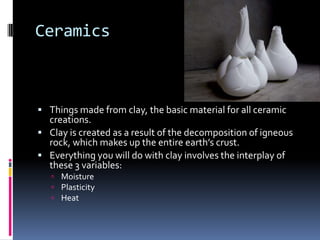
 Things made from clay, the basic material for all ceramic
  creations.
 Clay is created as a result of the decomposition of igneous
  rock, which makes up the entire earth’s crust.
 Everything you will do with clay involves the interplay of
  these 3 variables:
    Moisture
    Plasticity
    Heat
Origins of Ceramics

 Of all the arts, ceramics has perhaps the
  longest history, dating back to when people
  first learned to control fire.
 Theories:
   People first began to model clay as a diversion.
   People used clay for practical purposes.
Early Techniques

 The clay you work with in a studio has been
  processed and prepared to some degree.
 Early potters had to actually dig their raw
  material from the ground and prepare it.
 There were sometimes impurities that had to
  be taken out.
Chapter 2: Working with Clay

 Clay Properties
   Plasticity
   Shrinkage
   Texture
   Moisture
   Handling Clay
PLASTICITY

 Most beginners use highly plastic clay, or one
  that can easily take different shapes.
   PLASTIC – The property of clay that allows it to
    change shape without tearing or breaking.
 Numerous factors can make clay more
  plastic.
   You can spray it with water.
   You can store it in a bag with water.
   You can mix new plastic clay with the old.
SHRINKAGE

 All clay shrinks as they dry. Clay can crack
  when it shrinks if the potter doesn’t carefully
  monitor the drying process.
 It is frustrating the spend a lot of time on
  creating your artwork only to have it crack
  because you did not take the time to allow it
  to dry slowly.
TEXTURE

 The texture of a clay body can range from
  coarse to smooth.
 Some potters add sand or grog to change the
  texture of their clay.
MOISTURE

 All clay contains water. You can add water to
  clay to make it more workable or plastic. Add
  too much water, however, and the clay loses
  plasticity – it won’t hold any shape at all.
 Clay begins to dehydrate, or lose moisture,
  when it is exposed to air.
 You will occasionally need to rehydrate, or
  put water back into the clay, to keep it moist.
MOISTURE

 You can mist it with a spray bottle or dampen
  it with a wet sponge or damp paper towel.
 Once the clay is fired, it becomes
  permanently harder, stronger, and less likely
  to break.
 It can never become plastic again after being
  fired.
PREPARING THE CLAY

 Before you can make anything with clay,
  you’ll need to prepare it.
 All clay needs to be de-aired before you
  begin.
 Kneading or Wedging eliminates air bubbles
  and keeps the internal structure of clay more
  cohesive and consistent.
Kneading / Wedging Clay

 You will use a piece of canvas to absorb extra
  moisture.
 Since we are using a small amount of clay, we
  will use the kneading method.
Clay Safety Tips

 Little bits of clay that end upon the surface of
  your table are harmless. However, when they
  are brushed onto the floor these crumbles
  break down into smaller and smaller particles
  which then scatter into the air you breathe.
 CAPTURE CLAY DUST WITH WATER. Use a
  wet sponge to clean tables, tools, wheels, and
  sinks. Brooms and brushes only make more
  dust.
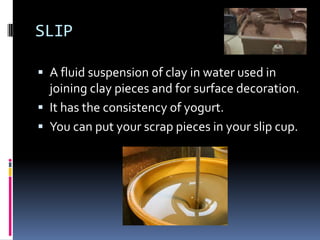
SLIP

 A fluid suspension of clay in water used in
  joining clay pieces and for surface decoration.
 It has the consistency of yogurt.
 You can put your scrap pieces in your slip cup.
STAGES OF CLAY

 Plastic
 Leather-hard
 Greenware / Bone Dry
 Bisqueware
 Glazeware
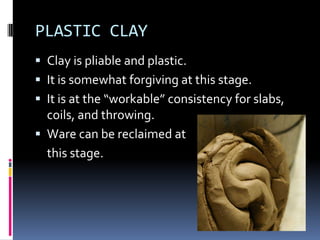
PLASTIC CLAY
 Clay is pliable and plastic.
 It is somewhat forgiving at this stage.
 It is at the “workable” consistency for slabs,
  coils, and throwing.
 Ware can be reclaimed at
  this stage.
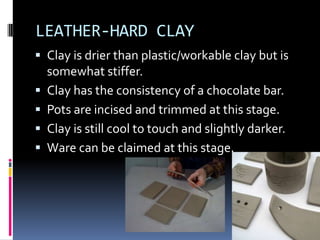
LEATHER-HARD CLAY
 Clay is drier than plastic/workable clay but is
    somewhat stiffer.
   Clay has the consistency of a chocolate bar.
   Pots are incised and trimmed at this stage.
   Clay is still cool to touch and slightly darker.
   Ware can be claimed at this stage.
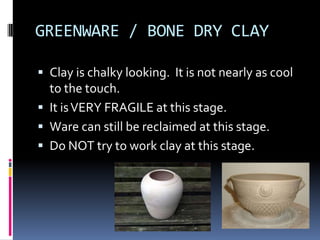
GREENWARE / BONE DRY CLAY

 Clay is chalky looking. It is not nearly as cool
  to the touch.
 It is VERY FRAGILE at this stage.
 Ware can still be reclaimed at this stage.
 Do NOT try to work clay at this stage.
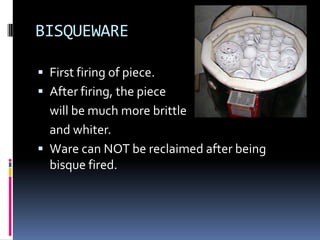
BISQUEWARE

 First firing of piece.
 After firing, the piece
  will be much more brittle
  and whiter.
 Ware can NOT be reclaimed after being
  bisque fired.
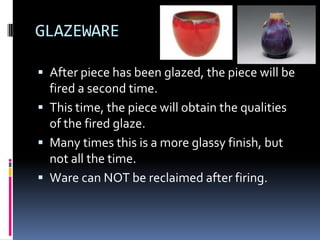
GLAZEWARE

 After piece has been glazed, the piece will be
  fired a second time.
 This time, the piece will obtain the qualities
  of the fired glaze.
 Many times this is a more glassy finish, but
  not all the time.
 Ware can NOT be reclaimed after firing.

Introduction to clay

  • 1.
  • 2.
    Ceramics  Things madefrom clay, the basic material for all ceramic creations.  Clay is created as a result of the decomposition of igneous rock, which makes up the entire earth’s crust.  Everything you will do with clay involves the interplay of these 3 variables:  Moisture  Plasticity  Heat
  • 3.
    Origins of Ceramics Of all the arts, ceramics has perhaps the longest history, dating back to when people first learned to control fire.  Theories:  People first began to model clay as a diversion.  People used clay for practical purposes.
  • 4.
    Early Techniques  Theclay you work with in a studio has been processed and prepared to some degree.  Early potters had to actually dig their raw material from the ground and prepare it.  There were sometimes impurities that had to be taken out.
  • 5.
    Chapter 2: Workingwith Clay  Clay Properties  Plasticity  Shrinkage  Texture  Moisture  Handling Clay
  • 6.
    PLASTICITY  Most beginnersuse highly plastic clay, or one that can easily take different shapes.  PLASTIC – The property of clay that allows it to change shape without tearing or breaking.  Numerous factors can make clay more plastic.  You can spray it with water.  You can store it in a bag with water.  You can mix new plastic clay with the old.
  • 7.
    SHRINKAGE  All clayshrinks as they dry. Clay can crack when it shrinks if the potter doesn’t carefully monitor the drying process.  It is frustrating the spend a lot of time on creating your artwork only to have it crack because you did not take the time to allow it to dry slowly.
  • 8.
    TEXTURE  The textureof a clay body can range from coarse to smooth.  Some potters add sand or grog to change the texture of their clay.
  • 9.
    MOISTURE  All claycontains water. You can add water to clay to make it more workable or plastic. Add too much water, however, and the clay loses plasticity – it won’t hold any shape at all.  Clay begins to dehydrate, or lose moisture, when it is exposed to air.  You will occasionally need to rehydrate, or put water back into the clay, to keep it moist.
  • 10.
    MOISTURE  You canmist it with a spray bottle or dampen it with a wet sponge or damp paper towel.  Once the clay is fired, it becomes permanently harder, stronger, and less likely to break.  It can never become plastic again after being fired.
  • 11.
    PREPARING THE CLAY Before you can make anything with clay, you’ll need to prepare it.  All clay needs to be de-aired before you begin.  Kneading or Wedging eliminates air bubbles and keeps the internal structure of clay more cohesive and consistent.
  • 12.
    Kneading / WedgingClay  You will use a piece of canvas to absorb extra moisture.  Since we are using a small amount of clay, we will use the kneading method.
  • 13.
    Clay Safety Tips Little bits of clay that end upon the surface of your table are harmless. However, when they are brushed onto the floor these crumbles break down into smaller and smaller particles which then scatter into the air you breathe.  CAPTURE CLAY DUST WITH WATER. Use a wet sponge to clean tables, tools, wheels, and sinks. Brooms and brushes only make more dust.
  • 14.
    SLIP  A fluidsuspension of clay in water used in joining clay pieces and for surface decoration.  It has the consistency of yogurt.  You can put your scrap pieces in your slip cup.
  • 15.
    STAGES OF CLAY Plastic  Leather-hard  Greenware / Bone Dry  Bisqueware  Glazeware
  • 16.
    PLASTIC CLAY  Clayis pliable and plastic.  It is somewhat forgiving at this stage.  It is at the “workable” consistency for slabs, coils, and throwing.  Ware can be reclaimed at this stage.
  • 17.
    LEATHER-HARD CLAY  Clayis drier than plastic/workable clay but is somewhat stiffer.  Clay has the consistency of a chocolate bar.  Pots are incised and trimmed at this stage.  Clay is still cool to touch and slightly darker.  Ware can be claimed at this stage.
  • 18.
    GREENWARE / BONEDRY CLAY  Clay is chalky looking. It is not nearly as cool to the touch.  It is VERY FRAGILE at this stage.  Ware can still be reclaimed at this stage.  Do NOT try to work clay at this stage.
  • 19.
    BISQUEWARE  First firingof piece.  After firing, the piece will be much more brittle and whiter.  Ware can NOT be reclaimed after being bisque fired.
  • 20.
    GLAZEWARE  After piecehas been glazed, the piece will be fired a second time.  This time, the piece will obtain the qualities of the fired glaze.  Many times this is a more glassy finish, but not all the time.  Ware can NOT be reclaimed after firing.