PRESENTATION
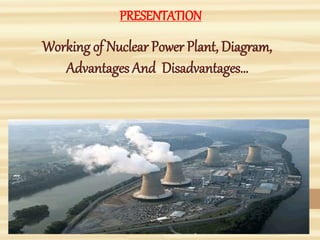
Working of Nuclear Power Plant, Diagram,
Advantages And Disadvantages…
Mr. Devender Kumar
Assistant Professor
P.I.E.T.
Vasu
B.Tech Civil 4th Semester
Introduction
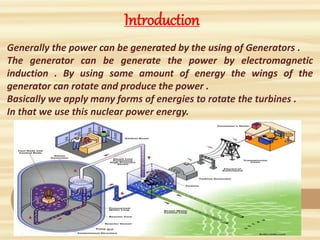
Generally the power can be generated by the using of Generators .
The generator can be generate the power by electromagnetic
induction . By using some amount of energy the wings of the
generator can rotate and produce the power .
Basically we apply many forms of energies to rotate the turbines .
In that we use this nuclear power energy.
Defination
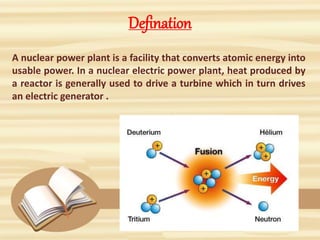
A nuclear power plant is a facility that converts atomic energy into
usable power. In a nuclear electric power plant, heat produced by
a reactor is generally used to drive a turbine which in turn drives
an electric generator .
Principle
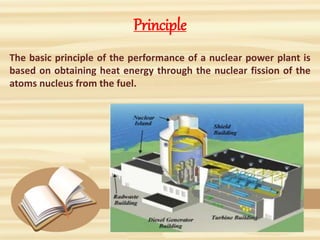
The basic principle of the performance of a nuclear power plant is
based on obtaining heat energy through the nuclear fission of the
atoms nucleus from the fuel.
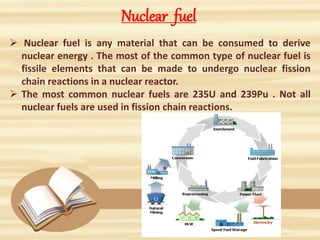
Nuclear fuel
 Nuclear fuel is any material that can be consumed to derive
nuclear energy . The most of the common type of nuclear fuel is
fissile elements that can be made to undergo nuclear fission
chain reactions in a nuclear reactor.
 The most common nuclear fuels are 235U and 239Pu . Not all
nuclear fuels are used in fission chain reactions.
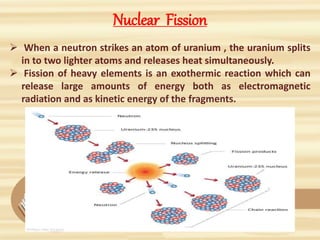
Nuclear Fission
 When a neutron strikes an atom of uranium , the uranium splits
in to two lighter atoms and releases heat simultaneously.
 Fission of heavy elements is an exothermic reaction which can
release large amounts of energy both as electromagnetic
radiation and as kinetic energy of the fragments.
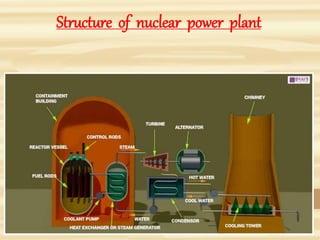
Structure of nuclear power plant
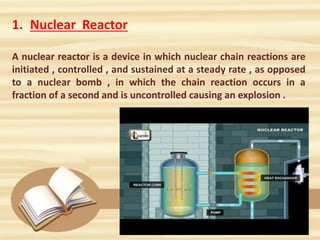
1. Nuclear Reactor
A nuclear reactor is a device in which nuclear chain reactions are
initiated , controlled , and sustained at a steady rate , as opposed
to a nuclear bomb , in which the chain reaction occurs in a
fraction of a second and is uncontrolled causing an explosion .
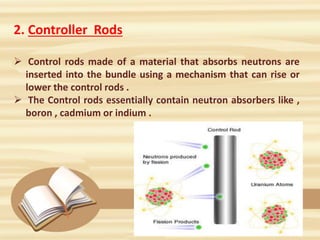
2. Controller Rods
 Control rods made of a material that absorbs neutrons are
inserted into the bundle using a mechanism that can rise or
lower the control rods .
 The Control rods essentially contain neutron absorbers like ,
boron , cadmium or indium .
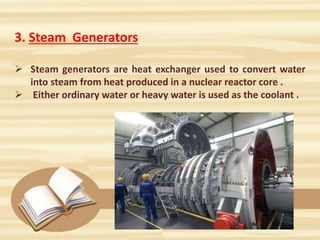
3. Steam Generators
 Steam generators are heat exchanger used to convert water
into steam from heat produced in a nuclear reactor core .
 Either ordinary water or heavy water is used as the coolant .
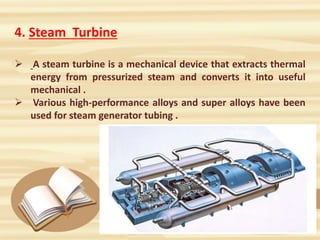
4. Steam Turbine
 A steam turbine is a mechanical device that extracts thermal
energy from pressurized steam and converts it into useful
mechanical .
 Various high-performance alloys and super alloys have been
used for steam generator tubing .
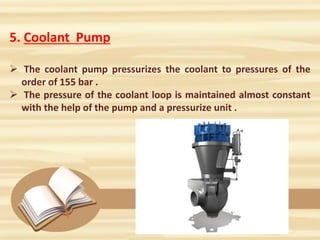
5. Coolant Pump
 The coolant pump pressurizes the coolant to pressures of the
order of 155 bar .
 The pressure of the coolant loop is maintained almost constant
with the help of the pump and a pressurize unit .
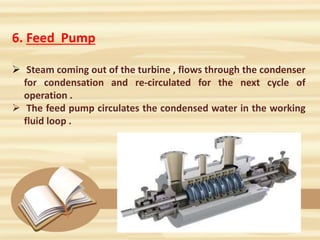
6. Feed Pump
 Steam coming out of the turbine , flows through the condenser
for condensation and re-circulated for the next cycle of
operation .
 The feed pump circulates the condensed water in the working
fluid loop .
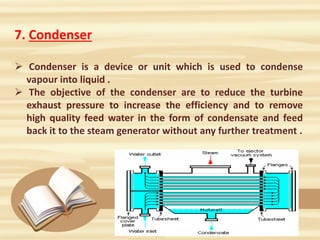
7. Condenser
 Condenser is a device or unit which is used to condense
vapour into liquid .
 The objective of the condenser are to reduce the turbine
exhaust pressure to increase the efficiency and to remove
high quality feed water in the form of condensate and feed
back it to the steam generator without any further treatment .
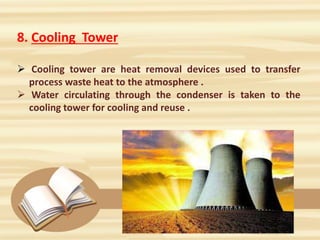
8. Cooling Tower
 Cooling tower are heat removal devices used to transfer
process waste heat to the atmosphere .
 Water circulating through the condenser is taken to the
cooling tower for cooling and reuse .
Working of Nuclear Power Plant
Heavy elements such as Uranium (U235) or Thorium (Th232) are subjected
to nuclear fission reaction in a nuclear reactor. Due to fission, a large
amount of heat energy is produced which is transferred to the reactor
coolant. The coolant may be water, gas or a liquid metal. The heated
coolant is made to flow through a heat exchanger where water is
converted into high-temperature steam. The generated steam is then
allowed to drive a steam turbine. The steam, after doing its work, is
converted back into the water and recycled to the heat exchanger. The
steam turbine is coupled to an alternator which generates electricity. The
generated electrical voltage is then stepped up using a transformer for
the purpose of long distance transmission.
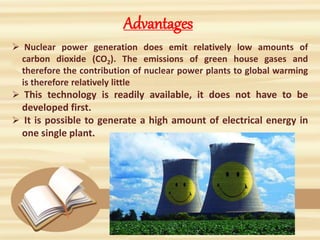
Advantages
 Nuclear power generation does emit relatively low amounts of
carbon dioxide (CO2). The emissions of green house gases and
therefore the contribution of nuclear power plants to global warming
is therefore relatively little
 This technology is readily available, it does not have to be
developed first.
 It is possible to generate a high amount of electrical energy in
one single plant.
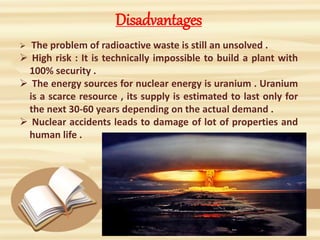
Disadvantages
 The problem of radioactive waste is still an unsolved .
 High risk : It is technically impossible to build a plant with
100% security .
 The energy sources for nuclear energy is uranium . Uranium
is a scarce resource , its supply is estimated to last only for
the next 30-60 years depending on the actual demand .
 Nuclear accidents leads to damage of lot of properties and
human life .
Nuclear Plant

Nuclear Plant

  • 1.
    PRESENTATION Working of NuclearPower Plant, Diagram, Advantages And Disadvantages…
  • 2.
    Mr. Devender Kumar AssistantProfessor P.I.E.T. Vasu B.Tech Civil 4th Semester
  • 3.
    Introduction Generally the powercan be generated by the using of Generators . The generator can be generate the power by electromagnetic induction . By using some amount of energy the wings of the generator can rotate and produce the power . Basically we apply many forms of energies to rotate the turbines . In that we use this nuclear power energy.
  • 4.
    Defination A nuclear powerplant is a facility that converts atomic energy into usable power. In a nuclear electric power plant, heat produced by a reactor is generally used to drive a turbine which in turn drives an electric generator .
  • 5.
    Principle The basic principleof the performance of a nuclear power plant is based on obtaining heat energy through the nuclear fission of the atoms nucleus from the fuel.
  • 6.
    Nuclear fuel  Nuclearfuel is any material that can be consumed to derive nuclear energy . The most of the common type of nuclear fuel is fissile elements that can be made to undergo nuclear fission chain reactions in a nuclear reactor.  The most common nuclear fuels are 235U and 239Pu . Not all nuclear fuels are used in fission chain reactions.
  • 7.
    Nuclear Fission  Whena neutron strikes an atom of uranium , the uranium splits in to two lighter atoms and releases heat simultaneously.  Fission of heavy elements is an exothermic reaction which can release large amounts of energy both as electromagnetic radiation and as kinetic energy of the fragments.
  • 8.
  • 9.
    1. Nuclear Reactor Anuclear reactor is a device in which nuclear chain reactions are initiated , controlled , and sustained at a steady rate , as opposed to a nuclear bomb , in which the chain reaction occurs in a fraction of a second and is uncontrolled causing an explosion .
  • 10.
    2. Controller Rods Control rods made of a material that absorbs neutrons are inserted into the bundle using a mechanism that can rise or lower the control rods .  The Control rods essentially contain neutron absorbers like , boron , cadmium or indium .
  • 11.
    3. Steam Generators Steam generators are heat exchanger used to convert water into steam from heat produced in a nuclear reactor core .  Either ordinary water or heavy water is used as the coolant .
  • 12.
    4. Steam Turbine A steam turbine is a mechanical device that extracts thermal energy from pressurized steam and converts it into useful mechanical .  Various high-performance alloys and super alloys have been used for steam generator tubing .
  • 13.
    5. Coolant Pump The coolant pump pressurizes the coolant to pressures of the order of 155 bar .  The pressure of the coolant loop is maintained almost constant with the help of the pump and a pressurize unit .
  • 14.
    6. Feed Pump Steam coming out of the turbine , flows through the condenser for condensation and re-circulated for the next cycle of operation .  The feed pump circulates the condensed water in the working fluid loop .
  • 15.
    7. Condenser  Condenseris a device or unit which is used to condense vapour into liquid .  The objective of the condenser are to reduce the turbine exhaust pressure to increase the efficiency and to remove high quality feed water in the form of condensate and feed back it to the steam generator without any further treatment .
  • 16.
    8. Cooling Tower Cooling tower are heat removal devices used to transfer process waste heat to the atmosphere .  Water circulating through the condenser is taken to the cooling tower for cooling and reuse .
  • 17.
    Working of NuclearPower Plant Heavy elements such as Uranium (U235) or Thorium (Th232) are subjected to nuclear fission reaction in a nuclear reactor. Due to fission, a large amount of heat energy is produced which is transferred to the reactor coolant. The coolant may be water, gas or a liquid metal. The heated coolant is made to flow through a heat exchanger where water is converted into high-temperature steam. The generated steam is then allowed to drive a steam turbine. The steam, after doing its work, is converted back into the water and recycled to the heat exchanger. The steam turbine is coupled to an alternator which generates electricity. The generated electrical voltage is then stepped up using a transformer for the purpose of long distance transmission.
  • 18.
    Advantages  Nuclear powergeneration does emit relatively low amounts of carbon dioxide (CO2). The emissions of green house gases and therefore the contribution of nuclear power plants to global warming is therefore relatively little  This technology is readily available, it does not have to be developed first.  It is possible to generate a high amount of electrical energy in one single plant.
  • 19.
    Disadvantages  The problemof radioactive waste is still an unsolved .  High risk : It is technically impossible to build a plant with 100% security .  The energy sources for nuclear energy is uranium . Uranium is a scarce resource , its supply is estimated to last only for the next 30-60 years depending on the actual demand .  Nuclear accidents leads to damage of lot of properties and human life .