PRESENTATION
CHEMISTRY
CERAMICS: SILICA
VASU GOEL
ABHINAV SAINI
RAGHAV AGGARWAL
CERAMICS: SILICA
 Silicon dioxide, also known as silica, is an oxide of
silicon with the chemical formula SiO₂.
 It is most commonly found in nature as quartz and in
various living organisms.
 In many parts of the world, silica is the major
constituent of sand.
WHAT IS SILICA?
CERAMICS: SILICA
 Silicon is the second most abundant element (≈27.6%)
in the earth’s crust.
 Silicon never occurs as a free element in nature. It
always occurs as a compound with oxygen, magnesium,
calcium, phosphorus or other elements.
 The most common minerals are silicates.
 Silicon has been detected in the sun and stars and
meteorites (aerolites), etc.
SILICA: OCCURRENCE
CERAMICS: SILICA
 Existence
 Hardness
 Color
 Melting Point
 Boiling Point
 Refractive Index vs Density
 Reactivity
PROPERTIES OF SILICA
CERAMICS: SILICA
 Silica mainly occurs in two allotropic forms: crystalline
and non-crystalline.
 Crystalline form is shiny, greyish-black, needle-like or
flat plates.
 Non-crystalline form usually occurs as brown powder.
PROPERTIES OF SILICA: EXISTENCE
CERAMICS: SILICA
 Under normal temperature and pressure conditions, it
is a solid, crystallized mineral.
 It is relatively hard, weighing
a “7” on the Mohs Scale.
PROPERTIES OF SILICA: HARDNESS
CERAMICS: SILICA
 Pure silica is colorless.
 However, if contaminants are present in quartz, it may
have some color.
e.g., Rose Quartz is silica with trace amounts of iron
PROPERTIES OF SILICA: COLOR
CERAMICS: SILICA
 Silica has very high melting and boiling points.
Melting Point = 3110⁰F = 1410⁰C
Boiling Point = 4046⁰F = 2355⁰C
 It takes a big hot furnace to melt silica sand in order to
make glass.
PROPERTIES OF SILICA: MP & BP
CERAMICS: SILICA
PROPERTIES OF SILICA: REFRACTIVE INDEX VS DENSITY
CERAMICS: SILICA
 Silica reacts with hydrofluoric acid. This reaction is used
to edge quartz in the semiconductor industry.
 Silica also reacts with metal oxides
(like NaO, PbO). These reactions are used
to produce different kinds of glass such as
borosilicate glass, leaded glass, etc.
PROPERTIES OF SILICA: REACTIVITY
CERAMICS: SILICA
SILICA IN DIFFERENT FORMS
 Silica Gel  Silica Dust
CERAMICS: SILICA
SILICA IN DIFFERENT FORMS
 Silica Sand  Silica Powder
CERAMICS: SILICA
 Silicon dioxide is mostly obtained by mining, including
sand mining and purification of quartz.
 Quartz is suitable for many purposes, while chemical
processing maybe required to make a purer and more
suitable (i.e., more reactive or fine-grained) product.
PRODUCTION OF SILICA
CERAMICS: SILICA
 Silica fume is obtained as a by product of hot processes
like ferro-silicon production.
 It is less pure than fumed silica and should not be
confused with that product.
PRODUCTION OF SILICA: SILICA FUME
CERAMICS: SILICA
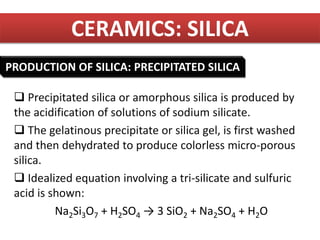
 Precipitated silica or amorphous silica is produced by
the acidification of solutions of sodium silicate.
 The gelatinous precipitate or silica gel, is first washed
and then dehydrated to produce colorless micro-porous
silica.
 Idealized equation involving a tri-silicate and sulfuric
acid is shown:
Na2Si3O7 + H2SO4 → 3 SiO2 + Na2SO4 + H2O
PRODUCTION OF SILICA: PRECIPITATED SILICA
CERAMICS: SILICA
 It is applied as a coat to create adhesion.
 It is used in the production of chalk boards and marker
boards.
 It is used as non-stick hybrid coatings.
 It is used for jewelry and silk-screening applications.
 It is used as an anti-caking agent in powdered foods
such as spices and non-dairy coffee creamer.
USES OF SILICA
CERAMICS: SILICA
 Colloidal silica is also used as a wine, beer and juice
fining agent.
 Hydrated silica is used in toothpaste as a hard abrasive
to remove tooth plaque.
 Hyper-pure silicon is used in transistors and other
electronic devices.
 It is used in grinding and polishing glass and stone.
and many more…maybe!!
USES OF SILICA
FINISH

Ceramics :- Silica

  • 1.
  • 2.
    CERAMICS: SILICA  Silicondioxide, also known as silica, is an oxide of silicon with the chemical formula SiO₂.  It is most commonly found in nature as quartz and in various living organisms.  In many parts of the world, silica is the major constituent of sand. WHAT IS SILICA?
  • 3.
    CERAMICS: SILICA  Siliconis the second most abundant element (≈27.6%) in the earth’s crust.  Silicon never occurs as a free element in nature. It always occurs as a compound with oxygen, magnesium, calcium, phosphorus or other elements.  The most common minerals are silicates.  Silicon has been detected in the sun and stars and meteorites (aerolites), etc. SILICA: OCCURRENCE
  • 4.
    CERAMICS: SILICA  Existence Hardness  Color  Melting Point  Boiling Point  Refractive Index vs Density  Reactivity PROPERTIES OF SILICA
  • 5.
    CERAMICS: SILICA  Silicamainly occurs in two allotropic forms: crystalline and non-crystalline.  Crystalline form is shiny, greyish-black, needle-like or flat plates.  Non-crystalline form usually occurs as brown powder. PROPERTIES OF SILICA: EXISTENCE
  • 6.
    CERAMICS: SILICA  Undernormal temperature and pressure conditions, it is a solid, crystallized mineral.  It is relatively hard, weighing a “7” on the Mohs Scale. PROPERTIES OF SILICA: HARDNESS
  • 7.
    CERAMICS: SILICA  Puresilica is colorless.  However, if contaminants are present in quartz, it may have some color. e.g., Rose Quartz is silica with trace amounts of iron PROPERTIES OF SILICA: COLOR
  • 8.
    CERAMICS: SILICA  Silicahas very high melting and boiling points. Melting Point = 3110⁰F = 1410⁰C Boiling Point = 4046⁰F = 2355⁰C  It takes a big hot furnace to melt silica sand in order to make glass. PROPERTIES OF SILICA: MP & BP
  • 9.
    CERAMICS: SILICA PROPERTIES OFSILICA: REFRACTIVE INDEX VS DENSITY
  • 10.
    CERAMICS: SILICA  Silicareacts with hydrofluoric acid. This reaction is used to edge quartz in the semiconductor industry.  Silica also reacts with metal oxides (like NaO, PbO). These reactions are used to produce different kinds of glass such as borosilicate glass, leaded glass, etc. PROPERTIES OF SILICA: REACTIVITY
  • 11.
    CERAMICS: SILICA SILICA INDIFFERENT FORMS  Silica Gel  Silica Dust
  • 12.
    CERAMICS: SILICA SILICA INDIFFERENT FORMS  Silica Sand  Silica Powder
  • 13.
    CERAMICS: SILICA  Silicondioxide is mostly obtained by mining, including sand mining and purification of quartz.  Quartz is suitable for many purposes, while chemical processing maybe required to make a purer and more suitable (i.e., more reactive or fine-grained) product. PRODUCTION OF SILICA
  • 14.
    CERAMICS: SILICA  Silicafume is obtained as a by product of hot processes like ferro-silicon production.  It is less pure than fumed silica and should not be confused with that product. PRODUCTION OF SILICA: SILICA FUME
  • 15.
    CERAMICS: SILICA  Precipitatedsilica or amorphous silica is produced by the acidification of solutions of sodium silicate.  The gelatinous precipitate or silica gel, is first washed and then dehydrated to produce colorless micro-porous silica.  Idealized equation involving a tri-silicate and sulfuric acid is shown: Na2Si3O7 + H2SO4 → 3 SiO2 + Na2SO4 + H2O PRODUCTION OF SILICA: PRECIPITATED SILICA
  • 16.
    CERAMICS: SILICA  Itis applied as a coat to create adhesion.  It is used in the production of chalk boards and marker boards.  It is used as non-stick hybrid coatings.  It is used for jewelry and silk-screening applications.  It is used as an anti-caking agent in powdered foods such as spices and non-dairy coffee creamer. USES OF SILICA
  • 17.
    CERAMICS: SILICA  Colloidalsilica is also used as a wine, beer and juice fining agent.  Hydrated silica is used in toothpaste as a hard abrasive to remove tooth plaque.  Hyper-pure silicon is used in transistors and other electronic devices.  It is used in grinding and polishing glass and stone. and many more…maybe!! USES OF SILICA
  • 18.