Advanced Ceramics
Jamal Eldin Ibrahim
Advanced Ceramics
♦
Advanced ceramics are ideally suited for industrial applications hat
provide a physical interface between different components due to their
ability to withstand high temperatures, vibration and mechanical shock
.
♦
A type of ceramic exhibiting a high degree of industrial efficiency
.
♦
A type of ceramic used in specialized, recently developed
applications
.
♦
Advanced ceramics often have simple chemical compositions, but they
are difficult to manufacture
.
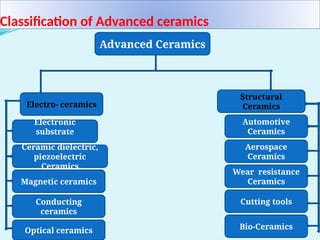
Classification of Advanced ceramics
Advanced Ceramics
Conducting
ceramics
Structural
Ceramics
Electronic
substrate
Ceramic dielectric,
piezoelectric
Ceramics
Magnetic ceramics
Electro- ceramics
Optical ceramics
Automotive
Ceramics
Aerospace
Ceramics
Wear resistance
Ceramics
Cutting tools
Bio-Ceramics
Electroceramics
♦
Is a class of ceramic materials used primarily for their electrical
properties
.
♦
It includes materials for a wide range of applications (power
conversion and storage, communications and electronics)
.
♦
The materials for such applications are usually prepared from
specifically formulated compositions (typically not found in
nature), and processed under strictly controlled conditions
.
♦
Further classified to
:
Electronic substrate
♦
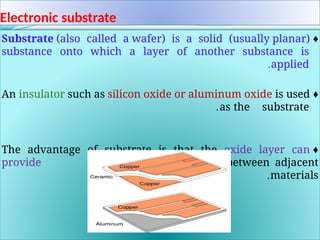
Substrate (also called a wafer) is a solid (usually planar)
substance onto which a layer of another substance is
applied
.
♦
An insulator such as silicon oxide or aluminum oxide is used
as the substrate
.
♦
The advantage of substrate is that the oxide layer can
provide superior insulation between adjacent
materials
.
Dielectric Ceramics
♦
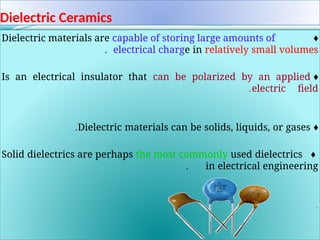
Dielectric materials are capable of storing large amounts of
electrical charge in relatively small volumes
.
♦
Is an electrical insulator that can be polarized by an applied
electric field
.
♦
Dielectric materials can be solids, liquids, or gases
.
♦
Solid dielectrics are perhaps the most commonly used dielectrics
in electrical engineering
.
.
Piezoelectric ceramics
♦
Piezoelectricity is a property of certain classes of crystalline
materials including Barium Titanate BaTiO3 and Lead
Zirconate Titanates Pb[ZrxTi1-x]O3(PZT)
.
.
♦
When mechanical pressure is applied to one of these materials,
the crystalline structure produces a voltage proportional to
the pressure. Conversely, when an electric field is applied, the
structure changes shape producing dimensional changes in
the material
.
♦
Use as sensors , actuators and transducers
.
Magnetic ceramics
♦
Magnetic ceramics are made of ferrites, which are
crystalline minerals composed of iron oxide in
combination with some other metal. They are given
the general chemical formula M(FexOy), M
representing other metallic elements than iron. The
most familiar ferrite is magnetite, a naturally occurring
ferrous ferrite (Fe[Fe2O4], or Fe3O4) commonly known as
lodestone
.
Ceramic Magnets
Optical ceramics
♦
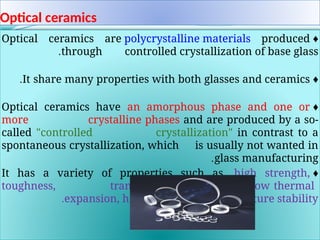
Optical ceramics are polycrystalline materials produced
through controlled crystallization of base glass
.
♦
It share many properties with both glasses and ceramics
.
♦
Optical ceramics have an amorphous phase and one or
more crystalline phases and are produced by a so-
called "controlled crystallization" in contrast to a
spontaneous crystallization, which is usually not wanted in
glass manufacturing
.
♦
It has a variety of properties such as, high strength,
toughness, transparency, opalescence, low thermal
expansion, high temperature stability
.
.
Structural Ceramics
♦
Ceramic materials that demonstrate enhanced mechanical
properties under demanding conditions. Because
they serve as structural members, often being subjected
to mechanical loading, they are given the name
structural ceramics
.
.
♦
Ordinarily, for structural applications ceramics tend to be
expensive replacements for other materials, such
as metals, polymers, and composites
.
.
♦
Further classified to
:
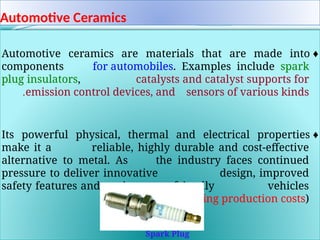
Automotive Ceramics
♦
Automotive ceramics are materials that are made into
components for automobiles. Examples include spark
plug insulators, catalysts and catalyst supports for
emission control devices, and sensors of various kinds
.
♦
Its powerful physical, thermal and electrical properties
make it a reliable, highly durable and cost-effective
alternative to metal. As the industry faces continued
pressure to deliver innovative design, improved
safety features and environment-friendly vehicles
(while also reducing production costs)
.
Spark Plug
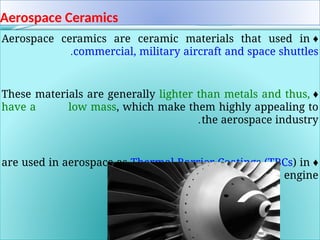
Aerospace Ceramics
♦
Aerospace ceramics are ceramic materials that used in
commercial, military aircraft and space shuttles
.
♦
These materials are generally lighter than metals and thus,
have a low mass, which make them highly appealing to
the aerospace industry
.
♦
are used in aerospace as Thermal Barrier Coatings (TBCs) in
the hot part of the engine
.
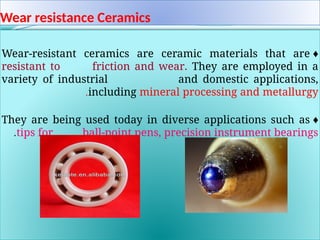
Wear resistance Ceramics
♦
Wear-resistant ceramics are ceramic materials that are
resistant to friction and wear. They are employed in a
variety of industrial and domestic applications,
including mineral processing and metallurgy
.
♦
They are being used today in diverse applications such as
tips for ball-point pens, precision instrument bearings
.
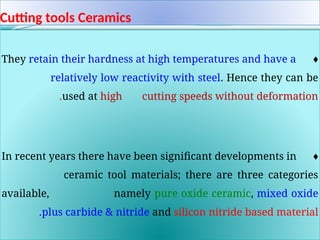
Cutting tools Ceramics
♦
They retain their hardness at high temperatures and have a
relatively low reactivity with steel. Hence they can be
used at high cutting speeds without deformation
.
♦
In recent years there have been significant developments in
ceramic tool materials; there are three categories
available, namely pure oxide ceramic, mixed oxide
plus carbide & nitride and silicon nitride based material
.
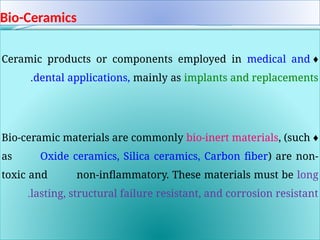
Bio-Ceramics
♦
Ceramic products or components employed in medical and
dental applications, mainly as implants and replacements
.
♦
Bio-ceramic materials are commonly bio-inert materials, (such
as Oxide ceramics, Silica ceramics, Carbon fiber) are non-
toxic and non-inflammatory. These materials must be long
lasting, structural failure resistant, and corrosion resistant
.
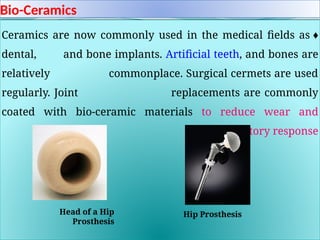
Bio-Ceramics
♦
Ceramics are now commonly used in the medical fields as
dental, and bone implants. Artificial teeth, and bones are
relatively commonplace. Surgical cermets are used
regularly. Joint replacements are commonly
coated with bio-ceramic materials to reduce wear and
inflammatory response
.
Head of a Hip
Prosthesis
Hip Prosthesis
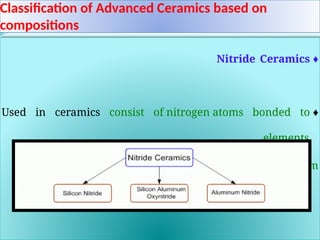
Classification of Advanced Ceramics based on
compositions
♦
Nitride Ceramics
♦
Used in ceramics consist of nitrogen atoms bonded to
elements
such as silicon and aluminum
.
.
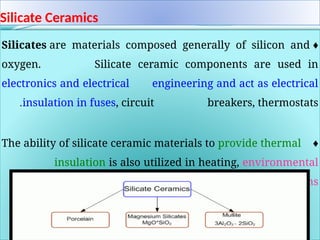
Silicate Ceramics
♦
Silicates are materials composed generally of silicon and
oxygen. Silicate ceramic components are used in
electronics and electrical engineering and act as electrical
insulation in fuses, circuit breakers, thermostats
.
♦
The ability of silicate ceramic materials to provide thermal
insulation is also utilized in heating, environmental
and thermal engineering applications
.
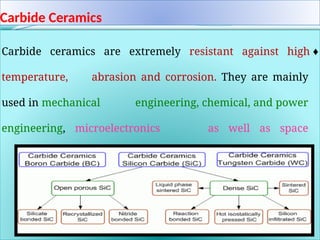
Carbide Ceramics
♦
Carbide ceramics are extremely resistant against high
temperature, abrasion and corrosion. They are mainly
used in mechanical engineering, chemical, and power
engineering, microelectronics as well as space
engineering
.
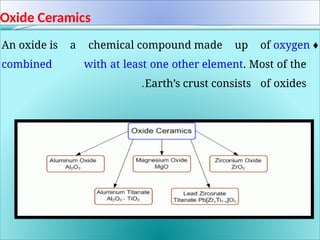
Oxide Ceramics
♦
An oxide is a chemical compound made up of oxygen
combined with at least one other element. Most of the
Earth’s crust consists of oxides
.
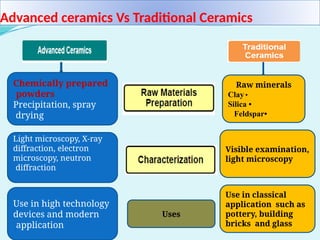
Advanced ceramics Vs Traditional Ceramics
Raw minerals
•
Clay
•
Silica
•
Feldspar
Chemically prepared
powders
Precipitation, spray
drying
Light microscopy, X-ray
diffraction, electron
microscopy, neutron
diffraction
Visible examination,
light microscopy
Use in high technology
devices and modern
application
Use in classical
application such as
pottery, building
bricks and glass
Uses
Raw materials of traditional ceramics
♦
The traditional ceramics industry is largely based on various
combinations of clay minerals, feldspar and silica
.
♦
The mineral raw materials used in the ceramic industry are mainly
inorganic, nonmetallic, crystalline solids formed by complex
geological processes
.
♦
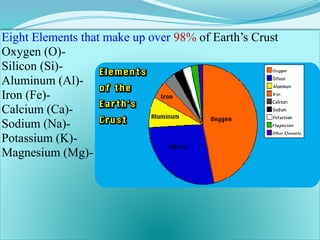
Oxygen, silicon, and aluminum together account for 90% of the
elements in the earth’s crust , These, together with other minerals
compounds of oxygen, constitute the greatest bulk of naturally
occurring ceramic raw materials
.
Eight Elements that make up over 98% of Earth’s Crust
-
Oxygen (O)
-
Silicon (Si)
-
Aluminum (Al)
-
Iron (Fe)
-
Calcium (Ca)
-
Sodium (Na)
-
Potassium (K)
-
Magnesium (Mg)
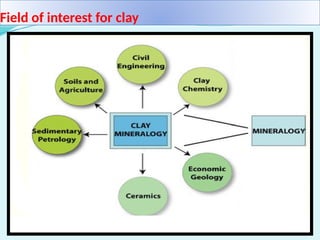
Field of interest for clay
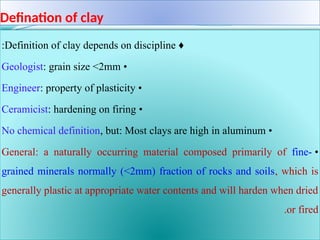
Defination of clay
♦
Definition of clay depends on discipline
:
•
Geologist: grain size <2mm
•
Engineer: property of plasticity
•
Ceramicist: hardening on firing
•
No chemical definition, but: Most clays are high in aluminum
•
General: a naturally occurring material composed primarily of fine-
grained minerals normally (<2mm) fraction of rocks and soils, which is
generally plastic at appropriate water contents and will harden when dried
or fired
.
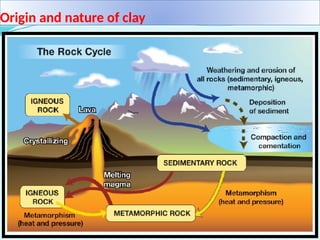
Origin and nature of clay
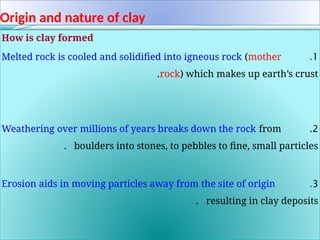
How is clay formed
1
.
Melted rock is cooled and solidified into igneous rock (mother
rock) which makes up earth’s crust
.
2
.
Weathering over millions of years breaks down the rock from
boulders into stones, to pebbles to fine, small particles
.
3
.
Erosion aids in moving particles away from the site of origin
resulting in clay deposits
.
Origin and nature of clay
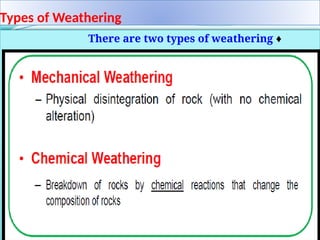
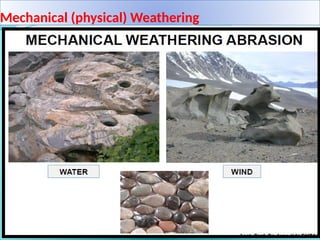
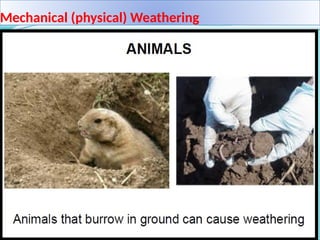
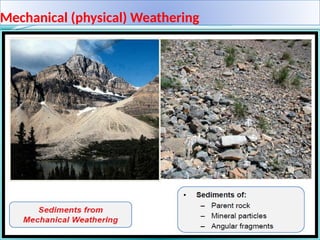
Types of Weathering
♦
There are two types of weathering
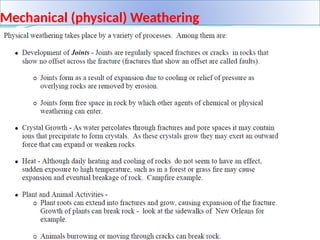
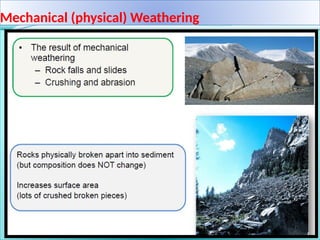
Mechanical (physical) Weathering
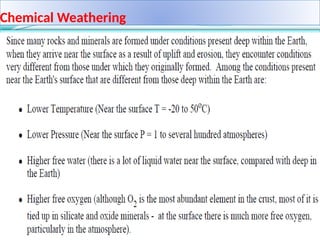
Chemical Weathering
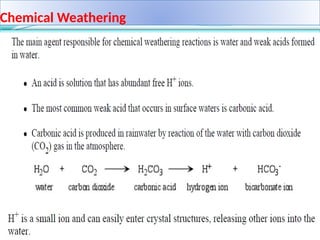
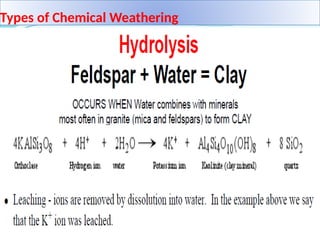
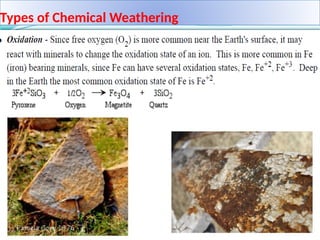
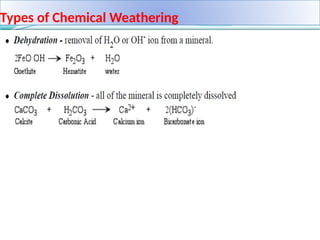
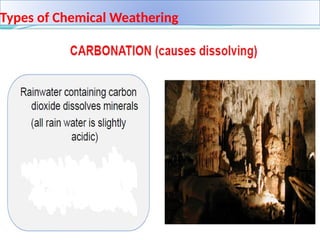
Chemical Weathering
Types of Chemical Weathering
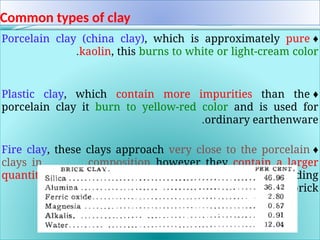
Common types of clay
♦
Porcelain clay (china clay), which is approximately pure
kaolin, this burns to white or light-cream color
.
♦
Plastic clay, which contain more impurities than the
porcelain clay it burn to yellow-red color and is used for
ordinary earthenware
.
♦
Fire clay, these clays approach very close to the porcelain
clays in composition however they contain a larger
quantity of iron, also more silica and is used for building
brick
.
Importance charactersitics of clay
♦
Clays have the ability to form clay-water composition and to
maintain their shape and strength during drying
and firing
.
♦
They fuse over a temperature range depending on their
composition in such a way as to become dense and
strong without losing their shape
.

Advanced Ceramics for different applications.pptx

  • 1.
  • 2.
    Advanced Ceramics ♦ Advanced ceramicsare ideally suited for industrial applications hat provide a physical interface between different components due to their ability to withstand high temperatures, vibration and mechanical shock . ♦ A type of ceramic exhibiting a high degree of industrial efficiency . ♦ A type of ceramic used in specialized, recently developed applications . ♦ Advanced ceramics often have simple chemical compositions, but they are difficult to manufacture .
  • 3.
    Classification of Advancedceramics Advanced Ceramics Conducting ceramics Structural Ceramics Electronic substrate Ceramic dielectric, piezoelectric Ceramics Magnetic ceramics Electro- ceramics Optical ceramics Automotive Ceramics Aerospace Ceramics Wear resistance Ceramics Cutting tools Bio-Ceramics
  • 4.
    Electroceramics ♦ Is a classof ceramic materials used primarily for their electrical properties . ♦ It includes materials for a wide range of applications (power conversion and storage, communications and electronics) . ♦ The materials for such applications are usually prepared from specifically formulated compositions (typically not found in nature), and processed under strictly controlled conditions . ♦ Further classified to :
  • 5.
    Electronic substrate ♦ Substrate (alsocalled a wafer) is a solid (usually planar) substance onto which a layer of another substance is applied . ♦ An insulator such as silicon oxide or aluminum oxide is used as the substrate . ♦ The advantage of substrate is that the oxide layer can provide superior insulation between adjacent materials .
  • 6.
    Dielectric Ceramics ♦ Dielectric materialsare capable of storing large amounts of electrical charge in relatively small volumes . ♦ Is an electrical insulator that can be polarized by an applied electric field . ♦ Dielectric materials can be solids, liquids, or gases . ♦ Solid dielectrics are perhaps the most commonly used dielectrics in electrical engineering . .
  • 7.
    Piezoelectric ceramics ♦ Piezoelectricity isa property of certain classes of crystalline materials including Barium Titanate BaTiO3 and Lead Zirconate Titanates Pb[ZrxTi1-x]O3(PZT) . . ♦ When mechanical pressure is applied to one of these materials, the crystalline structure produces a voltage proportional to the pressure. Conversely, when an electric field is applied, the structure changes shape producing dimensional changes in the material . ♦ Use as sensors , actuators and transducers .
  • 8.
    Magnetic ceramics ♦ Magnetic ceramicsare made of ferrites, which are crystalline minerals composed of iron oxide in combination with some other metal. They are given the general chemical formula M(FexOy), M representing other metallic elements than iron. The most familiar ferrite is magnetite, a naturally occurring ferrous ferrite (Fe[Fe2O4], or Fe3O4) commonly known as lodestone . Ceramic Magnets
  • 9.
    Optical ceramics ♦ Optical ceramicsare polycrystalline materials produced through controlled crystallization of base glass . ♦ It share many properties with both glasses and ceramics . ♦ Optical ceramics have an amorphous phase and one or more crystalline phases and are produced by a so- called "controlled crystallization" in contrast to a spontaneous crystallization, which is usually not wanted in glass manufacturing . ♦ It has a variety of properties such as, high strength, toughness, transparency, opalescence, low thermal expansion, high temperature stability . .
  • 10.
    Structural Ceramics ♦ Ceramic materialsthat demonstrate enhanced mechanical properties under demanding conditions. Because they serve as structural members, often being subjected to mechanical loading, they are given the name structural ceramics . . ♦ Ordinarily, for structural applications ceramics tend to be expensive replacements for other materials, such as metals, polymers, and composites . . ♦ Further classified to :
  • 11.
    Automotive Ceramics ♦ Automotive ceramicsare materials that are made into components for automobiles. Examples include spark plug insulators, catalysts and catalyst supports for emission control devices, and sensors of various kinds . ♦ Its powerful physical, thermal and electrical properties make it a reliable, highly durable and cost-effective alternative to metal. As the industry faces continued pressure to deliver innovative design, improved safety features and environment-friendly vehicles (while also reducing production costs) . Spark Plug
  • 12.
    Aerospace Ceramics ♦ Aerospace ceramicsare ceramic materials that used in commercial, military aircraft and space shuttles . ♦ These materials are generally lighter than metals and thus, have a low mass, which make them highly appealing to the aerospace industry . ♦ are used in aerospace as Thermal Barrier Coatings (TBCs) in the hot part of the engine .
  • 13.
    Wear resistance Ceramics ♦ Wear-resistantceramics are ceramic materials that are resistant to friction and wear. They are employed in a variety of industrial and domestic applications, including mineral processing and metallurgy . ♦ They are being used today in diverse applications such as tips for ball-point pens, precision instrument bearings .
  • 14.
    Cutting tools Ceramics ♦ Theyretain their hardness at high temperatures and have a relatively low reactivity with steel. Hence they can be used at high cutting speeds without deformation . ♦ In recent years there have been significant developments in ceramic tool materials; there are three categories available, namely pure oxide ceramic, mixed oxide plus carbide & nitride and silicon nitride based material .
  • 15.
    Bio-Ceramics ♦ Ceramic products orcomponents employed in medical and dental applications, mainly as implants and replacements . ♦ Bio-ceramic materials are commonly bio-inert materials, (such as Oxide ceramics, Silica ceramics, Carbon fiber) are non- toxic and non-inflammatory. These materials must be long lasting, structural failure resistant, and corrosion resistant .
  • 16.
    Bio-Ceramics ♦ Ceramics are nowcommonly used in the medical fields as dental, and bone implants. Artificial teeth, and bones are relatively commonplace. Surgical cermets are used regularly. Joint replacements are commonly coated with bio-ceramic materials to reduce wear and inflammatory response . Head of a Hip Prosthesis Hip Prosthesis
  • 17.
    Classification of AdvancedCeramics based on compositions ♦ Nitride Ceramics ♦ Used in ceramics consist of nitrogen atoms bonded to elements such as silicon and aluminum . .
  • 18.
    Silicate Ceramics ♦ Silicates arematerials composed generally of silicon and oxygen. Silicate ceramic components are used in electronics and electrical engineering and act as electrical insulation in fuses, circuit breakers, thermostats . ♦ The ability of silicate ceramic materials to provide thermal insulation is also utilized in heating, environmental and thermal engineering applications .
  • 19.
    Carbide Ceramics ♦ Carbide ceramicsare extremely resistant against high temperature, abrasion and corrosion. They are mainly used in mechanical engineering, chemical, and power engineering, microelectronics as well as space engineering .
  • 20.
    Oxide Ceramics ♦ An oxideis a chemical compound made up of oxygen combined with at least one other element. Most of the Earth’s crust consists of oxides .
  • 21.
    Advanced ceramics VsTraditional Ceramics Raw minerals • Clay • Silica • Feldspar Chemically prepared powders Precipitation, spray drying Light microscopy, X-ray diffraction, electron microscopy, neutron diffraction Visible examination, light microscopy Use in high technology devices and modern application Use in classical application such as pottery, building bricks and glass Uses
  • 22.
    Raw materials oftraditional ceramics ♦ The traditional ceramics industry is largely based on various combinations of clay minerals, feldspar and silica . ♦ The mineral raw materials used in the ceramic industry are mainly inorganic, nonmetallic, crystalline solids formed by complex geological processes . ♦ Oxygen, silicon, and aluminum together account for 90% of the elements in the earth’s crust , These, together with other minerals compounds of oxygen, constitute the greatest bulk of naturally occurring ceramic raw materials .
  • 23.
    Eight Elements thatmake up over 98% of Earth’s Crust - Oxygen (O) - Silicon (Si) - Aluminum (Al) - Iron (Fe) - Calcium (Ca) - Sodium (Na) - Potassium (K) - Magnesium (Mg)
  • 24.
  • 25.
    Defination of clay ♦ Definitionof clay depends on discipline : • Geologist: grain size <2mm • Engineer: property of plasticity • Ceramicist: hardening on firing • No chemical definition, but: Most clays are high in aluminum • General: a naturally occurring material composed primarily of fine- grained minerals normally (<2mm) fraction of rocks and soils, which is generally plastic at appropriate water contents and will harden when dried or fired .
  • 26.
    Origin and natureof clay How is clay formed 1 . Melted rock is cooled and solidified into igneous rock (mother rock) which makes up earth’s crust . 2 . Weathering over millions of years breaks down the rock from boulders into stones, to pebbles to fine, small particles . 3 . Erosion aids in moving particles away from the site of origin resulting in clay deposits .
  • 27.
  • 28.
    Types of Weathering ♦ Thereare two types of weathering
  • 29.
  • 30.
  • 31.
  • 32.
  • 33.
  • 34.
  • 35.
  • 36.
  • 37.
  • 38.
  • 39.
  • 40.
  • 41.
    Common types ofclay ♦ Porcelain clay (china clay), which is approximately pure kaolin, this burns to white or light-cream color . ♦ Plastic clay, which contain more impurities than the porcelain clay it burn to yellow-red color and is used for ordinary earthenware . ♦ Fire clay, these clays approach very close to the porcelain clays in composition however they contain a larger quantity of iron, also more silica and is used for building brick .
  • 42.
    Importance charactersitics ofclay ♦ Clays have the ability to form clay-water composition and to maintain their shape and strength during drying and firing . ♦ They fuse over a temperature range depending on their composition in such a way as to become dense and strong without losing their shape .